Showing posts with label Professional Skills. Show all posts

Saturday, May 25, 2024

Aligning Computer Professional Skills With the Nation's Needs

Greetings from the Australian Computer Society (ACS), Canberra Branch Hub, where I am taking part in an ACS Professional Standards Board meeting. ACS sets the standards for the education of computer professionals in Australia, and in conjunction with sister societies, world wide. In the usual bureaucratic processes of being on any committee, it is easy to forget how important the work is. We need to ensure what Australian universities and vocational institutions teach is what industry needs, and aligns with international standards. We also need to ensure that working professionals can keep up with developments in the industry, either individually or through their employer. All of this has to be acceptable to Australian governments, and industry. 

Being professionals, we first try to find an existing standard, but often have to enhance, or on occasion, write the standard from scratch. Not surprisingly new technology requires new skills of computer professionals, such as blockchain, and quantum computing. These are relatively easy to address. More surprising, and much harder, are soft skills, such as emotional intelligence. How do we define these, help professionals get them, and perhaps hardest, convince people they need them. Recently an assessment question I wrote for students was criticized by one of my colleagues as not being "academic", because it concerned soft skills. I look forward to being able to say "We are required to teach and test these professional skills".

The work of the board on skills standards goes all the way from high level definitions, down to how to document this, using digital badges, in electronic portfolios. This may all sound very esoteric, but it can result in someone being hired for a job much more quickly, a company getting a contract, a nation increasing productivity, and citizens being safer.

Saturday, September 11, 2021

Highest Demand for Digital Technical Skills

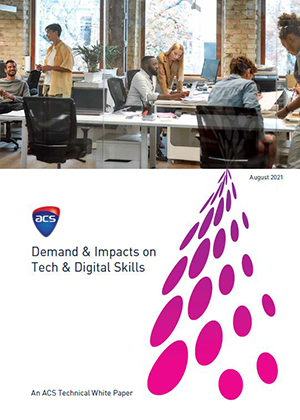
According to the ACS (2021), the greatest demands for technology workers are in: 1. Information, Media & Telecommunications (31%); 2. Professional, Scientific & Technical Services (14%), 3. Financial & Insurance Services (11%), 4. Education & Training - Adult, Community & Other Education (9%), and 5. Health Care & Social Assistance (5%). It will be interesting to see if the last two, education and health, increase further, due to the need for systems to address the COVID-19 pandemic.

Reference

Demand & Impacts on Tech & Digital Skills, An ACS Technical White Paper, The Australian Computer Society, August 2021. URL https://www.acs.org.au/insightsandpublications/reports-publications/demand-impacts-tech-digital-skills.html

Friday, January 31, 2020

Digital Professional Workshop in Canberra

The Australian Government's Digital Transformation Agency (DTA) is holding a workshop on what is a  digital professional, in Canberra 1pm, 6 February 2020. Government, industry and academia are welcome. Previously I have helped define what a computer professional is, and what knowledge and skills they require, how to teach and test them, in Australia, and internationally. It will be interesting to consider if there is such a thing as a digital professional, and what they are.
"One thing that has become clear is that without a clear definition of what ‘digital’ means, you cannot design a profession for it.
Everyone it seems has their own version of what ‘digital’ means, and this has a huge impact on our ability to design services to uplift digital capability, to enlarge the digital footprint of government or to develop digital services for all Australians.
The DTA invites you to participate in a workshop to co-design a definition and shared language of digital – one that is fit for purpose for the APS but also resonates with industry and academia."

Friday, September 15, 2017

Global CyberSecurity Certification by IFIP

The International Federation for Information Processing (IFIP) have announced a CyberSecurity Specialism as part of their International Professional Practice Partnership (IP3). This allows participating national computing bodies to issue a globally recognized certification for cyber-security practitioners. The IP3 new Specialism is based on work by the Australian Computer Society (ACS) which launched a cyber-security certification on 6 September. IP3 say the new Specialism will incorporate ISACA and ISC 2 certification.

It is not clear how the IP3 and ACS certifications will relate to the work of the Joint Task Force on Cybersecurity Education (JTF). See next post on the Task Force.

ps: The IFIP announcement was made at a conference in Colombo. A spot a can recommend. ;-)

Sunday, June 5, 2016

The Department

"The Department" (1975) is a play by David Williamson about the staff politics in an Australian university engineering department. The staff at the university struggle with inter and intra-departmental rivalries, increasing external scrutiny, student expectations, employer expectations and how to include the requirements for general professional skills (such as literacy) versus technical competences in a crowded curriculum. I was reminded of this play recently when attending a real engineering department meeting. In 40 years since the play was written not much has changed. There is perhaps less student activism on campus, but there are the revolutionary pressures brought about by the Internet. Thanks to the ACT Library for a copy of the play.

Sunday, September 6, 2015

Fund Research Not PhDs

A media report suggests that the leading Group of Eight Universities in Australia has proposed that funding of PHD students be limited to the world ranked universities: "Fund PhDs at the best unis and forget the rest, say elite universities" (Tim Dodd, AFR, 5 September 2015). I suggest instead that universities charge student fees for PHDs, as for other postgraduate degrees. Universities can then compete for research grants to cover the extra cost of any research facilities the PHDs need.

The Go8's proposal would cut funding in some disciplines from Macquarie, Flinders, La Trobe, Newcastle, Western Sydney, Curtin, James Cook, Bond, Murdoch,  Griffith, Tasmania, Murdoch and RMIT universities. Instead I propose abolishing the Research Training Scheme, Australian Postgraduate Awards and the International Postgraduate Research Scholarships. The funds from these schemes should instead be awarded to universities on a competitive basis for research.

The current system conflates funding of research training and research. I suggest these be separated.  University and departmental rankings are not a good way to select the best research to fund. A better alternative would be to have the tuition costs of research students covered by fees and the research paid for by competitive research grants. Those universities with a good research track record, and good research proposals, would be able to attract more research funding and so be able to have more PHD students. Those universities unable to attract research funding could still offer PHDs in fields which do not require expensive equipment and offer "professional" doctorates, paid for by fees.

Also I suggest "flipping" the approach to research training. The Go8 submission assumes there should be a few PHDs and everyone else has to have an inferior "professional" degree. I suggest reversing this and assume a professional degree is normal and a PHD is a specialized subset of this. All doctoral candidates would be required to start with a professional style program, where they have to take courses in communication and innovation, as well as research techniques. These courses would be paid for by the student through fees (with the usual government loans and subsidies available for domestic students). A small proportion (perhaps 10%) of those students who show the greatest aptitude for research would go on to a research degree (partly funded by research grants), most would complete a professional doctorate (paid for by the student fees).

The current PHD funding scheme is flawed in that it pays universities to produce far more research graduates than there are jobs for (about ten times as many) and does not fund the best research. If funds were moved from these unnecessary PHDs, there would be more for quality research and more graduates with useful skills.

Saturday, August 22, 2015

Universities Can and Should Educate for Employment

Stefan Popenici, Senior Lecturer at University of Melbourne argues that "Universities can’t, and shouldn’t, educate to suit employers" (The Conversation, 12

Friday, February 27, 2015

Soft Skills Review of Australian ICT Degrees

ACS is reported to be reviewing their ICT Profession Core Body of Knowledge (CBOK) and are particularly interested in what employers want in terms of "soft skills" of graduates. See "ICT tertiary courses under review", by David Swan (The Australian, 26 February 2015). I discussed how a university could use e-portfolios for teaching soft skills in "Proposal for Incorporating Professional Skills in the ANU Master of Computing".

ps: Dr Will Uther, from Google Sydney, is turning up here at ANU 3pm, to tell us what they really want from graduates.