Showing posts with label mental health. Show all posts

Thursday, February 18, 2021

Tracking Student Well-being Online

Posimente student well-being tracker
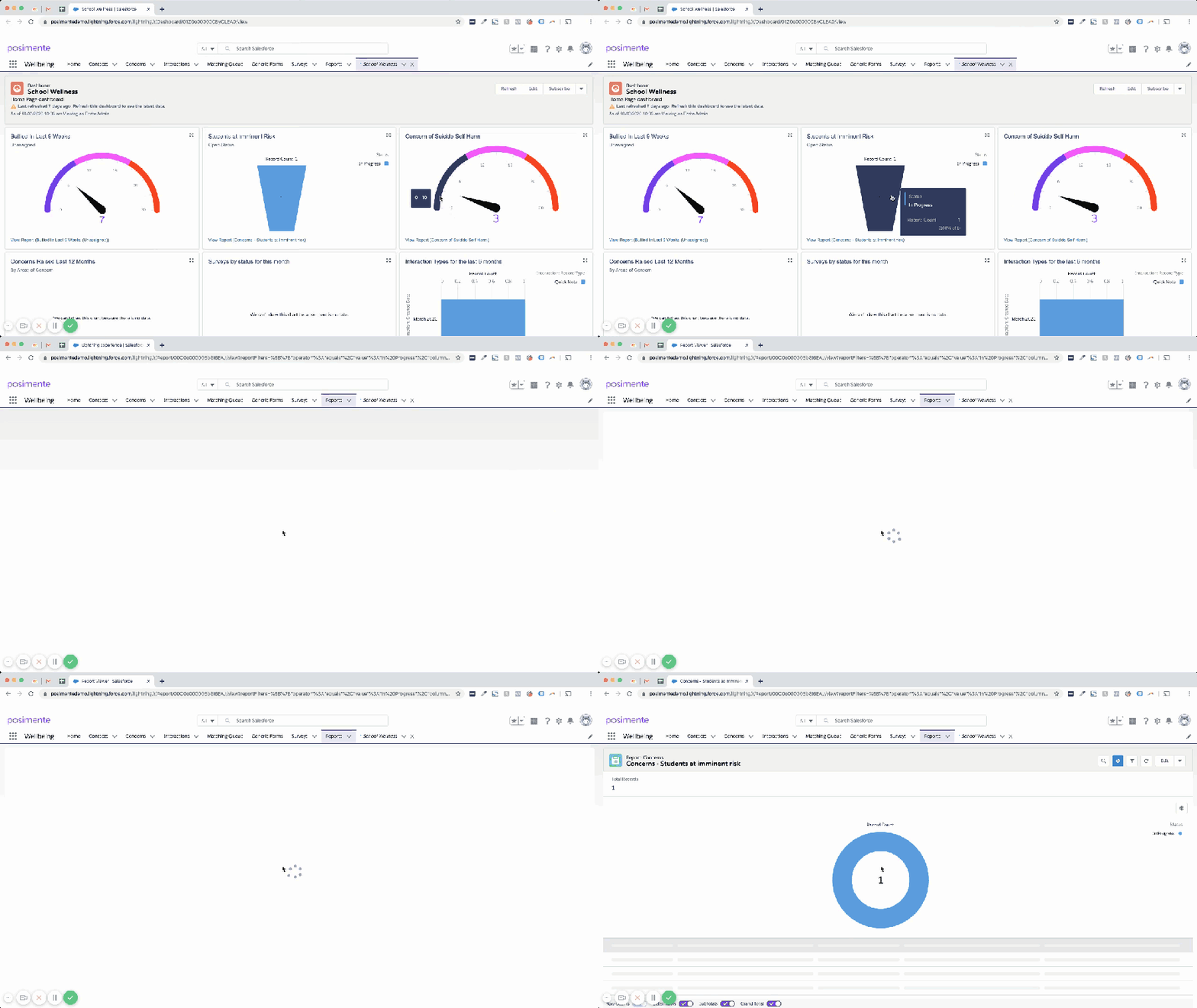
Yesterday Troy Ashton-Martin arranged an online demonstration for me of Posimente, a student well-being tracker. This accepts reports from teachers and others, about how students are doing. It helps plan interventions, involve the teachers and track progress. The system is implemented with Salesforce and has the usual dashboards. There isn't anything exceptional about the application,  and it does much as I would expect it to.

With the sudden shift to online learning last year, I have been concerned about the increased stress on students. As one of those who been an international online student, I was aware of the crushing loneliness, fear, anger and frustration it can engender.  Thus the increased need for applications to help with student well-being. 

One of the benefits of online learning is that it does allow better monitoring of students, giving early warning of problems. With conventional teaching, a student with a problem could remain invisible at the back of the class for months.  One technique I like to use is small frequent online assessed items. These can be automatically or peer assessed so little teacher effort is involved.  This way, each week I can have the LMS sort results in ascending order, and see which students need help.

However, I suggest these well-being monitoring techniques need to be extended to the teachers as well as students. Last year I watched with concern as my university colleagues in Australia, and across the world, who had little training in online teaching, attempted to quickly move their teaching. It took me seven years of formal study at four institutions, three qualifications, mentoring by experts, plus trial and error, to become comfortable teaching online. My colleagues had a few weeks. 

While I tried to provide some simple tips, some lessons can only be learned through practice. Having hundreds of students, who are not there by choice, and are also highly stressed, is not the ideal situation for learning to teach online.

Overall the crash conversion to online learning in 2020 went well. However, some of my colleagues assumed it would only be for a few weeks, then a few months, then a semester, then two. Some are having difficulty accepting that this change is permanent, at least for universities who wish to remain solvent. If all goes well, the COVID-19 pandemic should be over in a few years time. However, most students will continue to undertake the majority of their study 80% online, in blended courses. Emergencies could see them online again for all study, suddenly, at any time. Automated help for monitoring all our well-being would be useful.


Wednesday, January 27, 2021

Supervisors Can Better Support the Well-being of Higher Degree Students

Ryan, Baik and Larcombe (2021) surveyed 595 Australian master's and doctoral research students, about how their high rates of psychological distress could be addressed. The authors concluded students would be "likely to benefit from a whole-of-university approach to supporting their wellbeing, and from an academic research culture that values the wellbeing of all its members". However, I suggest what would be more useful are actions which individual supervisors can do. Recommending actions which they can;'t do may just have the effect of increasing the distress of supervisors and students.

Actions which supervisors can carry out on their own, without authorization or funding from their institution can help the students and the superior. Supervisors can encourage their students to obtain qualification which will fit them for a job outside academia and research. They can train students in staff supervision skills and apply them themselves, to avoid overwork.

In some cases potential supervisors should recommend to a student they not undertake a research degree, or at least not yet. Instead a combination of graduate coursework and vocational education would be a better career path.

Reference


Tracii Ryan, Chi Baik & Wendy Larcombe (2021) How can universities better support the mental wellbeing of higher degree research students? A study of students’ suggestions, Higher Education Research & Development, DOI: 10.1080/07294360.2021.1874886

Wednesday, May 13, 2020

Building rapport with your students in the online mode

I was asked at short notice to speak to university tutors on "Building rapport with your students in the online mode". Here are some thoughts:

Building rapport with your students in the online mode 

by Tom Worthington, MEd FHEA FACS CP IP3P
Honorary Lecturer, Research School of Computer Science, ANU

What is rapport?

"a close and harmonious relationship in which the people or groups concerned understand each other's feelings or ideas and communicate well."
From: OED 

Why Rapport?

"Preliminary modelling by the Brain and Mind Centre suggests the COVID-19 crisis could cause up to 750 extra suicides a year ..."

Guidelines for Rapport

  1. welcoming students through personal introductions 
  2. being responsive on discussion boards
  3. providing timely and detailed feedback
  4. encouraging deep learning through inclusive and relevant learning activities and assessments
  5. generating peer interaction over learning tasks
  6. making appropriate use of learning tools
  7. assisting with problems
  8. referring to the correct support.
From: National Guidelines for Improving Student Outcomes in Online Learning, Cathy Stone, NCSEHE & The University of Newcastle, 2016

Example: Learning to Reflect Instructor's Guide

"Welcome to Learning to Reflect, I am your instructor for this module, Tom Worthington. You can contact me via the Dialogue tool in Wattle. You will find materials on the course web page. There is an e-book with a chapter for each of the topics, a description of the assignments, and activities."

From Learning to Reflect, for ANU Techlauncher, Tom Worthington, 2019

Learn Rapport

Dogfooding: "the idea that someone would use the products they were making became known as 'eating your own dog food.'"
From Harrison, W. (2006). Eating your own dog food. IEEE Software, 23(3), 5-7. Retrieved from http://dx.doi.org/10.1109/MS.2006.72

Example: Coffee Courses

"... authentic real life assessment tasks should contain the challenges of a real life work context."

From: Principles of authentic assessment, from Assessment and Feedback, Jill Lyall and Mandy Tutalo, ANU Coffee Course, 2019

Wednesday, January 29, 2020

Community Trauma Toolkit for Disasters

Staff at the Australian National University (ANU) have developed a free Community Trauma Toolkit, to help with mental health in disasters. The toolkit covers preparedness for a disaster, as well as during and after. There are resources for parents, doctors, teachers, and others. Provided are summaries, workshop materials, podcasts, and videos. As well as assisting those recovering from bushfires, these materials could be of use for educators dealing with the Novel Coronavirus. In particular there is an Educators workshop, for professional development of teachers. This has a 51 page facilitator’s handbook, 41 pages of activities, a 91 slide presenters pack (with speaker's notes)..

The toolkit is comprehensive, but there are so many materials offered to so many groups, the website is difficult to navigate. Also there appears to be no online delivery option, which will severely limit its usefulness. The materials are designed for face to face delivery, by a trainer, to professionals, who then assist the community. I suggest that the toolkit should have options for e-learning, as there may not be the time, nor resources, for face-to-face training.

An additional difficulty with the toolkit is that modifications to the toolkit are prohibited. The policy of the Australia Government, which funded the toolkit, is to use a Creative Commons license, which provided less restrictive use of materials. As an example, it would be useful to be able to modify the materials to address the current coronavirus situation.

Also I experienced a technical difficulty when attempting to view the workshop slides:  "This error has been reported to Google and we'll look into it as soon as possible. Please reload this page to continue.". W hat the error was, was not displayed.