Showing posts sorted by date for query github. Sort by relevance Show all posts

Wednesday, May 21, 2025

Work Integrated Learning in the Age of AI

Next week I have been asked to help run some sessions at a symposium on Work Integrated Learning (WIL) for students of computing and related fields. It is a good time for this, as I just spent a semester tutoring four teams of students working on projects for clients. Also I mentored two groups of interns, one group working for private enterprise on AI projects, and the other working for government agencies. 

While I had mentored interns previously, and also mentor now entrants to the computing profession for the Australian Computer Society), I had not tutored the project students for some years. The group computer project course at the Australian National University ("Techlauncher"), was revamped this year, so I decided to tuor, to help bed in the new format & learn more about the new approach being used.

At the same time the concern over AI use at universities, and the debate over practical skills for students have not died down. To add to this, vocational degrees were added to the Australian Qualifications Framework (AQF) in February. This allows non-university educational institutions to offer degree level qualifications with more work integrated learning, or even entirely by WIL. Such a format is not new, and I learned computing only partly at a university, the Australian Bureau of Statistics hired trainers who came in and ran courses on site. I was paid to work downstairs part of the day, then go upstairs for training (on full pay).

As it happens I registered for an Eportfolios Australia "PARE" (Plan, act, reflect & eportfolio) session. I had assumed this was the usual webinar, but when it started, I discovered it was "Shut up and write" format. So I am writing. 

I am assisting with two sessions at the symposium: "Learning Systems: Canvas for WIL, Virtuous Loop", and "Accreditation requirements & Ungrading WIL". The "Virtuous Loop" is something some of my colleagues tell me they know about, so I will leave that to them.

Learning Systems: Canvas for WIL 

A few weeks ago I did the introductory training for the Canvas Learning Management System being introduced to ANU. Canvas seems very similar to Moodle, so should be suitable. My approach is to use the LMS as a place to provide the student with their instructions as to what to do, then collect the results. The actual learning happens elsewhere, outside the LMS. This approach works well with WIL, which clearly can't happen within the confines of the tools an LMS provides.

ePortfolios

This then raises the question of what other tools we can use to help the student with WIL. Given I am writing this during an ePortfolios Australia session, the most obvious is an ePortfolio. Canvas has an ePortfolio tool called "Folio". However, this is unlikely to have adequate versioning features to be usable. To be of use, we need to know when the student added what to their portfolio, including every edit,  for "show your work". Also we need to track the contributions of individual students in group projects, where they are assembling a jointly developed document. It is likely we will need to use tools like GitHub for this purpose. That will require training for non-computing students, unused to the concepts inherent in such tools.

Accreditation requirements & Ungrading WIL

Bodies such as the Australian Computer Society and Engineers Australia, accredit university courses. Common requirements of accreditation is for the student to have some group, work and project experience. I mentor interns who work individually at a real workplace and tutor group project students who work on a real project for a real client. In both cases there is scaffolding of the experience, to make it into a course. There are a few lectures, but the emphasis is on meeting with a mentor/tutor regularly. There are also assessed tasks to complete. These tasks are designed to be relevant to real world experience. Typically the students start by negotiating what they are going to do and submit a statement of work document, agreed with the client, for assessment. Also they typically end with a reflective work on what they did and learned from the experience. In between there are progress reports. In the case of internships, the assessor relies on reports from the client, as it is not feasible for them to assess the actual work the student does. In the case of group projects, the assessor may have more access to the work product, but even ... oops time is up ...

At this point, as per the PARE process, we stopped writing and had a few minutes discussion. I shared this document, up to this point. We discussed how to collect notes on what we had been doing for future use. This is very relevant to a discussion of how students document and provide evidence of, what they did in WIL. For assessment purposes we need that evidence, but it can't be too burdensome, for the student, their client, or the assessors. Ideally the evidence is captured as a byproduct of the WIL. This happens reasonably naturally for computer project students, who use online tools common in industry for software development. These tools timestamp every contribution by every team member, and provide statistics on their overall contribution. 

Grading WIL

Some WIL is not integrated. The student is required to undertake a set amount of work experience. A supervisor attests the student did the work. There is no detailed analysis of what they did, or how well. At the other extreme, a program like Techlauncher has assessors examining what each student does every week, and in more detail at checkpoints through the year. 

Typically in vocational education, students are assessed on a pass/fail (Competent/Not yet competent) basis. Even if there is a numerical grading, this is reduced to pass/fail at the end of the unit of study. The logic behind this is that the student is being assessed as being able to do a job. In some industries this is a legal requirement: no ticket, no job.  In contrast a university student is typically graded numerically on a 100 point scale, which is then reduced to a 4 to 7 level grade. The student's grades are aggregated to give a Grade Point Average  on a 4 or 7 point scale.

The course results and GPAs may be used internally as a requirement for students to progress in their program, or to apply for advanced study, but are of little or no value to outside employers. Given that WIL doesn't involve they type of learning of a typical academic course, they use of 100 point or even 7 point scale for assessment seem very artificial. The purpose of the exercise is not for the student to be excellent at working in a workplace, they can't be expected to achieve that ... opps time is up again. 

Conclusion

Having written about the topic stream of consciousness style, it is time to try to make some short, hopefully helpful, comments on WIL:

Learning Systems: Canvas for WIL 

LMS for Scaffolding

A learning management system is useful for providing structure for WIL. The unfamiliar and fragmented nature of WIL can be confusing for both students and staff. The LMS can provide a step by step checklist of who needs to do what, when, & a catalog of the tools and guides they need.  

Not Too Integrated

An LMS is not designed for WIL. A useful approach is to use the LMS to tell the student what they need to do, then have them go off and do it with specialised tools, but bring the evidence of what they did back to the LMS for assessment, and feedback. 

Most of the evidence of learning outcomes can achieved work products, rather than specially created academic artifacts. As an example, the client or supervisor can be asked to rate the student's performance. The work plans and output can be directly assessed. The tools used to record the student's work can be used to verify they were actually doing the work. As an example, tools such as GitHub record each time each team member contributed to the repository, timestamped. 

Accreditation requirements & Ungrading WIL

Accreditation authorities want to be assured the student achieved all skills and knowledge requirements at the set level. This can be difficult with WIL, as what the student does varies based on the client/supervisors' requirements. One way to meet the requirement is by adopting the approach of vocational education. Rather than assess how well the students achieved various tasks, and check they met an overall requirement, check they performed on each to the required level of competency. Numerical measures and scales can still be used, but what is important is the student achieved every requirement.


Tuesday, October 15, 2024

What do employers want?

Greetings from the final TechLauncher workshop at the Australian National University. This is a chance for students to not only listen to potential employers but also talk to them. Of course many computer students already have jobs, as they have in demand skills. There are some extra requirements for computer people, such as a Github account to show they can code. The workshop is held in "The Hive" which is an open plan area set up to look like a typical shared office environment. 

Bianca Sawyer,
Quantum Brilliance
Today we have Kevin Landale from Digital Atelier,  Bianca Sawyer from  Quantum Brilliance, and Jonathon Stapels from Overflow Solutions.
Kevin Landale,
Digital Atelier

These workshops are intended to help students, but a bonus for staff, such as myself, is to meet interesting people from interesting companies. The three company representatives (who are also company founders) talked about how they ended up where they are. 

Jonathon emphasised that applicants should be ready to talk about why they applied in everyday language. 
Jonathon Stapels,
Overflow Solutions
Bianca emphasised the importance of a cover letter focused on relevant qualifications, skills and experience, not just "sixteen pages of CV" and no "Spam CVs". Kevin said he uses behavioural pre-screening questions, unrelated to technical skills. Jonathon asked if job ads should give the specifics upfront, or talk about the learning opportunities in the job and he was surprised that students preferred the upfront version. The students then talked about what they studied and what they aspired to work on. One student said they wanted to work at a large company, at which point the employers discussed the pros and cons. 

Thursday, May 9, 2024

Generative AI to Boost Productivity?

Justin Hutchings, GitHub 
Greetings from Microsoft's Canberra office where I am attending a glitzy GitHub presentation. The bold claim made was that Copilot, Microsoft's implementation of ChatGPT, could end the computer productivity paradox. 

The paradox is that computers have not increased office productivity. We were invited to photograph the slide of claimed productivity increases. However, I can recall claims made decades ago for 4GL languages, not far from where we are, which would allow programs to write themselves. In practice they allowed amateurs to get into a mess. The current attempt is not like that, with tools for professionals. However, these tools only do the easy bits.

Some of the features demonstrated could be useful for teaching computing. In particular implementing rules about what code libraries can be used and what coding practices must be followed. The billing features might also be used for student hurdles, the idea being that to pass the course the student must put in a set amount of work (the quality of the work would determine their grade).

ps: At question time someone asked about legacy code. I guess we need Copilot COBOL. ;-)

pps: It is a long time since I have been in a corporate environment, and find sales pitches excruciating. One yesterday from a plagiarism detector company was particularly bad. But this Microsoft event today is okay.

Thursday, June 16, 2022

More on a Learning & Teaching Strategy

I am interested in improving education, by blending online and on campus. Also improving staff knowledge of teaching.

What has worked well during the pandemic are conventional online distance education techniques, which I have been using at university since 2009. Also the adaption of WIL to a blended format, with online fallback for  emergencies worked (planned in 2019, before pandemic).

What didn't work so well for others were high stakes exams moved online. But this was an expedient measure needed where staff were not trained to assess in other ways. The problem for universities is how to motivate staff to do the required teacher training, so they not only know how to teach and assess in other ways, but are willing to do it.

The approach I suggest is to design an asynchronous online core, plus syncronous/f2f components. As in Hapke, Lee-Post, and Dean (2020) did with their 3-in-1 Hybrid Learning.

A LMS, such as Moodle is fine (one LMS is much the same as another). Zoom is very good. Turnitin is a problem: as it doesn't integrate well. Add Github, or similar repository tool, and a logbook tool, to support student individual and group projects. This logs the student's progress, so you can see who did what, when, throughout the semester. 

The first year experience could be improved with a Professional Practice course. Have group activities from first semester, firm deadlines and zero for late work, to set expected behavior.

The campus experience can be improved by making extra curricular activities co-curricular, by offering course credit for relevant experience. Ensure all teaching spaces are equipped for blended learning. Make campus attendance optional, so students come because the want to be, not because they have to.

Program design requires staff trained in program design. This takes years to phase it in. Look at Singapore University of Technology and Design (SUTD) experience.

Australia's elite research universities need to accept that "research lead", and "campus based" are marketing slogans, not workable strategies. Universities don't need a corporate"model of learning", so much as trained, qualified, educators. The focus in staff training should be on "dogfooding": teach the staff to teach, in courses which give them the experience we want students to have. Also offer these courses to students.

Wednesday, September 9, 2020

Higher Education in the Post-pandemic World

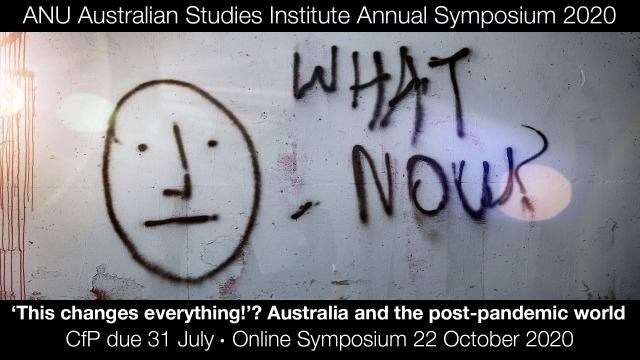
'This changes everything?'! Australia and the post-pandemic world, 22 October 2020
An online symposium 'This changes everything?'! Australia and the post-pandemic world is being hosted by the Australian Studies Institute at the Australian National University, 22 October 2020. I have offered to speak on "Higher Education in the Post-pandemic World" and will develop my presentation here, in a series of blog posts.

The organizers first asked for an abstract (below) and then a 5 to 8 minute video. The videos will be made available two weeks before the symposium. On the day, there are one hour sessions scheduled with five "papers" each, so about ten minutes per paper. Each presenter has been asked to include two or three questions, or statements, to promote discussion. This is an interesting attempt to translate the symposium format to the online world.

In a traditional academic symposium, the presenter reads their entire paper word by word. With a literate writer, who is also an engaging speaker, on an interesting topic, this can be spellbinding, but often it is very tedious. It will be interesting to see if the online format, with pre-recorded videos and the questions is successful in creating a useful discussion.

I am not sure what I can fit in a 5 to 8 minute video. So to start I produced a video with just the abstract, using Vidnami, synthetic speech and Creative Commons Licensed images. The abstract took just over one minute to read, so there was room for about seven more paragraphs.
 
This work started as a series of six talks in the Microlearning Series curated by Manisha Khetarpal at Maskwacis Cultural College in Canada. You can read the original talks, as well as the revised five minute version for the symposium: Video, Notes and Script


Higher Education in the Post-pandemic World

Mr Tom Worthington, Honorary Lecturer, Research School of Computer Science, The Australian National University

Abstract

Like many educators, my world changed suddenly in early 2020. I was called to an emergency meeting of the staff of the Australian National University, College of Engineering and Computer Science. We were told that due to COVID-19 many of our international students would be unable to get to campus: could we teach them online? There was a moment of shocked silence, then a roar of questions: “How many? How long for? Will they have Internet access? What about assessment?” It happened for my Masters of Education I looked at how to provide online education to international students at a research intensive university. Also I had worked in emergency planning at the Australian Department of Defence, so had some relevant experience. But it has been a challenging year. What are the lessons learned for educating professionals online? How will this change higher education for domestic and international students into the future?

Shift to Remote Work and Study in March 2020


"The advice from our ANU medical experts is clear: to control the spread of COVID-19 we must take tough action ... so effective tomorrow Thursday 26 March, all our campuses will shift to remote work and study." From the Vice Chancellor of the Australian National University, Professor Brian P. Schmidt AC FAA FRS, 25 March 2020.

On 6 February 2020 I attended an emergency staff meeting at the Australian National University where we were asked if we could quickly switch to teaching online. Some of our students and staff were overseas so unable to return to campus. The Vice Chancellor announced first a "pause", then a wholesale shift to online teaching and working from 26 March. 


Online Teaching for COVID-19 Worked
  • Course materials and assessment using the existing Moodle Learning Management System
  • Project group work using the existing project tools, such as Slack
  • Face to face student/staff interaction replaced with video conferencing (Zoom).
The Australian National University already had a well supported suite of online learning tools, based around the Moodle Learning Management System. This continued to be used to deliver documents, pre-recorded videos and assessment tasks to students. Moodle was also used to provide students with quizzes and text based asynchronous forums to aid their learning Computer science students continued to use project management and communication tools, such as GitHub and Slack, for working in teams on group projects (Worthington, 2020). COVID-19 forced the replacement of face to face team meetings, tutorials and workshops with video conference tools, such as Zoom.

Higher education after COVID-19: Online Plus Campus


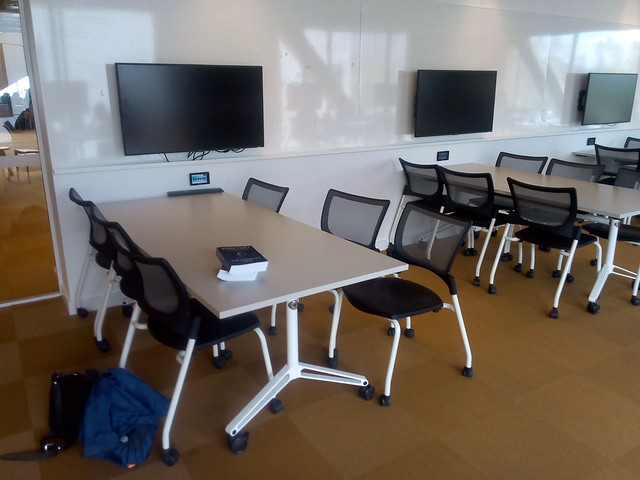
Wall mounted LCD screens and desks on wheels at ANU Marie Reay Teaching Centre
Wall mounted LCD screens & desks on wheels at ANU Marie Reay Teaching Centre


One possible future for higher education is Online Plus. There can still be campuses with classrooms, but with flexible flat floor rooms, like those in the the Australian National University's Marie Reay Teaching Center. The core of the curriculum will be online for delivery in asynchronous mode, so a typical student can spend about 80% of their time off campus, learning while working anywhere the world. 


Pathways to Work, Training and Further Education

Peter Shergold rChancellor of Western Sydney University

 "Senior secondary certification requirements and the way learning is packaged should be restructured so that students are not presented with a binary choice between vocational or higher education pathways." (Shergold and others,  2020)
A recent report to the Council of Australian Governments lead by Shergold (2020) recommended not presenting students with a binary choice between vocational and university education. COVID-19 has forced much of secondary and higher education online and this provides the opportunity to consider how to integrate them better and provide them more flexibly. Australian secondary education can be blended into the vocational education system and that  into university.

The Degree of the Future is Like a Car Platform


MQB Platform for VW, Audi, SEAT, Å koda, coupes, hatchbacks, saloons, station wagons, convertibles, MPVs, SUVs, and panel vans (Ra Boe / Wikipedia)
International vehicle manufacturers use one engineering "platform" to produce many different models for customers around the world. This approach can be used by universities to provide internationally standardized qualifications. These can be nested to allow from a three week micro-credential to a multiyear doctorate. The basic online curriculum can be available with blended, hybrid, face to face, and work integrating learning options.

Global Professional Standards


Excerpt from ACS Certified Professional Certificate


An example of the platform approach is the International Professional Practice Partnership (IP3) under the Seoul Accord for certifying computer professionals. The Australian Computer Society (ACS) certifies computer professional under the scheme, along with other nations, such as the Canadian Information Processing Society (CIPS). Engineering qualifications are similarly accredited under the Washington Accord. This provides a level of international standardization of the skills and knowledge required in professions, and a guide to university curricular. Universities are not required to teach in the same way, as long as graduates have the required attributes. Like a car maker's platform, such global agreements take many years to produce, but once agreed, they increase the quality and reliability of global education.

Synchronous learning in an asynchronous matrix

Fighting Pandemics virtual hackathon, August 8, 2020, by the ANU Humanitarian Innovation Society (ANU HISoc), with the Clinton Global Initiative University and IBM 


Classroom activities which require student interaction and  group work were easily able to transition from face to face to online mode in 2020. Examples of high interaction student group activities at the Australian National University are the TechLauncher computer science projects, Innovation ACT entrepreneurial competitions, and hackerthons. An example of the latter is the Fighting Pandemics virtual hackathon, run in August by the university's Humanitarian Innovation Society, with the Clinton Global Initiative University and IBM.

The transition from classroom to online was made possible by delivering synchronous learning embedded in an asynchronous matrix. This form of flipped learning uses a text message system, such as Slack, before, during and after video conference sessions, using a platform such as Zoom. Students are given a series of challenges, each with a deadline. The deadlines are used to synchronize the asynchronous communication  (Worthington & Wu, 2015).

COVID-19 & Geopolitics Changing Higher Education

Infographic: Learning
through Belt and Road
,
Ma Chi, China Daily,
2017-05-10 06:07

China's Education Action Plan for the Belt and Road Program offers assistance to students in developing nations (Worthington, 2014). The Chinese government is now also promoting online education as a result of COVID-19. International tensions may limit future student travel, without warning, just as COVID-19 did. 

For most students a campus experience will remain attractive, but only for a small part of their study. Australian universities should therefore offer an online option to domestic and international students, if they wish to remain a viable education option. Universities which require attendance for no good reason will find students voting with their smart-phones and taking their business online, elsewhere. 

References
  1. Chandran, R. (2010, May). National University of Singapore's Campus-Wide ELearning Week. In Global Learn (pp. 2062-3302). Association for the Advancement of Computing in Education (AACE). URL https://cpb-us-w2.wpmucdn.com/blog.nus.edu.sg/dist/0/119/files/2011/03/national-university-of-singapores-campus-wide-elearning-week.pdf
  2. Shergold P., Calma, T., Russo, S., Walton, P., Westacott, J., Zoellner, J. and O’Reilly, P. (2020, 17 June). Looking to the future – Report of the review of senior secondary pathways, into work, further education and training, for the Education Council of the Council of Australian Governments (COAG). URL https://uploadstorage.blob.core.windows.net/public-assets/education-au/pathways/Final%20report%20-%2018%20June.pdf
  3. Worthington, T. (2020). The Higher Education Whisperer on COV-19 (Blog). URL https://blog.highereducationwhisperer.com/search/label/COVID19
  4. Worthington, T. (2020, April). Responding to the Coronavirus Emergency with e-Learning, Athabasca University. Video URL https://youtu.be/CUiVH_g4PL4 Text URL https://blog.highereducationwhisperer.com/2020/04/responding-to-coronavirus-emergency.html
  5. Worthington, T. (2020, June). Blend and Flip for Teaching Communication Skills to Final Year International Computer Science Students. Paper accepted for the IEEE International Conference on Teaching, Assessment and Learning for Engineering (TALE), 10-13 December 2019, Yogyakarta, Indonesia. URL https://openresearch-repository.anu.edu.au/handle/1885/204833
  6. Worthington, T. (2018, December). Blended Learning for the Indo-Pacific. In 2018 IEEE International Conference on Teaching,Assessment, and Learning for Engineering (TALE) (pp. 861-865). IEEE. URL https://openresearch-repository.anu.edu.au/handle/1885/148733
  7. Worthington, T. (2017). Digital Teaching In Higher Education: Designing E-learning for International Students of Technology,Innovation and the Environment (ebook). URL http://www.tomw.net.au/digital_teaching/
  8. Worthington, T., & Wu, H. (2015, July). Time-shifted learning: Merging synchronous and asynchronous techniques for e-learning. In 2015 10th International Conference on Computer Science & Education (ICCSE) (pp. 434-437). IEEE. URL http://hdl.handle.net/1885/13554
  9. Worthington, T. (2014, August). Chinese and Australian students learning to work together online proposal to expand the New Colombo Plan to the online environment. In 2014 9th International Conference on Computer Science & Education (pp. 164-168). IEEE. URL: https://openresearch-repository.anu.edu.au/handle/1885/11724
  10. Worthington, T. (2012, July). A Green computing professional education course online: Designing and delivering a course in ICT sustainability using Internet and eBooks. In 2012 7th International Conference on Computer Science & Education (ICCSE) (pp. 263-266). IEEE.

The video contains images that were used under a Creative Commons License. https://link.attribute.to/cc/1559254