Resister now and apply to present at Collaboration across Boundaries, a free one day conference for early career academics, 4 December, at the Australian National University in Canberra. There are two $3,000 research grants for the best collaborative idea. Also there is a free skills development workshop on Tuesday 20 November.
Showing posts with label Australian Academy of Science. Show all posts
Showing posts with label Australian Academy of Science. Show all posts
Thursday, September 20, 2018

Thursday, April 28, 2016
Future Earth Australia Workshop

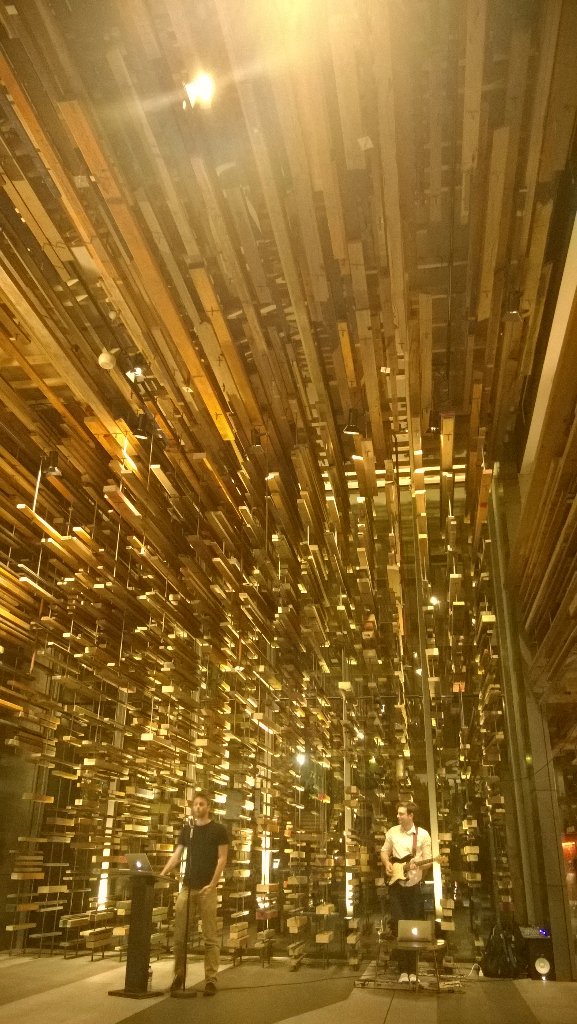 This was one of the weirder even
 ts I have been to recently,
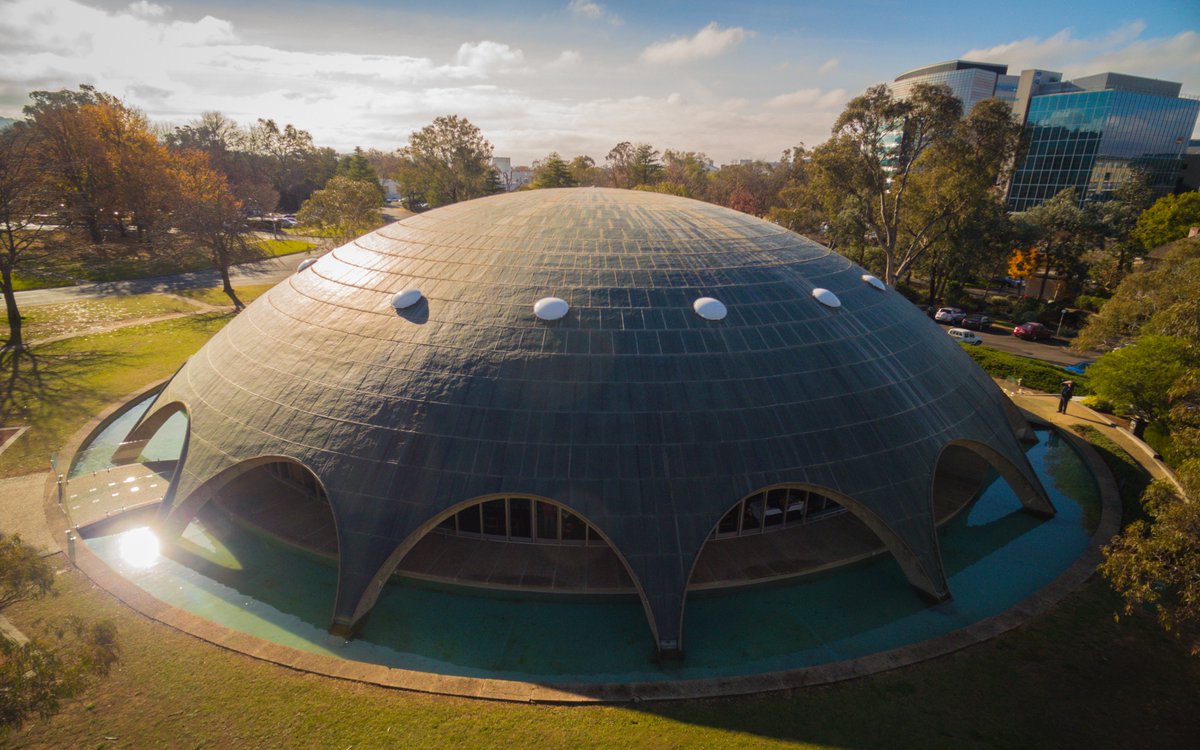
in a building shaped like a 1960s flying saucer surrounded by a moat
(headquarters of the Australian Academy of Sciences). The delegates were
then shepherded across the road to a ‘Visceral Communications’ performance at New Acton. Performance artists shoveled ice, dance in the middle of the street and recite quotes about climate change. This is all a little too much like an episode of the TV comedy "Utopia". ;-)
ts I have been to recently,
in a building shaped like a 1960s flying saucer surrounded by a moat
(headquarters of the Australian Academy of Sciences). The delegates were
then shepherded across the road to a ‘Visceral Communications’ performance at New Acton. Performance artists shoveled ice, dance in the middle of the street and recite quotes about climate change. This is all a little too much like an episode of the TV comedy "Utopia". ;-)
Future Earth Australia
Future Earth Australia"
future
look like in a sustainable global and Australian economy? What kind of
urban environment is compatible with a decent lifestyle for the 90% or
more of Australians who live in cities? What changes in values and
behaviour are required to enable the social transformation to
sustainability and how might we make them? - See more at:
https://www.science.org.au/news-and-events/future-earth-australia-workshop#sthash.2b2jzYmg.dpuf
What
will the corporations and institutions of the future look like in a
sustainable global and Australian economy? What kind of urban
environment is compatible with a decent lifestyle for the 90% or more of
Australians who live in cities? What changes in values and behaviour
are required to enable the social transformation to sustainability and
how might we make them? - See more at:
https://www.science.org.au/news-and-events/future-earth-australia-workshop#sthash.2b2jzYmg.dpuf
What
will the corporations and institutions of the future look like in a
sustainable global and Australian economy? What kind of urban
environment is compatible with a decent lifestyle for the 90% or more of
Australians who live in cities? What changes in values and behaviour
are required to enable the social transformation to sustainability and
how might we make them? - See more at:
https://www.science.org.au/news-and-events/future-earth-australia-workshop#sthash.2b2jzYmg.dpuf
What
will the corporations and institutions of the future look like in a
sustainable global and Australian economy? What kind of urban
environment is compatible with a decent lifestyle for the 90% or more of
Australians who live in cities? What changes in values and behaviour
are required to enable the social transformation to sustainability and
how might we make them? - See more at:
https://www.science.org.au/news-and-events/future-earth-australia-workshop#sthash.2b2jzYmg.dpuf
What
will the corporations and institutions of the future look like in a
sustainable global and Australian economy? What kind of urban
environment is compatible with a decent lifestyle for the 90% or more of
Australians who live in cities? What changes in values and behaviour
are required to enable the social transformation to sustainability and
how might we make them? - See more at:
https://www.science.org.au/news-and-events/future-earth-australia-workshop#sthash.2b2jzYmg.dpuf
Australian Academy of Science
Australian Academy of Science
Thursday, March 12, 2015
STEMing the Decline in Science and Maths Teaching
 Greetings from the Shine Dome in Canberra, where I am taking part in an IMSITE (Inspiring Mathematics and Science in Teacher Education) Dissemination forum. This is sponsored by the Office of Learning and Teaching to reverse the decline in science and maths teaching in schools. This adversely effects student's interest in, and ability to undertake, technology and engineering programs at university. This is an area being researched in Australia, as well as other countries.
University of Wollongong is part of IMSITE. They offer a teaching minor for science degree students and are hosting a STEM Teachers Conference 25 July 2015
It occurs to me that there are some obvious ways to foster teaching and learning maths and science. One would be to use the link to the exciting careers, which are the other two letters in the STEM acronym: Science, Technology, Engineering and Mathematics. It is the areas of technology and engineering which have the career prospects.
A way to improve the teaching would be to use on-line education, both for teacher training and, for direct student education. It seems to me that teacher educators are making their job harder than it needs to be, by not using e-learning techniques. It seems that educators don't think computers can be used for teaching in schools and so should not be used for teaching teachers. I suggest "flipping" the approach to place e-learning at the center of education. As I explained to one of the attendees, you can make your on-line materials backward compatible with paper and classroom teaching, whereas it is much more difficult to design for paper and the classroom, then adapt for on-line.
My rule of thumb is that the average university student needs to spend about 20% of their time in class (one day a week), with the rest on-line. Extending this to school, might see the youngest students starting at 80% in class, 50% for primary students, and about 30% for high school students.
This is not to say students will not be actively engaged in learning, just that this need not be in a formal classroom setting. The least useful activity is to have students sitting passively listening to a teacher, they should be doing something, mostly with other students. Where students are required to "attend" school, they can spend most of their time in a learning center (what used to be called a "library"). Only a few teacher-librarians are needed to watch over several hundred students.
Subscribe to:
Posts (Atom)