Showing posts with label First in Generation. Show all posts

Monday, March 20, 2023

Redesigning University for All Students

Greetings from the ANU First Generation Welcome Alumni Week event. Staff and graduates, who's parents did not go to university were asked along to share their experience. Despite studying this topic during my MEd, it was only a couple of years ago, at one of these ANU events, I realized I was one. But I still have difficulty understanding how this made my university experience different.

The talks from staff who were fist generation was useful, in helping current students understand they are not alone. However, I suspect that people who go on to become academics have very different university experience to the average student. As an example, they seem to have attended a lot of universities, and completed multiple qualifications ( as have I). That would be daunting for a student just starting out. We need to tell them it is okay to go to one university, and then get a job outside: you don't have to aim to be an academic.

Also what was of use were group discussions around tables. This helps students meet others like themselves. It also helped me realise that there are those who have a more difficult time then I did. Those of us from a low income, single parent first generation backgrounds may think we had it tough, but hearing from someone whose parents were political prisoners for years, puts it in perspective.

While a one off, face to face event is useful, I suggest much more is needed to help first generation students. This has to be built into the curriculum, as a compulsory assessed, for-credit component, not an optional extra-curricular activity. 

One way for first generation students to be helped, I suggest, is to offer training in how to be a student as a formal, compulsory, initial course, which counts towards their degree. As a student, I would not do an optional activity, as it would be stealing time (and money) from my essential compulsory courses. I suspect that is a mindset which goes with being a first generation student.

There also small impediments which can be easily fixed. As an example, getting textbooks is said to be something first generation students have difficulty with. The last university I studied at provided textbooks (this is a common feature at open and distance universities). As a student, I didn't have to pay extra, or do anything to get the books. A few weeks before the course started, a package of books arrived on my doorstep. This applied wherever in the world you were: I was 13,000 km from the campus, but the books still turned up, on time. This is something more Australian universities could emulate.

The approach, I suggest, is to flip the thinking on first in family students. At present universities design on the assumption that students know about university, through having attended a private school, or from university educated parents. Special arrangements are then just needed for those who did not. This is similar to the approach which used to be made for those with a disability. That approach would no longer be acceptable: you can't build a classroom without wheelchair access, and the offer to carry disabled students up the stairs: that would be unlawful discrimination. The approach to first in family and other disadvantaged students should similarly change: provision for them should be built into the curriculum, as the default option. This will then help all students, including those who had a less successful private school education or unhelpful university educated parents.

Wednesday, May 18, 2022

Lower Socioeconomic Status Students Don't Have Lower Aspirations But Are Rightly Wary of University

The University of Newcastle's course for teachers "Aspirations: Supporting Students’ Futures" references Gore, Holmes, Smith, et al (2015). While 2015 now seems a long time ago, the issues it investigates are very current. As we (hopefully) emerge from the COVID-19 pandemic, it is a good time for educational institutions to rethink who their potential students are, and what they want. 

The researchers set out to find if low low socioeconomic status (SES) students don't consider university, and contact by universities in schools, would change their minds. They asked about 3,000 NSW school students, in Years 4 to 10, split evenly between city and regions, at mostly government schools. As the authors point out, conventional wisdom is that Year 10 is too late to change a student's views on studying at university (as well as being too late for them to select suitable courses to get into university). 

The researchers found that earlier year students were more certain about a future career than later year ones. They therefore suggest discussion of careers in primary school, with the aim of maintaining this interest in later years.

The researchers also found that the assumed preference of higher SES students for more prestigious occupations (requiring university qualifications) was relatively small. Most students aspired to skilled, para and professional jobs (vet, teacher, sportsperson). The exceptions were two occupations: mechanic (aspired by low SES, and doctor (high). It was noted that low-SES students were aiming for financial security, with high were more often selecting a career out of interest. 

A key finding was that how the students had done in their study was more important than SES in determining their view of a future career. Those who did well aspired to higher status jobs. However, the researchers could only account for a small minority of the variation in career choice (13%). While they speculated what might account for the rest, they do not know.

As someone from a low SES background I found this of interest. It was not until after completing a graduate certificate and masters of education, that it occurred to me I was a low SES background, first in generation to university student. As a child I had aspirations of being an engineer, which was likely influenced by a strong mechanical bent of all males in the family (my nephew now designs robots for assembling cars). I ended up on the academic staff of an Engineering and Computer Science College of a university. 

Obviously there is self interest in universities wanting to attract low SES students, as the pool of high SES ones dries up. However, is this in the interests of the students, and the public interest? I find talk of striving for excellence by by academic colleagues troubling. As a student myself, as recently as 2016, I was not striving for excellence, I was aiming for the minimum required to complete my studies (or just a bit above the minimum , to be on the safe side). Even though I am now financially secure, and it doesn't really matter if I pass or fail, I can't break the habits of a lifetime, aiming to complete as quickly, cheaply and safely as possible.

Rather than trying to lure low SES students into university courses which they, for very rational economic reasons, may be avoiding, I suggest providing options which make sense to them. As an example, students can be offered a path from VET, where they can get a qualification for a secure well paying career, through further study at university to a higher paying career. That will make more sense to someone needing to aim for financial security, than asking them to aim for excellence, but likely end up with no qualification after several years of university study, and a large student debt. 

References

Gore, J., Holmes, K., Smith, M. et al. Socioeconomic status and the career aspirations of Australian school students: Testing enduring assumptions. Aust. Educ. Res. 42, 155–177 (2015). https://doi.org/10.1007/s13384-015-0172-5

Wednesday, July 24, 2019

Risks of University for Low SES Young People

Associate Professor Maria Raciti,
University of the Sunshine Coast)
Secondary school students from low SES backgrounds, and the parents, have been found to be more risk averse than their peers in deciding if they should go to university (Raciti, 2019). This was based on a national survey of more than a thousand people. While this result is well researched, I don't agree with the researchers recommendations for changing these student's minds about attending university. The student's fears are well founded. Convincing students to attend university, rather than undertake vocational education and training (VET), may not only be against the interest of those individual students, but also costing the community more, and harming the Australian economy.

The risks from attending university for low SES students are very real, and not going to university straight out of school is a rational choice. Rather than try to convince students to make the risky choice of university first, I suggest we need to change the educational system to support students, regardless of SES status, to all consider vocational education before university. This is a much safer option for low SES students. Students who choose VET first are making a smaller investment in education, in terms of time and money, with more secure employment prospects. These students can attend university later, for further qualifications. This approach benefits not just low SES students, as older more mature people, with work experience, make better university students.

At present, VET is considered a poor second choice: what those who can't get into university do.  That could be changed by promoting integrated VET studies in schools, and by fixing the current broken VET funding model. Government funding can also be changed to encourage universities to better integrate with VET.

The ten risks for students identified in Professor Raciti's  study were:
  1. Functional and future work risk 
  2. Financial and resource risk
  3. Psychological risk
  4. Social risk
  5. Time-loss risk
  6. Physical and wellbeing risk
  7. Social class identity risk
  8. Opportunity cost
  9. Competency risk
  10. Overall risk
As someone from a low SES background, and a first in family university generation, I can identify with those risks.

Reference


Raciti M. M. (2019). Career Construction, Future Work and the Perceived Risks of Going to University for Young People from low SES Backgrounds: Research Fellowship Final Report, Perth: National Centre for Student Equity in Higher Education.

Monday, June 17, 2019

Mixed Results from the Australian Demand Driven University System

The Australian Productivity Commission, released "The Demand Driven University System: A Mixed Report Card" on 17 June.  This extensive 205 page report looks at the demand driven university system Australia had from 2010 to 2017. The focus is on if this delivered better outcomes for 'equity groups'. The report found improved access for students from a low socioeconomic background, and ‘first in family’. However, participation by Indigenous people, and those from regional or remote areas, may have dropped.

Looking at key points from the report (listed below), the Commission found that "university education can be transformative", but is also costly, for the student and public funders. I suggest the non-fee cost to the student needs more emphasis. Educators tend to assume that students have nothing to do but study, however many have jobs, and family commitments.

The report found that the additional students had lower literacy, numeracy and Australian Tertiary Admission Rank. Despite this, many of these graduated and got good jobs. However, as would be expected, the dropout rate for these students was higher, with 21% receiving no qualification (9% higher than for other students).

The higher dropout rate was to be expected. This could have been addressed (and at many universities is now being addressed), through programs for those with limited literacy and numeracy, lower academic standards, and from families without experience of university. I am from a first in family generation, struggled with university study and am now assisting my students through better course design and delivery.

Another measure which could be introduced, but is not common, is nested programs. Rather than a student dropping out after several years study with no qualification, they can be given a job-relevant sub-degree qualification. The student should be then able to return later and continue their studies.

While the report found participation increased for students from a low socioeconomic background and ‘first in family’, it did not for Indigenous people, or those from regional or remote areas (the gap may have widened). I suggest that one way to address these groups, not mentioned in the report, is with high quality distance education programs. Instead, those from regional or remote areas are expected to move away from their community to campuses in larger population centers.

The alternative offered to regional and remote student, as well as those with family and work commitments, is to undertake online programs. However, these are in the main derived from urban campus courses, not suited to the remote students, and are staved of resources. It is possible to design and deliver quality online education. I studied how to do this online in North America, and now design such courses. The approach I now take to course design is to first produce an on-line module, and then add face-to-face components as required, and as resources allow. The approach which many universities take, of trying to turning a campus course into an online one, does not work as well.

The report suggests several ways to address the access issue. The last of these, I suggest, need more emphasis: "Viable alternatives in employment and vocational education and training will ensure more young people succeed." I suggest that this should be taken further, with incentives for schools and universities to integrate Vocational Training and Education (VET). One way to do this would be to transfer funding from the university system to VET, with the expectation that most students would start their studies in VET, possibly at school, and then transfer to university. The norm should be for students to have at least one VET qualifcaiton, before commencing university.

An area the report does not appear to address is the role which the quality of courses, and teaching, may have on student outcomes. Unlike the school and VET sectors, there are no legal requirements placed on universities to employ educationally qualified teaching staff. Academics had been traditionally appointed and promoted based on their research qualifications and skills, which are unrelated to teaching ability (some research suggests research experience makes for worse teachers). I suggest federal incentives, or requirements, for teaching qualifications at university would improve outcomes.

The study addressed two questions:
  1. "Who are the 'additional students' who enrolled in university under the demand driven system who would not have had the opportunity in earlier periods, and what are the academic and labour market outcomes they achieved?
  2. To what extent was the demand driven system more accessible to people from under-represented 'equity groups'? And what factors predict the under-representation of these groups?"
From  Productivity Commission, 2019

Key points from report (numbering added):
  1. "University education can be transformative. It is also costly in terms of forgone earnings, student debt and Commonwealth outlays, so it is important that students, taxpayers and the broader community benefit from the investment. 
  2. The ‘demand driven system’ in place between 2010 and 2017 was intended to increase domestic student numbers and give under‑represented groups greater access. The results were mixed. 
  3. It was certainly effective in increasing numbers: the share of young people that attended university by age 22 years increased from 53 per cent in 2010 to an estimated 60 per cent in 2016, based on data from the Longitudinal Surveys of Australian Youth. 
  4. Multivariate regression analysis shows that the ‘additional students’ — those whose attendance can be ascribed to the expansion of the system — were drawn from many backgrounds. However, compared with other students, they typically had lower literacy and numeracy and a lower Australian Tertiary Admission Rank (most had an ATAR less than 70). 
  5. Many of the additional students succeeded. About half of the additional students graduated by age 23 years (with many still studying). About half of those graduates entered managerial or professional occupations, outcomes that are similar to those of other graduates. 
  6. However, people that enter university with lower literacy and numeracy and a lower ATAR drop out at higher rates. By age 23 years, 21 per cent of the additional students had left university without receiving a qualification compared with 12 per cent of other students. 
  7. University participation increased within some under‑represented ‘equity groups’, but not others. 
    • School students from a low socioeconomic background and ‘first in family’ students were more likely to participate in higher education following the expansion in university places. 
    • However, the participation ‘gaps’ (compared to those not in the equity group) remain for Indigenous people and for people from regional or remote areas, and may have widened. 
  8. Despite the expansion, the level of participation among all these groups remains far lower than for people who do not come from disadvantaged backgrounds — a reflection of poorer average school performance and a range of cultural and environmental factors. In the latter respect, an equity group student with a given level of academic ability is still significantly less likely to attend university than their non‑equity equivalents. 
  9. Overall, the demand driven system succeeded in increasing the number of students and made progress in improving equity of access. However, many are entering university ill‑prepared and struggling academically. This study suggests some areas for further policy consideration: 
    • The school system has arguably not adapted to the role needed of it to prepare more young people to succeed at university, or more broadly to meet the growing demand in the Australian economy for complex and adaptable skills. Average literacy and numeracy of school children needs to rise to fill this role, reversing the sharp falls since 2003. 
    • Children growing up in regional or remote areas with the same academic ability as their metropolitan peers continue to be much less likely to attend university. 
    • The growing risk of students dropping out of university requires attention. On average, the additional students need greater academic support to succeed. While universities had strong incentives to expand student numbers, the incentives for remedial support are weak. 
    • University will not be the best option for many. Viable alternatives in employment and vocational education and training will ensure more young people succeed."

      From  Productivity Commission, 2019

Monday, April 16, 2018

Where is University Culture Going?

Greetings from the Australian Centre on China in the World, at the Australian National University
Canberra. I am here for a panel discussion on "University Academic Culture: Has It Gone Wrong?". But I am a half an hour early and so have been catching up with my mail. Two strange items are relevant to tonight's topic. One is a media release from University of New South Wales: "UNSW Sydney partners with Keypath Education to expand its digital campus" (16 April 2018). The other is a paper letter from Athabasca University (Canada) about a program review.

The media release from UNSW is a little odd. First of all it refers to "UNSW Sydney". Given that this is about on-line education, what relevance does a particular UNSW campus have? The release refers to "... the launch of a suite of new fully online Master’s programs ..." with the company a Keypath Education. However, there are no masters programs mentioned. Also it is claimed that "... Students aren’t comparing their online education experience to their experience on campus; they are comparing it to their online banking experience ...". This is not supported by the education research literature I have read, nor by my own recent experience as a student. It appears UNSW has launched some unnamed on-line programs and doesn't know what students expect from such education.

The second odd item is a paper letter from Athabasca University's Center for Distance Education in Canada. This says the university is conducting a scheduled review of the Master of Education program. I completed an MEd at Athabasca last last year and so I am being surveyed about it. That is not unusual, but what is odd is that there is no survey attached, nor any web address for a survey. There are no electronic addresses for anything, or anyone, in the letter. Athabasca prides itself on being an on-line university and in three and a half years of study I received only about a half dozen pieces of paper from them. From the wording of the letter it appears that the Center is not even conducing the survey, it is another part of the university.

Athabasca's letter is dated 26 March, postmarked 29 March and I got it 16 April. Is the survey on the way? Has it been lost in the paper or e-mail? Have I already completed it and forgot, as it was so long ago? What is the purpose of the letter? I suspect that the Center is worried about its future and hopes this letter will result in me completing the survey favorably (I will, if I ever get the survey).

Both the UNSW media release and the Athabasca University letter suggest a level of desperation from universities about where higher education is headed and what their role is in it.

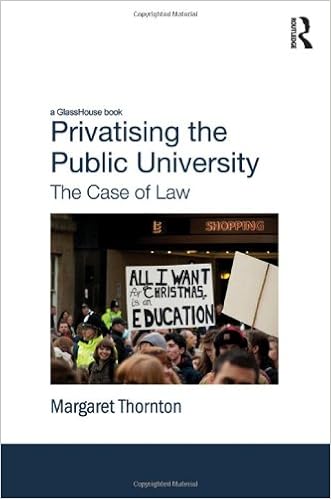
The panel and audience have arrived and the event has started. Professor Margaret Thornton, ANU College of Law (author of "
Privatising the Public University: The Case of Law"), warned of the managerat (managers at university) expanding, with the lost of academic freedom and an emphasis on commercial aspects. Professor Thornton appeared to be wanting to a return to an age where universities were given funding with no obligation to do anything in return. I don't think such an age ever existed.
Dr Kim Huynh, ANU School of Politics and International Relations, College of Arts and Social Sciences (and roving reporter for ABC Radio) told a story about a weightlifter with depression. This person is now a councilor of men to help them not be macho. He then related this to the Center for Western Civilization advocated by Tony Abbot. As far I understand it, Dr Huynh is arguing western universities need to be less focused on a male-focused view of civilization.

Ms Bianca Hennessy,  PhD Candidate in the School of Culture, History and Languages, College of Asia and the Pacific talked about how the college looks at decolonization. She then related that to what happens at universities, comparing Australian and pacific institution's practice. Ms Hennessy pointed out that regional institutions emphasize benefit to the community, not just the student's job prospects and produce free open access textbooks.

Ms Tess Snowball, Manager, ANU Academic Skills and Learning Centre, pointed out how university is now accessible to first in family Australian students who are not familiar with academic life. She also pointed out that international students come from different cultures. These points are familiar to me, being from a first in family generation and as an international higher education student. As a course designer and instructor I am very aware that I make assumptions about what me students know and expect.