Showing posts with label Mahara SmartEvidence. Show all posts

Saturday, August 19, 2017

ePortfolios for Australian Degrees

The Australian National University (ANU) launched its e-Portfolio system yesterday. E-portfolios have been in use in Australian universities for at least a decade, but are still not easy to use. QUT lead the Australian ePortfolio Project, which produced a 175 page report in 2008. QUT also produced a 41 page report in 2008 on what they were implementing at their own institution, which remains a useful guide for others to follow.
QUT identified three styles of student ePortfolios:
  1. Structured: predetermined framework of objectives to meet external / internal needs
  2. Learning / Dynamic: opportunity for self-audit, recording, reflection, feedback and on-going development
  3. Showcase: collect together, organise and present accomplishments...
From:  QUT's Student ePortfolio as a 'real world' learning tool, Harper, Hauville & Hallam, 2008
The type of e-portfolio I am most interested in is Structured, where the student can be guided through the requirements of a course, degree program, or professional certification, without being limited to completing fixed coursework or tests. Mahara's SmartEvidence may make this easier. This and could be used for courses, or whole bachelors, masters and professional doctorate degrees.
Problems occur with e-portfolios when the purpose is not clear. In particular a structured or learning e-portfolio is unlikely to be suitable as a showcase. The student's detailed work and reflections are unlikely to be of interest to a prospective employer, and may not be suitable for public release.
One problem is where the student is undertaking professional practice work in a real commercial or government workplace. The student's work can contain sensitive commercial or government information, which  instructors are permitted to see, but cannot be made public. In reflections, students can reveal much personal information, including mental illness, personal and family relationship difficulties, which are not suitable for release.

Also I don't agree with QUT's claim that "Writing reflectively is easy". Providing the digital tool is easy, but getting people to use it effectively is very, very, hard. In particular, reflective writing is not something which comes easily to STEM students, who have been trained to write in the third person from a neutral "objective" point of view. Reflection is something the students need to be trained to do, supported by a qualified teacher.

Athabasca University introduced an ePortfolio for MEd students in 2012. However, this was modified a few years later, in part due to the difficulties the students had in completing a portfolio (Hoven, 2015). It should be noted these portfolios were for students of education, well versed in writing. If anyone should be able to do an e-portfolio, it is an education student.

I was one of the cohort of students during the transition to the new Athabasca MEd e-portfolio process. We were given to choice of the old process, or the new and I chose the new. Rather than the e-portfolio being appended after then end of coursework, it was a capstone course. An instructor took students through stages of work, with peer feedback. However, even with this additional support, the e-portfolio process was not easy. Based on that experience, I hope to help avoid some of the problems with e-portfolios at ANU.

Reference


Hoven D. (2015, January 7). ePortfolios in Post-Secondary Education: An Alternate Approach to Assessment. UAE Journal of Educational Technology and eLearning. Edition 1. URL http://ejournal.hct.ac.ae/wp-content/uploads/2014_Article2_Debra.pdf#page=10


Friday, August 18, 2017

ANU ePortfolio Launch

Greetings from the Australian National University (ANU) in Canberra, where the new e-Portfolio is being launched. The software product being used is Mahara and it has been piloted extensively at ANU.

The choice of this product is a safe choice as it is typically installed alongside Moodle (which ANU already has). I have used Mahara in the ANU Techlauncher program, with computer science students. Previously I have used Moodle/Mahara at ACS, USQ and Athabasca University.

Professor Paul Maharg is providing an overview of how he has used e-portfolios for training lawyers. This was not about a box ticking exercise, but helping a student understand what it is to be a lawyer. He pointed out that "e-portfolios and reflection go really, really well together".

Professor Maharg also pointed out the difficulty getting students to work cooperatively together and to have curricula changed to incorporate it.He then got a little allegorical, likening an e-portfolio to the journal of early explorers, in how they explain not only what they have learned in an objective sense but as something they need to integrate with what they know.

In his presentation used the term "curriculum is technology" and asked where it was from. I traced it to a JISC report (Hughes, Gould, McKellar & Maharg, 2008, p. 40).

Last year I had to use Mahara as a graduate student to prepare a portfolio. This involved reflection and peer work with other students. My hope is that the SmartEvidence function of Mahara will take much of the tedium of the process, for students and supervisors.

Reference


Hughes, M., Gould, H., McKellar, P., & Maharg, P. (2008) SIMulated Professional Learning Environment (SIMPLE). URL http://simplecommunity.org/wp-content/uploads/2010/11/SIMPLE-FINAL-report.pdf

Tuesday, September 27, 2016

Assessing Competencies with Mahara

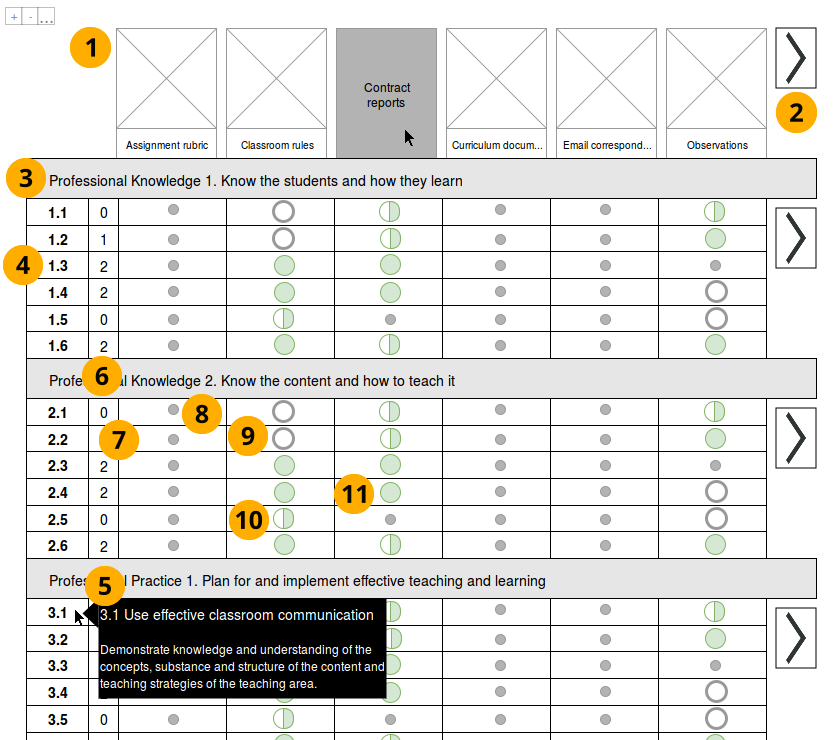
SmartEvidence overview page
Last week I attended a meeting in Canberra discussing how new features in Moodle and Mahara might be used for assessing the competencies of university students. Mahara is introducing SmartEvidence later in the year and Moodle already has "Competencies".

Mahara SmartEvidence seems to be more suited to the reflective development of higher-order skills, while Moodle Competencies may be useful for low level skills. SmartEvidence might be used across a program), while Competencies would be used within courses).

SmartEvidence is being introduced in Mahara version 16.10 (due for release 31 October 2016). There is a brief overview of Mahara SmartEvidence in the manual and detailed technical specification. The tool is intended to allow a "competency framework" with prescribed "competencies" (also called "skills" or "attributes") to be defined. A student can then nominate which pages in their e-portfolio they believe provides evidence of the competences. An assessor can then record if the evidence partly or fully meets the requirements. Without SmartEvidence a student can use Mahara to present their e-portfolio, but they and the assessor then has to manually tabulate the competencies.

SmartEvidence emulates the paper based process traditionally used for competency based evaluation. Competencies can be grouped into clusters of competences to make it easier to deal with a large assessment process. As an example, Athabasca University's MEd has six clusters, with a total of 47 competencies (Hoven, 2015).

SmartEvidence may not provide all the features needed to replace the on-line processes now used with Mahara and Moodle. As an example, SmartEvidence allows a student to nominate a page to support multiple competences. However, there is no way to point to a specific part of the page and the assessor is left to manually look though material seeing what may match.

SmartEvidence appears to have no provision for multiple levels of assessment. In particular there is no provision for peer review of e-portfolios by other students, which I have found to be a very useful part of a program Capstone (both as a reviewer and someone being reviewed).

In addition the competency frameworks for SmartEvidence are assumed to be centrally managed and fixed. The assessor cannot make up their own framework and cannot modify a provided framework. This makes sense where there is a centralized approach used, with a division between assessment designers and implementors, however, it limits flexibility.