Showing posts with label career. Show all posts

Friday, December 1, 2023

Join the Dots Career Planning

Greetings from the Australian Computer Society national office in Sydney. I am here for two days of meetings of the ACS Professional Standards Board, and the Accreditation Committee. I am on the Board, which sets standards for computing professional education in Australia, and am sitting in on the committee which accredits individual degrees at universities. 

During the break I went out for a coffee, and got chatting with an entrepreneur from a company in the start-up center ACS Harbor City Labs, at the other end of the floor. They said they were thinking of going back to finish their degree, which they left 15 years ago, and asked if that was feasible. I suggested their old university would be delighted to have them back, but they should not expect much credit for courses completed so long ago. They might instead apply for direct entry to a masters, based on experience. This got me thinking about the many staff in this situation, and how we can help them recognize their experience, and not have to do introductory courses.

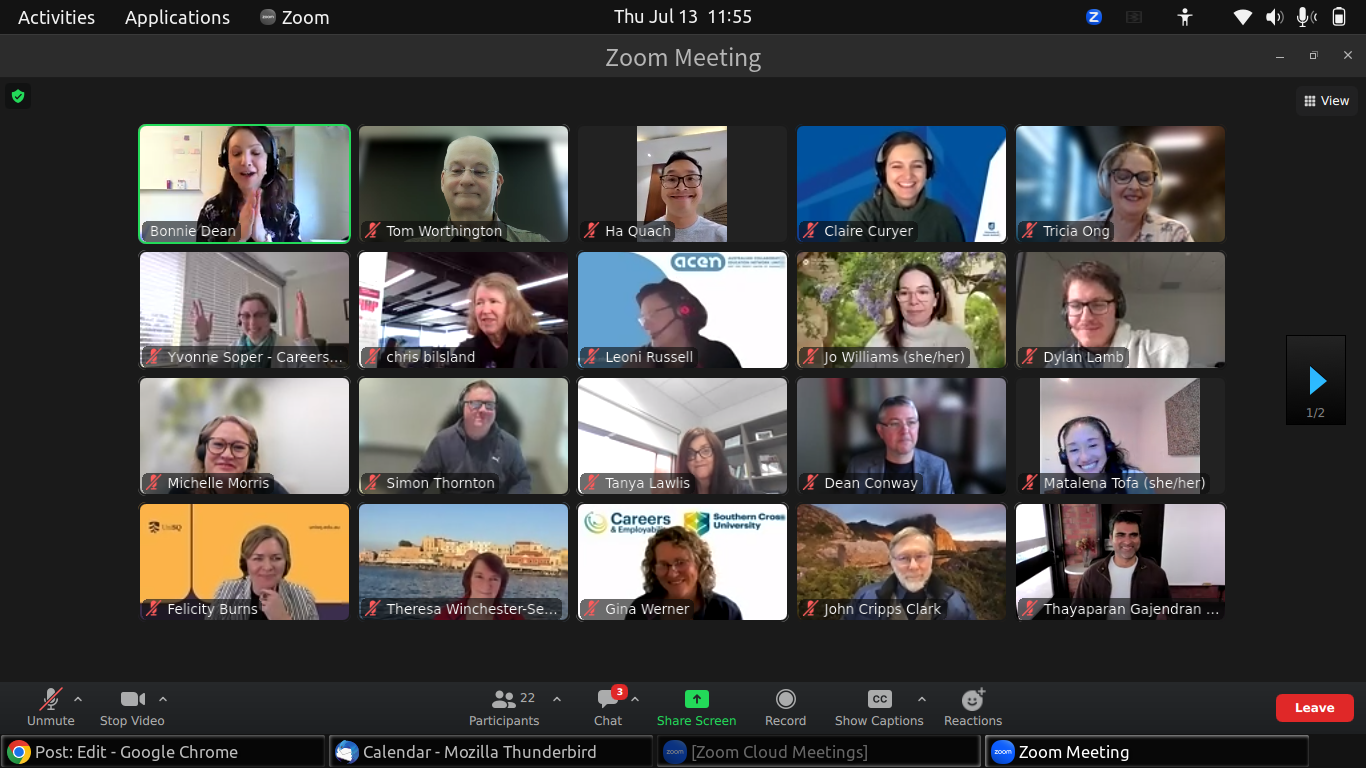
Thursday, July 13, 2023

Supporting diverse graduate career pathways through AI

NSW/ACT ACEN
Chapter Zoom Meeting
Greetings from "Supporting diverse graduate career pathways" at the NSW/ACT ACEN Chapter, and "The Re-Conception of AI and Robotics as Complementary Artefact Intelligence and Augmented Capability" by Roger Clarke at ANU. I am actually sitting in the seminar room at ANU, where Roger is presenting. That is also going out on Zoom, but I am listing to the ACEN seminar instead. This is because they happen to be on at the same time. Perhaps because I have been reading a book by William Gibson, and think I can mash these up. ;-)

Rodger is taking AI back to first principles ( see the the slide-set). The main point is that AI should complement human effort, rather than replace it: Augmented Intelligence.

ACEN's discussion is around how we prepare students for a career which may not be based on a few long term permanent jobs. Obviously a career may be even less certain due to AI, but perhaps we can design AI to work with the graduates, and train the graduates to be able to use it.

Sunday, January 19, 2020

Why Tutoring?

In teaching university tutors how to teach, perhaps the first question is why should they learn this. Tutors are unlikely to go on to a full time career in teaching (very few of those who complete a PhD become university academics). LinkedIn recently predicted that the most in-demand soft skills with employers for 2020 will be creativity, persuasion, collaboration, adaptability, and emotional intelligence. Learning to teach can help with these. A teachers must be able to design lesson plans (creativity), get students to study (persuasion), team teach and teach students to work in groups (collaboration), change the teaching method and content depending on student needs (adaptability), and use use emotional information to guide  their teaching (emotional intelligence).