Showing posts with label information warfare. Show all posts

Wednesday, August 3, 2022

Ukraine President Address to the Australian National University

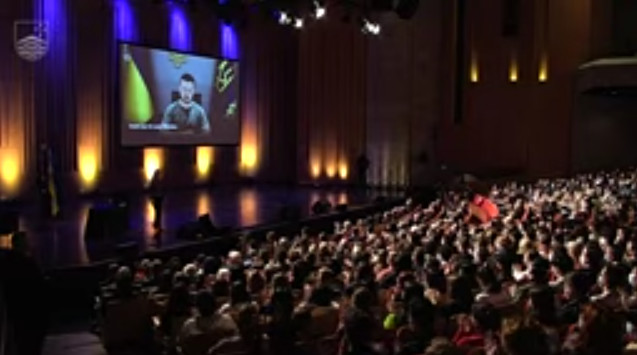
Audience in ANU Hall 
(still image from ANU TV)
This afternoon, Volodymyr Zelenskyy, President of Ukraine, addressed staff and students of the Australian National University, via video. He acknowledged Australia's contribution as the largest non-NATO provider of military assistance.

Ukraine have run an impressive Information Warfare campaign, with subtility, and occasional humor. This is a capability Australia needs to build as part of its defence rethink.. I will be speaking on "Designing for scale: How to use mobile devices to recruit, train and equip the extra 18,500 defence personnel", at the Mobile Learning Special Interest Group meeting of the Australasian Society for Computers in Learning in Tertiary Education (ASCILITE), 10 am, Friday, August 26, 2022.
President Zelenskyy speaking to ANU 
(still image from ANU TV)

Monday, August 24, 2020

Social Media Attacks on Critical Infrastructure

In a Hypothetical for Teaching ICT Ethics I asked computer science students if it was ethical for them to conduct a hacking attack on an electricity system for the military. However, Raman, AlShebli, Waniek, Rahwan and Chih-Hsien Peng (2020) have pointed out How weaponizing disinformation can bring down a city’s power grid, without any need for hacking. Instead a fake offer of a discount on electricity charges would be used to induce customers to turn on their appliances at peak time and overload the grid.

The authors suggest mitigation strategies can be used, with authorities being ready to broadcast warnings. However, I suggest that if the  warnings go out on "old" media, such as local TV stations, many may not see them. Also the attacker could reduce the effectiveness of the official announcements, by sending out fake official denials on social media saying the warnings were not real.

ANU energy researcher and entrepreneur, Dr Backhall, in 2019 described the current Australian electricity grid as being "duct-taped together".  His work on smart renewable energy would allow for a more robust grid, which could switch off loads and switch on battery supplies at peak times. However, this equipment would need to be secure, as it offers a new target for hackers.

Reference

Raman, G., AlShebli, B., Waniek, M., Rahwan, T., & Peng, J. C. H. (2020). How weaponizing disinformation can bring down a city’s power grid. PloS one, 15(8), e0236517. URL https://doi.org/10.1371/journal.pone.0236517
Tuesday, May 22, 2018

Secure Information Architecture for Information Warfare

Greetings from the National Pres Club In Canberra, where Dr Asif Gill is speaking on "Secure information architecture: security by design". Dr Gill is describing the strategy and architecture needed to get from the current insecure state of an IT system to the desired more secure state.

Dr Gill is describing a defensive strategy however, it occurs to me that the same approach could be used for thinking about offensive operations, where the desired state is less secure for your opponent.

Australian Department of Foreign Affairs Diplomatic Academy
This is my second security presentation for the day. The Minister for Foreign Affairs recently opened Australia's Diplomatic Academy. The Academy's impressive new premises are a short walk  from the Press Club. Today the Academy hosted a presentation by the Australian National University's National Security College on The New Weapons: Propaganda, Misinformation and Fake News. This is the topic of an ANU short course starting next week.