 |
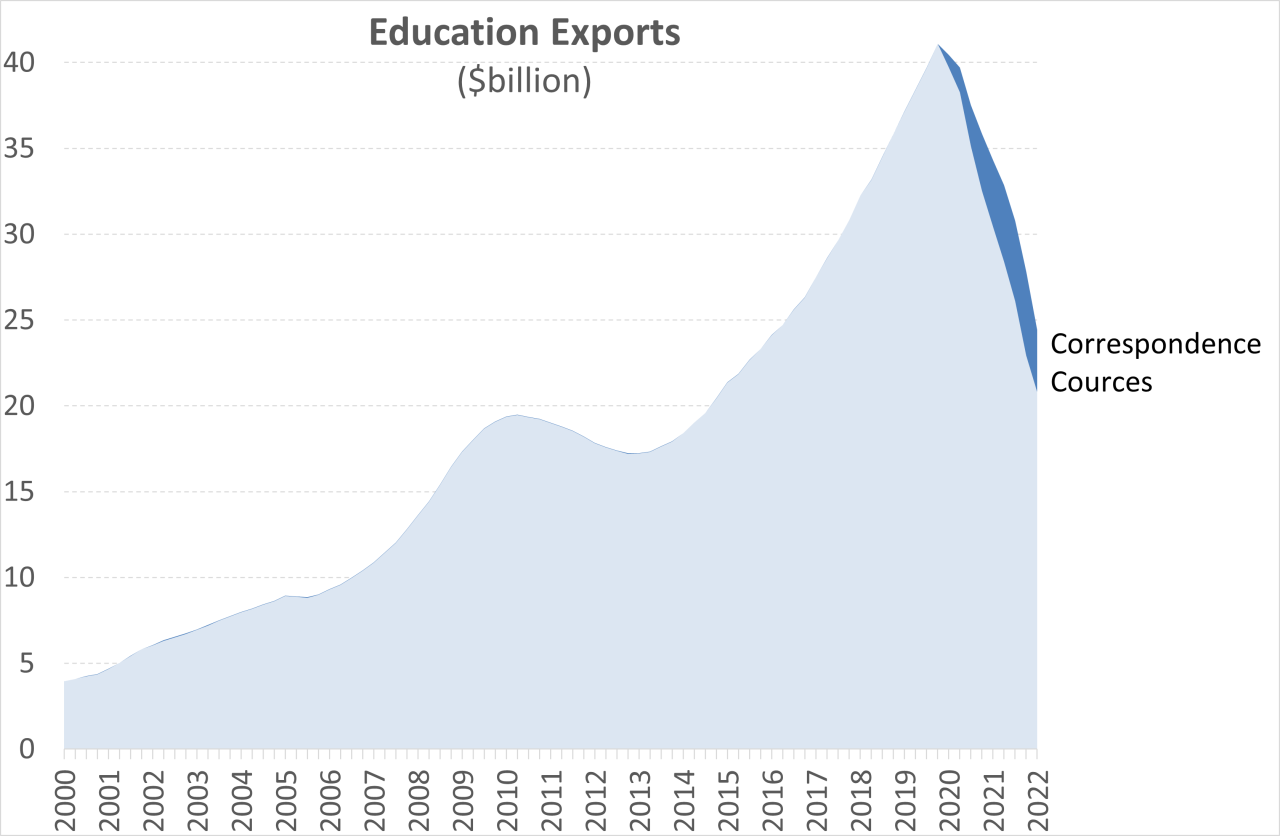
| Graph of education exports per year, from ABS data by Mary Clarke, 18 May 2022 |
Showing posts with label statistics. Show all posts
Showing posts with label statistics. Show all posts
Thursday, May 19, 2022
How Much is International Distance Education Worth to the Australian Economy?

Monday, July 30, 2018
What proportion of international students at Australian universities are studying for a computing qualification?
I am writing a paper on how Australia might do education better and I
wanted to include a figure on the proportion of computer students. From
the Australian Department of Education statistics I calculated that 9%
of international students in 2016 were in “Information
Technology”. However, that appears far too low and I would expect 20% to
30%. Perhaps this is because it doesn't include "information systems"
business students and "software engineering". Is there a better figure?
Tuesday, December 29, 2015
Technical Education is as Important As Business Skills
"75% of people lacking a technical education will believe made up quotes containing spurious statistics" - Tom Worthington ;-)More seriously, the ability to communicate, negotiate and lead is important, but it is also necessary to have at least basic technical knowledge. Being able to lead will be of no use if people can fool you with such obvious nonsense as the often cited, supposed quote:
"85% of your financial success is due to your personality and ability to communicate, negotiate and lead. Shockingly, only 15% is due to technical knowledge." - Carnegie Institute of TechnologyVariations of this appear in tens of thousands of publications. Jeff Lopez-Stuit traced it to a Forbes article by Keld Jensen (2012):
"Research carried out by the Carnegie Institute of Technology shows that 85 percent of your financial success is due to skills in “human engineering,” your personality and ability to communicate, negotiate, and lead. Shockingly, only 15 percent is due to technical knowledge. "Brian Austin traced this back to a 1918 work by the Carnegie Foundation. I was able to find the actual article (Mann, 1918), which does not support the proposition that technical knowledge is relatively unimportant. It is actually about how to improve technical education, which ensured the USA's economic success in the 20th century.
I suggest we need people who are trained in both technical and business skills. In particular there is great value in giving technical people some training in how to communicate and some understanding of business. One way to do this is with "innovation" programs, where the technical and business students are required to work together.
Reference
Mann, C. R. (1918). A study of engineering education. Bulletin, 11. Retrieved from: http://web.mit.edu/~jwk/www/docs/Mann%201918%20Study_of_Engineering_Educ.pdfMonday, December 1, 2014
Experiments with users and sample size
 Greetings from the Australian National University in Canberra, where Diane Kelly, University of North Carolina, is speaking on "Statistical power analysis for sample size estimation and understanding risks in experiments with users". Having struggled through a course in research methods, I was relieved to hear that there is no perfect sample size. Diane looked at some of the constraints on sample size, such as budget and time.
ABSTRACT:
One critical decision that researchers must make when designing experiments with users is how many participants to study. In our field, the determination of sample size is often based on heuristics and limited by practical constraints such as time and finances. As a result, many studies are underpowered and it is common to see researchers make statements like "With more participants significance might have been detected," but what does this mean? What does it mean for a study to be underpowered? How does this effect what we are able to discover about information search behavior, how we interpret study results and how we make choices about what to study next? How does one determine an appropriate sample size? What does it even mean for a sample size to be appropriate? In this talk, I will discuss the use of statistical power analysis for sample size estimation in experiments. Statistical power analysis does not necessarily give researchers a magic number, but rather allows researchers to understand the risks of Type I and Type II errors given an expected effect size. In discussing this topic, the issues of effect size, Type I and Type II errors and experimental design, including choice of statistical procedures, will also be addressed. I hope this talk will function as a conversation starter about issues related to sample size in experimental interactive information retrieval.
Tuesday, November 25, 2014
Sample size risks in experiments with users
Diane Kelly, University of North Carolina, will speak on "Statistical power analysis for sample size estimation and understanding risks in experiments with users" at CSIRO IR & Friends at the Australian National University in Canberra, 4pm, 1 December 2014.
ABSTRACT:
One critical decision that researchers must make when designing experiments with users is how many participants to study. In our field, the determination of sample size is often based on heuristics and limited by practical constraints such as time and finances. As a result, many studies are underpowered and it is common to see researchers make statements like "With more participants significance might have been detected," but what does this mean? What does it mean for a study to be underpowered? How does this effect what we are able to discover about information search behavior, how we interpret study results and how we make choices about what to study next? How does one determine an appropriate sample size? What does it even mean for a sample size to be appropriate? In this talk, I will discuss the use of statistical power analysis for sample size estimation in experiments. Statistical power analysis does not necessarily give researchers a magic number, but rather allows researchers to understand the risks of Type I and Type II errors given an expected effect size. In discussing this topic, the issues of effect size, Type I and Type II errors and experimental design, including choice of statistical procedures, will also be addressed. I hope this talk will function as a conversation starter about issues related to sample size in experimental interactive information retrieval.
Subscribe to:
Posts (Atom)