Showing posts sorted by relevance for query Forsyth. Sort by date Show all posts

Tuesday, December 2, 2014

Will Higher Education Reforms Position Australian Universities to Compete On-line?

The debate over changes to Australian Higher Education has failed to address the major challenges which Australian universities face. Australian higher education policy needs to change to accept the reality that Australian students need vocationally orientated education and this can be delivered most effectively on-line.

The 2014-15Australian Federal Budget included reforms to the funding of higher education, most significantly, from 2016, the removal of the government imposed limit on the fees universities could charge domestic students (Australian Department of Education, 2014). The intention was to introduce this change from 2016, but the measures have been held held up in the Australia Senate, where the government does not have a majority. Negotiations with minor parties might see some form of legislation pass during 2015 (Knott,2014). 

However, proposals for universities to set their own fees, structural adjustment fund to help universities with the change and a scholarship scheme for regional students will not address the needs of Australian students. This policy misdirection is similar to ineffective government efforts to restructure the Australian motor vehicle industry, with all manufacturers announcing they will cease production by the end of 2017.

Hannah Forsyth's "A History of the Modern Australian University" pointed out that Australian universities were created to deliver practically orientated education in areas important to the nation, such as mining. The most effective and efficient to provide vocationally orientated education now is on-line. This opens the Australian education market to international competition, as happened with the motor vehicle industry.

The debate which needs to take place is over how to optimize higher education, using a combination of universities and vocational education institutions. Providing subsidies to prop up obsolete university campuses will not assist the students and will condemn the Australian education industry to a similar fate as the  motor vehicle industry (although the collapse of the education industry will be much quicker).

Apart from courses where students travel to another country, or study on-line at an overseas instution, Australian universities now face competition from an international on-line university in Australia.  Laureate International Universities, is an international for-profit provider of on-line university education. It is now accredited to deliver courses from its international network, through an Australian arm, Torrens University Australia (TEQSA, 2012). In addition, Australia has signed a number of free trade agreements with other nations, which cover services. Education providers in those countries can argue that Australian students studying at their campuses must receive the same Australian government funding support as students at Australian campuses.

The Australian organization which seems to have the best idea of what is happening with Higher Education, and has positioned itself for the change, is not a university. Open Universities Australia (OUA) is a consortium of universities delivering on-line education. This started as a brokering service where OUA got the students, who then studied at the member universities. But in the last few years OUA has acquired companies and set up new initiatives to deliver learning services and courses directly, including in the VET sector.

Earlier in the year I discussed the issue of the future of higher education with academics in Vancouver, but have not seen a similar discussion happening in Australia. It would be unfortunate if the the "reforms" to Australian Higher Education failed to address the important questions.

The debate over universities setting their own fees is reminiscent of the Australian Wool Reserve Price Scheme. This scheme put a floor under the price Australian wool producers were paid and was designed to smooth out fluctuations. However, when the price of wool dropped for an extended period, the only buyer was the scheme, until it ran out of funds. Similarly universities are deluding themselves if they think they can set the prices for courses. The price for courses will be set by the world market. A few Australian universities with a prestigious reputation will be able to charge a premium, but most universities will not.

Friday, October 3, 2014

History of the Modern Australian University

Greetings from Glebe Books in Sydney, where John Dawkins AO, is launching Hannah Forsyth's "A History of the Modern Australian University". I only just bought a copy and so have not had time to read it, but the topics look interesting ("The DVC Epidemic"). One quibble is that the Internet does not have its own entry in the index (saying "See World Wide Web").
The title of the book makes too large a claim and that of the author's thesis, upon which the book seems to be based, is more accurate: "The Ownership of Knowledge in Higher Education in Australia 1939-1996". There are numerous references to the ANU student newspaper "Woroni", including an intriguing one about a student driven ‘Learning Exchange’ from Woroni , Thursday 2 August 1973. I was able to find a copy of the article in Trove. From this the Learning Exchange seems to have been a sort of phone and paper based MOOC:

"LEARNING EXCHANGE

On Thursday, July 12th, a meeting was held of some of those interested in the concept of a Learning Exchange in Canberra. Laura Turnbull, of the World Education Fellowship, was present and was able to suggest several possible contacts potentially influential in getting an exchange underway.

The meeting learned that there are several, Community Service Centres already becoming established in Canberra. These are at private addresses where people can ring for information on various things - such as, clubs and societies, legal advice, etc. Obviously, this is similar in concept to a learning exchange and any exchange set up should logically work with theses groups.

It was also learned that the TAB provide grants for community services. A submission for a grant is to be drafted this week. A publicity release, explaining the structure and aims of the Exchange is being printed for general and media distribution. A submission to the Dept. of the Capital Territory is yet to be drafted. It is hoped that they can be persuaded to bear the bulk of the financial burden that such things as rent for premises would create.

The Melbourne Learning Exchange has its own newspaper in which items of interest and lists of teachers/potential learners are published. It is hoped that the extra work-load could be avoided by printing the same sort of information in regular spaces in various established community newspapers. It is also hoped that notice board space in community centres such as the Monaro Mall and Woden Plaza would be another means of spreading information on learning/teaching requirements. The manager of the Mall has approached and seems interested. No formal response has been received.

An article about the Learning Exchange will appear in the CAE paper, CCAESARIAN soon, and also hopefully a feature in the Canberra Times. There is a meeting in the Clubs and Meeting Societies Room next Tuesday ,31st July. Anyone with any ideas on anything and especially on the submissions to the Dept. of the Capital Territory would be most we or interested in the Learning Exchange. Alternatively, contact Steve Jones, c/o CAC Office. There is a meeting about the School Without Walls in the old Canberra High on August 1st. Literature on the Exchange will be distributed there, as the people attending represent a fairly wide cross section of Canberra.The meeting will also be worth attending for its own sake.For further information see Jamie Griffin, c/o Woroni or read the article in the second Woroni of this term." From "LEARNING EXCHANGE", Woroni , Thursday 2 August 1973


Thursday, October 22, 2020

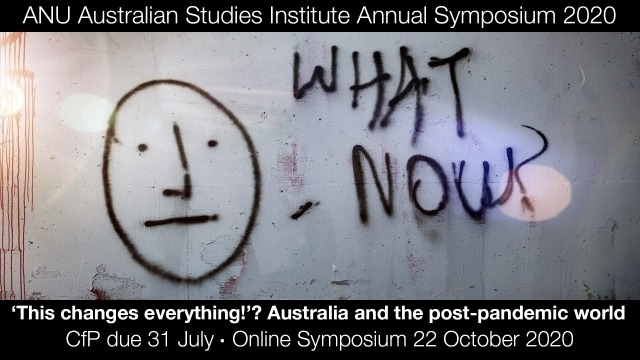
Australia and the post-pandemic world online symposium on now

 'This changes everything?'! Australia and the post-pandemic world, 22 October 2020

Greetings from "Australia and the post-pandemic world", a free online symposium being hosted by the Australian Studies Institute. This is on all day at the Australian National University until 5pm. I will be on a panel at 1pm on "education and online learning in a pandemic". An unusual format is being used, where each speaker prepared a 5 to 8 minute video in advance, so the live sessions move straight to discussion. It would be interesting to see if this format continues after face to face symposia are reintroduced.

I watched the videos for my session on education at 1pm and here are some notes:

Session 5: Education and online learning in a pandemic

E-learning and virtual transformation of histology and 
pathology learning during COVID-19: its impact on student 
learning experience and outcome
, Ms Samantha Waugh, Dr James Devin & Dr Vinod Gopalan, School of Medicine, Griffith University 

Used Blackboard Collaborate Ultra for live video lectures, including the use of a virtual microscope. Practicals with a tutor via Microsoft Teams. Online library of histology images. Student survey found the online lectures were as good as face to face and practicals better online, with students agreeing this should continue. Student exam results went up by 10%. My comments: But how was the assessment done? Also as noted these students had already completed a year of study face to face: would this have been as well received for studnts  new to university? 

Lessons to be learnt from the impact of COVID-19 on 
medical students’ wellbeing and learning experience
, Dr. Anna Efstathiadou & Dr Suja Pillai, University of Queensland 

Students were encouraged to undertake extracurricular craft activities. These reduced student stress by taking them away from their subject area for a time. My comments: Some students may be reluctant to engage in extra curricular activities. I suggest co-curricular ones, which are relevant to their studies and for which course credit is received. These can be, for example, on working in teams, communicating with the public and entrepreneurship. 

A Possible Solution to Bridge the Gap between off-Shore 
Students and Australian High Education 

Dr Ying Zhu, Adelaide Bio-Tech Development (Hengqin) Ltd 

This presentation points to the difficulties for the 80,000 Chinese students enrolled in Australian universities but unable to get to Australia. Distance Learning had problems with time zones between Australia and China as well as the distractions of studying at home. It  is suggested that local tutorials in China can be a useful alternative. My comment: These are issues and solutions which have been discussed, at length, in the distance education literature. No sooner had the Open University UK started distance education fifty years ago than students spontaneously started organizing their own study groups and arranging tutorial at local vocational campuses. As an international online student (of distance education) from 2013 to 2017, I found myself not only studying the phenomenon, but also doing it myself. However, providing F2F tutorials locally is a very high cost for an institution. 

Australian Higher Education in the Post-pandemic Worl
Mr Tom Worthington, Research School of Computer Science, ANU 

The other speakers focused on the impact of COVID-19 on education, but I had spent a decade working on how to deliver education online. In 2019 I implemented an education design with blended delivery. This was designed so that if international students could not get to campus due to a regional crisis, the face to face components could be quickly replaced with video. I had designed this in case of a war, but it worked fine in 2020 for COVID-19. The interesting question for me is not what was done for COVID-19, that was just standard distance education, but what happens next?

My notes are at:http://www.tomw.net.au/education/he_after_covid19/HE%20Postpandemic%20Tom%20W.pdf 

From butcher’s paper to Zoom breakouts: developments 
and transformations in Australian trade union education
 
Dr Alice Garner, Centre for Vocational and Educational Policy, University of Melbourne, Professor Anthony Forsyth, Graduate School of Business and Law, RMIT University Dr Mary Leahy, Centre for Vocational and Educational Policy, Melbourne Graduate School of Education Ms Renee Burns, University of Melbourne Law School 

This fascinating presentation is on the Trade Union Training Authority (TUTA), which was a joint government/union activity to provide vocational education in Australia. My comments: As a public servant and union member I attended TUTA training and found it very useful. Today's TAFEs have some of the flavor of still. The ANU's TechLauncher program, which I help teach, has some small element of this as well, with tutors and students who are practicing professionals who come with a workplace perspective very different to university staff, who are primarily researchers. 

Monday, November 9, 2015

Not-for-profit Private Australian University

Marko Beljac in "#Occupy the university" (Online Opinion, 5 November 2015) suggests that "In a free society university life must necessarily be autonomous and self managed" but "... the university essentially becomes a private enterprise supplying graduates to other corporations. The courses universities provide, the manner they are delivered, and the research that they do, necessarily will cater to the interests and concerns of the corporate sector. ...".

Universities do cater to the vocational needs of their students, which I suggest is not all together a bad thing. There should be scope for non-vocational studies, but someone has to be willing to pay for these. If the students are not willing to pay, because such studies will not get them a job, and the state will not pay, because their is no perceived social benefit, then who will pay?

Calls for a non-corporate approach to universities, such as that by Beljac, are not new. These are documented in Hannah Forsyth's "A History of the Modern Australian University". We do not need to look to Paris students riots and have our own history of learning experiments:
    "LEARNING EXCHANGE

    On Thursday, July 12th, a meeting was held of some of those interested in the concept of a Learning Exchange in Canberra. Laura Turnbull, of the World Education Fellowship, was present and was able to suggest several possible contacts potentially influential in getting an exchange underway.

    The meeting learned that there are several, Community Service Centres already becoming established in Canberra. These are at private addresses where people can ring for information on various things - such as, clubs and societies, legal advice, etc. Obviously, this is similar in concept to a learning exchange and any exchange set up should logically work with theses groups. ..." From "LEARNING EXCHANGE", Woroni , Thursday 2 August 1973

A radical dawn in the corporatization of Australian universities happened, almost unnoticed, in July 2012, when Torrens University Australia was admitted to the Australian National Register of higher education providers as an "Australian University" and authorized to self-accredit courses. Torrens is part of the private for-profit, Laureate International Universities, which provides education online to 800,000 students around the world.

Professor Jim Barber, while UNE Vice-Chancellor,  advocated changes to government regulations to allow on-line universities to be established in Australia. He failed in this, however Laureate's example with Torrens shows it is possible to establish a new institution with a different way of working. This approach could be applied for new non-government, not-for-profit higher eduction institutions which have social goals.