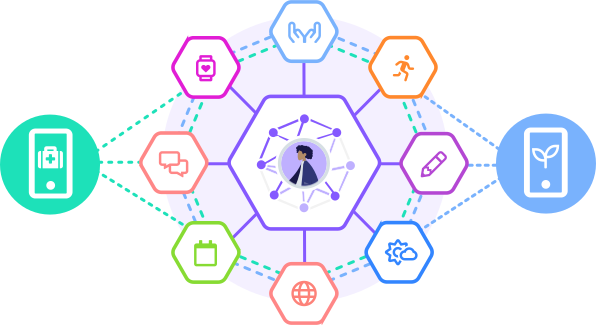
 Greetings from the start of Solid 2026 Hackathon: Building the Decentralised Web in Canberra, at the Australian National University. Solid is a standard from the W3C, the people who look after the web. It allows individuals to decide who has access to their data. Solid uses Personal Online Data Stores (PODS) which hold user data & they can choose who can read it. The problem, as I see it, is what would motivate for-profit companies and government agencies, to use the Solid standard, when their business is based on appropriating user data. Perhaps some of the teams today can come up with some business models to make Solid profitable.
Showing posts with label ANU Computing School. Show all posts
Showing posts with label ANU Computing School. Show all posts
Tuesday, July 14, 2026
Building the Decentralised Web in Canberra

Thursday, July 2, 2026
AI Teaching People to Assemble Flatpack Furniture and Drones

Zhan has spent time at Mitsubishi Electric Research Laboratories. As it happens Mitsubishi is building frigates for the Australian navy. Robot assembly could be used to speed construction. More locally, I had a technician in my home this week, trying to work out how to replace the motor in my Mitsubishi air-conditioner. ;-)
Apart from reducing the frustration with DIY, and teaching robots to assemble, this has applications in medical procedures and maintenance of safety critical infrastructure. As an example, in the past a large team of people would spend years producing maintenance training materials for a new aircraft. However, UAVs are now being designed, built and put into use within a few months, and being constantly updated. The operator needs to be able to assemble the UAV from a kit of parts in the field. Deployment can't be held up while instructional videos are produced, but correct assembly is a matter of life and death.
ps: The seminar also demonstrated the hybrid mode. In addition to a room full of people, there were some on Zoom. At question time it was imply a matter of switching on the audio from the remote participant, so they could ask.
Monday, October 20, 2025
Live Hackerthon Pitches to Combat AI Cheating
.jpg)
As well as having to pitch live, each team has to provide an electronic archive of their work. This makes it much harder for a student to contract out the work, either to a human or AI software. One subtley in the way the pitches are made is that Zoom is being used, although we are all in the room together on this occasion, this allows all the presentations to be easily recorded and the option of a blended mode, wth remote students and teachers.
Thursday, August 28, 2025
Quantum AI for Defence at ANU
 |
| Dr. Nils Herrmann, Quantum Brilliance |
"This talk introduces the concept of Quantum Utility - Quantum Brilliance’s vision for practical quantum advantage - and presents early gate-based QML results achieved on an on-site, room-temperature quantum computer. It then highlights the work of the newly formed Quantum Utility and Exploration (QUTE) team, whose mission is to uncover utility through control modes that operate closer to the physical diamond-based hardware. The talk concludes with an introduction to quantum reservoir computing, showcasing QUTE’s latest simulations on future single- and multi-NV systems that establish a compelling platform for near-term, practical quantum machine learning."
Wednesday, November 27, 2024
Design Exercies Game Participants Needed

Erika Wood, PhD Student in computing at the Australian National University needs volunteers to help her with the Design Exercise Game.

Thursday, October 24, 2024
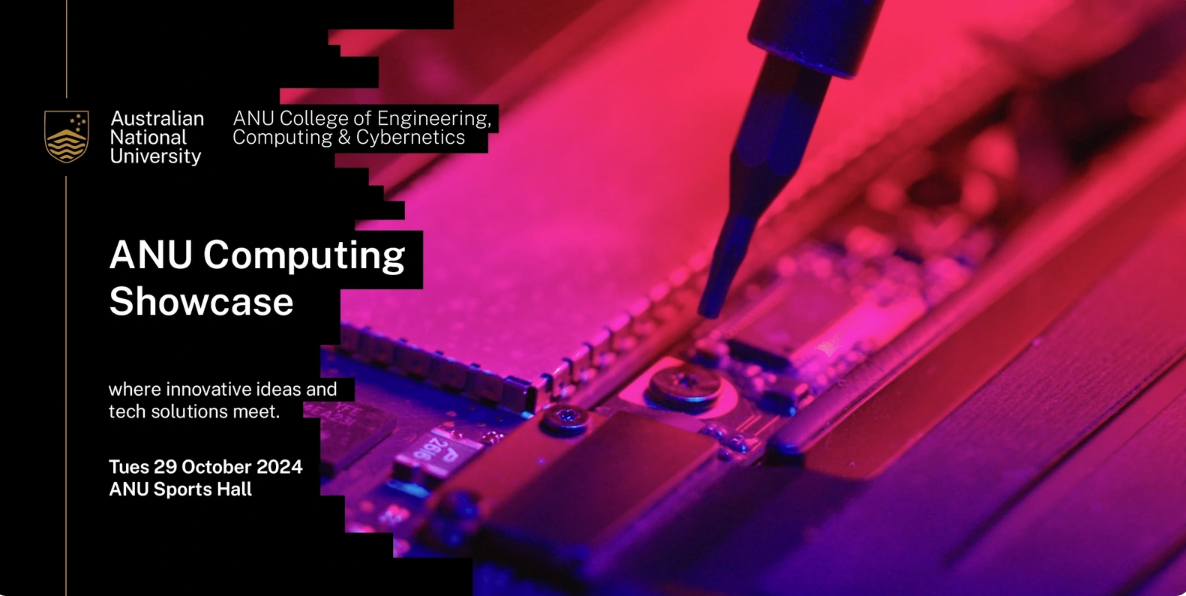
ANU Group Computing Projects on Display Tuesday 29 October 2024 12 noon
 |
Tuesday, June 18, 2024
Project proposals needed for computer student teams

For several years I have been one of a large team teaching project management to computer students. The ANU Techlauncher Program continues to gain in popularity, and we are in need of more projects for more students due to start their studies in the next few weeks. The project can be something from a small business, startup, large corporation, government agency, or a not-for-profit. You might have a glimer of an idea, and want a prototype to see if it makes sense, or something well specified, and just needs doing. In the past I have tutored students building software to test hydroelectric generators which keep the lights on in much of Australia, while others helped develop an anti-ballistic missile radar which protects Australian warships. At the other end of the scale, a team produced an app for a health professional, to help their patients with a fear of flying.
Thursday, June 13, 2024
ANU Techlauncher Project Wins IT Industry Award for Education
 |
| iAward to ANU Techlauncher |
Tuesday, April 16, 2024
Job Interview Skills
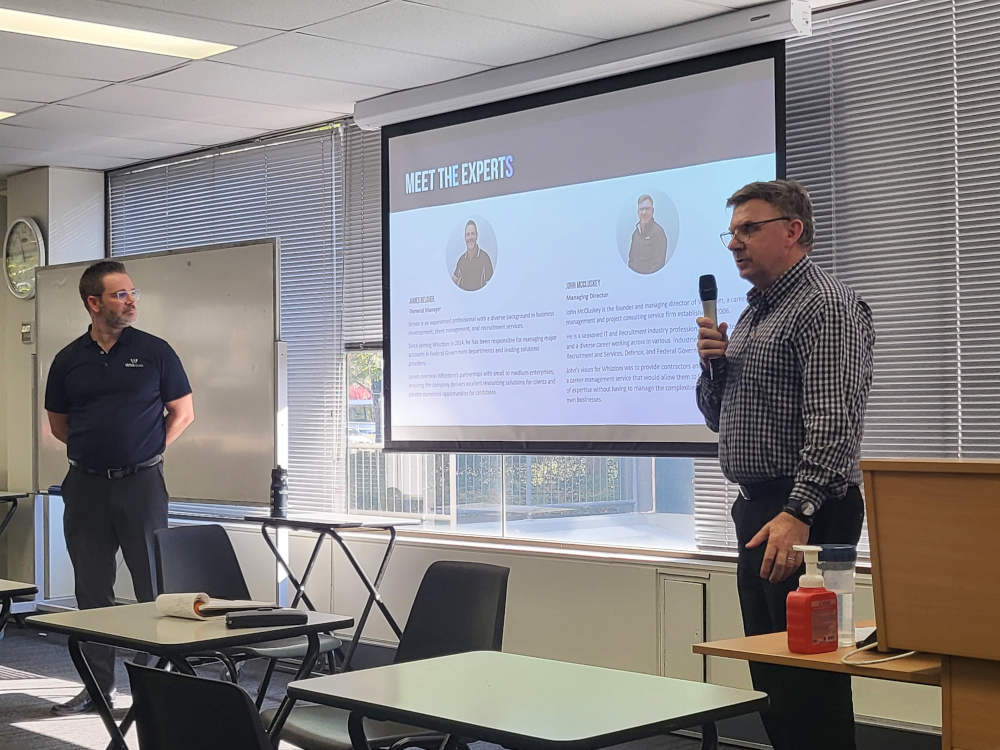 |
| John McCluskey, & James Bletcher, from Whizdom Recruitment |
Something that hadn't occurred to me were tips for team exercises during job selection. With this a small group of about a half dozen applicants have to work together, while being observed. This is to see how potential staff will work with others. I flippantly suggested I would undermine the rest of the team to get the job, and the flippant reply was I would be good at the Defence Department (I actually worked there nine years). ;-)
Staff from Whizdom Recruitment talked about hot job areas. One obvious area is AI, but less obvious is nuclear submarines, which don't just need physicists, but computer people as well. One suggestion which surprised me was to attend industry conferences such as MilCIS.
Tuesday, February 20, 2024
Learning to Reflect in the Age of AI
The ANU now provides Microsoft Copilot, as part of the Office suite. This provides the opportunity to take studnts through exercises to use it, to help with their writing. I have not used Copilot, but have explored the technology it is based on since 2022. The idea is to get the students in workshop groups to ask a career related question of Copilot, then critique & improve the answer.
A couple of weeks ago I attended a two-day Symposium at USyd on using AI this way, with team-based learning. One tip given at the symposium to stop students simply relying on the answers given by the AI. The idea is to prompt students with a very localized question, which the AI model can only answer with generalities:
Last week I attended an ANU AI Assessment Question Drop In Session. The impression I got was that the ANU would not be averse to using AI this way. One of the other people who dropped in for advice was already proposing to run some team-based AI sessions along these lines.
Monday, August 14, 2023
Agile Thinking for Agile Projects
 |
| ANU Hive in action |
Presenting in The Hive is challenging, as there are people coming and going all the time in the open plan area. There is a low level mum of voices, with meetings of teams with clients going on in the background. Eminent academics and industry professionals can wander in, sit down, and join in. This is useful for emulating the industry environment.
Rarely in government or industry will there be a polite fixed group sitting down listening to a presentation. Students need to cope with a slightly messy, changing, but therefore creative, environment. An extreme example of this were where I witnessed three people at a startup, all writing on a whiteboard at the same time, and shouting at each other, while a crowd watched them, like it was a competitive sport. Another was a hackerthon on weapons development for use in the South China Sea, where an Admiral suddenly appeared and "asked" for a briefing on progress.
For soft skills (or professional skills as careers expert Tempe Archer prefers), of communication, teamwork, leadership, emotional intelligence and relationship-building Dr Bernardo Pereira Nunes runs sessions in the Escape Room, in The Hive.
One of the communication skills I highlighted to the studnts is to identify all the issues without making the client feel you are getting at them. One team simply listed all the things they thought their client was doing wrong, and sent it to them. The team was surprised when the client stopped talking to them.
Tuesday, December 20, 2022
My Factory Floor is an Outdoor Cafe at a University
 |
| Tom Worthington at ANU Coffee Grounds Cafe. Photo by Tom Worthington CC-BY 2022 |
Later I bumped into someone and discussed if I would be helping assess applications for course credit of international students again next year. On Thursday I am having lunch with people to organise the work integrated learning of computer students. Coffee Grounds makes up part of the almost invisible infrastructure which provides the link between higher education and innovation.
Tuesday, September 27, 2022
On Campus Online

These are computing students at Australia's leading university, undertaking a technical degree in a highly sought after field. But what shocks them after mastering the intricacies of a very technical field is that employers want people who can talk to customers. Students, especially STEM students, find all this "soft skills" stuff, very hard. So me have them practice talking to each other, and talking to real clients.
This semester we have students back on campus, but not all of them. So we are operating in hybrid mode, with most instructors in a classroom, with some students, and others online via video conference. This makes for a high workload for those coordinating presentations, and breakout rooms.
Thursday, September 15, 2022
Wide Angle View of Hybrid Classroom
 |
| Screenshot from AI, ML & Friends Seminar, |
Wednesday, September 14, 2022
Casual Tutoring in Computing Available at the Australian National University
The School of Computing at the Australian National University has opened applications for casual tutoring for Semester 1 2023. The School teaches everything from AI and machine learning, systems, software, theory, analytics, to the practicalities of project management teams (I help with that in Techlauncher). Paid training is provided, & ACT Government staff visit the campus to help with getting your Working With Vulnerable People card.
Friday, April 29, 2022
What can universites do to enable computing to help the nation?
The host was worried no one here at the 50 years of computing at ANU dinner,would ask the keynote speaker, David Thodey AO a question. So I was just asked to be ready with one.

I was going to ask a follow-on to Sally-Ann Williams speech: "What can universities do to enable computing to help the nation?". But David anticipated the question in his speech. So I only need to ask how do we enable that better society?
This again, got harder, when he anticipated that question, listed what we should do: stick to the fundamentals, push boundaries, be bolder, keep doing pure and applied R&D, build partnerships with government and industry, collaborate better.
Fortunately there were plenty of questions. Q: What to ask the next PM? Answer: create common vision for the nation. Q: How does expert advice cut through? A: Present the truth and leave without opinion
David mentioned the power of technology in everyday life. I was confronted by this today when the robot cleaning the floor in Woolworth's talked to me.
Computing Enabling Australia's Future
 |
| 50 years of computing at ANU Dinner, Photo by Tom Worthington CC-BY 29 April 2022 |
Friday, April 1, 2022
50 years of Computing at ANU: A Long-expected Party
All ANU computing alumni, past staff and friends are invited to dinner, 29 April 2022. Nominations of Alumni laureates, and donations for scholarships, are also being sought. If you don't know anything about computing at ANU, or think you know everything, then check out David Hawking 's book, The History of ANU Computing (free online & I get a mention on page 139).
"Fifty years ago, 260 students enrolled in an introductory course called Computer Science B01. Nowadays, we typically have over 1200 full time students. In between, we grew from a sub-department of the Department of Statistics to our own department (1976), and now a School. Just as they did four and five decades ago, our alumni continue to blaze new trails across disciplines throughout Australia, and around the globe.
In recent years, our researchers led the global scientific community in the race to identify variants and develop vaccines for COVID19, twice set computational world records opening new frontiers for energy and medicine, and pioneered computer vision software that will improve safety for helicopter rescue missions and allow robots to make decisions about new scenarios much the way a human being does.
Please join us on 29 April for a celebration of early and recent accomplishments, and a discussion of future direction. This is our first opportunity to host a gala event since 2019, and we are working hard to make it a memorable one for you and for the computer science community.
It's not too late to nominate alumni laureates for the occasion — one from each of the past five decades — to help us celebrate this milestone and consider how taking stock of our past accomplishments should inform and inspire future endeavours.
To celebrate the gold anniversary of 50 years of Computing at ANU, we seek to raise a total of $50,000 to provide scholarship support to encourage a more diverse student population, including women, rural and remote populations.
Make a donation
A generous anonymous donor has offered to match gifts over $100 and under $25,000. So if you can’t be with us 29 April, consider sending a donation and be with us in spirit. Donations of $50 or more will earn you a 50 years in Computing T-shirt — the same one given to gala attendees.
Alumni laureates
It's not too late to nominate alumni laureates for the occasion — one from each of the past five decades — to help us celebrate this milestone and consider how taking stock of our past accomplishments should inform and inspire future endeavours.
Please reflect upon your ANU days and nominate someone who can contribute to this conversation in a way that reflects your experience and your outlook. We want and need your input on who should be featured at this milestone event."
ps: Apologies to JRRT for A Long-expected Party. ;-)
Subscribe to:
Posts (Atom)