
Showing posts with label hackerthon. Show all posts
Showing posts with label hackerthon. Show all posts
Sunday, July 19, 2026
Humanitarian Innovation Hackerthon for the Pacific

Thursday, June 11, 2026
Come and Build the Decentralised Web in Canberra at the Solid 2026 Hackathon
 |
| Solid Hackerthon Free Tickets |
Wednesday, June 3, 2026
Humanitarian Innovation Hackathon 2026

Friday, February 6, 2026
Civil Defence Apps
 |
| Rhys Kissell, at hackathon start |
Greetings from UNSW Canberra, where the Australian Defense Tech Hackathon just started. There is a room full of people ready to build defence related inventions. It was a unique and sobering experience to have a minute silence in memory of those lost in the Ukraine war. It was also useful to be reminded that defence tech is not all about drones dropping bombs, this can include civil defence. This is in conjunction with the European Defense Tech Hub. One interesting aspect is the emphasis on industry implementation and deployment, rather than just invent something. This is also a very hands on experience with UNSW's marker space with electronics equipment and 3d printers. I am presenting "How to Pitch to a General: Presenting to a Military Audience" 11am tomorrow for the hackerthon participants.
Wednesday, January 28, 2026
Who Hacks Wins: Australian Defense Tech Hackathon

This will be my fourth time mentoring at defence hackerthon.
 |
| Event canvas from NWIW 2020 by Paul Telling |
Two were hosed by the Australian Computer Society for the DoD and one by Navy.

Focus areas include the expected topics of electronic warfare & drones, but also includes "Battlefield Economics & Scaling Production". While the headlines are usually grabbed by exotic high tech weapons, if you can't afford to buy them or can't build them, they are no use.
Also I have offered to run a workshop on how to talk to your client when they are a general. This is not that different to talking to senior executives in industry or government, but there are some unusual conventions.
ps: Yes, as one of my eagle eyed colleagues pointed out this is the "Australian Defense Tech Hackathon", spelled with an American style "S" US, not the "C" of Australian English. This is in association with a European organisation, so it is not like it is a US thing. NATO use a "C" for English documents and "S" for French. When I worked in HQ ADF I had a complaint from a US journalist that we had misspelled "Defense" in a policy document. A short time later we received a groveling apology. ;-)
"Goals
1) Solve urgent defense and security challenges ...2) Launch new careers and companies...3) Strengthen Australia through defense innovation...Focus Areas ...
- SIGINT & OSINT
- Computer Vision & Edge AI
- Unmanned & Autonomous Systems (UxS)
- Electronic Warfare (EW)
- Modular Sensors
- Drone & Counter-Drone Tech
- Battlefield Economics & Scaling Production
- Hypersonics and Missile Defence ...
Agenda
Friday, February 6, 202612:00 - Doors open, Networking13:00 - Welcome and Opening Program14:00 - Workshops17:00 - Introduction to Mentors & Challenges, Last-Minute Team Formation18:00 - Start of HackingSaturday, February 7, 2026Hacking continues all daySunday, February 8, 202612:00 - End of Hacking, Lunch Break
Demo Day (Open to Visitors)13:00 - Pitches of the winning teams15:00 - Award Ceremony15:30 - After-party & Networking"
Monday, October 20, 2025
Live Hackerthon Pitches to Combat AI Cheating
.jpg)
As well as having to pitch live, each team has to provide an electronic archive of their work. This makes it much harder for a student to contract out the work, either to a human or AI software. One subtley in the way the pitches are made is that Zoom is being used, although we are all in the room together on this occasion, this allows all the presentations to be easily recorded and the option of a blended mode, wth remote students and teachers.
Saturday, June 3, 2023
Hackerthons for Training New Federal Government Consultants?
 |
| GovHack AGM Online |
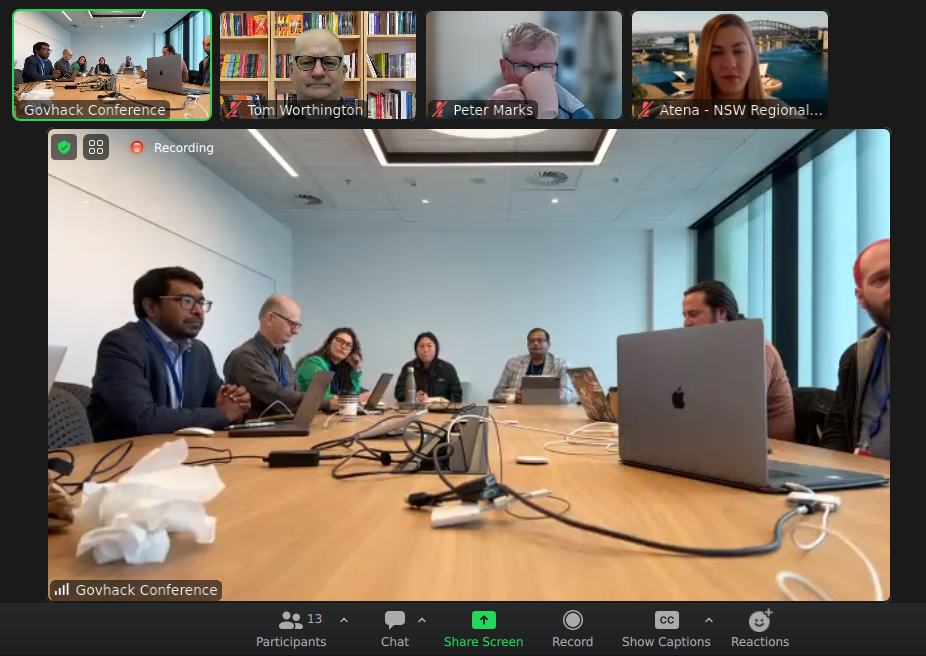
Greetings from the office of AWS Australia in Canberra, where I am attending the GovHack Annual General Meeting. GovHack is a non-profit organization which organizes an annual hackerthon using government data sources. This happens at sites around Australia (and last year NZ as well). Teams build applications using the data, and the best win prizes.
The meeting is around an impressive boardroom style table, with a large wall-screen showing Zoom participants. A slightly quirk touch is that the room's impressive video conferecne system is not being used. Instead a smartphone is propped up in a takeout coffee cardboard tray. This is in the makedo-do spirit of Govhack.
Many school, and university students take part, as do new staff at government agencies and corporations. In the past I have helped with university and defence department hackerthons. These are useful for people to learn to work rapidly on a project, and to work with people with diverse skills.
I was asked about participation by the Australian Computer Society (ACS). I suggested GovHack would appeal to the smaller chapters and branches, for participation in grass roots activites (I am a member of the ACS Professional Standards Board).
The hackerthon format I believe has considerable potential as part of formal assessed school and university courses, as well as professional development, and workplace learning. The hackerthon is similar to the group projects which students in some disciplines, such as computing, undertake over six months to a year, but compressed to three days. This may be of use for training the new federal government internal consultants.
|
| Event canvas from NWIW 2020 by Paul Telling |
The Australian Government has decided to reduce reliance on external consultants, and make more use of public servants, including an internal consulting team. This will require new skills, both for those transitioning from the private sector, and those used to working in one agency. The hackerthon provides a way to learn to work in a diverse team rapidly. Normally hackerthons are though of as open events. However, it is possible to run an internal event with cleared staff, working on sensitive matters. Over the last few years I have assisted with three defence related hackerthons (Navy Warfare Innovation Workshop 2020, Secure Supply Chains ADF/NZDF 2020).
ps: You will notice that I appear on the Zoom twice: once in the room in Canberra, and secondly as an individual Zoom participant. Someone around the table asked about this, getting confused seeing two of me. In the past I found it much easier to treat a hybrid meeting as online, plus a room, than the other way around. This works fine provided I don;t have audio on (which causes feedback problems). One advnatge is to be able to post into, and easily read, the chat.
Sunday, August 21, 2022
Hackerthon Format Has Potential for Education
This weekend teams across Australian and New Zealand have been participating in Govhack 2022, looking at how free open access data provided by government, might be used. Here are some of the videos submitted today. There will be judging and award of prizes from the sponsors. However, I suggest this form of rapid fire development process could be used as part of an educational program. ANU Techlauncher, and similar group programs, take six months or a year, whereas a hackerthon can take 72 hours. This provides a useful simulation of the type of high pressure graduates are likely to find themselves in.
Saturday, March 20, 2021
Australian Government Acknowledges ANU TechLauncher Developing Professionals
The Australian Public Service Commission has acknowledged the role of the Australian National University's TechLauncher program in "developing the next generation of tech professionals". This is a form of Work Integrated Learning where a team of students undertake a real project for a real client. But is not as easy as it sounds (I help out teaching the students soft skills).
The
APSC also have a case study of GovHack on the same page. Hackerthons
successfully transitioned to the online environment last year. I helped
with some for ANU, ACS, CSIRO, and DoD. There is scope for hackerthons, in both technical and non-technical disciplines, to be used more. Hackerthons could be used as part of the curriculum to give students a short sharp experience of teamwork for course credit, as well as for their usual role of learning as well as
outreach (as with the ANU Singapore Health Hack 2019)?
Reference
Delivering for Tomorrow: APS Workforce Strategy 2025, Australian Public Service Commission, March 2021. URL https://www.apsc.gov.au/sites/default/files/2021-03/APS_Workforce_strategy.pdf
Friday, January 29, 2021
Hackerthons for Learning
These are the notes for the third of four webinars on "Engaging students in the online environment", Wednesday, 3 February at 11 am AEDT Sydney time (Tuesday, 2nd, 5 pm MST in Edmonton). Please register now for the webinar and send your suggestions.
Hackerthons for Learning
Hackathons came from the computer industry, where teams competed over a few days to collaborate intensively on a project. These have now expanded into other fields. Can we use this format to keep students engaged, solving real world problems? I will talk about his experience with hackerthons involving students and military personnel. Be ready to contribute your ideas.
Next up: I-ACE Hackathon

The India Australia Circular Economy Hackathon (I-ACE), runs online from 9 to 10 February. It is hosted by the Australian Government's Commonwealth Scientific and Industrial Research Organisation (CSIRO) and the Government of India’s Atal Innovation Mission (AIM). Teams of students and startups compete for $52,000 in prizes. I have volunteered to mentors teams, due to my interest in computers to improve supply chains and reducing e-waste.
Navy Warfare Innovation Workshop 2020
|
| Event canvas from NWIW 2020 by Paul Telling |
The real value of such competitions is not to produce a product (or win a prize), but to have the participants learn new skills and meet people they can later work with on projects.
Tools for Hackerthons
 |
| Remo Conference |
Hackerthons traditionally took over a building at a university or school, with lecture halls used for presentations and class rooms for teams to work in. In 2020 this all moved online due to COVID-19. Zoom was the popular video conferencing choice for presentations and Slack for teams to work together. The Virtual Hackathon on Fighting Pandemics by the Australian National University Humanitarian Innovation Society (ANU HISoc), with the Clinton Global Initiative University and IBM, made the unusual choice of using Remo Conference, a video conferencing tools which looks like a conference room floor plan. While the tool looks promising, more work is needed.
Logistics of Hackerthons

The Australian Computer Society ran two Hackerthons, in 2020, using Slack, Zoom, and the usual collaboration tools. What makes these effective is that they recruit a team of volunteers to be actively involved with participants. These events had many hundreds of participants and the second around 80 mentors. These are large scale undertakings requiring careful planning. The Shockproof hackerthon on Secure Supply Chains for the Australian and NZ Defence Forces was unusual as it was aimed at defence force personnel, but open to anyone.
Hackerthons for Education
 | ||||
| ANU TechLauncher, | Team Formation Exercise, 2018 |
Thursday, December 10, 2020
Navy Warfare Innovation Workshop 2020
|
| Event canvas from NWIW 2020 by Paul Telling |
Participants use the same techniques as a business start-up competition, refining and presenting an idea, but one to defend the country. A panel of senior defence experts then select which merit further development.
However, the real value of such competitions is not to produce a product, but have the participants learn new skills and meet people they can later work with on projects.
Saturday, August 8, 2020
Hacking the Virtual Hackerthon
Greeting from the Virtual Hackathon on Fighting Pandemics. This is organized by the Australian National University Humanitarian Innovation Society (ANU HISoc), with the Clinton Global Initiative University and IBM. We have had an introduction from the organizers at HISoc, and a design thinking workshop from IBM. I will be talking about better logistics at 2:15pm. The opening sessions used Remo Conference, and I am impressed that the organizers have been able to get it to work so well, but Remo needs improvements to be usable for education.
Remo Conference
|
| Remo Conference |
Remo Conference (Version: 2.13.5) takes the "conference" part of video conferencing more literally than other products, with an interface which looks like a conference room floor plan. Participants can be pre-allocated to tables, with a tiny picture of them, labeled with their initials, around the table as if seated. Spare space at the table is indicated by empty chairs. Those at a table can see and hear each other with the video windows appearing at the top of the screen. Participants can move tables by double clicking on another. Some tables may be reserved for MCs and a help desk. The MC can call all participants to a presentation, at which point the table conversations shut down and a large window opens for the presenter. When in presentation mode Remo Conference looks much like any other webinar product, with a presentation window, chat, Q&A and Raise-Hand functions.
The room metaphor is a good idea, but Remo's implementation takes it a bit too literally. One problem is that when the participants arrive there is no sound and no welcome. I spent a lot of time trying to work out why my audio was not working, but it was just that no one was talking: we were all waiting for something to happen. It would be useful if there was some sort of avatar to show us to our seats and some sort of background hum of the crowd.
Also the fixed room layout does not make best use of screen space. When at a table, having all other tables displayed is a waste of space. It would be better if the interface zoomed in. There is a text chat window, but I could not find a way to resize it, so it obscured things I wanted to see. However, the largest problem is the video does not work well on a slower link.
This is my fourth attempt to use Remo. The first two times I did not manage to see or hear anything. The third time it worked, sort of. This forth time it is usable, but only just. The problem is that like many video conferencing tools, Remo have assumed the user has high speed broadband. As a result on my low speed connection Remo barely works, at the best of times. This is unfortunate, as Zoom have shown this does not need to be the case: Zoom adjusts well for a lower speed link. In Zoom, if I make the window smaller the resolution of video reduces and with that the data transmitted. This doesn't happen with Remo. Even if I minimize the window, so no video is visible, Remo still uses more than 1 Mbps, whereas Zoom uses much less.
The video data use in Remo seems to vary depending on the resolution the video participant is transmitting. During this week's CBRIN First Wednesday, everything was working okay with Remo, until the MC appeared. At that point I saw a blurry closeup of their face frozen on screen. Then a pre-recored YouTube video started and worked fine, but before then end this was interrupted by the MC again as a huge still image. What appears to have been happening was that the MC was in HD video which my system could not cope with. The YouTube was low resolution and worked fine, but was interrupted by the HD again before it could finish playing.
All this discussion of low resolution may sound irrelevant to those with high speed broadband: why not just spend a few dollars and get decent broadband? I could do that as I am relatively well of, and live in a first-world city which pioneered fiber to the node decades ago. But many people can't afford, or can't get, high speed broadband.
For-profit companies can simply ignore customers without high speed broadband, reasoning these people don't have enough money to be worth worrying about. As an educator, it would be unethical, and perhaps unlawful, to discriminate against students in this way. So when COVID-19 hit I decided to forgo the high speed broadband I had access to and instead make do with a high latency low speed 4G mobile broadband connection My connection works at around 1.5 Mbps, which is is part of the ANU Recommended student system requirements.
If a service doesn't work on low speed broadband, then some of my students, who are now scattered around the world, may not be able to use it. Although Remo recommends a minimum of 8 Mbps, it just about works at 1.5 Mbps. I suggest the developers implement video bandwidth adjustments, like those in Zoom, to make it usable for those who can't afford, or can't get, high speed broadband.
ZeroCO2 Hackathon 2020
Due to COVID-19 this years event is entirely online, whereas last year we were all at the Canberra Institute of Technology's excellent renewable energy training facility. However, this will be my fourth time helping with an online hackerthon this year, and the activity has easily translated to the online format.
Thursday, June 18, 2020
Rethinking Research and Industry Conferences Online
There are companies offering to provide a platform to reproduce face to face academic and trade conferences on line. But perhaps rethink what is useful and what participants value about a conference, rather than reproduce a physical one.
I have been impressed with EduTech Asia's zoom based live webinars. These are very simple: an MC a panel of two or three speakers and plenty of time for questions. However, they clearly see this as just a stopgap to keep potential delegates and exhibitors connected until they can have a traditional event. Their first event is planned for November in Singapore, which I would be delighted to speak at it again, but not if I have to spend two weeks in quarantine in Australia, on my return.
 Also the Australian Computer Society has run two Hackerthons, using Slack, Zoom, and the usual collaboration tools. What makes these effective is that they recruit a team of volunteers to be actively involved with participants. I was a mentor at the first and a lead mentor at the second. What also helps is having sponsors.
 A conference is not just one thing. There is the chance for a trip somewhere. TALE 2019 had the attraction for me of visiting Yogyakarta.
 |
| Martin Dougiamas, creator of Moodle, and Tom Worthingtont, EduTech Asia 2018 |

Friday, June 12, 2020
Successful Virtual Hackathons
ran two recent online hackerthons for the Australian Computer Society. He has written some very useful "Lessons Learned From Executing Successful Virtual Hackathons" (Forbes, These hackerthons ran over a few days. I was one of the mentors fort the first and a lead mentor for the second (mentoring the mentors). The idea is teams are formed and work on a project addressing a specific challenge. There are set deliverables with deadlines, judging, and prizes.
In the past I have helped out with hackerthons at a physical location, ome were national, or global, at multiple locations. An online hackerthon creates new challenges, but also new opportunities. Mostly the online tools mentioned by Steve worked very well, but it is the socialization using them which is important.
A hackerthon is similar in format to a student group projects used in many STEM university courses, except compressed in time: a hackerthon is two or three days, whereas a group project may be ten weeks. There is the potential to use the hackerthon format in industry and in education to give staff and students experience of creative group working quickly.
Friday, May 22, 2020
ANZDF Logistics Hack Awards
Wednesday, May 20, 2020
Making a Better Hackerthon
At the moment I am in the post event meeting of Lead Mentors for the joint hackathon to Secure
Supply Chains for the Australian and NZ Defence Forces. The Slack communications tool used used for the event and worked well, but it has taken me about four such events to get used to it. Here some suggestions I offered, which may be applicable to other hackerthons:
Innovation ACT Participants 2020
The Innovation ACT competition have steps for the teams, with badges, to make sure they have done the basics. Some can be very simple things, like a tick for initially contacting your mentor: https://innovationact.org/iact19/participant-info/
Friday, May 15, 2020
ANZDF Logistics Hack: A Blizzard of Messages.
A joint hackathon to Secure Supply Chains for the Australian and NZ Defence Forces starts at 7pm (Canberra Time). I have volunteered to help, as a Lead Mentor, mentoring some of the mentors, who in turn provide advice to the participants). The Slack communications tool is being used for the event. This can be a little overwhelming, with a blizzard of messages. It can be easy to miss some important, in among lots of "hello I am...".
This is something academics teaching online at university could useful experience, as it is similar to the bewildering flood of messages a student receives. The academic running a course may send out a message and wonder why students did not receive it. What they do not see are the other several hundred messages the student will receive from the university the same day.Some of the pre-reading for the hack, may be of interest:
- COVID-19 crisis, By Katherine Ziesing, Australian Defence Magazine, 5 April 2020
- Covid-19 shows Australia needs a national sovereignty strategy, by David Fawcett, Australian Strategic Policy Institute,12 May 2020
- Three Examples of a Supply Shock, Simplicable,6 February 2020
- One hundred days of the coronavirus crisis, By Inga Ting and Alex Palmer, 4 May 2020
Wednesday, May 13, 2020
Hackathon Friday to Secure Supply Chains for the Australian and NZ Defence Forces
 |
| Senator Reynolds, Australian Minister for Defence |
Senator Linda Reynolds, the Australian Minister for Defence, announced today the Australian and New Zealand Defence Forces will host a joint hackathon to strengthen supply chains. This is to be run by the Australian Computer Society (ACS), starting this Friday. Australians and New Zealanders have been asked to contribute ideas to secure the logistics of our military, in the light of the COVID-19 pandemic, as well as recent bushfires, earthquakes and floods.

 Participation can be as team members, mentors and partners. The event will be held over three days, with the same hackerthon format as used for the Flatten the Curve hack in April. On day one teams are formed, day two they design and build, and on day three they refine and present their proposals, which are judged for prizes.
Subscribe to:
Posts (Atom)