
Showing posts with label University of Sydney. Show all posts
Showing posts with label University of Sydney. Show all posts
Sunday, July 19, 2026
Humanitarian Innovation Hackerthon for the Pacific

Wednesday, June 3, 2026
Humanitarian Innovation Hackathon 2026

Wednesday, September 4, 2024
Generative AI For Higher Education
Greetings from the Australian National University where I am taking part in a Generative AI Workshop Day. Professor Adam Bridgeman and Professor Danny Liu from the University of Sydney are taking ANU staff through how to Microsoft Copilot to create rubrics, multiple and choice questions. The also demonstrated using other AI to create a tutor chatbot to help e with the topic and even give feedback on their writing. One point emphasised is that experts have to test what the AI is producing. In February I attended a " Team-Based Learning Collaborative Asia Pacific Community Symposium" at USyd and was impressed with what they are doing. The state of the art has advanced since 2018, when I wrote a tutor bot to handled applications for assignment extensions: it always said "no". ;-)
As an exercise I had Copilot write a summary the ANU VC's PhD thesis, in HTML:
Telling Stories Out of School: Remembering the Carlisle Indian Industrial School, 1879-1918
Overview: "Telling Stories Out of School" examines the Carlisle Indian Industrial School, the first government-funded, co-educational, secular, non-reservation Indian School in the United States.
Key Points:
- Historical Context: Carlisle operated from 1879 to 1918 and influenced other non-reservation boarding schools.
- Goals: The study explores state policies, student experiences, and post-school impact.
- Student Population: Approximately 8,500 students from 75 Native American Nations attended Carlisle, learning academic and vocational skills while navigating their identities.
Friday, July 19, 2024
Chatbots for More Rounded Employable Graduates?
Greetings from the weekly ASCILITE MLSIG webinar. One of the members had a positive report on using Cogniti (developed at University of Sydney), to build chatbots to help students. With this, the software simulates a patient in conversation with the student acting as a therapist. The chat-bot then switches to tutor more and provides feedback and advice to the student. It occurred to me the same would be useful for students "soft" skills.
Many STEM students have difficulty with the part of the job where they have to talk to people, especially non-technical clients. This also creates problems when talking to potential employers. It may seem odd to suggest the students talk to a machine to imp[rove personal communication skills. However, this way students can get a lot of practice with an infinitely patient tutor. Also client and work communication is increasingly using digital technology. In a way reality s becoming more like the simulation: you apply for a job not by writing a letter but via a web form, do online tests & get interviewed via Zoom. The graduate will likely communicate with their client, and perhaps colleagues, mostly online. So talking to a chat-bot online will be a more realistic simulation of the workplace, than talking face to face in a classroom.
Sunday, June 2, 2024
Misunderstanding What Success Is
 |
| Dr Anish Purkayastha, USyd |
The authors found that domestic students of tutors with a PhD were more likely to receive a Distinction grade. However, a high grade does not assist a student in meeting the minimum required to get their degree, and is a waste of effort for the typical student.
This effect, where a PhD graduate tends to help a few students get higher grades, whereas tutors who have been trained to teach tend to help struggling students pass, has been found in previous studies.
Reference
Purkayastha, A., & Huber, E. (2023). What factors contribute to higher grades in a first-year undergraduate management unit: an exploratory study at an Australian university. Higher Education Research & Development, 43(3), 735–752. https://doi.org/10.1080/07294360.2023.2258818
Friday, February 9, 2024
Meet my AI alter ego
 |
| Phillip Parannik, and Finn Johnson |
This is using Inworld, which was originally created for use in computer games, but is now being used for teaching. The workshop is being run by Phillip Parannik, and Finn Johnson from University of Sydney. The process was very much simpler than the last workshop on AI tutors I took part in, 2018.
If anyone in Canberra would ;like a system built with this, the ANU computer project students could help.
Team Based Learning Helped with Remote Learning
 |
| Larry K. Michaelsen |
A key point for me was that this team building process could occur in asynchronous mode. That is Dr Michaelsen said that as long as there was a deadline for the team response to be submitted, the participants could be anywhere, arranging their own work.
Dr Michaelsen suggested AI would have more difficulty answering TBL questions, as they are very specific. He gave the example of "Where would you locate a dry cleaning business in Norman Oklahoma, and why?". So I asked ChatGPT, and it gavce a very generic response, which an assor would not be impressed with. When I asked for more specific locations, it gave answers Dr Michaelsen said that anyone who knows Norman would know are not good locations:
"Determining the ideal location for a dry cleaning business in Norman, Oklahoma would depend on various factors such as target market, competition, accessibility, and zoning regulations. Here are some considerations to help you decide on a suitable location:
Commercial Areas: Look for commercial areas with a mix of retail and service-oriented businesses. Areas with a high concentration of offices, hotels, or shopping centers can attract potential customers who may need dry cleaning services.
Residential Neighborhoods: Consider placing the dry cleaning business in or near residential neighborhoods, as this would make it convenient for local residents to access your services. Proximity to residential areas can generate regular and loyal customers.
Proximity to Offices or Corporate Parks: If you are targeting the professional working population, setting up near offices, corporate parks, or business districts may be advantageous. Many professionals require dry cleaning services for their work attire.
Accessibility and Parking: Choose a location with easy access and sufficient parking space. Customers prefer convenience, and a location with ample parking makes it more convenient for them to drop off and pick up their items.
Competitor Analysis: Assess the competition in different areas. If there are already established dry cleaning businesses in a particular location, evaluate whether there is room for another competitor or if there's an underserved market elsewhere.
Demographics: Understand the demographics of the area. Consider factors such as income levels, age groups, and lifestyles of the residents to ensure that your services align with the needs of the local community.
Zoning Regulations: Check local zoning regulations to ensure that the chosen location complies with any restrictions related to operating a dry cleaning business. Some areas may have specific zoning requirements for businesses that use certain chemicals.
Visibility and Signage: Choose a location with good visibility from the road, and invest in clear and attractive signage. This will help attract passing traffic and make your business easily identifiable.
Cost Considerations: Evaluate the cost of renting or purchasing space in different areas. Balance the costs with the potential customer base and revenue generation of each location.
Future Growth: Consider the potential for future growth and development in the chosen location. An area that is experiencing growth may attract more customers over time.
Ultimately, a comprehensive analysis of the local market and careful consideration of these factors will help you determine the most suitable location for your dry cleaning business in Norman, Oklahoma."
One of the delegates suggested occasionally tell the students to turn off their gadgets. Dr Michaelsen suggested then asking studnts to reflect on the differences in the experience. However, I suggest the instructors need to also reflect on what technology they are dependent on: would the be willing to turn off the lights and air-conditioning in the room, turn off their hearing aid, take off their glasses? One generations new tech is just routine for the next. While is is tempting to think of the good old days, some technology is so useful it is worth becoming dependent on it.
Thursday, February 8, 2024
Online Team Based Learning
Greetings from the first workshop at Team-Based Learning Collaborative Asia Pacific Community Symposium. Rosa Howard, University of Sydney, is talking on "Adapting TBL to Changing Times". This highlighted the benefits of providing text base input, as opposed from verbal. This raises an interesting issue as to if graduates need to be able to confidently talk in front of large groups. If it becomes routine to use computer mediated communication in the workplace talking to a group becomes an obsolete skill, like handwriting.
The Fear of Failure & TBL
Greetings from the first workshop at Team-Based Learning Collaborative Asia Pacific Community Symposium. This is using Intedashboard software and ChatGPT. Something which slowly dawned on me during the morning session was that the medical educators were using Team Based Learning (TBL) not as a general term for learning in teams, but a very specific methodology. I felt a bit like the student who was not told there was to be a test. At the start of the workshop we were asked to lo into Intedashboard, and was immediately asked a question I didn't understand, at which point I had the unprepared student panic. Having recovered from this I struggled with some of the acronyms MCQ (multiple choice questions), ILO (no idea).
The workshop was modeled on TBL, and this was a familiar format for me. What I found fascinating were examples of giving ChatGPT very complex requests to create course material. Doing this never occurred to me, no more so that I would get a random person off the street and ask them to do so. Habitually I would consider the qualifications and experience of any person, company or organisation. But ChatGPT is essentially a black box.
As a team we then used ChatGPT to create objectives for a learning exercise. It was interesting to see the range of experience with ChatGPT, with some participants having never used it, while others routinely used it to create course content. My team got a bit naughty, asking ChatGPT to write the evaluation of what we thought of ChatGPT. Another team accidentally ended up with a rubric for assessing learning objectives. One team found what ChatGPT too wordy, but another went further and told it to be less wordy, which it then was.
In terms of a TBL exercise I found this like the previous development exercises. The first is the worry of getting the software used to work. The next is how rushed everything seems to be. There is then the worry of getting the exercise done in time. My approach would always be to produce a draft answer, then refine it. However, that is an approach difficult to get a group to do.
ps: One use for ChatGPT I hadn't thought of was suggested b y one of our team: planning an itinerary for a trip.
Team Based Learning & AI
 |
| Professor Simon Buckingham Shum |
Professor Buckingham Shum pointed to a paper he wrote about how one such tool carried out a very good analysis of a complex policy paper (2024). There was one flaw in the Professor's analysis: he claimed the AI was in error by referring to an "Argument from ignorance" which did not exist. It turns out that this is known to philosophers such as John Locke, and politicians such as Donald Rumsfeld. When I asked about this the Professor suggested that students need to be gently introduced to the limitations of the AI, so they are not awed by it.
I am looking forward to workshops, and short talks later today and tomorrow, with people not only from Australia, but around the region.
ps: One area where TBL AI might be used is in helping students meet diffuse learning outcomes.
Reference
Buckingham Shum, S. (2024). Generative AI for Critical Analysis: Practical Tools, Cognitive Offloading and Human Agency. 1st International Workshop on Generative AI for Learning Analytics: 14th International Learning Analytics and Knowledge Conference (LAK’24), March 18-22, 2024, Kyoto, Japan [PDF]
Thursday, February 1, 2024
Designing Social Isolation Out of University Programs
 |
| Carmen Vallis, University of Sydney |
Rather than treating social isolation as a problem to be diagnosed and cured, I suggest designing university programs and courses to incorporate teaching of social skills and group activities. Rather than treating students from underrepresented groups as an exception to what a normal student is, incorporate into the program what the students need to learn. This is not about putting tennis on the curriculum, but recognizing that students learn better in a group, and will be required to work with other people when they graduate. The skills of teamwork are central to any profession.
As a graduate student I experienced social isolation. This was because I was an online international student, studying a different discipline with people who were a different gender from a different culture. What helped were group exercises, and peer feedback exercises, where I was reluctantly forced to interact with other students. I now teach students who are required to work in cross cultural teams. The students complain about having to do this, but they do know that after they graduate this is how they will be working.
Sunday, September 17, 2023
Tech Central Sydney Needs Old Buildings, a Good Cafe, & Course Credit for Students
 |
| In Clamperdown Park, for the Tech Central Sydney consultation. Tom Worthington CC-BY 2023 |
I went along today to a consultation in Camperdown park, about the Camperdown Node. The collection of government lanyards, and branding, would rival an episode of ABC TV's Utopia. There was even someone from the Greater Cities Commission, successor to the Greater Sydney Commission. This is worryingly close to the "Even Greater Sydney Planning Committee", which was a comedy sketch on ABC Radio Sydney each Friday, by HG Nelson and James Valentine.
It was a little odd having planning staff of three agencies consulting the public about a high technology precinct. There was a map showing the area, but little in the way of detail of what was proposed, so not much to be consulted on. I was asked about my views, and couldn't resist asking the staff what they would like me to tell them about how to set up a high tech hub, as I had spent a few decades looking into this.
Building Arcadia: Emulating Cambridge's High Technology Success
In my closing address as chair of the 1998 Information Industry Outlook Conference,in Canberra, I argued that Australia should create a cultured image to market information industries. I suggested Cambridge (England) as the model, as detailed in the report The Cambridge Phenomenon. It is now possible to use Canberra as a model, with the Canberra Innovation Network (CBRIN), and a cluster of high tech companies adjacent to the Australian National University (ANU).
Old Building and Egg Rolls
I told the staff at the consultations, what was needed for an innovation precinct were old low cost industry and commercial building for startups to re-purpose. The problem for planners is how to prevent this transition zone close to the Sydney CBD being filled with retail outlets, and high rise apartments, with no place for companies, and advanced manufacturing. Also there needs to be a really good cafe for entrepreneurs to meet in. One angel investor keeps singing the praises of the egg rolls at the Australian Technology Park Cafe.
The other ingredient is a nearby university to supply people with innovative ideas. University of Sydney can provide this. One point I had to NSW, Sydney and Inner West planning staff on was not relying on graduates to provide entrepreneurs. There needs to be schemes to encourage current students, and staff to become entrepreneurs, as well as graduates. Through programs such as Techlauncher, the ANU allows studnts to work on a commercial startup at CRBIN, while a student. The students can get course credit for working on their own, or someone else's startup.
Innovating for Health at Your Fingertips
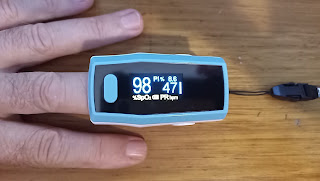 |
| Oximeter from RPA in Use, Tom Worthington CC-BY 2022 |
Resources
Building Arcadia: Emulating Cambridge's High Technology Success, closing address to the ACS 1998 Information Industry Outlook Conference, Canberra, 7 November 1998
Projects & internships for student employability, EduTECH Australian, 2023
Sunday, November 28, 2021
Media Rich Asynchronous Online Education with OB3
 |
| Gloria Gomez |
The issue of engaging asynchronous materials is one I have been investigating since I stared teaching at a university 20 years ago. I have had supervised individual students and teams working building a "Async-Sync Learning System", with limited success.
The examples used for the workshop were from University of Sydney medical courses, which have a lot in common with the STEM computer courses I teach. The model where students jointly create course content in the form of a Wiki, and review it, could be applied in computing and other STEM subjects. With this approach students are assessed both on content contribution and collaboration.
Having been a student of collaborative work, and set it for a class with hundreds of students, the question for me was how not to get overwhelmed by the quantity of detail to assess.
OB3 provides a system for students to jointly assemble complex documents, with tutors able to keep track which student contributed what. What could be added to this, I suggest, is a way for students to peer assess, and then the tutor assess the peer assessment. That would help with situations like mine, in ANU Techlauncher, where I have hundreds of students to keep track of.
Reference
Gomez, G., Daellenbach, R., Kensington, M., Davies, L., & Petsoglou, C. (2017). Benefits of enabling lecturers and students to author, share and discuss media-rich documents for online study. In Digital poster presented at ASCILITE 2017 at 34th International Conference on Innovation, Practice and Research in the Use of Educational Technologies in Tertiary Education. http://2017conference.ascilite.org/program/benefits-of-enabling-lecturers-and-students-to-author-share-and-discuss-media-rich-documents-for-online-study-2/
Friday, November 8, 2019
Do You Have a Digital Twin?
* They used to be the Interoperability for Extreme Events Research Group (IEERG)., but pivoted.
9:30am Welcome (and Housekeeping) – Professor Deborah Bunker (University of Sydney) Intelligent Cities and Transport: What Are the Issues?
9:45am Mr Bruce Thompson - Executive Director, NSW Spatial Services Division
KEYNOTE: Spatial Digital Twin: The New Digital Workbench for Intelligent Cities and Transport
10:30am Morning Tea
11:00am Professor Sisi Zlatanova - Built Environment (UNSW)
Digital Twin: Challenges and Opportunities.
11:40am Professor Christopher Pettit - City Futures Research Centre (City Analytics Lab UNSW) Value Australia - Sharpening Our Land and Property Decisions with Artificial Intelligence
12:20pm Professor Linlin Ge & Mr Peter Mumford - Geoscience and Earth Observing Systems Group (UNSW) New Directions in Smart Parking
1:00pm Lunch
2:00pm Professor Michiel Bliemer - Chair in Transport and Logistics Network Modelling ITLS (University of Sydney) Future Transport: Technology-led or Technology-fed?
2:40pm Mr Yale Wong – Research Associate in Integrated Mobility Services and Contractual Structures, ITLS (University of Sydney) Mobility as a Service (MaaS): Rationale, Governance, Trials
3:20pm Afternoon Tea
3:40pm Mr Shane Conserdyne & Mr Nathaniel Bavinton – City of Newcastle
Recent developments in Newcastle’s Digital Twin and Smart City Initiatives
4:20pm Panel & Wrap Up Chair - Adjunct Associate Professor Tony Sleigh (University of Sydney)
5pm Networking
Friday, January 25, 2019
Blended Learning for the Indo-Pacific in Sydney 4 February

Topics and speakers:
- Reimagining WIL in the Innovative Research Universities, Amani Bell
- A holistic approach to evaluating an institution-wide WIL program, Kate Lloyd, Anna Rowe, Cherie Nay, Lucy Corrigan
- WIL to scale, Mita Das, Phil Laufenberg
- Impacting the curriculum: An institution wide approach to embedding career development learning, Bonnie Dean, Tracey Glover-Chambers, Venkata Yanamandran, Michelle Eady, Tracey Moroney, Nuala O’Donnell
- EfS@Mq Education: Fostering creative
approaches to sustainability cross-curriculum
priority in teacher education, Bronwen Wade-Leeuwen, Wendy Goldstein, Kathleen McLachlan, Thelma Raman - A NSW regional school and university partnership: reconceptualising reciprocity in initial teacher education professional experience, Deb Clarke, Matthew Winslade
- Development of a WIL rubric to facilitate identification and mapping of WIL activities in science courses, Christopher Jones, Thomas Millar, Jo-Anne Chuck
- Are science academics on the same page as
society for a new future of work?, Jo-Anne Chuck, Felicity Blackstock, Thomas Millar, Christopher Jones - Exploring the role of WIL in developing professional networking capabilities for career development, Denise Jackson, Ruth Bridgestock, Kate Lloyd
- Internships: A case for a pre-internship preparation programme (PIPP) for accounting students, Mark Hughes, Greg Boland, Iwona
Miliszewska - Debriefing the shapeshifter: How practitioners conceptualise debriefing for Work-Integrated Learning, Theresa Winchester-Seeto, Anna Rowe
- Bringing theory to life: Using WIL to motivate Commitment and master complexity, Lisa Anderson, John Burke
- Reflection for learning as a quality framework for WIL, Marina Harvey , Kate Lloyd, Kath McLachlan, Anne-Louise Semple, Greg Walkerden
- Ethnography in work integrated learning, research, Bonnie Dean
- Blended Learning for the Indo-Pacific, Tom Worthington
Friday, January 6, 2017
University of Sydney X-lab
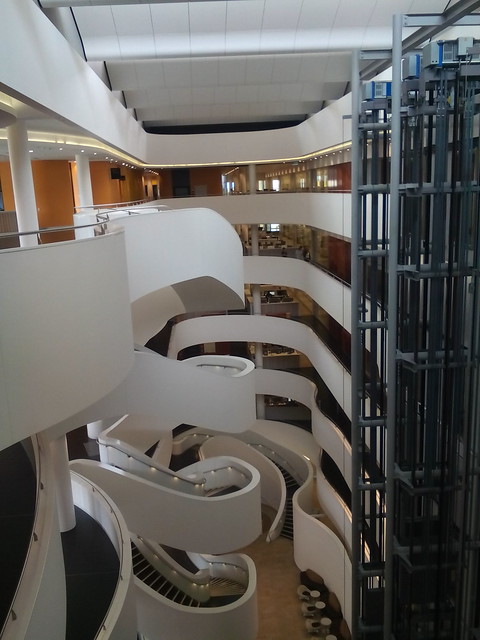
The building has an atrium with curved balconies and a sinuous staircase offering an alternative to the lifts. There is the usual modern layout with open plan in the middle and meeting rooms around the outside, with glass walls.
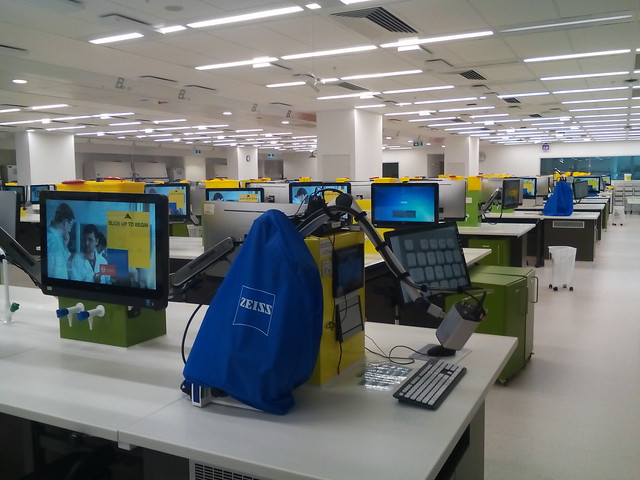
The x-lab provides an advanced teaching environment, but is not perfect. The directional speakers work well enough, but are an expensive solution. A lower cost alternative would be to divide the room into four zones, with a row of equipment cabinets separating the zones. Low cost loudspeakers (or the speakers in the computers) in each zone would then have provided adequate sound separation. Alternatively headphones could be used, which would also allow the students to speak to the instructor: a technique I have dubbed the "silent lecture".
The DELL touchscreen computers, at about 36 inch, are somewhat oversize and tend to dominate the room. Smaller touch screens, of around 15 inch, might be more suitable (and cheaper).
The operator consoles at the ends of the benches are well equipped, but the screens here are also large and make the instructor hard to see. It might be useful to have the instructors station raised and smaller screens used.
The building also has "dry" teaching rooms, with a microscope for each student and a large computer monitor. There are also conventional teaching rooms and informal group spaces for students. A surprise is that under the entrance to the building is a very large lecture theater. This is a good use of space, as a lecture theater d does not require a view and so can be placed underground.
Friday, November 18, 2016
Are today's universities failing society?
Greetings from the Australian National University in Canberra, where a panel is discussing "Are today's universities failing society?". This is topical as the federal government, having sorted out vocational education is turning its attention now to universities. Next week I will be starting my contribution to the policy discussions with "Learning to Teach On-line with an E80 Blend".
Panel:
- Moderator, Dr Nicholas Farrelly
- Associate Professor Julia Horne, University Historian at the University of Sydney.
- Julie Hare is Higher Education editor for The Australian.
- Associate Professor Kristen Lyons, University of Queensland
(a) advancing and transmitting knowledge, by undertaking research and teaching of the highest quality;
(b) encouraging, and providing facilities for, research and postgraduate study, both generally and in relation to subjects of national importance to Australia;(c) providing facilities and courses for higher education generally, including education appropriate to professional and other occupations, for students from within Australia and overseas;(d) providing facilities and courses at higher education level and other levels in the visual and performing arts, and, in so doing, promoting the highest standards of practice in those fields;(e) awarding and conferring degrees, diplomas and certificates in its own right or jointly with other institutions, as determined by the Council;(f) providing opportunities for persons, including those who already have post-secondary qualifications, to obtain higher education qualifications;(g) engaging in extension activities.(2) In the performance of its functions, the University must pay attention to its national and international roles and to the needs of the Australian Capital Territory and the surrounding regions.
This can be summarized as research and
teaching for Australia. The interesting part is "extension activities", which is normally taken to be a form of cut down university education for the general public (a moder example being the MOOC).
ANU, and other universities, also act as a reserve of independent expertise for the community, government and industry. This latter role only becomes controversial when someone in the community, government or industry does not like the independent advice provided (such as with climate change).
ANU, and other universities, also act as a reserve of independent expertise for the community, government and industry. This latter role only becomes controversial when someone in the community, government or industry does not like the independent advice provided (such as with climate change).
Monday, July 25, 2016
Sydney University Transforming Learning
The University of Sydney 2016–20 Strategic Plan (March 2016, p. 29), has as Strategy 5 "Transform the learning experience", with three initiatives:
- "Develop interactive and collaborative learning designs that foster excellence and innovation ... greater use of pre-readings, pre‐recorded videos, and brief, ideally automated, diagnostic assessment of understanding of core concepts and themes. ...
- Create contemporary environments that enable
flexible and interactive learning ... Taking advantage of our experience with the award-winning X-lab in the Charles Perkins Centre research and education hub, we will maximize the effectiveness of higher cost, well-equipped teaching spaces such as laboratories and studios by finding
ways to share space, equip it flexibly and to a high
standard, and increase usability. - Build a new professional learning and
support environment ...Educational Innovation Team within the Education Portfolio will create a refreshed framework for professional learning. ..."
Subscribe to:
Posts (Atom)