Showing posts with label logistics. Show all posts

Friday, July 31, 2020

Better Logistics for Fighting Pandemics

Health Innovation Hackerthon
The Australian National University’s Humanitarian Innovation Society (ANU HISoc), along with the Clinton Global Initiative University and IBM are holding a virtual hackathon from August 8, 2020 on Fighting Pandemics.

Organized for and by students, teams will work on pandemic management with lessons from SARS, MERS, Ebola and COVID-19.

I am helping out with Track 2: Creating faster and more efficient resource allocation systems. Below are some notes I am preparing for the students. Suggestions, comments and contributions are welcome.

Track #2: Creating faster and more efficient resource allocation systems

"How can we better manage logistics so crucial personnel, medical supplies and equipment are quickly allocated to places where they are needed? " From ANU HISoc

Logistics

Modern warehouse with pallet rack
storage system
(Wikpedia, Axisadman / CC BY-SA)
"Logistics is generally the detailed organization and implementation of a complex operation. In a general business sense, logistics is the management of the flow of things between the point of origin and the point of consumption to meet the requirements of customers or corporations. The resources managed in logistics may include tangible goods such as materials, equipment, and supplies, as well as food and other consumable items. The logistics of physical items usually involves the integration of information flow, materials handling, production, packaging, inventory, transportation, warehousing, and often security. " From: Logistics, Wikipedia (2020, June 30).

Pandemic

1918 Flu Victims St Louis
(Wikipedia, Uncredited photographer
for St. Louis Post Dispatch / Public domain)
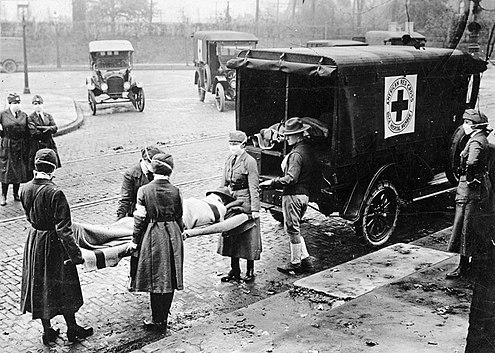
'A pandemic (from Greek πᾶν, pan, "all" and δῆμος, demos, "people") is an epidemic of an infectious disease that has spread across a large region, for instance multiple continents or worldwide, affecting a substantial number of people.' From Pandemic, Wikipedia (2020, June 30).

Sahana Disaster Management System

Warehouse Inventory Page fromSahana Eden (2014)
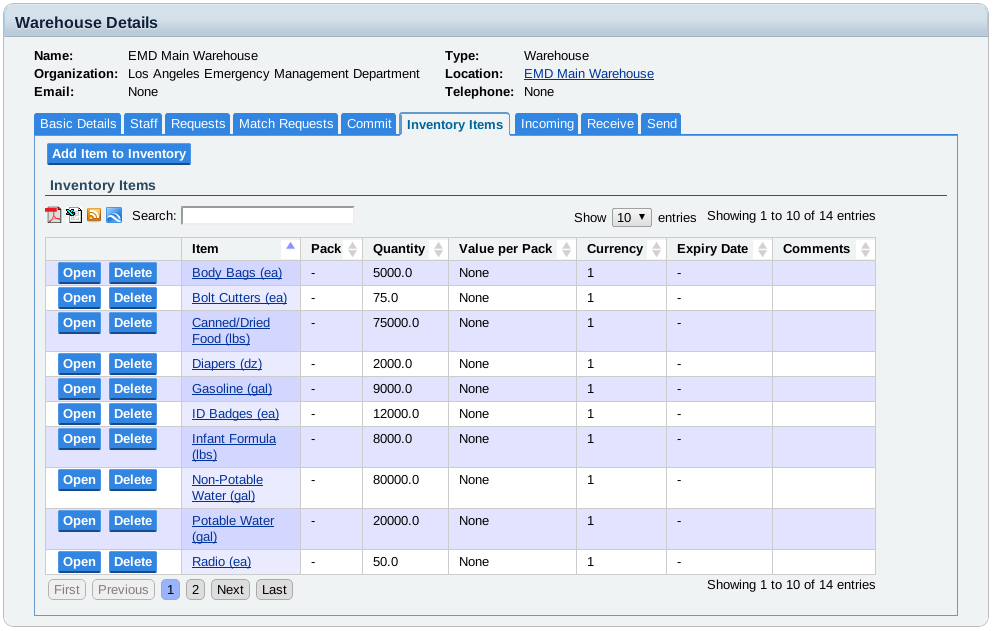
"Sahana is a Free and Open Source Disaster Management system that has been deployed with Gov, NGOs and Civil Society in enabling effective coordination and resource management particularly in a coordinated multi-agency response. The project has its inception during the Boxing Day Indian Ocean Tsunami of 2004 that required a large scale response effort bringing together multiple partners to help 500,000+ victims including displaced and injured in Sri Lanka." From Sahana Applicability for COVID-19, Wikipedia (2020, June 30).

Some questions for the hackerthon participants:

  1. Who are you helping manage the logistics?
  2. What is being managed (personnel, medical supplies and equipment)?
  3. How are places and need identified?
  4. How are resources allocated?

See also:

  1. E-government for emergencies: dealing with a bird flu pandemicusing the wireless web and podcasting, Tom Worthington, for CeBIT Australia, 9 May 2006, Sydney
  2. Sahana Meetup with Tom Worthington, Sri Lanka, 2013

Friday, May 22, 2020

ANZDF Logistics Hack Awards

Greetings from the ANZDF Logistics joint hackathon awards. The judges thanked the 500 participants, 70 mentors (I was one of those), the Australian Computer Society who hosted the event, and the platform Slack.The awards were held using Zoom, which had also been used for the opening, and for several organizer meetings in between. This worked flawlessly for the awards, however, without an audience, or the winning teams, or the videos of what they did (for security reasons) the awards ceremony was a bit of an anti-climax. I suggest for this sort of event a little pomp is in order, perhaps music, envelopes opened, some trophies, and a few speeches thanking families. But at least it was short, at only 15 minutes. ;-)

Wednesday, May 20, 2020

Making a Better Hackerthon

At the moment I am in the post event meeting of Lead Mentors for the  joint hackathon to Secure Supply Chains for the Australian and NZ Defence Forces. The Slack communications tool used used for the event and worked well, but it has taken me about four such events to get used to it.  Here some suggestions I offered, which may be applicable to other hackerthons:

  1. Canberra start-up "OK RDY" have an app for connecting people with mentors. I mentored the project team when they won the Innovation ACT competition. There are a few products like this. Perhaps one could be used for the hackerthons. https://blog.highereducationwhisperer.com/search/label/OK%20RDY
  2. It might be useful to also have a hurdle where mentors have to sign up to Slack in advance. The idea would be to filter out the people who are very clever, and important, but might not get around to actually participating. 
  3. Coaches not lead mentors: Rather than having someone administratively in charge of a group of mentors, have people to provide advice. I took on the Coach role for GovHack 2017. https://blog.tomw.net.au/2017/07/toms-ten-tips-for-govhack.html
  4. For team building, something like the ANU TechLauncher process could be used. Each person with a project idea gives a very brief pitch. Those interested then sign up. The organisers then check there are not too few or too many, and do some rearrangement. https://cs.anu.edu.au/TechLauncher/dates/team_formation/
  5. Wednesday, May 13, 2020

    Hackathon Friday to Secure Supply Chains for the Australian and NZ Defence Forces

    Senator Reynolds,
    Australian Minister for Defence

    Senator Linda Reynolds, the Australian Minister for Defence, announced today the Australian and New Zealand Defence Forces will host a joint hackathon to strengthen supply chains. This is to be run by the Australian Computer Society (ACS), starting this Friday. Australians and New Zealanders have been asked to contribute ideas to secure the logistics of our military, in the light of the COVID-19 pandemic, as well as recent bushfires, earthquakes and floods.

    Participation can be as team members, mentors and partners. The event will be held over three days, with  the same hackerthon format as used for the Flatten the Curve hack in April. On day one teams are formed, day two they design and build, and on day three they refine and present their proposals, which are judged for prizes.

    ps: I have volunteered to help, with my experience working at Australian Defence Force Headquarters in the 1990s, while President of the ACS, developing national policy online as part of what the media called the Internet "Cabal".