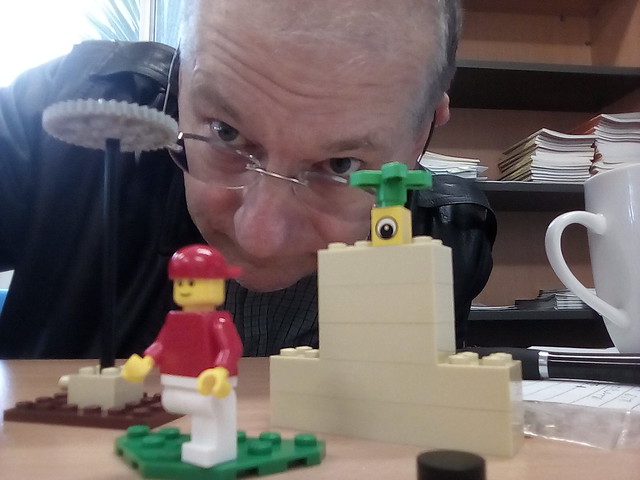
The idea of fun in education is something I have difficulty with. For me studying and teaching is highly stressful. As a result I find attempts at fun or play even more stressful. However, I have been a participant is ome successful, tightly run exercises, such as Dr Stephen Danns' sessions ofLego Serious Play for ANU staff and students.
Athabasca University recently renamed their Master of Education in Distance Education (MEd DE) to be a Master of Education in *Open*, *Digital* and Distance Education (MEd ODDE). Join Tom Worthington, one >of the graduates, to discuss what open education is, what are the benefits and pitfalls and how to do it.
Pre-reading "Use of Open Education Resources", from Digital Teaching In<br>Higher Education, Tom Worthington, 2017. URL http://www.tomw.net.au/digital_teaching/use_open_education_resources.shtml
Manisha suggested an additional webinar to explore issued raised in the previous ones. In particular, how can teaching staff convert courses for online delivery, while continuing to teach and carry out other responsibilities. This is an issue confronting educational systems, institutions, and individual teachers.
The Australian National University recently invited comment on its ANU 2025 Strategic Plan. As with the previous 2017-2021 plan, I suggest the major issue is the transition to online working. However, this has to be done while keeping the day to day teaching and research happening.
There may be educational designers and educational technologists brought in from a central pool, or contracted companies, to help convert courses. However, teachers need to do a considerable amount of work to collect teaching material, discuss online learning options, evaluate proposals, review drafts, alpha test designs, beta test with students, collate test results and recommend changes.
As an IT professional and educational designer, I have decades of training and experience in design, test and delivery of such complex systems, but it is still not easy. Many teachers have no formal training in online education and don't have years to do it (or the tens of thousands of dollars this education cost me).
Dogfooding
The first step I suggest is for the teacher to experience being an online student in a short course about teaching online. Such dogfooding is useful in showcasing good online teaching techniques, building the teacher's confidence and giving them the sense they are not alone by participating in group exercises with other teachers. There are many courses of a few hours, to a few days, duration available free online. One I tried out recently was "Blended and Online Learning Design" from UCL through Future Learn (set up by the UK Open University).
Professionalism
Teachers should look to their professional associations, both teaching and discipline based, for guidance and support with online learning. As an IT professional who teaches I am a member of IT and education bodies which provide training, advice, and someone to listen. This is not just about the technical aspects of teaching, but of being a professional. It is useful to remind teachers that being a professional is not about working long unpaid hours, it is about deciding what is most important to do with the resources available (especially your own time).
When given an impossible workload, the responsible professional makes recommendations to their boss as to what should be done and not accept the reply "do everything!". Where given no workable set of priorities, the individual professional must apply their own judgement. Attempting to do everything, knowing this is impossible is bad for the teacher, for their students, and ultimately for the community. Professional associations can be useful in seeking guidance and getting support in this situation.
Online learning lends itself to the use of standards. Rather than trying to invent everything from scratch, the teacher can apply a standard set down by international, national, local, discipline or professional bodies. When designing industry training or a university course I look for some defined skill definition to base the learning on. This might be set by the institution, or the profession. They then can look for pre-prepared learning materials, including free open access ones, to use. This can include electronic versions of old fashioned text books, as well as videos, interactive materials, and educational games.
As an example of standards the Skills Framework for the Information Age (SFIA) has a set of skills definitions for computer professionals. The Queensland State Government in Australia has mapped the SFIA Skills to public service levels. If designing a vocational course, this provides a useful shortcut (once you have found your way around all of SFIA's levels).
Results
The teacher needs to keep in mind the aim is to provide skills and knowledge for their students. The best way to do this may not be to teach everything which was in a face to face course, or test it the same way online. Often courses have accumulated content which someone thought a good idea in the past. If the content is not going to be tested, then it should not be included in the course. If there is no way to test it, then there is no point in teaching it. Online communication offer new options for teaching and testing. The student can learn using simulations, or in a real workplace, with their performance of the task as the test. This approach works for plumbersandprogrammers. As an example in the Australian vocational education system, a prospective plumber needs to plan the layout of plumbing, to show they know how to do that.
Loose Integration
Online courses delivered to thousands of students have to be tightly integrated for maximum efficiency. The learning materials guide each of the thousands of students through the steps required. However, this requires a large team of highly skilled staff to design, test and maintain. This is not something a teacher can do part time on their own. Instead they can design an online shell which tells the student what the steps required are and provides pointers to the materials needed. The materials can be in many different formats on different online systems. The student will need more frequent help from a teacher with this, and there will be more manual work for the teacher to do. However, this is much quicker to set up, and allows greater flexibility.
As an example of loose integration providing flexibility, in 1995 I was on holidays on the Australian south east coast. At the same time I was updating the website for an Australian Defence Force exercise taking place at the other end of the continent. The defence media people would send me reports by email, which I would then add to the website. I did not have to speak to the media people, or have any video conferences, just collect, post and reply.
Senior Science TeachMeet, February 21
"meriSTEM are hosting a simple online TeachMeet for the meriSTEM Teacher Community. Whether you’re perfectly organised for the year or wildly rushing about the staffroom, take an hour to reflect, inspire and invigorate your lessons for the second half of term."
From meriSTEM (modular educational resources in Science, Technology, Engineering and Mathematics), The Australian National University, 2021
ANU's meriStem provides science teachers with free teaching materials, plus forums on how to better teach science.
ANU Coffee Courses on Teaching & Learning with Technology
"The coffee course is equivalent to a one-hour or two-hour training session, but broken down into small pieces. Grab a cup of coffee (or tea) while you do a short reading or activity at morning tea time, at your own desk. It should take about 15 minutes a day, over one week. You just need to subscribe to theANU Coffee Courses blogto get the updates as they happen, and join in at any time.
"This webinar was presented by the ASCILITE Open Educational Practice SIG on 24 September 2019 and presented by Jay Cohen, Associate Professor Transform Online Learning at Charles Sturt University. The SIG convenors are Adrian Stagg (University of Queensland), Carina Bossu (The Open University UK) and Michael Cowling (CQUniversity).
The session detailed how Charles Sturt University’s Transforming Online Learning (TOL) project has incorporated an agile approach to online subject development so that learning design for an online cohort of students can occur at scale, by presenting the experience of a pilot within the Business Faculty. Agile is an iterative approach to project management that, in this instance has afforded learning designers the opportunity to develop online learning subjects at scale more quickly quicker and with fewer errors." From: ASCILITE OEP-SIG webinar "Scaling Online Education" by Jay Cohen, CSU 24 Sept 2019
How do we get students to engage beyond the class?
Education is supposed to be a social and cultural experience, not just learning stuff. With students online, how do we get them to engage outside formal coursework? Athabasca celebrated the end of year with their Athabasca University Cozy Mountain Lodge and the Australian National University is holding a hybrid multi-location virtual/real& Grand Graduation: Class of 2020. Join me and be ready to give your examples of informal student interaction (presentation Powerpoint and PDF).
Athabasca University Cozy Mountain Lodge
In December I visited the Athabasca University Cozy Mountain Lodge in Canada. I was not actually in Canada, this was via the Remo video conference system. As well as small group chats around virtual tables, in front of a virtual log fire, the group "PostScript" singing country and western.
I had spent three years studying at AU (and previously designed one of their courses), but have never actually been to the campus or seen a student face to face. But as an online university, AU have put considerable effort to providing a social experience for remote students. Thus is well in advance of the efforts made this year by conventional universities suddenly forced online by COVID-19.
Australian National University Grand Graduation
The Australian National University (ANU) is holding a hybrid multi-location virtual/real Grand Graduation: Class of 2020. on 8 February. This will be streamed from the regular graduation location, ANU's Llewellyn Hall in Canberra. There are satellite locations in Sydney, Melbourne, Perth, Brisbane, Shanghai and Beijing.
Students who can't make it to one of these venues have been invited to celebrate with a Virtual Graduation Party Pack. Like the Athabasca University Cozy Mountain this has taken on elements of the surreal, if not just silly, with ANU students given a template for a cardboard "DIY Mortarboard" and "Cake Toppers".
How Do We Engage Students Day to Day to Stop Our Universities Going Broke?
James Guthrie, Macquarie University An extreme form of learning beyond the usual classroom is Transnational Education (TNE). Croucher, Elliott, Locke and Yencken (2020) define two types of: offshore campus-based and online. They are are cautiously optimistic about the future of Australian TNE, both in existing markets, particularly China, and new ones, such as Sri Lanka and Indonesia.
However, the authors don't mention a third form of TNE, a blended model using an onshore campus in Australia, plus online study in the student's nation. I suggest this could prove an attractive option for students and is, in effect, what many international students have been forced to do, due to COVID-19. It is also cost-effective and logistically easier for universities, as they do not have to maintain overseas campuses. This also could be applied more generally to on-shore vocational education.
Guthrie et al. (2021) have warned that ten Australian universities are at a "high risk of financial default" due to dependence on revenue from international students who can't get to campus because of COVID-19 restrictions. Their "probable" scenario is for onshore international students dropping 33.3% in 2021 due to COVID-19 and 60% by 2030 due to competition from China. So Australia's universities, I suggest, need to improve the quality of student engagement to remain competitive.
Virtual mountain lodges and ceremonies with cardboard hats are good for occasional fun, but how do you engage students, domestic and international, day to day? While traditional institutions like to cultivate an image of students enjoying themselves, most are busy studying. Students have jobs,families, and other commitments, so little time to do any more than study. However, some of the most useful parts of study are the contacts with other students and staff, outside formal courses. Also some of the most valuable professional skills for graduates are some of communication and teamwork. Is there a way to build this into programs, without taking all the fun out of it?
As a graduate student I avoided contact with students outside what was required in each course and only communicated with a staff member when required to do so. It was only at the very end of the program, just before graduating, I undertook a course on how to connect with students online that I did so.
The solution, I suggest, is to explain to students that what they do off-campus and outside a particular course is important to learning. However, students need guidance as to what experiences are educationally useful, to be guided while doing these and rewarded with course credit when they do them. This can be as small as a worksheet which students use for a fled project, or as large as multi-year fieldwork or work experience, with hundreds of skills requirements to meet.
Due to COVID-19 many academic conferences were moved online in 2020. This was a temporary expedient measure. However, it did highlight some advantages as well as disadvantages for the format. People who could not previously attend a conference, due to cost, accessibility or family commitments, could now do so. Normally I would prepare one paper for an international conference, help with reviewing for it and attend. But busy with my own online teaching, and helping others, I had assumed I would write no papers in 2020. Instead I co-authored three papers, helped present two and attended more conferences than I would normally. This was because I could do so from the comfort of my home office. Admittedly, watching a video conference presentation was not the same as being in some exotic city. There is still work needed on how to replicate the informal and accidental conversations which happen at conferences. Also the differing aims of delegates and sponsors need further consideration. In may ways the same issues apply to students as they do to academics and researcher at conferences: how can we get real engagement from participants?
James Guthrie, Martina K Linnenluecke, Ann Martin-Sardesai, Yun Shen, and Tom Smith (January 2021). On the resilience of Australian public universities: Why our institutions may fail unless Vice-Chancellors rethink broken business models, Macquarie University Business School working paper. Download link at: https://campusmorningmail.com.au/news/the-three-threats-to-australian-universities-and-the-ten-most-exposed/
These are the notes for the third of four webinars on "Engaging students in the online environment", Wednesday, 3 February at 11 am AEDT Sydney time (Tuesday, 2nd, 5 pm MST in Edmonton). Please register now for the webinar and send your suggestions.
Hackerthons for Learning
Hackathons came from the computer industry, where teams competed over a few days to collaborate intensively on a project. These have now expanded into other fields. Can we use this format to keep students engaged, solving real world problems? I will talk about his experience with hackerthons involving students and military personnel. Be ready to contribute your ideas.
My last hackerthon was the Navy Warfare Innovation Workshop 2020 (NWIW), where I am facilitated one of the teams. Participants were from the military, public servants and defence contractors. They had to form teams, select a challenge to work on and then work on a solution. Each day there were presentations from experts, help with techniques and tools. A panel of experts then judged the final presentations. A visual summary of the projects was produced by Paul Telling. My team came up with TIDE: Treat Identification Detection and Effects for dealing with swarms of RAS (Robotic Autonomous Systems). The real value of such competitions is not to produce a product (or win a prize), but to have the participants learn new skills and meet people they can later work with on projects.
Tools for Hackerthons
Remo Conference
Hackerthons traditionally took over a building at a university or school, with lecture halls used for presentations and class rooms for teams to work in. In 2020 this all moved online due to COVID-19. Zoom was the popular video conferencing choice for presentations and Slack for teams to work together. The Virtual Hackathon on Fighting Pandemics by the Australian National University Humanitarian Innovation Society (ANU HISoc), with the Clinton Global Initiative University and IBM, made the unusual choice of using Remo Conference, a video conferencing tools which looks like a conference room floor plan. While the tool looks promising, more work is needed.
Logistics of Hackerthons
The Australian Computer Society ran two Hackerthons, in 2020, using Slack, Zoom, and the usual collaboration tools. What makes these effective is that they recruit a team of volunteers to be actively involved with participants. These events had many hundreds of participants and the second around 80 mentors. These are large scale undertakings requiring careful planning. The Shockproof hackerthon on Secure Supply Chains for the Australian and NZ Defence Forces was unusual as it was aimed at defence force personnel, but open to anyone.
Hackerthons for Education
ANU TechLauncher,
Team Formation Exercise, 2018
Hackerthons are run by educational and research organisations, professional bodies and companies for promotional purposes. This is a good way to get positive publicity. However, I suggest the same format could also be used for education. The hackerthon essentially takes the group project format used in schools and universities (such as ANU TechLauncher), and compresses it from weeks, to a few days. The competitive element makes it more exciting for students. The short duration helps get by-in from expert helpers.
Assessing for understanding: Person, Process, Product
Assessment in the visual arts and design is complex and often over-focused on a final product that may or may not represent understanding and learning. By assessing the design process, personal reflection, as well as the product, assessment becomes more holistic and meaningful for students and teachers.
Bio
Naoko is a practicing graphic designer, faculty member, and Associate Chair in the School of Communication Design at the Alberta University of Arts where she teaches graphic design, information design, and typography. Curiosity about how practitioners learn to become educators in the post-secondary art and design context lead her to study curriculum and assessment at the University of Lethbridge, where she is currently working on her graduate thesis. Her interests include curriculum design, practitioner-educator identity, and student engagement.
These are the notes for the second of four webinars on"Engaging students in the online environment", Wednesday, 27 January at 11 am AEDT Sydney time (Tuesday, 26th, 5 pm MST in Edmonton). Please register now for the webinar and send your suggestions.
Show-Your-Work to Discourage Students Cheating Online
These are the notes to accompany the Powerpoint/PDF presentation:
How do we keep students engaged with their major assessment tasks all the way through a course? I propose to have students record their notes and work for assignments, both to keep them engaged and make cheating harder. Be ready to contribute your ideas and experience of having students show their work.
Professionals working in academia, research, industry and government document their work. This is to protect their own intellectual property and that of their employers and clients. It is also a way to record what has been done, so they, or others can build on the work. It is a way to plan what might be done next, as well as what has been done. For students this is also a good way to learn, by reviewing what they have learned, and planning what they need to learn next.
As with working professionals, students can use their logbook to provide evidence that their work is there own. It is much easier to defend a charge of plagiarism if you have a timestamped record of everything you did for a project, from the time it was conceived.
Lieutenant James Cook wrote a detailed 354 page logbook as a "... trusted and coherently authored account with which to convince his backers in London" (Eóin Phillips, History and Philosophy of Science, University of Cambridge).
Traditional records are on paper. As a public servant, I was trained in how to make these harder to tamper with. Official files were kept in secure storage, administered by specialist staff who recorded who had which file out, when. Pages were required to be numbered and destroying a record without authorization was (and is) a crime. Professionals can use use this paper trail to protect the public interest, and themselves, by making it clear, who did what when. The advent of electronic documents has made it harder for the record keeper, as electron ic documents can be easily altered or deleted. However, it has also made it harder for the fraudster, as it can be hard to track down every copy and every log of changes.
Student Logbook For Work Notes
Web Social Science, Ackland, 2013
'I found Robert Ackland's "Web Social Science: Concepts, Data and Tools for Social Scientists in the Digital Age" (SAGE Publications, 2013), on the new books stand at the ANU Library. This is very relevant ... Ackland discusses how a "community" develops "common beliefs, norms and shared understandings. ...' From Web Social Science: Concepts, Data and Tools for Social Scientists in the Digital Age, Posted by Tom Worthington on 19 January 2014, 9:31 PM
As an international online graduate student from 2013 to 2016, I kept a private electronic journal. In addition, I created one for each course. These were stored on the university's electronic portfolio system. By the end of three years study, each journal had about one hundred postings (1,200 postings in total, made up of about 100,000 words). This was useful to keep notes for later use in assessed work. I would jot notes as topics came up and was careful to include a full reference to the source, so I could use these later.
Student Logbook for Reflection
Vancouver from 17th floor, UBC Walter Gage Student Residence, 2014.
"It is four days before I start as an on-line student ... So I am checking I have access to the course materials. So far everything looks very familiar... The one worry is a group "presentation". I am worried about how I am going to work in a group on-line internationally (there appear to be no other Australian students). Also there are some syncronous (real-time) activities, which I will be unlikley to attend due to the time differece. These are listed under assesment as not complusory, but in that case why are they listed?" From
Starting as a Student at University, Posted by Tom Worthington on 07 January 2014, 4:17 PM
Another use for the journals was to make notes about my reaction to the course. Being a student, and particularly an online student can be a lonely, frustrating experience. Through the journals I in effect had a conversation with myself about what I was doing and why I was doing it.
Student Logbook as Evidence of Having Done the Work
"I have not had a reply from the tutor about my selected paper, but another student replied saying it looked okay. The instructions said to post to the forum in preference to emailing the tutor, so I guess this is okay (otherwise the tutor would have said). So far I have 450 words, but these seem to be more about me than the paper. ;-)
Attached files ... Assignment1...doc - [22.5KB]" From: Assignment 1: First Attempt, Posted by Tom Worthington on 29 January 2014, 12:05 AM
Another reason to keep a journal was as a defense against plagiarism. At any time anyone, however senior, can be accused of using someone else's work without acknowledgment. If an examiner asked "where did this come from?", I had a day by day, draft by draft, timestamped audit trail of my work on the topic, back to when I started. This not only included the what, but the why. As an international student this was particularly important, as the norms could be different, and even down to the page size.
What Technology to Use for an Electronic Student Logbook?
"It appears to me that students can "game" assignment deadlines by creating incomplete Journal entries before the assignment deadline, then editing them after the deadline, since the Journal entry time stamps don't update after editing..." From: Journal entry time stamps - not updated when edited...?, by Robert Lyon, Mahara Forums, 30 September 2014: https://mahara.org/interaction/forum/topic.php?id=6470&offset=0&limit=10
The best tech to use is whatever you already have. I have been fortunate as a post-graduate student, in that the three institutions where I studied, all used the same electronic portfolio (Mahara), teamed with the same Learning Management System (Moodle). This made it very easy for me to create Journals in Mahara and keep them secure.
One problem, was that Mahara did not record when a student updated a journal entry, so they could game the system by creating a empty entry, then updating it later. This was later fixed, with each journal entry displayed showing both a "Posted on" and "Last updated" timestamp. I tried this out on Mahara and it seems to work. But is anyone using this?
However, if students are not using Mahara, or another journalist system already, then asking them to do this is a burden. This is also a burden for the teacher who has to learn to use just another product.. Also Mahara is much more than the student needs for a simple logbook.
"Write a paragraph about a ... goal you would like to reach. Explain why you want to reach that goal.
Write a paragraph about what you did today that helped you to be successful in today's activities.
Write a paragraph about your ... behavior for the day. What things might you do to demonstrate more sporting behavior in the future?
What was the hardest thing for you to do today? Why was it hard?
Write a paragraph that includes the cues of striking that we learned today. What will you do outside of school to practice these cues?
Write a paragraph that includes the main aspects one should consider when developing a fitness program. Hint: Remember the FIT principle
Write a paragraph that describes activities that you can do in your community that promote cardiovascular endurance .
Write a paragraph that explains the difference between verbal and nonverbal communication. Why is it important to use both in cooperative activities? Be sure to give specific examples of both verbal and nonverbal communication." From p.43, James, Alisa, "Journaling as an Assessment Option" (2005). Kinesiology, Sport Studies and Physical Education Faculty Publications. 78. (numbering added) https://digitalcommons.brockport.edu/pes_facpub/78
There has been much written about the use of reflective e-portfolios for assessment. I have been trained to write, teach and assess reflectively. However this is something the average STEM student and teacher finds very difficult. James (2005) sets out how to guide physical educations students through preparing an assessed journal.
Writing prompts are more important for an e-journal used with an online course, than for the face to face classes James (2005) discusses. As the student will be mostly studying asynchronously, the teacher is not there to be saying "put a copy of that in your journal now". This has to be explicitly stated in course materials, ideally as part of a assessed task, so the student has an incentive. This can also be a good point. I suggest to mark a point in the course, an approach of synchronization of asynchronous learning (Worthington, 2013).
James' prompts are ordered from more to less reflective. The first four are about the individual student goals, success, behavior, difficulties. The next three are about future plans of the student to learn skills. The last is a more traditional study question about the course material. These questions are not that different to ones which might be asked as study aids in any course. One of my frustrations as a student was that my answers to such questions were never looked at by anyone, let alone count towards assessment. In theory they help with learning, but in practice, like any student, I would tend to focus on what got looked at and especially marked. The e-journal gets around this problem by having answers go somewhere, perhaps be looked at and help me at least pass the course.
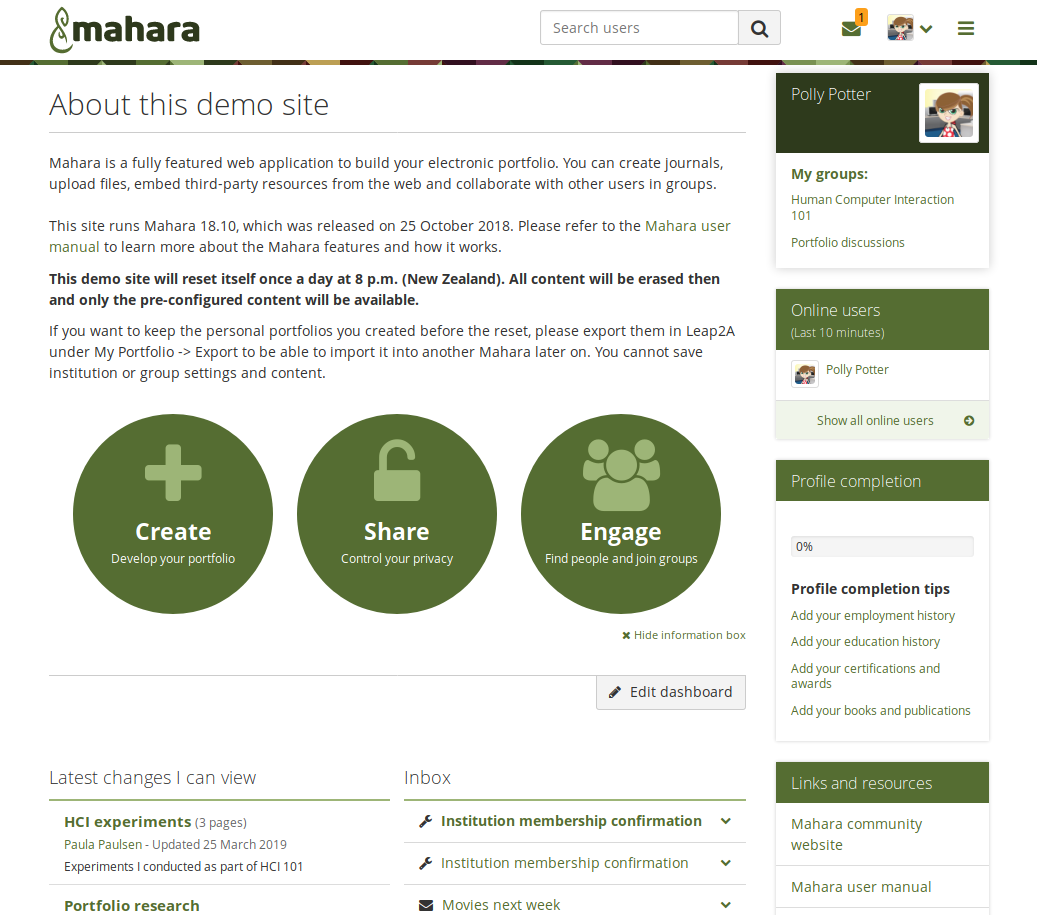
Logbook entries need not be just text, there can be diagrams, photographs, and with an electronic journal, video. Dr Stephen Dann, has adapted theLego Serious Play technique for reflection workshops. In 2017 Dr Dann ran a workshop for ANU staff working on their reflective e-portfolio for theHigher Education Academy Fellowship. In 2018 he ran a similar exercise for ANU Techlauncher students to consider their role in a group project. In each case the student is asked to make something with building blocks representing the topic and then talk about it. By talking about it, the students are encouraged to talk about themselves. They are also encouraged to take a photograph of their work.
Moodle Wiki for a Student Logbook
The Mahara Journal looked promising, especially as it is usually installed alongside Moodle. However, this would still be an additional tool students and staff would have to become familiar with. An alternative which looks promising is the Moodle Wiki. This can be set up so each student gets their own. I have created a logbook template which can be provided in the Wiki.
My template has a paragraph of explanatory text, then sections for the student to fill in. The student could create extra pages if they have a lot of content. But I expect one page will do for a typical student. They just click on "edit" the heading for a week, and put in some content.
The fill in the blanks sentences are adapted from James (p.43, 2005). The topics for each week are from the Australian National University's Techlauncher program (Awasthy, Flint, and Sankaranarayana, 2017). Questions for the Work Portfolio (Weeks 4 and 8) were suggested by Tempe Archer, ANU Careers. The idea here is to provide a prompt for the student each week to start writing and avoid presenting then with a confronting blank page. The students are asked to write about the activity set for that week and a specific aspect of it.
Jacques, Ouahabi and Lequeu (2020) refer to the use of logbooks in Google Drive for French first year first year engineering students learning online, but unfortunately give no more details. Kumar, Silva and Prelath, R. (2020) mention not having a project logbook as a problem for studio based learning in a Malaysian course, but again provide no more details.
Reference
Awasthy, R., Flint, S., & Sankaranarayana, R. (2017, April). Lifting the constraints—Closing the skills gap with authentic student projects. In 2017 IEEE Global Engineering Education Conference (EDUCON) (pp. 955-960). IEEE. URL https://doi.org/10.1109/EDUCON.2017.7942964
James, Alisa, "Journaling as an Assessment Option" (2005). Kinesiology, Sport Studies and Physical Education Faculty Publications. 78. https://digitalcommons.brockport.edu/pes_facpub/78
Jacques, S., Ouahabi, A., & Lequeu, T. (2020). Remote Knowledge Acquisition and Assessment During the COVID-19 Pandemic. International Journal of Engineering Pedagogy (iJEP), 10. URL https://www.thierry-lequeu.fr/data/JACQUES-04.pdf
Kumar, J. A., Silva, P. A., & Prelath, R. (2020). Implementing studio-based learning for design education: a study on the perception and challenges of Malaysian undergraduates. International Journal of Technology and Design Education, 1-21. URL https://link.springer.com/content/pdf/10.1007/s10798-020-09566-1.pdf
Professor Rory McGreal, who taught me open educational resources (OER) at Athabasca University, has proposed the use of blockchain for their dissemination. While most OER are free and authors are happy to see their work widely, they still want to be acknowledged for their work.
The Creative Commons licenses, commonly used for open materials, all have a "by attribution" requirement: "... the original creator (and any other nominated parties) must be credited and the source linked to". However, this is only a legal and moral requirement, the technology doesn't enforce it. Professor McGreal proposes to go a step further and use a blockchain to securely record who first created the work, and all the changes made and by whom.
While technically feasible, using block chain would throw up some challenges. As an example, nothing can ever be deleted from the blockchain, so if there was something which was incorrect, or harmful, or illegal, it would be there in perpetuity.
The idea of using blockchain in academia might have other uses. Recently I have been considering how students could record their progress with assessed work, such as assignments. One problem is to find an easy way for students to record what they did, but not be able to falsify the record. I have been looking at using some form of electronic logbook stored on the educational institution's system, so the student can't tamper with it. An alternative would be a blockchain.
Reference
McGreal, Rory. (January 20, 2021) How blockchain could help the world meet the UN’s global goals in higher The Conversation. URL https://theconversation.com/how-blockchain-could-help-the-world-meet-the-uns-global-goals-in-higher-education-152885
The video presentation contains images that were used under a Creative Commons License. Click here to see the full list of images and attributions: