Showing posts with label defence. Show all posts

Wednesday, January 28, 2026

Who Hacks Wins: Australian Defense Tech Hackathon

I am delighted to be mentoring teams in the Australian Defense Tech Hackathon, 6 to 8  February 2026, at UNSW Canberra. This is being held in association with the European Defense Tech Hub. The usual hackathon format is used, with teams spending a few days working on an idea & competing for prizes. But the point with a hackerthon is that you are not there to invent something, but to learn.

This will be my fourth time mentoring at defence hackerthon. 
Event canvas from NWIW 2020
by Paul Telling
Two were hosed by the Australian Computer Society for the DoD and one by Navy

Also I have volunteered to to run a workshop on how to present tech to senior people. This semester I will be also helping out with ANU's Software Construction course, which uses hackerthons for learning.

Focus areas include the expected topics of electronic warfare & drones, but also includes "Battlefield Economics & Scaling Production". While the headlines are usually grabbed by exotic high tech weapons, if you can't afford to buy them or can't build them, they are no use.

Also I have offered to run a workshop on how to talk to your client when they are a general. This is not that different to talking to senior executives in industry or government, but there are some unusual conventions.

ps: Yes, as one of my eagle eyed colleagues pointed out this is the "Australian Defense Tech Hackathon", spelled with an American style "S" US, not the "C" of Australian English. This is in association with a European organisation, so it is not like it is a US thing. NATO use a "C" for English documents and "S" for French.  When I worked in HQ ADF I had a complaint from a US journalist that we had misspelled "Defense" in a policy document. A short time later we received a groveling apology. ;-)

"Goals

​​1) Solve urgent defense and security challenges ...
​​2) Launch new careers and companies...

​​3) Strengthen Australia through defense innovation... 

Focus Areas ...

  1. ​SIGINT & OSINT
  2. ​Computer Vision & Edge AI
  3. ​Unmanned & Autonomous Systems (UxS)
  4. ​Electronic Warfare (EW)
  5. ​Modular Sensors
  6. ​Drone & Counter-Drone Tech
  7. ​Battlefield Economics & Scaling Production
  8. ​Hypersonics and Missile Defence ...

Agenda


Friday, February 6, 2026

​​12:00 - Doors open, Networking
​13:00 - Welcome and Opening Program
​14:00 - Workshops
​17:00 - Introduction to Mentors & Challenges, Last-Minute Team Formation
​18:00 - Start of Hacking

​Saturday, February 7, 2026

​Hacking continues all day

​Sunday, February 8, 2026

​12:00 - End of Hacking, Lunch Break

​Demo Day (Open to Visitors)

​13:00 - Pitches of the winning teams
​15:00 - Award Ceremony
​15:30 - After-party & Networking"

Saturday, January 11, 2025

Australian Defence Advanced Research Projects Agency Proposed

An Australian Defence Advanced Research Projects Agency, modeled on the US DoD's DARPA, has been proposed in a paper published by the Australian Strategic Policy Institute (ASPI). I support the proposal, and not just because I suggested it myself in 1999. My proposal got some positive press at the time. I also had the honor of being pilloried in a public statement from DSTO, now Defence Science and Technology Group (DSTG). ;-)

Robert Clark and Peter Jennings propose a partnership between the Defence Department, industry and universities for research & development. This would be extended internationally to instutions in Australia's closet allies (the so called "Five-Eyes"). 

Jack Dalton's comments on ASPI's proposal are curious in that he expresses a grudging admiration for the Chinese political system. He notes the benefits of a centralized one party state in terms of economic development. However, I suggest centralized five-year plans are not necessarily a good way to become a world leader in a technical field. Japan tried this approach with the Fifth Generation Computer Systems project and found that throwing money at something does't necessarily work. Australia needs something more decentralized, fluid and flexible. Even in the case of China, their central plans are not as centralized as they appear.

Wednesday, April 26, 2023

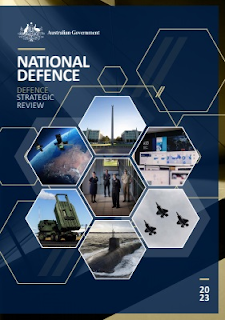
Cyber Security in Defence Strategic Review

Had a call from the media asking about cyber security in the Defence Strategic Review (I was interviewed from the shower cubicle in my Singapore hotel room). There is a section on "Cyber domain and targeting" in the report (page 63): https://www.defence.gov.au/about/reviews-inquiries/defence-strategic-review

"Australia’s cyber and information operations capabilities must be scaled up and optimised.

Under project REDSPICE, the Australian Signals Directorate is significantly expanding its signals intelligence and cyber capabilities and capacity.

Defence must enhance its cyber domain capabilities to deliver the required responsiveness and breadth of capability to support ADF operations. This must focus on: integrating the defence and management of Defence’s C4 networks and architectures; delivering a coherent and, where possible, centralised cyber domain capability development and management function; and building and sustaining a trained Defence cyber workforce."
 But I am not sure centralizing is a good idea.
"Defence must also continue to develop its cyber and space capabilities." page 7
Good.
"To maximise the deterrence, denial and response options for the Government, the ADF must evolve into a genuine Integrated Force which harnesses effects across all five domains: maritime, land, air, space and cyber." page 19
 Will cyber have the corresponding funding and staffing?
"In the contemporary strategic era, we cannot rely on geography or warning time. Regional military modernisation, underpinned by economic development, has meant that more countries are able to project combat power across greater ranges in all five domains: maritime, land, air, space and cyber. Emerging and disruptive technologies are being rapidly translated into military capability." page 24
Is Australia planning to transition into combat in the cyber domain?
"Cyber warfare is not bound by geography." page 25
So what are the implications of cyber war not being geographically bounded?
"Internal measures have included: increased defence and national security spending; the reorganisation of elements of the national intelligence and national security community; substantial investments in cyber security;" page 33
In particular?
"Deterrence strategy and practice is evolving. In military terms it now spans five domains: maritime, land, air, space and cyber." page 37
Is deterrence effective in the cyber domain?
"Although invasion of the Australian continent is a remote possibility, any adversary could seek to coerce Australia through cyber attacks ..." page 37
Could the attacks be made in a coordinated enough way to be useful for coerce? Under international law, Australia need not respond to cyber attack with a cyber attack, it can use missiles, bombs, and troops.
"Resilience requires the ability to withstand, endure and recover from disruption. ... robust cyber security, data networks and space capabilities;" page 38
For example, having backups.
The strategy of denial must also recognise the importance of non-geographic security threats, including cyber, space and long-range missile capabilities." page 49
Could Australia be digitally blockaded?
"The adoption of this approach will necessarily lead to a very different force structure and posture to what the ADF has today. More attention and resources must be devoted to crucial future-focused joint capabilities such as information warfare, cyber capabilities, electronic warfare, and guided weapons and explosive ordnance." page 51

How many cyber and information warfare troops does the ADF have? How many do they need? Will the ADF pay enough to retain them?
"The evolution to five domains – maritime, land, air, space and cyber – demands a new approach." page 54

"Defence’s cyber security arrangements should be enhanced in
close collaboration with the Australian Signals Directorate." page 83

"Defence’s cyber security operations capability in Chief
Information Officer Group should be increased and legacy systems and platforms should be decommissioned." page 83
What will that cost, and how long will it take? For Y2K we took years, and hundreds of millions of dollars, to tidy up old systems.
"Options should be developed to change Defence’s recruitment framework to improve the eligibility pool of potential applications and to align service recruitment requirements to military employment, especially in key technical and specialist trades (cyber, engineering, space, etc.)." page 88
Perhaps the physical fitness requirement will be lowered for computer nerds? 😉
"The Government also notes that in the contemporary strategic environment, developments in cyber, space and long-range precision strike mean our defence interests are not bound by geography alone." page 103

"A comprehensive framework should be developed for managing operations in the cyber domain that is consistent with the other domains. Agreed"

"Defence’s cyber domain capabilities should be strengthened to deliver the required breadth of capability with appropriate responsiveness to support ADF operations. Agreed in-principle" page 106
Only in principle?
"Options should be developed to change Defence’s recruitment framework to improve the eligibility pool of potential applications and to align service recruitment requirements to military employment, especially in key technical and specialist trades (cyber, engineering, space, etc.). Agreed" page 107
So the nerds will not need to do pushups?
"Defence’s cyber security arrangements should be enhanced in close collaboration with the Australian Signals Directorate. Agreed" page 108
And the universities? 

Thursday, August 18, 2022

Expanding Defence Training via Mobile Devices


I will be speaking on "Designing for scale: How to use mobile devices to recruit, train, and equip the extra 18,500 defence personnel", at the Mobile Learning Special Interest Group meeting of the Australasian Society for Computers in Learning in Tertiary Education (ASCILITE), 10 am Canberra time, Friday, August 26, 2022. All are welcome, via Zoom (no need to register). In this post, I am collecting my thoughts for the presentation. Comments, corrections, and additions are welcome. Presentation slides are also available, along with a video preview (made with a synthetic voice*), and the video recording of the live event (Worthington, 2022).

Reference

Worthington, Tom (2022): Designing for scale: How to use mobile devices to recruit, train and equip the extra 18,500 defence personnel. University of Melbourne. Media. https://doi.org/10.26188/20742451.v1 

Why Expand the Australian Defence Force?

On 10 March 2022, the then Prime Minister announced that the Australian Defence Force personnel will increase 30% by 2040, at for $38B. As the PM noted, “You can’t flick a switch to increase your army, navy and air force overnight, growing the type of people and skills we need to face the threats of the future takes time, so we must start now so critical skills can be taught and experience gained". While the government has changed since then, there is bipartisan support for a stronger military to meet increased challenges.

Volodymyr Zelenskyy speaking to ANU, 3 August 2022, 
(still image from ANU TV)

Russia invaded Ukraine in February 2022. Volodymyr Zelenskyy, President of Ukraine, made an impassioned speech to staff and students of the Australian National University, on 3 August, via video. He acknowledged Australia's contribution as the largest non-NATO provider of military assistance to his country. That assistance included not only Australian-made armored vehicles, but training in cyber defence.   

On 4 August 2022 China commenced air and naval exercises involving live fire, around Taiwan, including ballistic missiles fired over the islandTaiwan responded with its live-fire exercises on 7 August. Fortunately, the situation has not escalated, but tension remains. 

On 3 August, the new Australian Prime Minister announced a review of Australia's Defence posture and structure, to report by March 2023, for mobilization needs in 2032-33. An interim report is to be provided, but no deadline for this has been made public. While the review documentation mentions infrastructure, estate, disposition, logistics, and nuclear-powered submarines, the skills required of the members of the ADF, and the people who support them, are not mentioned. 

What New Skills Will Defence Personnel Need?

Conduct Cyberwarfare

Eesmaa Public Lecture, ANU, 30 July 2021
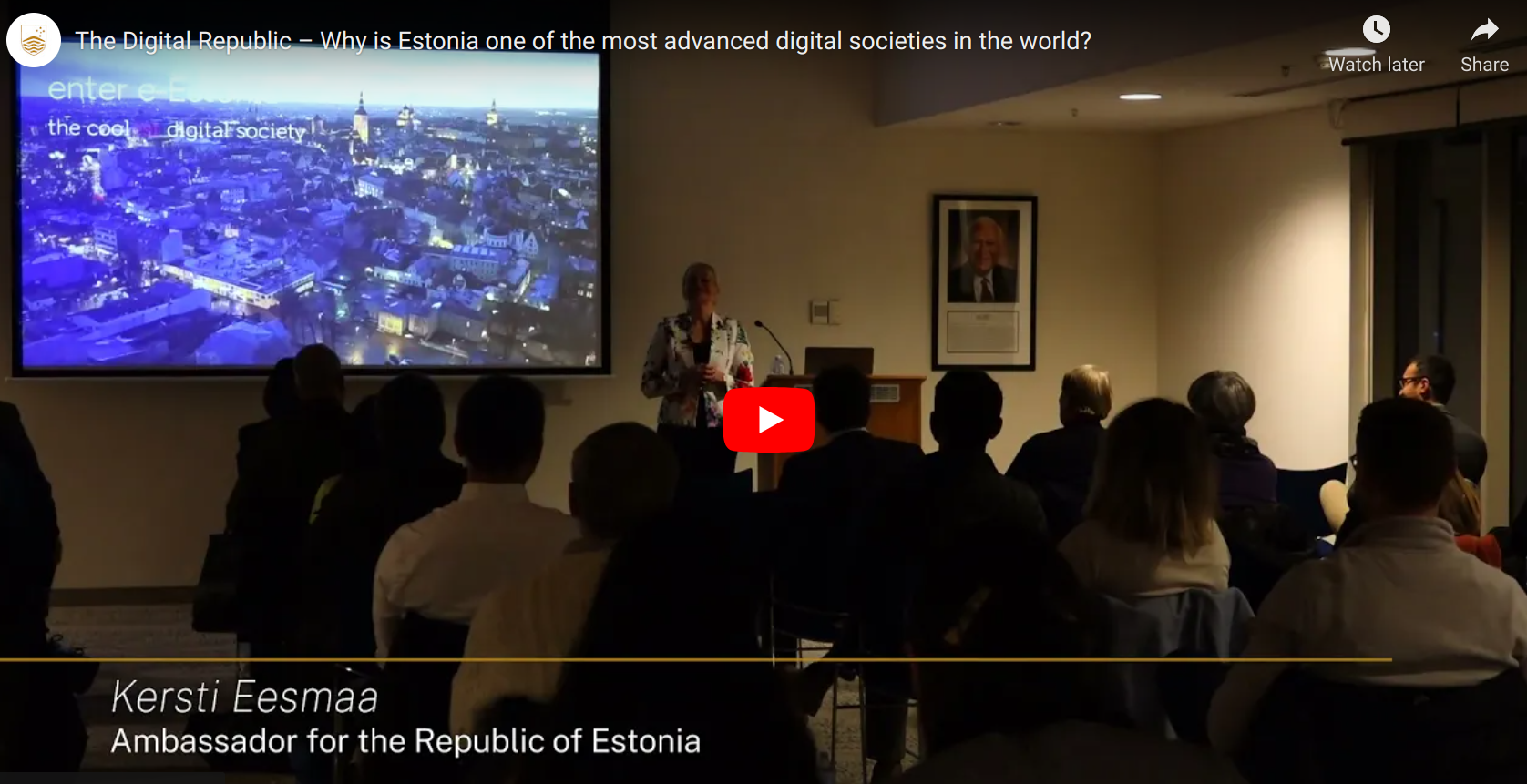
In July 2021, Ms. Kersti Eesmaa, Estonian Ambassador to Australia, talked at the ANU about how her nation was developing a sophisticated digital economy. Part of this was protecting government and civil infrastructure from cyber attacks. In April 2007 cyber-attacks were launched against Estonia, suspected to be from Russia. In response, NATO created a Cooperative Cyber Defence Center of Excellence (CCDCOE) in Tallinn, Estonia. CCDCOE now offers a comprehensive set of courses related to defensive and offensive cyberwarfare.

Coordinate Information Warfare

Mr. Myroshnychenko,
speaking in the ANU Moot Court.
Photo by Tom Worthington, CC-BY 30 March 2022

In March 2022 Ukraine's new Ambassador to Australia made an unscheduled speech at ANU on 
"Russia's Invasion of Ukraine". He said Ukraine destroyed the myth of Russian invincibility. Mr. Myroshnychenko pointed out he doesn't have a background in diplomacy, but in strategic communications, and co-founded Ukraine Crisis MediaBefore coming to Australia he ran Information warfare for Ukraine. He pointed out US Starlink satellite communications system had been useful for both civilian and military communications in Ukraine. He also pointed out how Russia sought to manipulate public opinion using messages different for internal and external audiences. The Ambassador also suggested Australia could play a useful role in countering Russian propaganda in the Pacific. 

Information Warfare Division
Australian Department of Defence
Mr. Myroshnychenko referred to the use of talk shows by Russia, which manipulates emotions, modeled on those popularized in the USA. He then looked ahead to how difficult it will be to reeducate the people influenced by Russian messages. He pointed out how difficult this was, with people in Germany after WWII. But perhaps a better analogy today would be with those convinced by QAnon conspiracy theories.

The day after the Minister's speech, the  Australian Government announced a doubling of the staff of the Australian Signals Directorate, and an expansion of offensive cyber operations. However, there was no mention of increasing the staff of the ADF  Information Warfare Division.

The ADF will need personnel with very deep technical skills in how to protect our computer systems, and attack those of our enemies. They will also need a deep understanding of how to provide convincing information, directly online, and through the media.

Operate Large Armed Air, Sea & Land Drones


In the 2022 Australian election campaign, the Australian Liberal Party has proposed an "Autonomous undersea warfare capability for Australia's navy" as part of its electoral platform (5 May 2022). The new Labor government is reported to have accelerated this program, with the first drone submarine to be built in Sydney in 2023 (Robotic submarines fast-tracked for build at a site on Sydney harbor to plug capability gap, Tory Shepard, SMH, 18 August 2022). These drones, at 30 m long, are larger than the midget submarines which attacked Sydney harbor in WWII. ADF personnel will need to know how to operate and maintain the drones. 

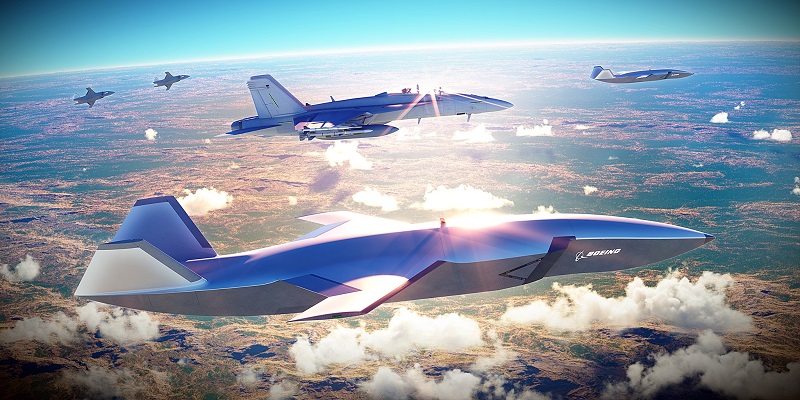
Loyal Wingman supersonic fighter UAV

Work is also progressing on a high-performance pilot-less aircraft for the air force, the Loyal Wingman, to be built in Queensland. As well as operators, the ADF will need personnel to understand the complexities of the AI software used,  and how the aircraft will operate alongside crewed aircraft. The operators may use VR headsets to fly the aircraft, while on the ground personnel would use wrist-mounted controllers.  

Work with Industry


Event canvas from NWIW 2020
by Paul Telling
In December 2020 I coached a team in the Navy Warfare Innovation Workshop 2020 (NWIW), at the Australian Defence Force Academy. Mixed teams of defence personnel from the Army, Navy, and Air Force, worked with civilian government personnel, and staff from defence companies, on ways to combat threats with new technology. My team came up with TIDE: Treat Identification Detection and Effects for dealing with swarms of RAS (Robotic Autonomous Systems). An important part of this exercise was having ADF personnel get used to working in diverse teams to come up with quick solutions.


How Can Mobile Devices Help With Skills?

VT to Learn to Drive the Drones

ANU  Defence Industry Workshop on XR,
5 November. 2019
VR headsets, AR glasses, and handheld devices are increasingly used as the interface for modern weapons and equipment. This allows for integrated training, using the same equipment and interface as for operation. Increasingly this is using ruggedized consumer-derived equipment, rather than bespoke hardware. This also allows for lower-cost consumer devices to be used in training, even by the personnel at home.

The ANU College of Engineering and Computer Science hosted a Defence Industry Workshop on XR, 5 November. 2019 as part of a national Extended Reality Cooperative Research Center (XR-CRC) bid.

Learn to Work Together Using a Smartphone

Robert Lester sending a report from K95

An important military skill is working with others. This is where mobile devices can be as important as operating drones. Personnel will need to be able to distribute
Tom Worthington at TT97
information and make decisions, with military personnel from other services, and civilians. It will not be possible to bring everyone to a central location, instead decisions have to be made on the fly (literally). Working at the Department of Defence in the 1990s, I observed military conferences in offices, in the field, and at sea. These initially required a satellite dish several meters wide, & a room full of equipment. Later this was reduced to umbrella, and briefcase size. The same capability is available in a hand held-unit. 

Promote Reserve Defence Careers via Mobile Devices


Detail from"Here to guide you there" (video), 
Open Universities Australia, 11 April 2022 
https://www.youtube.com/watch?v=pHo7-hxLz64

Australia can't afford to pay for all of the personnel needed with advanced technical skills to be employed full-time in the ADF. This requires expansion of reserve part-time personnel. This provides the opportunity to use mobile devices to train, and coordinate part-time recruits. Traditional war planning assumes that reserve personnel will be mobilized when required. However, the fast tempo of modern warfare may not permit reserves to be called up in time to be of use. Also, there are likely to be months, or years, of "grey-zone" operations, which do not meet the criteria for all out-war. In these situations, it would be useful to be able to call on reserves, for a few minutes or hours of work, much like the gig economy. These people need not leave their usual workplace but instead, work via a secure mobile device.

The ADF tends to use advertising promoting an outdoors active dynamic lifestyle to attract recruits. However, something more like Open Universities Australia's  marketing of online university courses may be more appropriate for STEM reserve recruits. In the TV ad, the student is shown leaping from place to place but then ends with them sitting studying on a smartphone. The message is that this is something that can fit into everyday life.

Hackathons for Recruitment and Training


In addition to 
the Navy Warfare Innovation Workshop  (NWIW), there were two defence sponsored hackerthons run by the Australian Computer Society ran in 2020. These used Slack, Zoom, and the usual collaboration tools. These had hundreds of participants and about 80 mentors. The Shockproof hackerthon on Secure Supply Chains for the Australian and NZ Defence Forces was unusual as it was aimed at defence force personnel, but open to anyone. 

A Role for Universities in Research & Teaching ADF via Mobile Devices

The need to recruit and train an expanded Australian Defence Force in new technical areas will challenge the capacity of current trainers and techniques. This provides an opportunity for Australian university academics to assist, particularly using the skills and knowledge gained over the last two years of the COVID-19 pandemic. Australian universities have been forced to rapidly evolve from places that offered classroom teaching, to ones where most learning is now done online. In particular, the use of VR for training rescue (Pedram, 2018), and emergency medical personnel (Aiello, Sevigny, & Cochrane, 2021), can be directly applied to the ADF. 

Some Ways to Scale

Mobile Recruiting

Recruiting, training, and managing more than ten thousand extra defence personnel is a daunting task. The technology can be used to help manage this. One way is to use mobile devices to provide potential recruits with information and guide them through the application process. Ideally, an applicant should be able to do this online with their phone in a couple of sessions, without needing to speak to anyone, unless they need to clarify something.

The first time I was a graduate university student, I had to fill in a paper form and hand it in at an office. The next time I filled in an online form, the university called me a few seconds later, to check something. The third time it was all done online: I never spoke to anyone from admin, before, or during, three years of study.

Mobile Trainers

The military traditionally provides quality training for personnel. However, this can be at a high cost to the organisation, and also in terms of time for reservists. Mobile and online learning can allow personnel to train and be trained with the minimum of standing around waiting.

Industry Standard Training

A major incentive for personnel to join and remain in the military is free training. For this to be an effective inducement, the training needs to be well delivered,  relevant, and recognized outside the Australian Defence Force. The military should adopt Australian civilian standards for qualifications of their trainers, and courses. Personnel should be formally trained in how to teach, particularly online, as part of leadership training. The students can also be trained in how to provide feedback online and assess fellow students, to reduce the need for specialist instructors. Students can be shown how to prepare an e-portfolio to showcase their skills. All of this will need to be done mindful of security requirements, as individual skills are a valuable source of information for potential enemies. 

Uber War 

Preparing reports from K95, 1995 
Members of a militia traditionally keep their rifles at hand to be ready to fight at any time. Members of Australia's reserve should treat their government security-approved smartphones the same way. Rather than having to muster at a military base, they should be able to train and fight, from wherever they are. This may be for only a few minutes at a time, in between a regular civilian job, over days, months, or years, of a conflict.

Earlier I showed a photo of someone from the Australian Defence media unit, sending reports from Exercise Kangaroo 95. There is a companion photo, of me receiving the reports. But I was not at my desk in Headquarters Australian Defence Force. I happened to be on holiday, so I was receiving the reports via a pocket modem (this was last century), and adding them to the Department of Defence website, using a laptop computer. That could now all be done on a pocket-size smart device. Some personnel would require devices with higher levels of security, and which do not depend on public data networks.

References

Aiello, S., Sevigny, C., & Cochrane, T. (2021). The Affordances of Immersive Virtual Reality Clinical Simulation Within Healthcare Education: A Scoping Review Protocol.

Pedram, Shiva, Evaluating Virtual Reality-based Training Programs for Mine Rescue Brigades in New South Wales (Australia), Doctor of Philosophy thesis, School of Computing and Information Technology, University of Wollongong, 2018. https://ro.uow.edu.au/theses1/441

Worthington, Tom (2022): Designing for scale: How to use mobile devices to recruit, train and equip the extra 18,500 defence personnel. University of Melbourne. Media. https://doi.org/10.26188/20742451.v1 

Tuesday, July 26, 2022

Drones and Global Order

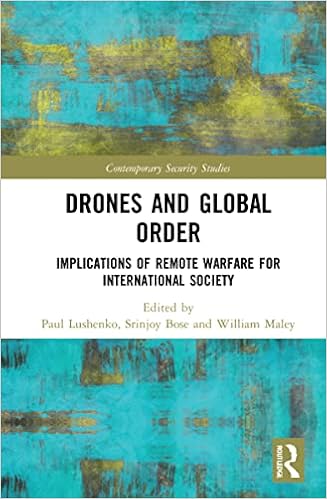
Greetings from the ANU College of Asia & the Pacific where a panel is speaking on "Drones and Global Order: Reflections on Ukraine". This is to discuss the book "Drones and Global Order: Implications of Remote Warfare for International Society" (edited by Paul Lushenko, Srinjoy Bose, William Maley). Moderator, Professor John Blaxland, Head of the ANU Strategic and Defence Studies Centre, pointed out that the book was prepared before the current conflict in Ukraine, and so is prescient. 

Lieutenant Colonel Paul Lushenko,  U.S. Army and Cornell University, mentioned that drones can be used to breech and protect national sovereignty. He nominated the General Atomics Reaper drone as the preeminent system. I suggest it is worth pointing out that the usefulness of this aircraft is reflected in its general design being widely copied by both allies and enemies.

Cecilia Jacob, Associate Professor, ANU International Relations, pointed out the dilemma that drones have been useful in response to conflicts short of war. However, the low cost of drones, and low risk for operators, may make war more likely. A positive point mentioned was using a drone to capture evidence for war crimes trials.

Emeritus Professor William Maley, ANU Diplomacy, reminded the audience that drones are not new, with the German V-1, being mass produced in 1944. As the Professor points out, the V-1 was not accurate enough, and the war did not continue long enough for its significance to be appreciated. Drones could be used for surveillance, material delivery, conventional military attack, attack on terrorist leadership, and drone swarms. On the last point I coached a team of Australian Navy, government and industry people working on swarm defence. Media reports suggest Ukraine used drones to distract the defenders of a Russian warship

Professor Maley commented that "Most people think of drones for delivering pizza, not bombs". This made me wonder what will be the effect of low cost mass-produced drones. Will this be like the effect smart anti-tank weapons have had in the Ukraine? What if both sides are supplied with thousands of small, disposable armed drones, which can loiter over a battlefield? I suggest a drone packaged in a disposable  larch tube similar in size and operation to an anti-tank missile would prove a popular product. This would be larger than the AeroVironment Switchblade, with a battery motor for loitering, and a rocket motor for attack.


Thursday, July 14, 2022

On-line Graduate Certificate of New Technologies Law at the ANU

Tim Hillman just ran an online seminar on the new ANU Graduate Certificate of New Technologies Law. This program is unusual, as it was designed, and is offered, entirely online. It is short, with the student able to complete the four courses in only six months, full time. But I suggest that if you are working or have significant home commitments, consider doing it one course at a time. There are summer course offerings, so this could take a little under two years.

There is a compulsory introductory course with those not having a prior law degree, then 12 electives. What got my attention was that there are two defence related courses offered: Cyber Warfare Law (LAWS8035), Weaponry and Targeting (LAWS8401). Also #MeToo and the Law (LAWS8403), looks interesting.

The certificate courses can be credited towards a Masters program, but as Tim pointed out in the seminar, you have to thing about your program of study.

ps: I will be speaking on "Designing for scale: How to use mobile devices to recruit, train and equip the extra 18,500 defence personnel", at the Mobile Learning Special Interest Group meeting of the Australasian Society for Computers in Learning in Tertiary Education (ASCILITE), 10 am, Friday, August 26, 2022. 

Friday, June 24, 2022

Designing for scale: How to use mobile devices to recruit, train and equip an extra 18,500 defence personnel

I will be speaking on "Designing for scale: How to use mobile devices to recruit, train and equip the extra 18,500 defence personnel", at the Mobile Learning Special Interest Group meeting of the Australasian Society for Computers in Learning in Tertiary Education (ASCILITE), 10 am, Friday, August 26, 2022. All welcome, via Zoom (no need to register).

On 10 March 2022, the then Prime Minister announced that the Australian Defence Force would ADF personnel will increase 30% by 2040, at a cost of $38B. As the PM noted, “You can’t flick a switch to increase your army, navy and air force overnight, growing the type of people and skills we need to face the threats of the future takes time, so we must start now so critical skills can be taught and experience gained". 

The new and existing personnel will require new skills in fields such as cyber security, nuclear propulsion, and warfighting in space. Intelligence, information and communications capacity were singled out in the announcement.

This seminar explores how mobile technology and mobile learning could be used to recruit, train and equip these personnel.

Friday, May 20, 2022

Designing for scale: How to use mobile devices to recruit, train and equip the extra 18,500 defence personnel

 I will be speaking on "Designing for scale: How to use mobile devices to recruit, train and equip the extra 18,500 defence personnel" at the Australasian Society for Computers in Learning in Tertiary Education (ASCILITE) Mobile Learning Special Interest Group (ML-SIG), 10 am AEST, 26 August 2022. Any suggestions would be welcome.

Some of my defence related posts:

Wednesday, March 30, 2022

Saturday, March 12, 2022

Expert Analysis of Russia's Invasion of Ukraine at the Australian National University

The Australian National University is holding a free two day event on "Russia's Invasion of Ukraine", 28 and 30 March 2022. This will feature eight ambassadors of European countries on the first day, and strategic scholars on the second.

COVID-19 closing campuses has caused many to ask what universities are for. This event answers one of those questions: at times of crisis, universities provide experts, with a depth of experience, to help answer very difficult questions. It is easy to dismiss the views of academics, but some of us have direct experience of working in defence organisations.

Sunday, March 7, 2021

eXtended Reality Cooperative Research Centre Workshop

A workshop on a proposed Xtended Reality Cooperative Research Centre (XR CRC) will be held online, 1pm, 19 March 2021.

"Six Australian Universities; Deakin University, Charles Sturt University, Curtin University, Griffith University, The Australian National University and University of Technology Sydney, all with research and application expertise in immersive experience and solutions are working on the development of the eXtended Reality CRC (XRCRC) program proposal to Government.

The XRCRC aims to enable our partners transform for the new global environment and manage the impact and opportunity of accelerated digital experience and digital offerings.

With a focus on the integration of people content and technology, XRCRC research and development is relevant where human and digital worlds combine across the following sectors:

Education and Training
Health, Accessibility, Inclusion and Aged Care
Media, Entertainment and Creative
Advanced Manufacturing, Resources and Industrial Services
Agriculture,
Architecture and Construction
Emergency Services, Defence, Security, and Public Safety ..."

Loyal Wingman supersonic fighter UAV

ps: One use for XR could be to provide an interface for high performance drones, such as the proposed Loyal Wingman supersonic aircraft. The operator would sit in a flight simulator, controlling the remote aircraft.

Thursday, October 10, 2019

Defence Industry Workshop on Extended Reality in Canberra, 5 November

The ANU College of Engineering and Computer Science is hosting a Defence Industry Workshop on XR, Tuesday 5 November. Defence and government organizations, as well as industry, and academia. are invited to attend. The Australian National University (ANU), is investigating the establishment of an Extended Reality Cooperative Research Center (XR-CRC) with other universities.  The term XR includes augmented reality, virtual reality, and other forms of computer generated simulations, using wearable, and other technology. For more details contact Dr Penny Kyburz, Senior Lecturer, Human-Centred Computing, ANU CECS.

Loyal Wingman supersonic fighter UAV
ps: One use for XR could be to provide an interface for high performance UAVs, such as the proposed Loyal Wingman supersonic aircraft. With this approach the remote operator would sit in a flight simulator, controlling the remote aircraft. The movement of the simulator would provide additional feedback, needed for fast decision making in combat.The simulator could be made small enough to be loaded on-board and operated from the aircraft being protected, such as the KC-30A tanker.

pps:  It happens I was the Defence representative on a joint industry project to produce a graphical user interface in the early 1990s. Unfortunately the Web came along and made our work obsolete. ;-)

Sunday, September 23, 2018

Zero-Carbon Energy for the Asia-Pacific Wins ANU Grand Challenge


The project "Zero-Carbon Energy for the Asia-Pacific" has won the Australian National University Grand Challenge.  This project will be funded to research how to capture solar and wind renewable energy on a large scale in north-west Australia, then export it to Asia.

Wednesday, September 19, 2018

Zero-Carbon Energy for the Asia-Pacific

Greetings from the ANU Grand Challenges pitch night in Canberra.  Four teams are presenting their ideas. One will receive funding. The last is "Zero-Carbon Energy for the Asia-Pacific". This project proposes to capture solar and wind renewable energy on a large scale in north-west Australia, then export it to Asia.

The energy will be exported by undersea cables, as synthetic fuel in supertankers and as refined metal. The project has to work out how to negotiate with traditional owners of the land on which the energy will be collected, and with the nations the cables and tankers will need to transit.

One issue is that cables and supertankers of fuel make attractive targets for terrorists and nations. The tradition approach to such defence would involve UAVs and rapid reaction air and seaborne forces. However, this could also include the local community as part of the early warning system.

Tuesday, March 22, 2016

Why China Shouldn't Join the INF Treaty

Yesterday Professor Bradley Thayer, University of Iceland talked at the Australian National University in Canberra on "INF Treaty: Why China Should Join". Professor Thayer argued for joining the USA and Russia in the Intermediate-Range Nuclear Forces Treaty (INF), which banned ground-launched missiles with ranges of  500–5,500 km from Europe. He argued this would improve strategic stability for China. However, Professor  Thayer  undermined his argument by claiming Russia violated the Treaty by testing a land based cruse missile.

https://en.wikipedia.org/wiki/Northrop_Grumman_X-47B
The geography of East Asia and the technology of 2015, I suggest, is different to that of Europe in the 1980s. The INF addressed a potential land conflict in Europe. China has a long coast and faces a threat from the sea. The INF would ban Chinese land based missiles, while allowing the sea based weapons of its potential adversaries. Also it is not clear if armed UAVs (pilot-less aircraft), on land or sea based, would be banned under the treaty.

Professor Thayer also claimed that China was not transparent as to its military strategy. However, a quick web search finds the full text of "China's Military Strategy" (State Council Information Office of the People's Republic of China, Peoples Daily, 26 May 2015). The strategy is as clear as the recent Australian Defence White paper.

Tuesday, August 13, 2013

Learning Counterinsurgency at University

Greetings from the Australian National University in Canberra, where Dr. John A. Nagl, Lieutenant Colonel, United States Army (Retired) is speaking on "Learning to eat soup with a knife - counterinsurgency Iraq and Afghanistan". He is the author of "Learning to Eat Soup with a Knife: Counterinsurgency Lessons from Malaya and Vietnam" (University Of Chicago Press, 2005).

Dr. Nagl explained the title of his book (and thesis) came from  T. E. Lawrence's ("Lawrence of Arabia") book Seven Pillars of Wisdom. (on page 136 of the Wilder Publications 2011 Edition). His thesis is that the US Army was not prepared for counterinsurgency in Vietnam and after learning the lessons in that war decided not to do so again. As a result the US Army had to relearn counterinsurgency in Iraq.

Dr. Nagl explained how counterinsurgency depends on intelligence information rather than firepower. He detailed the importance of providing infrastructure (roads, water sewage) to the civilian population, which required liaison with the civilian aid agencies. He likened the current conflicts as being similar to the Cold War, being dependent on economic development, rather than military force.

Dr. Nagl suggested that the Afghanistan government will survive, provided 15,000 US and European military personnel are kept in country indefinitely, along with funding.

Dr. Nagl  asked why great power conflict had reduced. He suggested this was due to nuclear weapons deterring large wars and general improvements in economic conditions reducing the impetus for war. He suggested the photocopier brought down the Soviet Union and the smart phone would bring down the Communist Party of China. This seemed an overly simplistic view to me. Professor Christian Goebel, Vienna University, will provide a more useful analysis in "E-monitoring and regime improvement in China: technical capabilities and systemic limitations", at ANU 4:00pm 10 September 2013.


I asked Dr. Nagl if the US Army should be able to conduct counterinsurgency, as this is more a role for the US Marines and special forces. Most medium to large countries have their military structured with a large conventional force and smaller more flexible forces for counterinsurgency. He responded that Iraq required more personnel than the special forces had. He suggested that as the US reduces its armed forces, the more experienced NCOs and Colonel should be retained to retain corporate knowledge.

It would be interesting to hear Dr. Nagl  views on the Australian Army. The ADF appears to be planning to re-fight US Navy's war in the Pacific in World War Two, building up a long range submarine force and carrier battle groups with amphibious assault capabilities. It is unlikely that the Australian government will provide sufficient resources to purchase all of the hardware required, or the even more expensive personnel and if they did it is not clear how such a force would be used. It is more likely that the ADF will be involved in counterinsurgency operations where sophisticated equipment is, at best ineffective and may actually make the situation worse by isolating the personnel from the local population.

In my view the ADF and the Australian Government are failing to invest sufficient resources in cyber-warfare. For this I proposed a "Australian CyberWarfare Battalion".

This was one of a series of talks at the ANU Strategic & Defence Studies Centre. The center teaches senior military officers the Australian Defence College, as well as public servants and others.