Showing posts with label drones. Show all posts

Tuesday, August 6, 2024

Killing Bushfires with Drones

Associate Professor Roslyn Prinsley,
Head of Disaster Solutions,
ANU Institute for Climate,
Energy & Disaster Solutions
Associate Professor Roslyn Prinsley, Head of Disaster Solutions, ANU Institute for Climate, Energy & Disaster Solutions is taking about ways to prevent natural disasters. One of these being worked on at the Australian National University is to detect lightening strikes, resulting bushfires and quickly targeting them from the air with drones. This is a very challenging application as bushfires can start in large areas of Australia, and there can be thousands of lightning strikes which can potentially start a fire. Such a system can't simply water bomb every potential fire. This was at the ANU Disaster Solutions Update 2024.  The event is available live online.

The approach Professor Prinsley outlined was for small spot fires to be detected by UAVs and targeted with water dropped by steered parachutes. Such as system would be similar to those needed to defend Australia. Such a system has to scan large areas, decide what is a potential target deploy assets & assess results. Recent conflicts have shown it is no longer feasible to do this with crewed systems & human decision making. There are too many potential targets to be serviced & too much happening too quickly.


Saturday, December 16, 2023

Attracting Australians to Military Service

Luke Townsend, 
 Managing Director at Outlook Industries
Luke Townsend Managing Director at Outlook Industries Pty Ltd, has proposed an Australian service questionnaire ("Revolutionising ADF recruiting: an opt-out system", Australian Strategic Policy Institute, 15 Dec 2023). This would be compulsory for all year 11 or 12 Australian students, to determine their suitability for military service. Those considered most suitable would be sent an offer of a full or part time position. He proposes this could be extended to also cover civilian government job offers as well. This is proposed to answer a chronic shortage of Australian Defence Force personnel. However, in this form, the idea is unlikely to receive widespread political support.

A service questionnaire is likely to meet opposition as being conscription by stealth. Compulsory military service is an issue which has divided Australian society, even in times of world war. Also the questionnaire would not address the reasons why young people are not volunteering, and not choosing to remain in military service. The military needs people with advanced technical skills, and are competing with civilian employers for those people. While all trained to fire a rifle, most now sit behind a computer console to do their job. The ADF needs to offer competitive pay and conditions to attract and retain personnel who can maintain and operated advanced systems. 

Mr Townsend gives examples of the Australian 1st Armoured Regiment being removed from the order of battle, and HMAS Anzac has now been mothballed due to lack of crew. However, in the next decade tanks, & most warships will be replaced with drones having no crews. These will new fewer people to operate, but those people will need advanced technical skills, and be supported by techncans to keep the systems running.

Mr Townsend gives the example of Finland with 5% of the population in the reserve forces. However, Finland has a long land boarder which can be defended by troops, in some cases on skis. Australia is an island, requiring ships, submarines, and aircraft as its primary defense, and which will be mostly automated and uncrewed. This will require an advanced workforce, of mostly civilians working in industry, to support.

This is not to say an Australian service questionnaire could not be useful. But I suggest it needs to be voluntary to avoid political opposition. Also the questionnaire could emphasize civilian roles, not military ones. At the same time the ADF could reform its training programs, to offer civilian standard vocational certificates to recruits, as well as the university degrees already offered.


Tuesday, July 26, 2022

Drones and Global Order

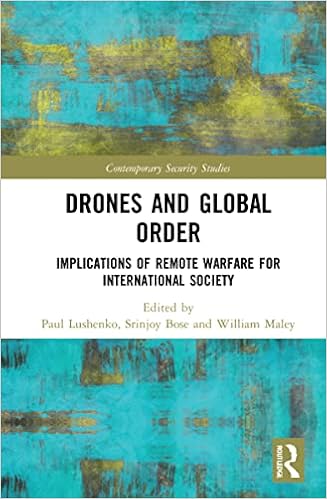
Greetings from the ANU College of Asia & the Pacific where a panel is speaking on "Drones and Global Order: Reflections on Ukraine". This is to discuss the book "Drones and Global Order: Implications of Remote Warfare for International Society" (edited by Paul Lushenko, Srinjoy Bose, William Maley). Moderator, Professor John Blaxland, Head of the ANU Strategic and Defence Studies Centre, pointed out that the book was prepared before the current conflict in Ukraine, and so is prescient. 

Lieutenant Colonel Paul Lushenko,  U.S. Army and Cornell University, mentioned that drones can be used to breech and protect national sovereignty. He nominated the General Atomics Reaper drone as the preeminent system. I suggest it is worth pointing out that the usefulness of this aircraft is reflected in its general design being widely copied by both allies and enemies.

Cecilia Jacob, Associate Professor, ANU International Relations, pointed out the dilemma that drones have been useful in response to conflicts short of war. However, the low cost of drones, and low risk for operators, may make war more likely. A positive point mentioned was using a drone to capture evidence for war crimes trials.

Emeritus Professor William Maley, ANU Diplomacy, reminded the audience that drones are not new, with the German V-1, being mass produced in 1944. As the Professor points out, the V-1 was not accurate enough, and the war did not continue long enough for its significance to be appreciated. Drones could be used for surveillance, material delivery, conventional military attack, attack on terrorist leadership, and drone swarms. On the last point I coached a team of Australian Navy, government and industry people working on swarm defence. Media reports suggest Ukraine used drones to distract the defenders of a Russian warship

Professor Maley commented that "Most people think of drones for delivering pizza, not bombs". This made me wonder what will be the effect of low cost mass-produced drones. Will this be like the effect smart anti-tank weapons have had in the Ukraine? What if both sides are supplied with thousands of small, disposable armed drones, which can loiter over a battlefield? I suggest a drone packaged in a disposable  larch tube similar in size and operation to an anti-tank missile would prove a popular product. This would be larger than the AeroVironment Switchblade, with a battery motor for loitering, and a rocket motor for attack.