Showing posts with label CECS. Show all posts

Wednesday, December 13, 2023

AI in Society

Greetings from the Australian National University 2023 AI in Society Workshop. This is run by ANU Humanising Machine Intelligence. Some topics are Design Justice AI, Critical AI in the art museum, AITA and daily moral decisions, Robot Decision-making with Humans-in-the-loop. First up is James Bailie from Harvard University on Privacy, Data Privacy, and Differential Privacy 
(there is an earlier paper from him available). He started with the right to be let alone, then moved on to data privacy (although I don't know what non-data privacy is). Next was the concept of privacy via randomized responses, where randomness is added to protect individual privacy. 


ps: The subsequent presentations raised some interesting questions on timely topics. However, what is needed is to take the next step to practical implementation. As well as raising interesting areas for further research, this would also provide benifit to the community. 

Tuesday, February 1, 2022

Back on Campus


Greetings from Coffee Grounds cafe at the Australian National University. I have come in to prepare for the semester after many months away due to COVID-19. I was telling Elijah, the barista that this felt like déjà vu: I started my teaching at ANU 20 years ago, right here. 

Sunday, August 8, 2021

Old ANU Chemistry Building Turned Into a State of the Art Teaching Facility

ANU Birch kitchen/meeting
area by Vibe FM
On Friday I attended two events at the Australian National University's Birch Building. I did not think much of this, as it was the old Chemistry building, which I had given occasional lectures in. But when I walked in, the building had been completely refurbished. This is not just new carpet and a coat of paint, significant structural work has been done by Taylor Thomson Whitting, along with fit-out by Vibe FM to make a state of the art teaching facility for the ANU College of Engineering and Computer Science. 

Structure of ANU Birch
building by TTW 

The two spaces I found most impressive are the kitchen built into the ground floor, and the flat floor space over what was the Chemistry lecture theater. The kitchen has seating and a large flat screen, perfect for informal events. The upstairs space has windows on three sides, large sliding doors and movable flip up tables on wheels.

Friday, May 14, 2021

Real World Tests to Prepare Graduates for the Real World

I am helping out with some project audits of ANU Techlauncher computer students this week. Students have been working for ten weeks in teams for a real client to produce a system. They are audited every few weeks to see how they are doing and to make suggestions for improvements. The clients, and other students have input to this as well as staff. This is an approach which might be applied in other disciplines, to make assessment for useful for learning and prepare graduates for the workplace.

This approach is modeled on real world software engineering practice. I have carried out similar audits at the Defence Department on large projects, some of which were subsequently cancelled (as an expert witness in court cases I have reviewed documentation from projects which should have been cancelled). I thought I should revise the fundamentals and found a Wiki version of the Software Engineering Body of Knowledge (SWEBOK) which doesn't need registration to access (but I am not sure how up to date this is). Chapter 10: Software Quality, 2.3 Reviews and Audits is the relevant part:

"Reviews and audit processes are broadly defined as static—meaning that no software programs or models are executed—examination of software engineering artifacts with respect to standards that have been established by the organization or project for those artifacts. Different types of reviews and audits are distinguished by their purpose, levels of independence, tools and techniques, roles, and by the subject of the activity. Product assurance and process assurance audits are typically conducted by software quality assurance (SQA) personnel who are independent of development teams. Management reviews are conducted by organizational or project management. The engineering staff conducts technical reviews."

Sunday, March 7, 2021

eXtended Reality Cooperative Research Centre Workshop

A workshop on a proposed Xtended Reality Cooperative Research Centre (XR CRC) will be held online, 1pm, 19 March 2021.

"Six Australian Universities; Deakin University, Charles Sturt University, Curtin University, Griffith University, The Australian National University and University of Technology Sydney, all with research and application expertise in immersive experience and solutions are working on the development of the eXtended Reality CRC (XRCRC) program proposal to Government.

The XRCRC aims to enable our partners transform for the new global environment and manage the impact and opportunity of accelerated digital experience and digital offerings.

With a focus on the integration of people content and technology, XRCRC research and development is relevant where human and digital worlds combine across the following sectors:

Education and Training
Health, Accessibility, Inclusion and Aged Care
Media, Entertainment and Creative
Advanced Manufacturing, Resources and Industrial Services
Agriculture,
Architecture and Construction
Emergency Services, Defence, Security, and Public Safety ..."

Loyal Wingman supersonic fighter UAV

ps: One use for XR could be to provide an interface for high performance drones, such as the proposed Loyal Wingman supersonic aircraft. The operator would sit in a flight simulator, controlling the remote aircraft.

Sunday, December 29, 2019

Improving Tutor Training

How much teacher training do those teaching at university need and how should this be provided? This is a question I have been looking at since first becoming involved in teaching at a university twenty years ago. I have been subjected to poorly designed online introductory tutoring course, a better four day face to face course, as well as longer programs. I decided to look at some of my frustrations, and recommendations, so I do not repeat the mistakes of the past.

Online course exemplar: In reflecting on being an online student of teaching, one frustration was in difficulty using the Learning Management System (LMS). In that case I was using one unfamiliar to me (Blackboard). In teaching tutors, who are mostly students, it would therefore help to use the LMS they have been using as students. It would also help to lay out the tutor course using a familiar standard template of courses at the university. The online materials should be an example of good design. One of my frustrations as an online student of education, was where the content of the course said to do something, but that was not followed in the way the course was implemented (a case of "Do as I say, not as I do"). It is especially important that the materials are provided online for a tutor training course, as you only have the students for a short time.

Provide Assessment: As a form of staff training, short tutor training courses are often not assessed, although the student may get a certificate of attendance. There may be some optional assessment offered, if they intend to apply for credit to program, or apply for an external certificate (such as fellowship of the Higher Education Academy, Association for Learning Technology, or the Higher Education Research and Development Society of Australasia). However, I found it difficult to take some teacher training seriously as there was no assessment, and I just needed to turn up. Even if only for the purposes of formative feedback, some type of assessment should be provided. This will also provide the participant with some idea of what it is like for their own students.

Peer Support: As a student I disliked any form of group work. My attitude was that I just wanted to be told what to do, I would do it on my own, and then get out of there. However, this does not make for a satisfying learning experience. New tutors, like new students, need help and support, which they can't just get from supervisors. So forms of group work, peer feedback and assessment, should be built into the tutor training. This may be difficult to arrange, and unpopular, but is useful.

Practical Exercises: Much of the teacher training I have been a student of has been very "academic", with theory expounded by an expert talking to a passive class of students. There is plenty of research to show this is not an effective way to learn. Ironically, some of that evidence was cited by people standing up presenting slide after slide, just as that research said not to do. What I found most useful as a student was to be told a little theory, and then have to prepare a practical lesson, with my peers as students.

Not Intensive Mode: Being crammed into a room for a few hours, or days is not a useful way to learn. There needs to be time to reflect, and ideally try out, what is being learned.

Wednesday, November 27, 2019

Tutor Training

Principles of Tutoring & Demonstrating" (ANU, 2014):
"Principles of Tutoring and Demonstrating is a decamod in the Academic Professional Development (APD) program. It is a program specifically designed for research students to give a broad introduction to university teaching in the context of tutoring and demonstrating. It runs weekly during semester to provide ongoing support just when tutors and demonstrators may need it. "
This was made up of ten modules:

  • Preparing for the first class
  • Overview of rights and responsibilities
  • Reflective practice
  • The Professional Standards Framework and the EFS
2. Setting the Scene: Student Learning

  • Student learning styles and how this affects the way we teach
  • The role of the teacher - Theories of teaching
3.  Planning a Tutorial
  • Theories of student learning and lesson planning
  • Structuring a teaching session
4.  Teaching Groups & individuals
  • Small group and cooperative learning strategies
  • Strategies for engaging with student one-on-one
 5. Dynamics & Diversity
  • Dealing with diverse groups of students.
  • Responding to challenging situations and "difficult" students
  • Notions of group life cycle
  • Student needs and support services
 6. Introduction to Wattle* for Tutors
  • Tricks and tips for using Wattle to enhance your teaching
 7.  Peer Observation
  • Observation of another tutor with reflection online 
 8. Assessment & Marking

 9. Evaluation & Reflective Practice

  • Evaluation practices
  • Creating a teaching portfolio
  • Action learning - evaluation to inform practice
  • Personal reflection
10.  Troubleshooting (The Tutoring Toolkit)
  • Discussion of teaching scenarios from past semester
  • Key skills in a tutor's teaching toolkit
ANU College of Engineering and Computer Science (CECS ) offered a Teaching and quality Program (TQP), based on the above.


 * Wattle is ANU's Learning Management System, made up of Moodle and other tools.

Reimagining engineering and computer science tutor training for the 21st Century

I have been asked to help teach engineering and computer science tutors how to tutor. But first, what is the role of the graduates of these disciplines in the 21st century? The College of Engineering and Computer Science (CECS) at the Australian National University (ANU) has set out to reimagine engineering and computing for the mid 21st century.

The re-thinking of ANU engine ring and computing includes how to teach them, with Reimagine Co Design Culture Lab this week in Canberra. This includes consecrations of "Transformational education experiences that give a distinctive edge in technological problem formulation, with experience curated from the breadth of engineering, computing, science, social science and humanities". Some of the key aspects of this are creativity, collaboration, and human needs.

For STEM students trained and selected for their skills in narrow technician specializations,  creativity, collaboration and meeting human needs, are a challenge. For teachers who have also been trained in a narrow technical area, how to teach these broader skills, and assess them is also challenge.

The answer I suggest is authentic education and assessment. That is the teaching should be as much like the real workplace as possible. Students are then given a real task and assessed on how well they do it. Hardly anyone spends their days working by sitting silently in a big hall listing to some giving a presentation, so that should not be how they learn. Hardly anyone works by answering written questions on paper, alone, with no reference materials, so that is not how they should be assessed.

University teachers can be trapped in a vicious circle, where they teach using the same poor techniques used to teach them. The problem is that university academics receive little teacher training, and then pass or poor practices to their students. Even when offered more extensive teacher education, academics are busy teaching, or researching. Tutor training, provides an opportunity to break this cycle, by showing the pre-career academic, alternative ways to teach, before they become too busy to lean.

Thursday, October 10, 2019

Defence Industry Workshop on Extended Reality in Canberra, 5 November

The ANU College of Engineering and Computer Science is hosting a Defence Industry Workshop on XR, Tuesday 5 November. Defence and government organizations, as well as industry, and academia. are invited to attend. The Australian National University (ANU), is investigating the establishment of an Extended Reality Cooperative Research Center (XR-CRC) with other universities.  The term XR includes augmented reality, virtual reality, and other forms of computer generated simulations, using wearable, and other technology. For more details contact Dr Penny Kyburz, Senior Lecturer, Human-Centred Computing, ANU CECS.

Loyal Wingman supersonic fighter UAV
ps: One use for XR could be to provide an interface for high performance UAVs, such as the proposed Loyal Wingman supersonic aircraft. With this approach the remote operator would sit in a flight simulator, controlling the remote aircraft. The movement of the simulator would provide additional feedback, needed for fast decision making in combat.The simulator could be made small enough to be loaded on-board and operated from the aircraft being protected, such as the KC-30A tanker.

pps:  It happens I was the Defence representative on a joint industry project to produce a graphical user interface in the early 1990s. Unfortunately the Web came along and made our work obsolete. ;-)

Friday, July 19, 2019

3Ai Masters 2020 Program Open

Applications are open for the 3Ai Masters 2020 program. This is at the  Autonomy, Agency and Assurance Innovation Institute (3Ai), set up by Professor Genevieve Bell, at the Australian National University in Canberra. Exactly what the Institute does it a bit hard to explain. They say "... we are building the knowledge and tools needed to ensure that as technology advances, humanity advances with it ...".

I have had the pleasure of sitting in the ANU Computer Science and Information Technology common room with the first cohort of students. They are a diverse and interesting collection of people. Some are hard core computer nerds, but with a wide range of interests.

Thursday, April 18, 2019

Three ANU Research Schools Need Directors

The Australian National University (ANU) in Canberra has advertised for heads of three Research Schools: Electrical, Energy, Materials Engineering; Aerospace, Mechanical & Environmental Engineering; and Computer Science.
"ANU is seeking to appoint three new School Directors who will play a pivotal role in shaping the future of the College of Engineering and Computer Science (CECS) as a hub that will grow and inspire a new generation of creative thinkers, who will challenge historic biases in a truly inclusive environment.
The three new roles represent part of the University’s ambitious Reimagine Project, an interdisciplinary venture with the aim to attract the very best and brightest from around the world to identify, articulate and solve problems. Not just in the traditional spheres for engineers or computer scientists but those with varied backgrounds and areas of expertise, who aspire to innovate and lead new approaches to technologies, intelligence and data and human interface.
The new Directors will provide the vision and leadership to reinforce the distinctive, applied identity of the Schools and will be motivated by a desire to drive excellence in research, education, engagement and impact. With delegated powers for academic and resource management, candidates will demonstrate the intellectual, strategic and operational leadership qualities to engage colleagues and industry partners in shaping and delivering the Reimagine strategy that will enhance the University’s international reputation and network of relationships.
Given the scope of the roles, applications are welcomed from engineering and IT research-led academics, as well as those pioneers with appropriate leadership expertise across business and industry."

Friday, February 15, 2019

New Applied Science of Cyber-physical Systems

Greetings from the opening of the new Autonomy, Agency and Assurance Innovation Institute (3Ai) at the Australian National University in Canberra. Professor Genevieve Bell, aims to create a new applied science to address the challenge of cyber-physical systems.

The institute has started with sixteen masters students, who will help work out what this new discipline is. The emphasis is on "cross disciplinary" work. For 2019, there are courses, starting with "Fundamentals of a New Applied Science I" (CECS6001).

Inventing a new discipline, while teaching it, is something rarely attempted, and even more rarely succeeds. I suggest the new Institute would benefit from studying past attempts and having the students research these. 

One example is Environmental Studies at Griffith University:
"Australian Environmental Studies was so near the academic cutting edge in the early seventies that the primary challenge for the first Chairman, Professor Calvin Rose, was to determine what actually constituted the field of environmental studies." From: Preparing for the Future: A History of Griffith University, Noel Quirke, 1996, p. 11 
Environmental Studies continue today at Griffith University. A better known international example is the Bauhaus, a German art and design school of the early 20th Century. The organization suffered internal conflict and external pressure. I was invited to talk to the Bauhaus Dessau", but while this occupies the original premises, it has a limited and less radical outlook.

ps: I first came across Professor Bell, in 2009 with the Realising Our Broadband Future forum. Then in 2010, speaking at the NLA in Canberra on The Future is Messy, the next week I bumped into her at the SA Library in Adelaide cafe. She was cited in the 2011Regional Telecommunications Review. Then in 2017, it was announced she was joining us at ANU.

Reference

Sunday, February 3, 2019

Launch of the ANU 3Ai Masters Program 15 February

The Australian National University's new Autonomy, Agency and Assurance Innovation Institute (3Ai) will be launching its first masters program 15 February 2019 in Canberra. Founded by Professor Genevieve Bell, 3Ai aims to create a new applied science to address the challenge of cyber-physical systems. Exactly what that is, I am not sure, but it will make for some interesting discussions. The Institute just a few steps from my office at ANU. ;-)

Monday, November 5, 2018

Reimagining Project-Based Learning in Engineering at ANU

Greetings from the TELFest conference at the Australian National University (ANU) in Canberra where
Chris Browne, has been speaking on "Reimagining Project-Based Learning in Engineering". The idea is to change from semester ling courses which each have a group project, to a smaller number of longer and larger projects supported by learning modules. Each student will also prepare a reflective portfolio throughout their studies. While the package as a whole looks like a radical change, many of the components have been tried and proven in engineering and computer science at ANU.

Saturday, August 25, 2018

Teaching and Research Jobs at ANU in Computer Science

New ANU Maths &
Computer Science Building
The Australian National University has advertised three positions for lecturers in the Research School of Computer Science. These jobs are not as dull as described in the official documentation. Some of things I have been involved at ANU recently:


ANU TEL ED HE Certificate awarded to Tom Worthington Wednesday, August 22, 2018

ANU Technology-Enhanced Learning in Higher Education Certificate

This week I received my ANU Technology-Enhanced Learning in Higher Education Certificate. This required completing ten short online "ANU Coffee Courses" and a 500 word reflection.

Friday, August 10, 2018

Innovation ACT

InnovationACT is a ten week startup program and completion for Canberra's university students (with a $50,000 seed pool). IACT starts 14th August. I am one of the mentors (my team last year was OK RDY).

Tuesday, June 26, 2018


ANU Social Enterprise Bootcamp

Greetings from the ANU Social Enterprise Bootcamp, at the Australian National University (ANU) in Canberra. This is hosted by the ANU Technology Transfer Office. The workshop is being run by Cindy Mitchell, Social Impact Strategist at the University of Canberra and CEO of the Mill House Social Enterprise Accelerator. Cindy has adapted the tools usually used to start-up a new for-profit business to the not-for-profit sector.


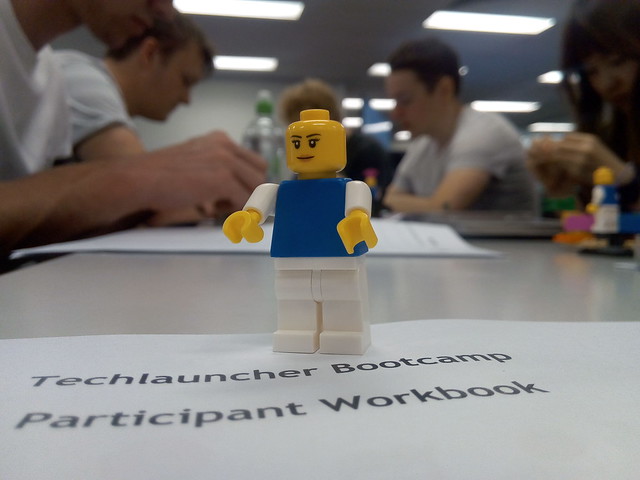
Students taking part in a  Lego Serious Play exercise at the Australian National University in Canberra Sunday, February 25, 2018

ANU Project Bootcamp with Lego and User Centered Process

On Saturday I participated in the TechLauncher "Bootcamp" at the Australian National University in Canberra. There were about three hundred students who had been formed into about fifty teams of six students each, after Thursday night's team formation exercise. Each team has a tutor and a client, plus there as some mentors to help teams in areas such as social enterprises.

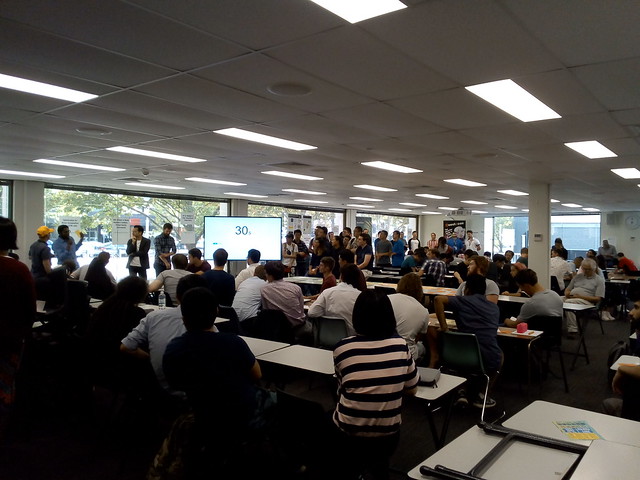
A flat floor large classroom at ANU, with large mobile LCD screens used to relay presentation to the back of the room. Thursday, February 22, 2018

Team Formation Exercise in ANU Large Flat Floor Classroom

Greetings from the TechLauncher Team Formation event at the Australian National University in Canberra. There are more than three hundred students hearing 30 second pitches from potential clients. The students then select the project they prefer and form a team. They have a year to build what the client wants, which is usually software, but could be engineering hardware.

Monday, December 11, 2017

Join Genevieve Bell's 3A Institute of AI at ANU to Change the World

The new Autonomy, Agency and Assurance Innovation Institute (3A Institute) at the Australian National University is seeking two Associate Professors and three postdoctoral/research fellows. The new staff will work with Professor Genevieve Bell at the 3A Institute "... to build a new applied science around the management of artificial intelligence, data and technology and of their impact on humanity". It is not every day you are invited to change the world. ;-)

ps: Dr Bell's is down the corridor from mine at the
ANU College of Engineering & Computer Science in Canberra. It will be interesting to see what develops.