

Greetings from the inaugural IDEATE Summit at the Australian National University. The Vice Chancellor opened proceedings with a St Crispin's Day type speech. She talked passionately about the difficulties of opening university up to a more diverse range of students and staff. As a first in family university student from a low SES background, with limited literacy, I have a direct interest in this as well as having studied the topic as an educator (ironically I typed "optic" rather than topic, before the spell checker intervened).
The Summit is intended to be an annual event for leaders from in computer science and engineering teaching to work on more inclusion and more ralivant skills for graduates:
"understanding the current state of diversity in university technology courses;
sharing lessons learned and putting success stories into context for initiatives across universities; and
collaborating on ways to overcome barriers to inclusive learning, or to recruiting greater diversity among students and staff." From: IDEATE Summit, 2025
My approach to inclusion at university is to provide online and blended options. As well as making access easier, the limitation of online learning design requires a more structured, more explicit approach which I found helped me as a student. Also I would like to see more students start in the Vocational Education Training (VET) sector, before transitioning to university. We also need to explicitly teach and test soft skills: how to give a presentation, organise a team ...
ps: One of the presenters said they had to "reset the North Star" of their organisation. I had to look this up, as I am from the southern hemisphere.
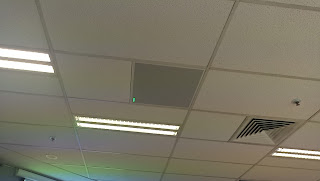 |
| Ceiling microphone in Room N101 |
The terminology used at ANU is:
"Hybrid: ... more than one method, though NOT at the same time.Dual Delivery: ... with students in the physical space on campus while simultaneously having students online for the live session. ..."
So ANU hybrid is what is called blended elsewhere, and ANU Dual Delivery is called hybrid, or hyflex, elsewhere.
N101 is no stranger to advanced equipment, being the seminar room for the computing researchers, as well as previously those from CSIRO. In this room I have helped run global events, including ones helping set networking policy for the nation (with a Senator and two cabinet ministers at one event). This tended to make the room difficult to use for ordinary seminars and teaching, as you could never be sure what equipment was installed, and working. For a time there was a super high definition projection screen covering the whole front wall of the room, used for experiments in remote collaborative working. However, this made it difficult to just show some slides. There were also sockets for connection to different ultrahigh speed networks, but sometimes it was difficult to get ordinary Internet.
 |
| Diagram of the operation of the Sure MXA910 Ceiling Array Microphone |
The room has now been set up with the ANU's standard teaching equipment for "Dual Delivery (High)". There is a panning camera on the ceiling, along with the largest, most sophisticated microphone I have ever seen, to cover the entire room (a Sure MXA910 Ceiling Array Microphone). The control console on the lectern has been reprogrammed to operate these.
Some other rooms have a "Dual Delivery (Basic)" setup, with a web camera on the lectern pointed at the speaker, and a desktop microphone. Other rooms are "Dual Delivery (BYO)", where the lecturer has to bring their own camera and laptop, to plug into the room system.
By default, the "Dual Delivery (High)" room works much as in the past. If there is a lecture scheduled, sound and vision will be automatically recorded, and provided to enrolled students after the lecture (what ANU calls hybrid mode). If the lecturer wants remote students to be able to join in live to air (synchronously), they are required to manually start Zoom, or Teams, on the computer built into the desk, or on their laptop. This is what ANU is calling Dual Delivery mode. The control panel on the desk can be used to select vision from the inbuilt computer, a laptop connected by HDMI, or a wireless device via WiFi.
Inevitably, this is a complex system, with many options. The lecturer needs to have the options explained to them, and try it out, to become comfortable. After that they will likely decide on a way of working they are comfortable with, and it will likely all just work.
ANU has been through floods, fire, hailstorms, and a pandemic, in the last few years. So it is a good idea to be ready. I now design my teaching to allow for students to attend class on campus face to face. If that is not possible, they can attend live online. If that is not possible, they can download videos and documents, to interact asynchronously. All these options can be available at all times, without changing the course content, or assessment. The key to this is to design first for old fashioned distance education (asynchronous), then add the synchronous online option, and lastly add the classroom option. Starting with a face to face design and then trying to add online options does not work well. That may seem a bold claim to make, but I have been doing, researching, and training in how to do this for ten years.


Round 1
Round 2
Placements begin – week beginning 21 February 2022
The ANU Computing School is now providing its monthly Foundations of Computing Seminars online, as well as free on campus in Canberra. All are welcome to attend free.
Next is:ps: See my own posts on e-voting.Title: The state of “verifiable" online voting: and the ethical problems therein
Speaker: Thomas Haines
Abstract: At present the best theoretical solutions for online voting do not meet the requirements. Moreover, the solutions being used in practice are far weaker than the theoretical best solutions. This talk will examine these three areas and discuss the ethical issues they raise for academics working in the area.
When: Wednesday, 18 August, 2021, at 1pm.
Where: ANU Hanna Neumann (Building 145) Room 1.33. Or, via Zoom.
 |
| Expert Panel |
I am helping out with some project audits of ANU Techlauncher computer students this week. Students have been working for ten weeks in teams for a real client to produce a system. They are audited every few weeks to see how they are doing and to make suggestions for improvements. The clients, and other students have input to this as well as staff. This is an approach which might be applied in other disciplines, to make assessment for useful for learning and prepare graduates for the workplace.
This approach is modeled on real world software engineering practice. I have carried out similar audits at the Defence Department on large projects, some of which were subsequently cancelled (as an expert witness in court cases I have reviewed documentation from projects which should have been cancelled). I thought I should revise the fundamentals and found a Wiki version of the Software Engineering Body of Knowledge (SWEBOK) which doesn't need registration to access (but I am not sure how up to date this is). Chapter 10: Software Quality, 2.3 Reviews and Audits is the relevant part:
"Reviews and audit processes are broadly defined as static—meaning that no software programs or models are executed—examination of software engineering artifacts with respect to standards that have been established by the organization or project for those artifacts. Different types of reviews and audits are distinguished by their purpose, levels of independence, tools and techniques, roles, and by the subject of the activity. Product assurance and process assurance audits are typically conducted by software quality assurance (SQA) personnel who are independent of development teams. Management reviews are conducted by organizational or project management. The engineering staff conducts technical reviews."
Greetings from the project examiners meeting of the Computer School at the Australian National University in Canberra. Due to COVID-19 this is being conducted online, via video conference. The format is much the same as a face to face examiners meeting. The meeting works its way through a spreadsheet (displayed on screen), where each line shows the proposed grades for a student from reviewers, a proposed final grade and color code to indicate if the academic in charge thinks there is consensus. Most are coded green, indicating there is a consensus and these are generally accepted with little discussion. Those coded amber need more discussion, while the red ones have vigorous debate.
In past years the discussion has got quite heated for a few projects, but not today. There were quite a few comments about the difficulty students had due to COVID-19, with some overseas and unable to meet in person with their supervisor. This can also be difficult where students are working on a project with human subjects, but unable to see them in person. However, I was impressed how, despite the difficulties, staff and students were still able to undertake valuable work.
An observer might think there is not much to such a meeting. But behind this are years of work establishing standards. With that all done, the final decisions can be made smoothly.

