Showing posts with label artificial intelligence. Show all posts

Thursday, October 8, 2026

AI Bubble About to Burst?

It seems I am the last IT professional in Canberra to have heard of Firmus Technologies. Late last night, there was a news report, about an AI data center company from Canberra, floating on the stock exchange. There was no Wikipedia entry for the company, so I created one. At least that is what I thought I did. 

This morning, there was no Wikipedia entry. At that point I thought I had dreamed all this. But then I discovered the Wikipedia did not like the references in my article, so it was not approved. In the light of day, I could understand their skepticism. Was the idea to put chips in boxes in warehouses really worth billions? Later I found Marta Khomyn, from Adelaide University's excellent article on the topic. 

In 2008 I suggested palletized data warehouses. The idea was to mount servers on standard stock pallets in a factory. These would then be shipped to a warehouse, where a forklift would then place them in a rack, several stories high. A technician would plug the server's data and power in. 

Firmus idea is similar, in that the processing units are assembled in a factory, then placed in a warehouse, rather than a purpose built data center. One key difference is fluid cooling, which is more efficient. This requires the technician to plug in just two extra couplings: for incoming & outgoing coolant (like a large garden hose fitting). I don't know if they use racks to be able to stack the boxes. 

While a clever idea, is this really worth billions of dollars? Previously I have suggested the current AI boom is a bubble, like the Dot-com bubble of the 1990s. Perhaps that bubble is about to burst.

Here is the rejected Wikipedia entry, generated by Google AI:

Firmus Grid Limited, trading as Firmus Technologies (commonly known as Firmus), is an Australian artificial intelligence (AI) infrastructure and cloud computing company. Headquartered in Sydney, the company designs, manufactures, and operates modular, liquid-cooled compute facilities known as "AI Factories." Unlike traditional data center providers that lease physical space and power to clients, Firmus purchases, houses, and provisions graphics processing units (GPUs) directly, renting high-performance computing power to technology companies to generate AI tokens.

The company maintains operational infrastructure in Australia and Singapore, with expanding projects across Malaysia and Indonesia. In late 2026, Firmus initiated steps toward listing on the Australian Securities Exchange (ASX) at a targeted valuation of A$43.7 billion, representing one of the largest initial public offerings (IPOs) in Australian corporate history.

History

Firmus was founded in 2019 by Oliver Curtis, Tim Rosenfield, and Jonathan Levee. The company initially operated as a Bitcoin mining venture, utilizing high-density hardware to exploit energy arbitrage markets. As demand shifted toward high-performance machine learning workloads, the company transitioned its core strategy exclusively to building AI infrastructure.

In February 2022, former technology executive Edward Pretty was appointed Chairman of the board. By 2025, the company launched its "HyperCube" platform—a proprietary, factory-built modular system integrating computing, cooling, and power management into a vertical stack designed to optimize power-to-compute ratios.

In late 2025, Firmus announced a major strategic partnership with CDC Data Centres valued at a projected A$73 billion to roll out high-density AI hubs across Australia. However, the three-way relationship between Firmus, CDC, and strategic supplier Nvidia collapsed in early 2026. The partnership was formally dissolved by mutual agreement, shifting Firmus's strategic focus toward independent international expansion.

Throughout 2026, Firmus secured multi-billion-dollar investments to accelerate its infrastructure deployment. In August 2026, the company completed a US$2 billion strategic equity investment round backed by Coatue, Nvidia, and Blackstone Tactical Opportunities. In October 2026, Firmus entered institutional book-build phases to finalize its A$43.7 billion float on the ASX 1.

Technology and Infrastructure

Firmus operates via a "neocloud" business model. The company specializes in building self-contained compute blocks packed with Nvidia hardware, including Blackwell GB300 and H200 HGX platforms. Rather than relying on traditional air conditioning, the hardware uses a specialized liquid-cooling system to support high-density power draws.

The company operates and develops several key sites across the Asia-Pacific region:

  • Australia: Active facilities operate in Melbourne and Canberra (Hume), with large-scale regional hydro-powered projects underway in St. Leonards (Launceston), Tasmania. The company has further proposed mega data center and battery grid developments across South Australia.
  • Singapore: Includes a retrofitted operational 3-megawatt GPU factory deployed at Media Hub in Loyang.
  • Southeast Asia: Developing large-scale capacity pipelines in Malaysia and Indonesia, heavily targeted toward supporting hyper-scaler clients and large language model (LLM) research.

Controversy and Criticism

Firmus's rapid scale and aggressive valuation ahead of its late-2026 IPO have drawn intense scrutiny from financial analysts. Critics and portfolio managers have raised concerns regarding the structural risks of the company’s business model 2. Because Firmus directly owns highly depreciable GPU hardware rather than simply leasing real estate, it faces significant exposure to the hardware lifecycle of Nvidia chips. Additionally, analysts have highlighted concentration risk, as a massive portion of the company's projected future earnings relies on a small handful of foundational tech clients, such as Meta Platforms and OpenAI.

Media coverage has also frequently focused on the background of Co-CEO Oliver Curtis, who was convicted of insider trading in 2016 and served twelve months in prison prior to co-founding Firmus 3.

See also

References

  1. ^ Rowe, David (2026-10-07). "What Firmus is telling investors in the race to IPO finish line". The Australian Financial Review.
  2. ^ "Can data centre company Firmus live up to its blockbuster $43 billion listing value? Why some investors doubt it". The Conversation (2026-10-07).
  3. ^ "Firmus, Australia's great AI hope, just hit a speed bump". The Sydney Morning Herald (2026-10-06).


Monday, September 14, 2026

AI in Practice in Industry

Back in July I took part in"Still figuring out what AI means for your business?", a webinar by Siobhan O'Sullivan for the Future Skills Organisation. This demonstrated the Australian Government sponsored SME AI Coach. FSO have having two new seminars on "AI in Practice" & "AI in Industry, both on 30 September. 

Wednesday, August 12, 2026

Learning AI from a Children's Book

Dr Ben Swift
Yesterday I took part in Ben Swift's "LLMs Unplugged: A tech-free guide to understanding (and teaching) AI" at the Australian National University's College of Systems & Society. The workshop is aimed at school teachers and earns the attendee professional development points. But this would be useful for anyone who wants to understand how Large Learning Models (LLMs) work. I have a technical computing background, so much of this is familiar to me, but this clear fun overview was still very useful.

Ben took us through several exercises using children's story books. The advantage of this is that the source material has a limited vocabulary & repetitive patterns, making analysis easy, and fun. But the exercise could be carried out using government policy documents, or military reports.

The next workshops are 16 September & 25 November.

Wednesday, July 29, 2026

Figuring out AI

Greetings from "Still figuring out what AI means for your business?", a webinar by Siobhan O'Sullivan for the Future Skills Organisation. The Australian Government sponsored the creation of a free "SME AI Coach" to help small businesses learn about AI. 

The clever part of this is that it is not another tedious animated power-point slideshow training package. Instead  the toolkit has a primer to load into an AI tool (such as Claude). The AI then prompts the student for details of their views on AI, their business, and then guiding them through some small simple AI tasks they could try. 

The form of interaction reminds me of the tutor-bots I learned to build with IBM Watson a decade ago, but without the technical setup. Apart from being useful for small business, this is useful example of the sort of AI tutor which school, vocational and university educators could build themselves. The tool will be formally launched next month.

Saturday, July 18, 2026

Agentic Coding Studio

Charles Martin and Ben Swift are offering the course "Agentic Coding Studio" this semester at Australian National University, School of Computing. The idea is to teach professionals how to use AI tools to systematically write computer code. 

Thursday, December 4, 2025

Australian Professional Standards Forum

Greetings from the Professional Standards Forum of the Professional Standards Councils. Today's forum is on AI, with Dr Ryan Payne, University of Canberra. 

The councils set professional standards, including computing. In return members of participating organisations have their liability capped. AI creates many challenges for organisations wanting to ensure their members act legally and ethically. 

Dr Payne claimed that NFTs are making a comeback, which I hadn't noticed. He also mentioned a number of other technologies which have been coming real soon for a long time, but which AI will make mainstream. 

Dr Payne claimed that AI had changed the words MPs use in Parliament and drafted in laws. He then touched on doomsday scenarios of AI optimizing human out of existence, or just subtly nudging human behavior. Of course, given governments, individuals and corporations have engaged in crimes against humanity, so could AI be worse? 

Today Meta started suspending the accounts of children, ahead of the Australian ban. It occurs to me that it should be possible to use AI to make a safer social media for children. I worry that in the next few weeks we will have millions of children suffering real pain and at risk of their lives, due to the ban. 

Then we got to play with Lego! Dr Payne used Lego to explain how a Large Learning Model (LLM) works. This was cleaver, as it got us out of the mode of just looking at Powerpoint slides.

Thursday, September 4, 2025

AI for Student Discuissions

At the moment I am taking part in a webinar on Instructure's IgniteAI. Today's topic is how to use AI to improve student discussions and feedback. This is to enhance the Canvas Learning Management System. Canvas are being modest in the claims for what AI can do for education, using terms like "We are currently developing ... to help ...", rather than saying this is a proven product which can replace the teacher. But the killer application is, I suggest is creating worksheets and quizzes based on your course content. These are useful, easy, quick and reasonably safe application of AI.

Instructure is also working on accessibility test and remediation features. This is possible with third party tools, but it will be handy to have it built in. However, I suggest learning designers still need basic training in accessibility. 

Insight is also providing a general purpose AI tool for the teacher, similar to that provided for office packages and software development tools. Insight claims to be able to use this to identify students needing extra help and provide them with material. One interesting point is if students also get a version of the AI tool to help them. This could be thought of as AI with trainer wheels. 

IgnightAI can be used to chart data from Canvas. This worries me a little, with academics and administrators coming up with correct, but misleading, charts. While much is written about the value of analysis of student data, this is not a substitute for educational training. 

Friday, August 1, 2025

Developing a national sovereign AI strategy

For the first time in a long time this week I missed the launch of the annual Australia’s Digital Pulse, by the Australian Computer Society at the National Press Club (earlier in the day I twisted my knee running for a bus). The report has 10 recommendations. My comments on some:
  1. Develop a national sovereign AI strategy: The ACS is calling for a "long-term vision for sovereign AI development". However, I suggest this should be looking for short term measures. If Australia looks to the long term the strategy will be out of date before it can be implemented. As I suggested for the ACT Government last week, we can look to countries such as Singapore, for mature AI strategies to emulate.

  2. Develop an innovation strategy: The Australian Government is to release a "Strategic Examination of Research and Development", this year. Aligning workforce readiness with innovation by encouraging entrepreneurship is my day job. Government can do more to support startups and scaleups. One area is for defence, where the nation needs new capabilities quickly. Cancelling a few failed big ticket defence projects reliant on overseas suppliers could provide thousands of billions of dollars for local innovation.

  3. Government co-investment in scaleups: Not so sure about this recommendation, as it sounds dangerously like government trying to pick winners. Apart from strategically important areas, such as defence, energy security and availability of vaccines, government should avoid direct investment in scaleups, as they are really, really bad at it. 
  4. Greater incentives for R&D in AI and tech adoption by businesses: ACS point out there is a skills gap in the use of AI by business. The obvious solution, I suggest, is training. Many of the computer project students I teach are planning to work in AI. To them it is not new and exotic, just a tool they are very familiar with. We need vocational education programs which similarly give business people a deep understanding of AI. 
  5. Executives take a digital skills health check: Rather than trying to get C-suite leaders up to scratch on digital capabilities, I suggest political parties, government agencies and company boards need to hire more technocrats. We need some digital professionals running the nation and corporations, not just lawyers who learned a bit about computers.
  6. Promote entry-level pathways for cybersecurity professionals: ACS point out that we simply can't get enough computer professionals to fill cyber security positions. What we can do is take people qualified in allied fields and train them up. This can be done online with vocational education techniques, rather than in university lecture theatres.
  7. Implement an ‘earn while you learn’ scheme: ACS proposes business and government sharing the cost of worker retraining. Unfortunately what has tended to happen is as federal government introduces subsidies for university and vocational education, business and state governments have stopped funding. We have the technology to do the retraining (I spent a decade learning how this works). The problem is to make a watertight agreement on funding which business and states will abide by. Assuming Jobs and Skills Australia release their national skills taxonomy promptly, this can be used (if not someone else can). This can be aligned with the UK based Skills Framework for the Information Age (SFIA), used by ACS. The match will not be perfect. When ACS commissioned me to design a course in Green Computing (way back in 2008), there were no relevant skills in SFIA. I sent SFIA HQ a copy of my course and they added green skills, but that took considerable time.
  8. A national commitment to alternative tech pathways: ACS argues for greater trust in vocational qualifications by business. Another approach to this, I suggest, is the use of the Vocational Degrees, added to the Australian Qualifications Framework in February 2025. With this entry level staff can obtain a certificate and then go on to a degree at the same vocational institution. This should give business more comfort as to the depth of training provided. 

Thursday, July 25, 2024

Future History of AI

Greetings from "AI and Other Scientific Fables" at the ANU School of Cybernetics. We have tech storytellers exploring how AI is changing our lives. Note that the term "Cybernetics." is used in a more social was in this school, than the way the computing profession understands it, as being about technical control systems. The first reading was by Kathryn Gledhill-Tucker of "Campfire". The event ends with a screening of Moonrise and Requiem by Ceridwen Dovey and Rowena Potts (Dovey is the author of "Life After Truth"). The event is in person and live online.

I wrote some future history for an ACT Government project "Canberra 2020: World Information Capital" (Informatics Magazine, September 1993). In this I had Canberra as the capital of the world, with a massive computer complex providing world government from under the Bruce Technology Park. The original version had an automated missile defence system nicknamed "Skywalker" shooting down an off course light aircraft. In a case of life imitating art, decades later I was tutoring a team of students helping test the radar for Australia's anti-missile system (there is a test radar for this in Canberra). 

Wednesday, May 29, 2024

Researching Floods with AI

Dr Yossi Matias, 
Head of Google Research 
Greetings from the Australian National University in Canberra where Yossi Matias,  Head of Google Research is visiting to talk about their work. 

One example is Google's flood and fire information for the public. I first came on Google's work in this area 10 years at an unconference at ANU. I had helped with an emergency management system so was bemused when someone I took to be a school student got up and talked about emergency management. It turned out they were a Google engineer with extensive experience.

Wednesday, December 13, 2023

AI in Society

Greetings from the Australian National University 2023 AI in Society Workshop. This is run by ANU Humanising Machine Intelligence. Some topics are Design Justice AI, Critical AI in the art museum, AITA and daily moral decisions, Robot Decision-making with Humans-in-the-loop. First up is James Bailie from Harvard University on Privacy, Data Privacy, and Differential Privacy 
(there is an earlier paper from him available). He started with the right to be let alone, then moved on to data privacy (although I don't know what non-data privacy is). Next was the concept of privacy via randomized responses, where randomness is added to protect individual privacy. 


ps: The subsequent presentations raised some interesting questions on timely topics. However, what is needed is to take the next step to practical implementation. As well as raising interesting areas for further research, this would also provide benifit to the community. 

Friday, October 21, 2022

GPT3 + AI: What is the human value in light of AI developments?

Next week I am helping with a webinar on AI and education (announcement below). AI has the potential to help students, by providing very dedicated personal tutoring, but risks making plagiarism much worse. In 2018 I took part in a workshop were participants built a tutor chatbot. Even in this primitive form it had potential for answering routine questions from students. However, that for of AI required the knowledge to be manually encoded by an expert. Much attention in recent years has been on AI which learns for itself. The OpenAI research laboratory, with for-profit and non-profit arms has come to prominence with AI trained using material on the Internet. Best known is GPT3, which can answer questions and write text. The Openai beta provide a simple question and answer demonstration. I had fun asking the algorithm some questions:

Q: How can we stop students cheating?

A: There is no one answer to this question as the reasons why students cheat vary. Some possible solutions include increasing the consequences for cheating, providing more opportunities for academic help, and increasing the difficulty of assignments.

A very plausible answer, although the first sentence could apply to anything. As one person at the seminar commented, it is the sort of answer a politician gives: vague on details.

Q. How successful was Online Learning during the COVID-19 Pandemic?

A: There is no one-size-fits-all answer to this question, as the success of online learning during the COVID-19 pandemic depends on a variety of factors, including the type of online learning platform used, the quality of the online learning content, the students' prior experience with online learning, and the students' level of motivation. However, overall, online learning appears to have been successful for many students during the COVID-19 pandemic.

The start of this answer seems to use the same formula as thew previous one, to say there are many factors. It has that same vague quality to the balance of the answer.

Q: Who is Tom Worthington?

A; Tom Worthington is an Australian information technology academic, consultant and commentator. He is a Fellow of the Australian Computer Society and a Visiting Fellow in the Research School of Computer Science at the Australian National University.

A bit out of date: I am now an Honorary Senior Lecturer, and the School is now just "Computing".

What is more worrying is that AI has reached the point where it could write a plausible student paper. One way to address this is to use AI to look for the characteristics of AI written work. Another is to teach students about AI, and where it can be legitimately used.


GPT3 + AI: What is the human value in light of AI developments?

presented by The ASCILITE Mobile Learning SIG
28 October @ 10:00 am - 11:00 am AEST Free

In this presentation, the ASCILITE Mobile Learning Special Interest Group members will explore the implications of Artificial Intelligence for higher education. The panel will demo some of the current possibilities with AI generators for Art, Text, Video and Assessment. This will be followed by a discussion of the state of the art of AI and implications.

Thursday, September 1, 2022

Digital Legislation

Greetings from the Australasian National University where Dr. Guido Governatori is speaking on "Digital Legislation" at a AI, ML and Friends Seminar. The idea is to have legislation which computers can read and interpret as computer code. Dr. Governatori commented he was not talking about Robodebt, which failed due to a data problem, with social services not having tax data. He said he would talk about smart contracts, which are neither smart, or contracts. The claim is that this will reduce the burden on business, as an automated system can work though all the legal obligations. However, I suggest this might increase the burden, as it would allow much more, and more intricate legislation to be written. Also not only black letter law, issued by the legislature will be need to be encoded, but also case law from courts. 

Tuesday, June 21, 2022

Academic integrity and AI

 Just attended the ASCILITE seminar "A positive approach to academic integrity and the potential future of artificial intelligence", with Ishpal Sandhu & Patrick Lynch,from RMIT University. They discussed the potential and pitfalls of AI with issues such as student plagiarism. One of the audience asked how they could see the tools used, without signing up to a contract cheating site. So I did a quick search and found an interface to an AI system. I asked it a few questions, and got answers which seem very plausible, at a casual glance:

Q: How can we stop students cheating?

A: There is no one answer to this question as the reasons why students cheat vary. Some possible solutions include increasing the consequences for cheating, providing more opportunities for academic help, and increasing the difficulty of assignments.

A very plausible answer, although the first sentence could apply to anything. As one person at the seminar commented, it is the sort of answer a politician gives: vague on details.

Q. How successful was Online Learning during the COVID-19 Pandemic?

A: There is no one-size-fits-all answer to this question, as the success of online learning during the COVID-19 pandemic depends on a variety of factors, including the type of online learning platform used, the quality of the online learning content, the students' prior experience with online learning, and the students' level of motivation. However, overall, online learning appears to have been successful for many students during the COVID-19 pandemic.

The start of this answer seems to use the same formula as thew previous one, to say there are many factors. It has that same vague quality to the balance of the answer.

Q: Who is Tom Worthington?

A; Tom Worthington is an Australian information technology academic, consultant and commentator. He is a Fellow of the Australian Computer Society and a Visiting Fellow in the Research School of Computer Science at the Australian National University.

A bit out of date: I am now an Honorary Senior Lecturer, and the School is now just "Computing".


Tuesday, May 10, 2022

Toby Walsh not in conversation with Andrew Leigh on the Morality of AI

Toby Walsh
& 
Andrew Leigh at
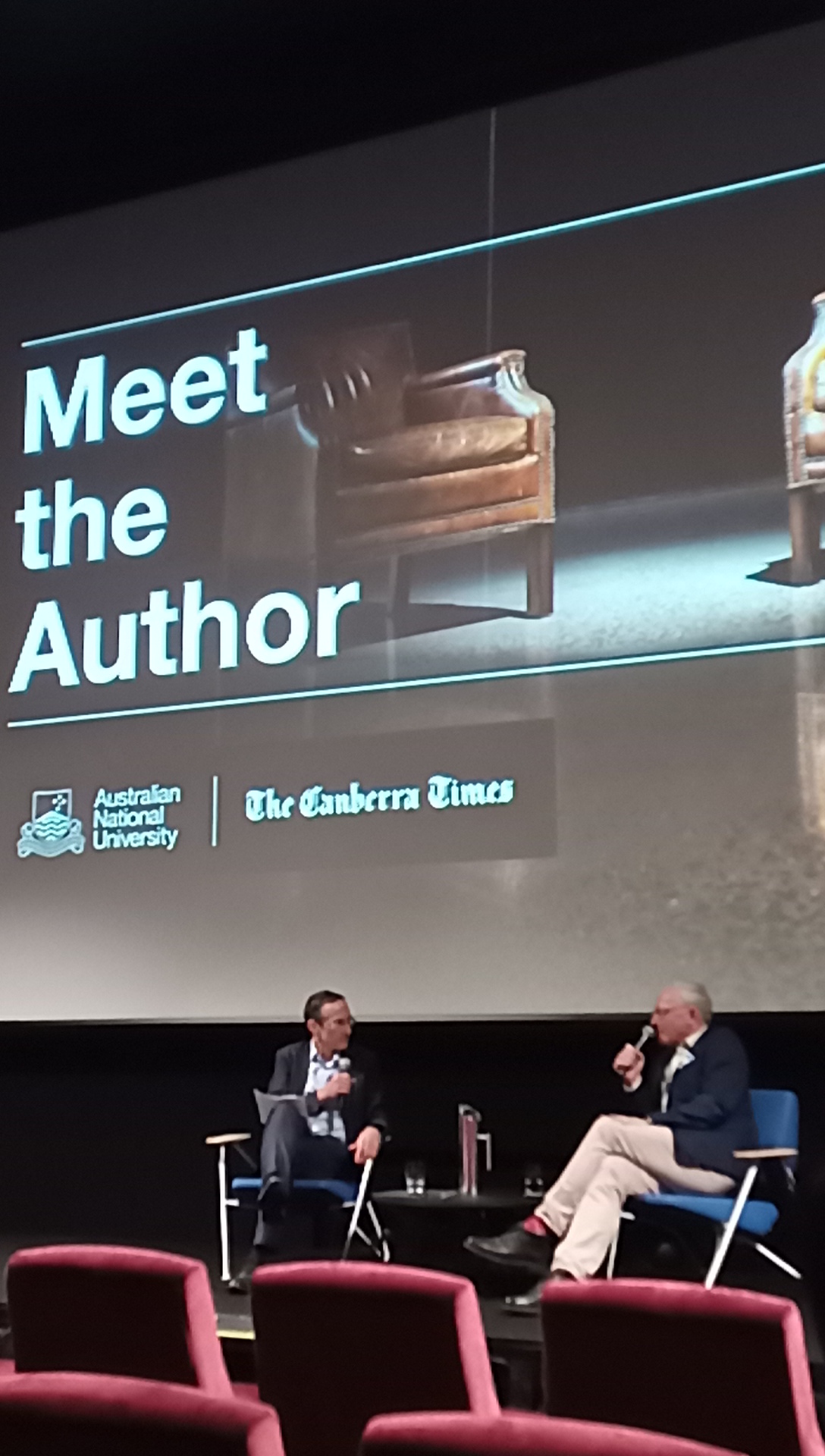
ANU Meet the Author 
Greetings from the Australian National University (ANU) where Professor Toby Walsh is supposed to be in conversation with Andrew Leigh MP, on Toby's book "Machines Behaving Badly: The Morality of AI". Andrew, is our local MP, and a former ANU lecturer, but he stuck on his way back from Jervis Bay, where he has been working on improving telecommunications (Ironic given the topic of the talk, and that this is Australia's high tech capital). Toby started with an anecdote about a Google AI system which umms in its synthetic voice to sound more human. Andrew turned up and apologized his Tesla ran out of charge due to a non-functioning super charger (also ironic).

Toby gave a broad definition of AI, as being something a computer does which would be considered intelligent for a person. That seems reasonable to me. In practice most AI works by "training" software with lots of examples.

Toby seems, as he says, to be a glass-half-empty person. One negative outcomes of cheap mass air travel, he claimed, was the spread of Hong Kong flu. He went on to mention that most of the small number of people developing AI are while males "on the spectrum", so the rest of the world gets left out.

However, not all the faults of AI can be blamed on the AI, or the people who built it. Another example given by Toby was software making sentence recommendations in the USA, which turned out to be biased against non-white defendants. However, the software was just doing what humans previously did. The software highlighted an existing bias. 

In the Australian situation with Robodebt, there was systematic persecution of a group of disadvantaged people by the Australian Government.  However, this can't really be blamed on AI. There was not very sophisticated software used for this project, so it is not the case that the discriminatory behavior emerged from AI, it was designed into the project. It was clear from the outset that disadvantaged groups who did not vote for the parties making up the government were to be targeted. In a way it might have been better had AI been used, so the illegal nature of the project could have been clear from the outset.

Toby went on to mention intelligence is not just one thing, and consciousnesses is an illusion: we are a collection of intelligences. Andrew raised an interesting question as to if robots should have rights. I was not convinced by Toby's response that robots are not self aware and so do not suffer. However, the same argument used to allow the mistreatment of animals, which today would get you arrested.

The conversation then got on to free will, and consciousness. Toby argues AI research might provide insights. 

Toby ended by proposing "Turing's Red Flag". The idea is to have a warning sign to say you are interacting with a machine, not a human. I don't find this convincing as many people working for organisations are so constrained in what they can say and do their behavior is just as constrained and predetermined as a machine.

ps: One of Professor Walsh's previous books "It's Alive!: Artificial Intelligence from the Logic Piano to Killer Robots". Economist William Stanley Jevons, best known for the Jevons paradox, had a Logic Piano built in 1886, after living in Sydney.

Tuesday, December 17, 2019

Machine Learning Innovation Report

Karen Andrews MP,
Minister for Industry,
Science & Technology
The report "Machine Learning Innovation:A Patent Analytics Report" by IP Australia for for the Australian Computer Society, is now available. A major finding of the report is that China dominates machine learning patents, having filed 69% of the global total since 2012. One government owned Chinese electric utility is responsible for 3% of these patents globally. The report was launched today by Karen Andrews MP, Minister for Industry, Science and Technology.

Key Report Findings

  1. 36,740 patent families have been filed in machine learning technologies since 2012.
  2. 25,319 originate from China.
  3. Machine learning patent filings have grown 27% or more every year since 2012.
  4. 91% of AI and machine learning related patent families are in an active state.
  5. The State Grid Corporation of China is the top global innovator, with 1,018 active patent families (88% are active).
  6. China is the largest filing destination in the world, while Australia is 10th.
  7. Australian innovators rank 17th globally, with 59 patent families.
  8. The telecommunications sector leads real world applications of machine learning, with 17% of patent applications.
  9. Image and video analysis is the largest core capability application, with 36% of patent applications.
From Summary,  Machine Learning Innovation:A Patent Analytics Report,  IP Australia, December 2019 (numbering added)
The direction China may want to take AI could be troubling for other countries. As an example, at the recent education conference an academic from a Chinese university presented research on an AI system for monitoring student attention. A camera observes the facial expressions of all students in the classroom at all times, and from this prepares a report on who is paying attention. This is used to prepare reports not only about the student's behavior, but the performance of the teacher. There was some disquiet among the delegates at the Orwellian nature of this. However, the presenter pointed out that the research showed it was very effective. As a result, this approach may find its way into classrooms in other countries.

ps: Kate Crawford, Principal Researcher at Microsoft Research, will talk on "AI and Power: From Bias to Justice" at ANU, 5:30pm today.

Friday, July 19, 2019

3Ai Masters 2020 Program Open

Applications are open for the 3Ai Masters 2020 program. This is at the  Autonomy, Agency and Assurance Innovation Institute (3Ai), set up by Professor Genevieve Bell, at the Australian National University in Canberra. Exactly what the Institute does it a bit hard to explain. They say "... we are building the knowledge and tools needed to ensure that as technology advances, humanity advances with it ...".

I have had the pleasure of sitting in the ANU Computer Science and Information Technology common room with the first cohort of students. They are a diverse and interesting collection of people. Some are hard core computer nerds, but with a wide range of interests.

Wednesday, March 27, 2019

Artificial intelligence and ethics: challenges and responsibilities

Greetings from the Australian National University in Canberra, where Brad Smith, Global President and Chief Legal Officer of Microsoft, is speaking on Artificial intelligence and ethics: challenges and responsibilities. In his introduction, the ANU VC expressed concern over the lack of broadband access around Canberra. He also mentioned the ANU 3AI Institute students who are looking at issues of technology and people (I am sitting in the audience with the students).

This is the second presentation this week on the implications of technology. Yesterday Lieutenant Colonel Keirin Joyce, UAS Sub-Program Manager for the Australian Army talked on "Drones for Good". He handed around a "Black Hornet Nano" advanced military drone, about the size of my thumb. He pointed out that such devices are not "intelligent", they only follow pre-programmed instructions. He also mentioned that drones had been used extensively for disaster relief in the recent Queensland floods.

Brad Smith also was downplaying the current state of AI. He suggested there had been and would not be a sudden achievement of AI. Instead increased computational power and access to data make AI gradually possible. He pointed out some AI is already in routine use, such as in cars for detecting people in the vehicle's path.

Brad Smith raised the issue of ethics with AI and weapons. While suggesting that the laws of war needed to take this into account, he had no specific proposals. I suggest a good start would be for Microsoft to call for China, the United States, and Russia to sign the Ottawa Treaty Banning Anti-Personnel Mines (Australia joined in 1999).

Brad Smith warned of a world like Nineteen Eighty-Four, with routine mass surveillance of the public, preventing free assembly. He proposed laws to limit such surveillance to where there is a court order or an imminent threat. However, Microsoft provides technology which could be used to create a surveillance state. One ethical approach would be for Microsoft to not supply its technology to countries which did not have suitable citizen protections.

Brad Smith ended by raising the issue of a need for a global approach to the issues. One of last slides in the presentation showed statues of Confucius, and Socrates, hinting at the differences of views between China and the West.

Well, I thought that was the end of the talk, but Brad Smith ended on a more positive note, by pointing out three Microsoft initiatives: AI for Earth, AI for Accessibility,  and AI for Humanitarian Action.

Friday, February 15, 2019

New Applied Science of Cyber-physical Systems

Greetings from the opening of the new Autonomy, Agency and Assurance Innovation Institute (3Ai) at the Australian National University in Canberra. Professor Genevieve Bell, aims to create a new applied science to address the challenge of cyber-physical systems.

The institute has started with sixteen masters students, who will help work out what this new discipline is. The emphasis is on "cross disciplinary" work. For 2019, there are courses, starting with "Fundamentals of a New Applied Science I" (CECS6001).

Inventing a new discipline, while teaching it, is something rarely attempted, and even more rarely succeeds. I suggest the new Institute would benefit from studying past attempts and having the students research these. 

One example is Environmental Studies at Griffith University:
"Australian Environmental Studies was so near the academic cutting edge in the early seventies that the primary challenge for the first Chairman, Professor Calvin Rose, was to determine what actually constituted the field of environmental studies." From: Preparing for the Future: A History of Griffith University, Noel Quirke, 1996, p. 11 
Environmental Studies continue today at Griffith University. A better known international example is the Bauhaus, a German art and design school of the early 20th Century. The organization suffered internal conflict and external pressure. I was invited to talk to the Bauhaus Dessau", but while this occupies the original premises, it has a limited and less radical outlook.

ps: I first came across Professor Bell, in 2009 with the Realising Our Broadband Future forum. Then in 2010, speaking at the NLA in Canberra on The Future is Messy, the next week I bumped into her at the SA Library in Adelaide cafe. She was cited in the 2011Regional Telecommunications Review. Then in 2017, it was announced she was joining us at ANU.

Reference

Sunday, February 3, 2019

Launch of the ANU 3Ai Masters Program 15 February

The Australian National University's new Autonomy, Agency and Assurance Innovation Institute (3Ai) will be launching its first masters program 15 February 2019 in Canberra. Founded by Professor Genevieve Bell, 3Ai aims to create a new applied science to address the challenge of cyber-physical systems. Exactly what that is, I am not sure, but it will make for some interesting discussions. The Institute just a few steps from my office at ANU. ;-)