Professor Ken Baldwin, Director of the ANU Energy Change Institute, then gave the history as to how Australia ended up in the unusual situation of the government abandoning its has no effective energy policy, and the opposition adopting. He commented that while there had been a lack of government policy, industry had powered ahead.with renewable energy. He projected that renewable will take over from fossil fuel in Australia by 2024. At the current rate Australia will exceed its renewable energy target by 2020 and exceed emissions reduction targets. Even so, Professor Baldwin said that the certainty of policy was needed for this investment to continue, and for energy prices to be contained. Or as Jane Austen might have said: "It is a truth universally acknowledged, that a country in possession of a good energy demand, must be in want of a carbon price."
Showing posts with label ANU Energy Change. Show all posts
Thursday, November 29, 2018
Public Policy as a Canberra Export
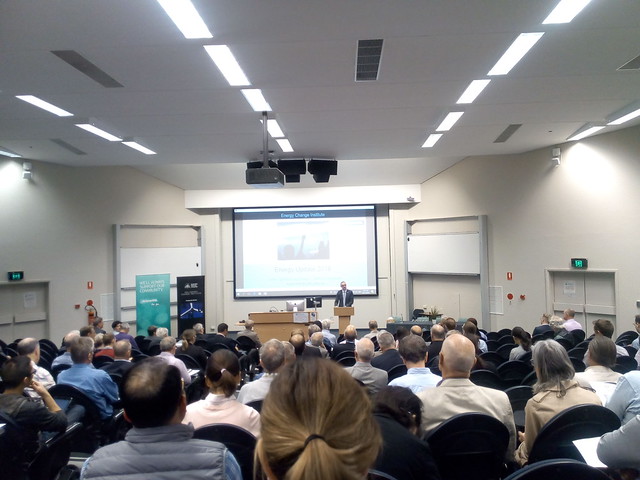
Greetings from the Australian National University in Canberra, where Andrew Barr, ACT Chief Minister is addressing the ANU Energy Update 2018. He mentioned that the ACT Government (the local government for Canberra), had worked with Reposit Power, to produce a virtual power station (claimed to the the world's largest). The Chief Minister also commented that one of Canberra's exports was policy, including energy policy.
Professor Ken Baldwin, Director of the ANU Energy Change Institute, then gave the history as to how Australia ended up in the unusual situation of the government abandoning its has no effective energy policy, and the opposition adopting. He commented that while there had been a lack of government policy, industry had powered ahead.with renewable energy. He projected that renewable will take over from fossil fuel in Australia by 2024. At the current rate Australia will exceed its renewable energy target by 2020 and exceed emissions reduction targets. Even so, Professor Baldwin said that the certainty of policy was needed for this investment to continue, and for energy prices to be contained. Or as Jane Austen might have said: "It is a truth universally acknowledged, that a country in possession of a good energy demand, must be in want of a carbon price."
Wednesday, November 29, 2017
How quickly can a pumped hydro system be built?
Greetings from the Australian National University in Canberra, where the ANU Energy Update 2017 is ending. The last speaker is speaker Ms Audrey Zibelman, CEO Australian Energy Market Operator (AEMO). She pointed out that the world's largest battery was installed in South Australia in only a few months and a new solar farm was increased in Queensland similarly quickly. It occurred to me that there could be an opportunity for similarly fast installation of pumped-storage hydroelectricity.
While batteries are useful for storing power for a few minutes or hours, renewable energy systems need days of storage. ANU's Professor Blakers (who is at the event today) has identified 22,000 potential pumped hydro sites in Australia. However, building reservoirs, pipes, pumps, turbines and grid connection can take ten years.
It is not feasible to build a pumped hydro system in the few months it took for South Australia's battery, but it may be feasible in one or two years. This would place the option within the decision cycle of Australian governments and business.
The time to build a pumped hydro system could be shortened using modern project management and manufacturing techniques. The site could be surveyed using satellite and drones. At the same time the site's social and legal issues would be examined on-line.
The dams, pipes, and buildings could be manufactured in standardized modules which can be shipped across the world in standard container loads.
The turbines and pumps could be additive manufactured. Australian researchers produced a 3D printed a gas turbine in 2016.Multiple small units could be used, for ease of manufacture, transport and installation (at the cost of efficiency). Units could be made small enough to be transported to the site by heavy lift helicopter.
As a quick back-of-the-envelope calculation, consider how many modular industrial water tanks would be needed to store as much energy as the SA 129MWh battery. Modular steel water tanks are available with a 748kl capacity (5.6m tall x 13 m diameter). Using the Simplified PHES Calculator (Andrew Blakers, Matt Stocks, Bin Lu, Kirsten Anderson and Anna Nadolny), with a 300 m head each tank will store 0.4 MWh of energy. So 323 tanks would be required to store as much energy as the SA battery. The materials for each tank would be within the capacity of a heavy lift helicopter, removing the need to build a road to the mountain top.
Pumped hydro systems could be built in stages, so they can start producing power (and revenue), with extra modules added later.
It would be tempting to focus on the engineering aspects of such a project: the 3D printed turbines and modular pipework. However, it is likely to be the planning of the land use which will create the greatest obstacles. One technique which has been found to be effective in Europe in reducing complaints about wind turbines from the local community is to offer them a financial stake in the project. The same may work with pumped hydro.
It is very difficult to convince a politician to fund a project which will not be completed for a decade, long after the next election, or a business-person long after their bonus has been calculated. It would be very much easier if they can see progress in months and completion in a few years.
This might be a suitable project for the Canberra Innovation Network (CBRIN) or the Renewables Innovation Hub.
While batteries are useful for storing power for a few minutes or hours, renewable energy systems need days of storage. ANU's Professor Blakers (who is at the event today) has identified 22,000 potential pumped hydro sites in Australia. However, building reservoirs, pipes, pumps, turbines and grid connection can take ten years.
It is not feasible to build a pumped hydro system in the few months it took for South Australia's battery, but it may be feasible in one or two years. This would place the option within the decision cycle of Australian governments and business.
The time to build a pumped hydro system could be shortened using modern project management and manufacturing techniques. The site could be surveyed using satellite and drones. At the same time the site's social and legal issues would be examined on-line.
The dams, pipes, and buildings could be manufactured in standardized modules which can be shipped across the world in standard container loads.
The turbines and pumps could be additive manufactured. Australian researchers produced a 3D printed a gas turbine in 2016.Multiple small units could be used, for ease of manufacture, transport and installation (at the cost of efficiency). Units could be made small enough to be transported to the site by heavy lift helicopter.
As a quick back-of-the-envelope calculation, consider how many modular industrial water tanks would be needed to store as much energy as the SA 129MWh battery. Modular steel water tanks are available with a 748kl capacity (5.6m tall x 13 m diameter). Using the Simplified PHES Calculator (Andrew Blakers, Matt Stocks, Bin Lu, Kirsten Anderson and Anna Nadolny), with a 300 m head each tank will store 0.4 MWh of energy. So 323 tanks would be required to store as much energy as the SA battery. The materials for each tank would be within the capacity of a heavy lift helicopter, removing the need to build a road to the mountain top.
Pumped hydro systems could be built in stages, so they can start producing power (and revenue), with extra modules added later.
It would be tempting to focus on the engineering aspects of such a project: the 3D printed turbines and modular pipework. However, it is likely to be the planning of the land use which will create the greatest obstacles. One technique which has been found to be effective in Europe in reducing complaints about wind turbines from the local community is to offer them a financial stake in the project. The same may work with pumped hydro.
It is very difficult to convince a politician to fund a project which will not be completed for a decade, long after the next election, or a business-person long after their bonus has been calculated. It would be very much easier if they can see progress in months and completion in a few years.
This might be a suitable project for the Canberra Innovation Network (CBRIN) or the Renewables Innovation Hub.
ANU Energy Update 2017
Greetings from the Australian National University in Canberra, where the ANU Energy Update 2017 just opened. The keynote speaker: are Dr Alan Finkel, Chief Scientist and Ms Audrey Zibelman, CEO Australian Energy Market Operator (AEMO).
The opening address is by Dr Mike Kelly, Shadow Assistant Minister for Defence Industry and Support. Dr Kelly pointed out the defence dimensions of energy policy. He also described the Snowy Hyro Scheme as the "grandfather of renewable energy". He pointed out that the renewable energy stored in the Snowy Hyrdo Scheme now comes from sources including South Australian wind farms.
ANU Energy Change Institute
2017 Energy Update and Solar Oration
Program
8.00-8.30 Registration
8.30-9.00 Introduction: Professor Ken Baldwin, Director, ANU Energy Change Institute
Welcome: Professor Brian Schmidt, Vice-Chancellor, ANU
Opening Address: The Honorable Dr Mike Kelly, Shadow Assistant Minister for Defence Industry and Support
9.00-10.15
Keynote address: Implementing the National Electricity Market Review, Dr Alan Finkel, Chief Scientist
10.15-11.00 Morning Tea11.00-12.30 Special Presentation on the 2017 World Energy Outlook, Mr Ian Cronshaw, International Energy Agency (IEA), Paris
12.30-13.30 Lunch13.30-15.00 WEO2017 focus theme, China’s Energy OutlookProfessor Frank Jotzo, Crawford School of Public Policy,
Panel discussion and Q&A
Mr Qiang Wang, Embassy of the P.R. China in AustraliaDr Xunpeng (Roc) Shi, University of Technology Sydney
Mr Ben Jarvis, Department of Foreign Affairs and Trade
15.00-15.30 Afternoon Tea
15.30-17.00 WEO2017 focus theme – Making Sense of Australian Gas Policy
Presentation by Professor Quentin Grafton, Crawford School of Public PolicyPanel discussion and Q&A
17.00-17.10 Dr Ross Lambie, Department of the Environment and EnergyMr Damian Dwyer, Australian Petroleum Production & Exploration Association
Dr Justine Lacey, CSIRO Land and Water
Closing remarks - Professor Ken Baldwin, Director, Energy Change Institute
ACT Government/ANU Solar Oration Program
(also held in the Copland Theatre)
17.15 Finger food and drinks served in the foyer
18.00 Welcome
Professor Michael Cardew-Hall, ANU Pro-Vice Chancellor (Innovation)
18.02 Update on progress towards 100% renewable energy in the ACT and
presentation of student prize.
Mr Shane Rattenbury, ACT Minister for Climate Change and Sustainability
18.08 Introduction
Professor Andrew Blakers, Research School of Engineering
18.10 The Australian Energy Transition Ms Audrey Zibelman, CEO of the Australian Energy Market Operator
19.10 Q&A
19.40 Close
Subscribe to:
Comments (Atom)
