Showing posts with label Arizona State University. Show all posts

Friday, July 22, 2016

Designing a New University

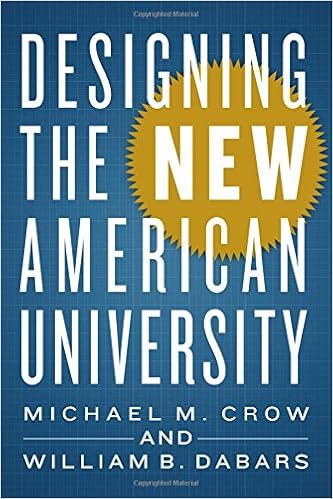
Speaking on ABC Radio National this morning, Michael Crow, President of Arizona State University (ASU), talked about how they increased graduation rates of disadvantaged students. One measure was to return to an admission standard from the 1950's, with students requiring a B average in high school and preparatory courses. Professor Crow is author of "Designing the New American University" (with William B. Dabars). The book expands on the issue of selective admission (Page 33), citing Douglass (2007, p. 42).

While not mentioned in the interview, I noticed that ASU sponsors "ASU Preparatory Academies". These are K to 12 schools with specific programs to prepare students for university, including critical thinking and "deep learning experiences". There is a risk with this approach that schools will focus on meeting university entrance requirements and not provide students with broader skills. However, if the university requirements are broad, then both aims could be met.

Professor Crow also mentioned that Arizona State had 75,000 on-campus and 25,000 on-line students. That seems the wrong mix to me and the ideal would be 20,000 on-campus, plus 80,000 on-line.

References

Crow, Michael M & Dabars, William B (2015). Designing the new American university. Baltimore, Maryland Johns Hopkins University Press

Douglass, John Aubrey & ebrary, Inc (2007). The conditions for admission : access, equity, and the social contract of public universities. Stanford University Press, Stanford, Calif

Tuesday, March 1, 2016

MOOCs a Screening Tool for E-learning Ready Students?

In "Better 21C Credentials: Evaluating the promise, perils and disruptive potential of digital credentials" Oliver (2016) points out that an alliance of six universities, including University of Queensland and the Australian National University are proposing to give students credit towards a university degree for massive open on-line courses (MOOCs) undertaken at each others institution.

Oliver suggests "The business plan underpinning this venture is likely to be aimed at scaling online degrees, and ensuring that students who convert from MOOCs are retained and complete remaining units at the usual university fee" (Oliver, p. 11, 2016). However, another reason for offering students credit for a MOOC is to screen applicants for their ability to complete a course relatively independently, at a low cost to the institution.

There are already several schemes for EdX students to earn university credit, however, these are mostly sponsored by a single university and limited to that university's edX courses. Global Freshman Academy, allows edX courses to be counted towards first year at Arizona State University, Charter Oak State College offer edX credit. The ACE Alternative Credit Project from the American Council on Education (ACE), offers an "official" ACE transcript, however, there are only three edX maths courses currently offered (through Boston University).

MIT Micro-Master's


The most unusual of the edX credit offerings is the MIT Micro-Master's Credential in Supply Chain Management. The other edX credit offerings have the student complete edX courses and then a capstone project, for credit towards the first year of an undergraduate degree. However, the MIT is offering a credential called a "MITx MicroMaster’s" on completion of the on-line courses and then a Masters degree, after the student completes a further one semester on campus.

The MIT Micro-Master's seems at odds with the idea of open access courses, which anyone can do with no prerequisites. A Masters degree normally requires the student to have completed a prior degree. The fine print says "the “MicroMaster’s, which will be granted by MITx (MIT’s online learning initiative) to students who do exceptionally well in a given set of graduate-level online courses and do well in a subsequent exam". Given that less than 10% of students complete an undergraduate level MOOC normally, the chances of them completing a set of graduate level courses and doing "exceptionally well" would seem remote (perhaps one in one thousand students). For the institution this low completion rate may not be a problem as MOOCs are designed for low cost delivery, but for the students and society, this is a waste of human resource.

MOOCs for Student Screening


MOOCs offer very limited staff support to the student and very few of those who enroll complete successfully (usually less than 10%). The students who can successfully complete a MOOC should therefore be more likely to complete a university program, than the average applicant. These students should be easier to teach, at a lower cost, requiring less human supervision. There could therefore be a very great incentive for universities to enroll these students, in preference to those who will require staff support.

Such a strategy will not work if the MOOC screened student is then given conventional lecture and paper based courses. The students may not respond to this format and the university will be wasting resources unnecessarily. But the educational institution does not need to prepare its entire degree program in the form of MOOCs, which would require very high levels of investment (and would be difficult for more advanced topics). Conventional distance education design techniques could be used, supplemented with face-to-face classes, where required.

In particular an institution does not need to make high quality videos, as these do not help with learning (students like videos, but these do not help them learn). Instead the student can be provided with an ebook and activities to undertake, via a learning management system. Courses can be structured to have students work in stoups for mutual support.
Friday, April 24, 2015

EdX Global Freshman Academy


EdX, the on-line course consortium and Arizona State University have announced "Global Freshman Academy", offering introductory university courses. These differ from previous edX courses, being for credit, so they can count towards a university degree. The "Verified Certificate" costs $45 in advance, plus $200 per credit hour if the student passes the course. The course "Introduction to Solar Systems Astronomy" is 4 credit hours, making the total cost of that course $845. Other courses offered initially are Western Civilization: Ancient and Medieval Europe (3 credit hours), Human Origins (3 credit hours). There is also a demonstration course "Welcome to Global Freshman Academy".

An unusual aspect of the Astronomy course is that it is only 8 weeks long (not the more typical 13 weeks for a university course) and requires 18 hours work by the student per week week (not the usual eight to ten hours). As an on-line student myself I have found a course requiring eight to then hours difficult to do while having a day job. This seems to be a common experience and the trend for such on-line courses has been to make them shorter (down to four hours) with less student work per week (as little as four hours), not more.

An interesting aspect of the new edX  Global Freshman Academy is the status of the students. Previous edX students were not really students, as their courses were not for credit. However, these for-credit courses would need to be subject to all the usual university, state and national government rules and laws. The cost of administering these rules and laws would need to be taken into account in working out the fees for the course. As an example, the university has to have courses run thorough a quality control process and students have a right of appeal over their results.

The fees for these courses may need some further explanation. Arizona State University fees foe non-edX courses are $1,993 for 4 credit hours to a Nonresident Online Tuition student. This is more than twice as much as the edX fee. Of course the edX course only costs $45, so if most students fail the edX course it will be cheaper than a regular one for them (the success rate for these type of on-line courses has been low: about 10%). However, in a well designed conventional on-line course progressive assessment is used and a student will know if they are unlikely to pass and be able to withdraw (and get at least a partial refund) before the end of the course.