Greetings from EduTech Asia in Singapore, where Christyl Potgieter, Director, Enterprise Partner Marketing at edX and Dr Paulina Pannen, Senior Expert, Indonesia Cyber Education Institute, Universitas Terbuka are talking on AI, skills and learning. edX has been around for some time, delivering puerly online courses, which were marketed as "MOOCs" Massive Open Online Courses. These did not catch on at traditional universities, but as is being discussed could still find a role to provide shorter qualifications (marketed as "microcredentials") for those who are unable to attend a traditional university program.
Showing posts with label EdX. Show all posts
Showing posts with label EdX. Show all posts
Wednesday, November 5, 2025

Tuesday, August 21, 2018
Online Courses Offered by Australian Universities
In thinking about how Australian higher education might offer blended courses to the region, I decided to look at what is already available. One interesting option is the edX "micromasters" offered by four Australian universities:
Australian universities also offer some online degrees and online versions of campus courses, to their own students and those of other institutions. As an example, the ANU offers twelve undergraduate language subjects through Open Universities Australia. In total ANU offers 116 online courses, of these 30 are undergraduate.
- Australian National University: Evidence-Based Management
- Curtin University: Human Rights,Marketing in a Digital World, Internet of Things (IoT),
- UQ: Business Leadership, Corporate Innovation, Sustainable Energy, Leadership in Global Development
- University of Adelaide: Big Data
Students undertake a series of online courses and then may
undertake some form of capstone project. Students are offered 25% credit (one semester
full time study) towards a Masters, subject to an additional test. This makes the micromasters similar in level and length to an Australian university graduate certificate. However, the micromasters, despite the name, is not itself a qualification under the Australian Qualifications Framework.
Australian universities also offer some online degrees and online versions of campus courses, to their own students and those of other institutions. As an example, the ANU offers twelve undergraduate language subjects through Open Universities Australia. In total ANU offers 116 online courses, of these 30 are undergraduate.
Tuesday, January 17, 2017
Georgia Tech Masters On-line for US$10,000

For comparison, the Masters of Education I recently completed on-line at Athabasca University (Canada) cost about US$15,000. This was with classes of a couple of dozen students and a human tutor. The Georgia Tech Masters is structured similarly to Athabasca, in that the student completes ten courses and then a capstone project.
It is likely that the coursework with capstone will become the standard format for graduate programs, both on-campus and on-line. However, I found the capstone process remarkably difficult. This was remarkable as I was a student of education and was studying the pedagogy of the process, so was much better prepared than the average student would be.
Institutions need to put in place a process to prepare students for the capstone from the start of their program (including assessment of their progress). Leaving it to the end, as students will otherwise do, will extend the time taken and increase the non-completion rate.
Also we may see use of tools such as Mahara's SmartEvidence, to provide more flexibility. This would allow students to show they have met program requirements using a wide range of courses and non-course activities. However, this will require training students (and staff) to think strategically about learning, rather than just ticking boxes to meet requirements. If we could do this we could offer students additional certifications easily, for example in teaching.
Wednesday, September 21, 2016
Australian Universities in EdX MicroMasters
Three Australian universities: ANU, Curtin and Queensland, are offering masters level blended courses as part of EdX MicroMasters Programs. Students can obtain credit towards up to one-quarter of a Masters (six months of the two years full-time study) for completing a series of EdX courses:
The completion rate for the EdX MicroMasters could be expected to be less than 1%. Rather than a low cost university program, the MicroMasters could be seen as a form of extended for-fee university entrance examination. Rafael Reif, MIT President, is quoted as saying EdX MicroMasters is "an experiment in what I call inverted admissions. Anybody anywhere can try to take those courses online."
Under the Australian Qualifications Framework, the EdX MicroMasters is closest to a Graduate Certificate, as part of a nested qualification. The use of the term "Masters" is misleading and may not comply with Australian law.
- Australian National University: Evidence-Based Management
- Curtin University: Human Rights
- The University of Queensland: Leadership in Global Development
The completion rate for the EdX MicroMasters could be expected to be less than 1%. Rather than a low cost university program, the MicroMasters could be seen as a form of extended for-fee university entrance examination. Rafael Reif, MIT President, is quoted as saying EdX MicroMasters is "an experiment in what I call inverted admissions. Anybody anywhere can try to take those courses online."
Under the Australian Qualifications Framework, the EdX MicroMasters is closest to a Graduate Certificate, as part of a nested qualification. The use of the term "Masters" is misleading and may not comply with Australian law.
Tuesday, July 19, 2016
Accessibility Problems with Massive Open Online Courses
Park, Kim and So (2016) found problems with the accessibility of Coursera, edX, and Khan Academy for users with a disability. Particular problems found were with drop-down menus (toggled on mouse is roll-over), dynamic webpage structures (quiz feedback without page reloading), repetitive elements (course description at the top of each page), illogical focus movement (such as back to top of screen not to next item). Many of the problems appear to be with quizzes. Also the mobile versions of the interface were less accessible than the PC based versions. Also user comments appeared to favor down-loadable content (as in more conventional distance education courses).
What the authors did not address is if Learning Management Systems, such as Moodle, which are not designed for MOOCs, have more accessible interfaces.
Reference
Park, K., Kim, H. J.,
& So, H. J. (2016, January). Are Massive Open Online Courses (MOOCs)
Really Open to Everyone?: A Study of Accessibility Evaluation from the
Perspective of Universal Design for Learning. In Proceedings of HCI Korea (pp. 29-36). Hanbit Media, Inc. Retrieved from http://dx.doi.org/10.17210/hcik.2016.01.29
Tuesday, March 1, 2016
MOOCs a Screening Tool for E-learning Ready Students?
In "Better 21C Credentials: Evaluating the promise, perils and disruptive potential of digital credentials" Oliver (2016) points out that an alliance of six universities, including University of Queensland and the Australian National University are proposing to give students credit towards a university degree for massive open on-line courses (MOOCs) undertaken at each others institution.
Oliver suggests "The business plan underpinning this venture is likely to be aimed at scaling online degrees, and ensuring that students who convert from MOOCs are retained and complete remaining units at the usual university fee" (Oliver, p. 11, 2016). However, another reason for offering students credit for a MOOC is to screen applicants for their ability to complete a course relatively independently, at a low cost to the institution.
There are already several schemes for EdX students to earn university credit, however, these are mostly sponsored by a single university and limited to that university's edX courses. Global Freshman Academy, allows edX courses to be counted towards first year at Arizona State University, Charter Oak State College offer edX credit. The ACE Alternative Credit Project from the American Council on Education (ACE), offers an "official" ACE transcript, however, there are only three edX maths courses currently offered (through Boston University).
The most unusual of the edX credit offerings is the MIT Micro-Master's Credential in Supply Chain Management. The other edX credit offerings have the student complete edX courses and then a capstone project, for credit towards the first year of an undergraduate degree. However, the MIT is offering a credential called a "MITx MicroMaster’s" on completion of the on-line courses and then a Masters degree, after the student completes a further one semester on campus.
The MIT Micro-Master's seems at odds with the idea of open access courses, which anyone can do with no prerequisites. A Masters degree normally requires the student to have completed a prior degree. The fine print says "the “MicroMaster’s, which will be granted by MITx (MIT’s online learning initiative) to students who do exceptionally well in a given set of graduate-level online courses and do well in a subsequent exam". Given that less than 10% of students complete an undergraduate level MOOC normally, the chances of them completing a set of graduate level courses and doing "exceptionally well" would seem remote (perhaps one in one thousand students). For the institution this low completion rate may not be a problem as MOOCs are designed for low cost delivery, but for the students and society, this is a waste of human resource.
MOOCs offer very limited staff support to the student and very few of those who enroll complete successfully (usually less than 10%). The students who can successfully complete a MOOC should therefore be more likely to complete a university program, than the average applicant. These students should be easier to teach, at a lower cost, requiring less human supervision. There could therefore be a very great incentive for universities to enroll these students, in preference to those who will require staff support.
Such a strategy will not work if the MOOC screened student is then given conventional lecture and paper based courses. The students may not respond to this format and the university will be wasting resources unnecessarily. But the educational institution does not need to prepare its entire degree program in the form of MOOCs, which would require very high levels of investment (and would be difficult for more advanced topics). Conventional distance education design techniques could be used, supplemented with face-to-face classes, where required.
In particular an institution does not need to make high quality videos, as these do not help with learning (students like videos, but these do not help them learn). Instead the student can be provided with an ebook and activities to undertake, via a learning management system. Courses can be structured to have students work in stoups for mutual support.
Oliver suggests "The business plan underpinning this venture is likely to be aimed at scaling online degrees, and ensuring that students who convert from MOOCs are retained and complete remaining units at the usual university fee" (Oliver, p. 11, 2016). However, another reason for offering students credit for a MOOC is to screen applicants for their ability to complete a course relatively independently, at a low cost to the institution.
There are already several schemes for EdX students to earn university credit, however, these are mostly sponsored by a single university and limited to that university's edX courses. Global Freshman Academy, allows edX courses to be counted towards first year at Arizona State University, Charter Oak State College offer edX credit. The ACE Alternative Credit Project from the American Council on Education (ACE), offers an "official" ACE transcript, however, there are only three edX maths courses currently offered (through Boston University).
MIT Micro-Master's
The most unusual of the edX credit offerings is the MIT Micro-Master's Credential in Supply Chain Management. The other edX credit offerings have the student complete edX courses and then a capstone project, for credit towards the first year of an undergraduate degree. However, the MIT is offering a credential called a "MITx MicroMaster’s" on completion of the on-line courses and then a Masters degree, after the student completes a further one semester on campus.
The MIT Micro-Master's seems at odds with the idea of open access courses, which anyone can do with no prerequisites. A Masters degree normally requires the student to have completed a prior degree. The fine print says "the “MicroMaster’s, which will be granted by MITx (MIT’s online learning initiative) to students who do exceptionally well in a given set of graduate-level online courses and do well in a subsequent exam". Given that less than 10% of students complete an undergraduate level MOOC normally, the chances of them completing a set of graduate level courses and doing "exceptionally well" would seem remote (perhaps one in one thousand students). For the institution this low completion rate may not be a problem as MOOCs are designed for low cost delivery, but for the students and society, this is a waste of human resource.
MOOCs for Student Screening
MOOCs offer very limited staff support to the student and very few of those who enroll complete successfully (usually less than 10%). The students who can successfully complete a MOOC should therefore be more likely to complete a university program, than the average applicant. These students should be easier to teach, at a lower cost, requiring less human supervision. There could therefore be a very great incentive for universities to enroll these students, in preference to those who will require staff support.
Such a strategy will not work if the MOOC screened student is then given conventional lecture and paper based courses. The students may not respond to this format and the university will be wasting resources unnecessarily. But the educational institution does not need to prepare its entire degree program in the form of MOOCs, which would require very high levels of investment (and would be difficult for more advanced topics). Conventional distance education design techniques could be used, supplemented with face-to-face classes, where required.
In particular an institution does not need to make high quality videos, as these do not help with learning (students like videos, but these do not help them learn). Instead the student can be provided with an ebook and activities to undertake, via a learning management system. Courses can be structured to have students work in stoups for mutual support.
Wednesday, January 27, 2016
Credit for MOOCs from Australian, North American and European Universities
Grove (2016) reports that a consortium of the Australian National University, University of Queensland, University of British Columbia, Boston University and Delft University of Technology, are
setting up a credit transfer system for MOOCs. All are members of the edX consortium and offer a small number of low cost on-line courses. Students who undertook a
MOOC through one institution would be able to gain credit at any of the
others.
What is interesting about this proposal is that the MOOCs are generally not integrated into the degree programs of the institutions offering them. Not only do the universities need to set up a system to recognize each others MOOCs, but their own. Also each institution only offers a small number of courses, which are usually a short part (typically 4 to 8 weeks) of an existing introductory course.
 MOOCs are currently used as a marketing tool by universities to give potential students a taster of a topic, not provide them with a complete educational program. Some of these universities also offer full on-line courses as part of degree programs, but those courses are not part of the edX system, are charged at a higher rate, delivered using different software and part of the same quality control system as face-to-face courses. The University of Queensland has a UQx Design Methodology for Course Development.
If this scheme follows the pattern set by other MOOC recognition schemes, it will not be free and will cost about the same as existing e-learning. Coursera offer "Specialization Certificates", where the student does a series of MOOCs, then a capstone project and receives a university certificate. An example is the University of California, Irvine's Virtual Teacher Program. The student undertakes four courses and a final capstone. The courses are each 2 to 4 hours a week over five weeks. Each course and the capstone is US$66, for a total of US$333.
That may sound cheap, but it is about the same cost as an on-line Certificate IV in Training and Assessment (TAE40110) offered by more than seven hundred Australian Registered Training Organizations (RTO). The RTOs are part of the Australian Higher Education system and as well as offering vocational courses (for plumbers and electricians) they also offer introductory programs for those wanting to go on to university. The MOOC consortia seem to want to reproduce this system, without acknowledging its existence.
What is interesting about this proposal is that the MOOCs are generally not integrated into the degree programs of the institutions offering them. Not only do the universities need to set up a system to recognize each others MOOCs, but their own. Also each institution only offers a small number of courses, which are usually a short part (typically 4 to 8 weeks) of an existing introductory course.
If this scheme follows the pattern set by other MOOC recognition schemes, it will not be free and will cost about the same as existing e-learning. Coursera offer "Specialization Certificates", where the student does a series of MOOCs, then a capstone project and receives a university certificate. An example is the University of California, Irvine's Virtual Teacher Program. The student undertakes four courses and a final capstone. The courses are each 2 to 4 hours a week over five weeks. Each course and the capstone is US$66, for a total of US$333.
That may sound cheap, but it is about the same cost as an on-line Certificate IV in Training and Assessment (TAE40110) offered by more than seven hundred Australian Registered Training Organizations (RTO). The RTOs are part of the Australian Higher Education system and as well as offering vocational courses (for plumbers and electricians) they also offer introductory programs for those wanting to go on to university. The MOOC consortia seem to want to reproduce this system, without acknowledging its existence.
References
Grove, J. (2016, January 4). Moocs: international credit transfer system edges closer. Times Higher Education. Retrieved from https://www.timeshighereducation.com/news/moocs-international-credit-transfer-system-edges-closerFriday, April 24, 2015
EdX Global Freshman Academy

An unusual aspect of the Astronomy course is that it is only 8 weeks long (not the more typical 13 weeks for a university course) and requires 18 hours work by the student per week week (not the usual eight to ten hours). As an on-line student myself I have found a course requiring eight to then hours difficult to do while having a day job. This seems to be a common experience and the trend for such on-line courses has been to make them shorter (down to four hours) with less student work per week (as little as four hours), not more.
An interesting aspect of the new edX Global Freshman Academy is the status of the students. Previous edX students were not really students, as their courses were not for credit. However, these for-credit courses would need to be subject to all the usual university, state and national government rules and laws. The cost of administering these rules and laws would need to be taken into account in working out the fees for the course. As an example, the university has to have courses run thorough a quality control process and students have a right of appeal over their results.
The fees for these courses may need some further explanation. Arizona State University fees foe non-edX courses are $1,993 for 4 credit hours to a Nonresident Online Tuition student. This is more than twice as much as the edX fee. Of course the edX course only costs $45, so if most students fail the edX course it will be cheaper than a regular one for them (the success rate for these type of on-line courses has been low: about 10%). However, in a well designed conventional on-line course progressive assessment is used and a student will know if they are unlikely to pass and be able to withdraw (and get at least a partial refund) before the end of the course.
Thursday, February 12, 2015
MOOCs Uncovering Unmet Demand for Teacher Education?
Writing in EDUCAUSE Review,
Daniel Thomas Seaton, Cody Coleman, Jon Daries, and Isaac Chuang have found that a significant proportion of those participating in edX on-line courses are teachers ("Enrollment in MITx MOOCs: Are We Educating Educators?", 9 February 2015). They suggest the teacher's experience could be used in the courses, as well as using this as part of using this as part of formal teacher education and teachers using content from the courses for their teaching. What the authors did not point out is that perhaps this indicates an unmet demand from teachers for further education. Perhaps further courses could be targeted specifically at teachers. Also it is not clear if teachers are enrolling in online courses for the content, or to learn or to create and teach such courses.
Thursday, January 22, 2015
Energy Storage for the Grid and Cost Based Discovery

Professor Sadoway described his investigation of possible battery chemical processes, looking at what are low cost materials which would be inexpensive to process. You can read some of his research work in Bradwell, Kim, Sirk, & Sadoway (2012) and Kim et al. (2012). But the presentation was more about how to research to produce a a cost effective result. This is a message which Australian university researchers need to list to: they can be academically rigorous and also produce something of use to the community (and will make money).
Professor Sadoway claimed 70% efficiency for a liquid metal battery, which is comparable to pumped hydroelectric storage (the only form of electricity storage in common use). He argued that while a tub of hot liquid metal sounds dangerous he pointed out that a leak in the containment vessel will be self sealing (as the metal cools, it hardens).
One possible early application Professor Sadoway mentioned for liquid metal batteries was powering forward military bases. Solar panels are not sufficient on their own, and while you can package them with diesel generators, but fuel transport is still an issue. Professor Sadoway argued that a liquid metal battery could be easily transported, as it is solid when cold and would be resistant to small arms fire (and also silent).
While currently being shipping container sized and intended for stationary use, the liquid metal batteries already have an energy density similar to lead acid batteries and improving. So I asked Professor Sadoway is his batteries would work in a submarine. He said this had been discussed with the Pentagon and there were no particular problems. This could be of interest to Australia, which is considering lithium iron battery submarines with Japanese technology for the Collins class submarine replacement in Project SEA 1000.
Professor Sadoway then mentioned that he teaches first year chemistry. He mentioned the lectures are videoed and that Bill Gates watched and came to visit. This indicates that understand what MOOCs are really for: self promotion. ;-)
References
Bradwell, D. J., Kim, H.,
Sirk, A. H., & Sadoway, D. R. (2012). Magnesium–Antimony Liquid Metal Battery for Stationary Energy Storage. Journal of the American Chemical Society, 134(4), 1895-1897.
Kim, H., Boysen, D. A.,
Newhouse, J. M., Spatocco, B. L., Chung, B., Burke, P. J., ... &
Sadoway, D. R. (2012). Liquid metal batteries: Past, present, and future. Chemical reviews, 113(3), 2075-2099.
Thursday, November 27, 2014
Blow up the MOOC

The panel was made up of and experienced MOOC maker from the USA, Professor Armando Fox, Faculty Advisor to the UC Berkeley MOOCLab; an ANU professor developing a new MOOC at ANU, Gabriele Bammer from the National Centre for Epidemiology & Population Health; an ANU student who has taken some MOOCs
Benjamin Niles, President of the ANU Postgraduate and Research Students' Association (PARSA); and Year 8 student from a local school who has studied some MOOCs.
All the panelists were enthusiastic about the potential of large scale low cost or free courses to broaden education. While I am equally enthusiastic about making education broadly available, MOOCs are not the way to do it. Decades of experience in developing on-line courses, with hard lessons as to what works and what does not, are being ignored by MOOC enthusiasts. Also the recent evidence that MOOCs are not delivering claimed benefits is being ignored.
Fortunately most universities have only made a modest investment in MOOCs. There will be little financial or reputation loss if MOOCs fall out of favor over the next few months. Universities can, and should, continue to provide free and low cost extension courses, as they have done for hundreds of years. However, universities should not be distracted from their main role in degree education.
The idea that developing MOOCs will some how improve the overall quality of education at universities is flawed. This thinking needs to be flipped back to the traditional university approach, where materials from degree courses are adapted for short and extension courses. University degree programs are changing from a face-to-face mode to blended and on-line. Some of the materials and techniques used for teaching degree students on-line could be adapted for the broader population. This is essentially the approach one of the panelists, Professor Armando Fox, . He did not get the chance to speak at length but discussed it in a previous presentation "How MOOCs Can Reinvigorate Classroom Teaching". Note that Professor Fox uses the term "Residential Education" to refer to face-to-face teaching in this presentation (not students living in dormitories),
In addition, universities need to keep in mind that there are other educational institutions tasked, and better equipped, to provide broad, low cost education for the community. The most enthusiastic proponents of MOOCs have tended to be prestigious western research universities. These institutions tend to have the least experience in on-line education. The less prestigious teaching universities, which have developed expertise in on-line education over decades, have tended to be sidelined in the MOOC hype, but continue to turn out well educated graduates each year. Australia's TAFEs and Registered Training Organizations are set up to deliver unglamorous, but educationally sound, low cost on-line education.
Saturday, October 18, 2014
edX Professional MOOCs Not Cheaper Than University
Massive Open Online Courses (MOOCs) have been promoted as a way to provide low cost education. However, I noticed that edX is now offering "edX Professional Education" courses which are considerably more expensive than previous edX MOOCs and comparable in cost
to regular university courses.
Rice University is offering a course in "Basics of Energy Sustainability" for US$495. This is a four week course requiring two to four hours study a week (eight to sixteen hours total). That works out to between $31 and $62 per hour of study.
The course "ICT Sustainability" I run at ANU costs about $3,000. It is a typical twelve week long university course and requires eight to ten hours a week study (96 to 120 hours total). So this costs about $25 to $31 per hour, about the same, or less than the edXRice course. This is an on-line course which typically has twenty students and has a human tutor to assist.
Rice University is offering a course in "Basics of Energy Sustainability" for US$495. This is a four week course requiring two to four hours study a week (eight to sixteen hours total). That works out to between $31 and $62 per hour of study.
The course "ICT Sustainability" I run at ANU costs about $3,000. It is a typical twelve week long university course and requires eight to ten hours a week study (96 to 120 hours total). So this costs about $25 to $31 per hour, about the same, or less than the edXRice course. This is an on-line course which typically has twenty students and has a human tutor to assist.
Tuesday, April 29, 2014
edX MOOC in English and Hindi
The Australian National University's second edX free online coruse (MOOC) "Engaging India" (ANU-INDIA1x) has just commenced. This ios calimed to be the first edX course in two languages (English and Hindi). For the web content the English is followed by the Hindi. For the PDF downloads, there are separate English and Hindi documents. I noticed that the course outline is 175 kbytes for the English version, but 3.2 Mbytes for the Hindi, about eighteen time the size. This is presumably because the fonts for English are built into PDF, but those for Hindi are being included in the PDF file.
Unlike other ANU online courses, this is being conducted using UTC, rather than Canberra time, as suits the international location of the students.
Unlike other ANU online courses, this is being conducted using UTC, rather than Canberra time, as suits the international location of the students.
Wednesday, March 26, 2014
Greatest Unsolved Mysteries of the Universe MOOC: Part 2
Having found my edX password I was able to enter the course website for the Australian National University’s first Massive Open Online Course (MOOCs): "Greatest Unsolved Mysteries of the Universe" (ANUx: ANU-ASTRO1x). Provided is a video (which I can't access due to my limited bandwidth at home). Also there is a five page course outline, provided as a PDF download. At 6.1MBytes, the course outline taxed my low bandwidth wireless link and is about ten times as large as it need be. The outline provides a good overview of what the course is about and the assesment.
Assessment for the course is :
The course is run using Universal Time (UTC). Recently I had difficulty with time-zones for a course and the use of UTC s a sensible choice for an international course.
The course-ware (course notes) appear to have been divided into chunks of 120 to 180 words of text. Interestingly this is about the amount which fits on a TV screen and also the amount a typical student would write in a forum posting.
The course-ware included short videos, which I can't access. There is an option for downloading transcripts of the videos, but that does not seem to work either. Alongside the video window is some text (about 500 words) which might be the transcript. On the next page is a multiple choice question, which is presumably about whatever the video was supposed to tell me.
Without being able to access the videos, it does not appear this course will be usable. Even without the videos, the interface is so sluggish as to not be usable.
Assessment for the course is :
- Lesson Questions: 10% multiple choice
- Homework: 50%. Mathematical questions.
- Final Examination: 40%.
The course is run using Universal Time (UTC). Recently I had difficulty with time-zones for a course and the use of UTC s a sensible choice for an international course.
The course-ware (course notes) appear to have been divided into chunks of 120 to 180 words of text. Interestingly this is about the amount which fits on a TV screen and also the amount a typical student would write in a forum posting.
The course-ware included short videos, which I can't access. There is an option for downloading transcripts of the videos, but that does not seem to work either. Alongside the video window is some text (about 500 words) which might be the transcript. On the next page is a multiple choice question, which is presumably about whatever the video was supposed to tell me.
Without being able to access the videos, it does not appear this course will be usable. Even without the videos, the interface is so sluggish as to not be usable.
Tuesday, March 25, 2014
Greatest Unsolved Mysteries of the Universe MOOC
The first of the Australian National University’s edX Massive Open Online Courses (MOOCs), started today "Greatest Unsolved Mysteries of the Universe" (ANUx: ANU-ASTRO1x). I signed up for this and "Engaging India" (ANU-INDIA1x: ), which starts 29 April 2014. Previously I have tried MOOCs and have not found them a very satisfying experience, as a student. So I thought I would try two newer ones, from a leading Australian university, to see how the state of the art had improved.
The astrophysics course started with a welcome message to the students, inviting use to watch a video. Unfortunately my home bandwidth is limited, so I clicked on the link in the email which took me to the course website to read the introduction. However, under the headings "Course Updates & News" and "Course Handouts" I couldn't find any content. It seemed odd that neither the welcome video, nor a text alternative (as required under Australian anti-discrimination law) was provided.
So I then went to the "courseware" page, which asked me for a user-id and password. It is some months since I signed up and could not remember the password, so I requested this be reset. So far the reset email has not arrived. So the only Great Unsolved Mystery so far with this course is "where is the content?". ;-)
The astrophysics course started with a welcome message to the students, inviting use to watch a video. Unfortunately my home bandwidth is limited, so I clicked on the link in the email which took me to the course website to read the introduction. However, under the headings "Course Updates & News" and "Course Handouts" I couldn't find any content. It seemed odd that neither the welcome video, nor a text alternative (as required under Australian anti-discrimination law) was provided.
So I then went to the "courseware" page, which asked me for a user-id and password. It is some months since I signed up and could not remember the password, so I requested this be reset. So far the reset email has not arrived. So the only Great Unsolved Mystery so far with this course is "where is the content?". ;-)
Wednesday, February 26, 2014
Education at a New Level
Greetings from the Australian National University in Canberra where Professor Marnie Hughes-Warrington said the ANU aims to have more MOOC students by the end of the year, than the total number of graduates the university has ever had. ANU is currently accepting enrolments for its first two edX on-line courses: Engaging India and Greatest Unsolved Mysteries of the Universe. Professor Hughes-Warrington then showed the amusing video promotion for the astronomy MOOC and the more sober, but none the less exciting, promotion for the India course. Then
Professor Anant Agarwal, President of edX, explained how Massive Open Online Courses (MOOCs) can complement traditional university education. He then discussed the flipped classroom and blended learning.
On-line learning is not a new concept, but as Professor Anant Agarwal explained, this has not had a good reputation. Today's event and edX in general, is essentially an exercise in promoting e-learning as a respectable form of education, for respected universities. This is as much an exercise in marketing to the academic staff, as to potential students.
Professor Brian Schmitt, Nobel Prize winner, said that some low quality Australian universities will not survive the age of the MOOCs. The cost of creating a MOOC was quoted at $100,000, plus presenter time. Professor Agarwal commented the first time a MOOC was prepared it takes much work, but is easier to revise (this is the same I find with conventional on-line courses and UK Open University has produced methodologies for costing).
Professor Schmitt commented that MOOCs from ANU provided something for students in developing nations. But this is something I disagree with. Many developing nations have their own online open universities. These institutions do not have the prestige of ANU, but they provide courses relevant to the needs of those countries and their students. There may well be undiscovered astronomy geniuses in developing nations, but those countries have other priorities for economic development.
One question from the audience was how edX authenticate who is doing the course. Professor Anant Agarwal explained edX take an image of the student and their ID, and provides this with certificates. In some ways this is more secure than ANU's certificates which are electronic, but have no biometric identification.
Professor Schmitt commented that the optimal length for an educational video is six minutes. This is about two thirds the length of the average adult video viewing, suggesting the perhaps education could be made more stimulating. ;-)
Professor Schmitt suggested that MOOCs would not fundamentally change the nature of elite universities. However, I suggest there is a very great risk for Australian universities. If low cost on-line courses really do deliver a quality education, there will be no need for most of the international students to come to Australia or pay the current fees. Instead the students would pay a few hundred dollars for an on-line course in their own country. If Australian universities do not offer these courses, then the students would go elsewhere. In my view, MOOCs are no threat to the Australian education industry (they are more of a threat to universities which over-invest in them), but other more mature and sustainable forms of e-learning offer better opportunities.
Some months ago, I attended and presented seminars at UWA on e-learning. There had been a white paper on MOOCs and debate at UWA, over the role of e-learning and MOOCs. When I visited it was clear that these issues were still under active discussion. This debate has yet to start at ANU and perhaps this event will be of use to spark discussion. However, I don't think MOOCs are the main issue, or are fundamental to the future of education.
Tonight’s event is being recorded.
On-line learning is not a new concept, but as Professor Anant Agarwal explained, this has not had a good reputation. Today's event and edX in general, is essentially an exercise in promoting e-learning as a respectable form of education, for respected universities. This is as much an exercise in marketing to the academic staff, as to potential students.
Professor Brian Schmitt, Nobel Prize winner, said that some low quality Australian universities will not survive the age of the MOOCs. The cost of creating a MOOC was quoted at $100,000, plus presenter time. Professor Agarwal commented the first time a MOOC was prepared it takes much work, but is easier to revise (this is the same I find with conventional on-line courses and UK Open University has produced methodologies for costing).
Professor Schmitt commented that MOOCs from ANU provided something for students in developing nations. But this is something I disagree with. Many developing nations have their own online open universities. These institutions do not have the prestige of ANU, but they provide courses relevant to the needs of those countries and their students. There may well be undiscovered astronomy geniuses in developing nations, but those countries have other priorities for economic development.
One question from the audience was how edX authenticate who is doing the course. Professor Anant Agarwal explained edX take an image of the student and their ID, and provides this with certificates. In some ways this is more secure than ANU's certificates which are electronic, but have no biometric identification.
Professor Schmitt commented that the optimal length for an educational video is six minutes. This is about two thirds the length of the average adult video viewing, suggesting the perhaps education could be made more stimulating. ;-)
Professor Schmitt suggested that MOOCs would not fundamentally change the nature of elite universities. However, I suggest there is a very great risk for Australian universities. If low cost on-line courses really do deliver a quality education, there will be no need for most of the international students to come to Australia or pay the current fees. Instead the students would pay a few hundred dollars for an on-line course in their own country. If Australian universities do not offer these courses, then the students would go elsewhere. In my view, MOOCs are no threat to the Australian education industry (they are more of a threat to universities which over-invest in them), but other more mature and sustainable forms of e-learning offer better opportunities.
Some months ago, I attended and presented seminars at UWA on e-learning. There had been a white paper on MOOCs and debate at UWA, over the role of e-learning and MOOCs. When I visited it was clear that these issues were still under active discussion. This debate has yet to start at ANU and perhaps this event will be of use to spark discussion. However, I don't think MOOCs are the main issue, or are fundamental to the future of education.
Tonight’s event is being recorded.
MOOCs and the Church of Reason
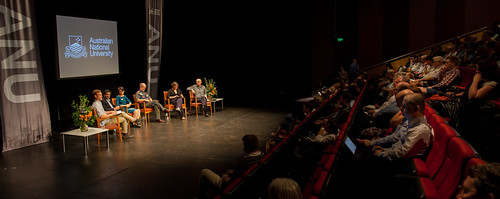
ANU is currently accepting enrollments for its first two edX on-line courses: Engaging India and Greatest Unsolved Mysteries of the Universe.
My view is that neither lectures, nor MOOCs (Massive Open Online Courses), are the future of university education. Lectures, live or via video, are a useful supplement to an education program, but are not essential. In Pirsig's 1974 semi-autobiographical work "Zen and the Art of Motorcycle Maintenance", a teacher and computer software documenter, argues that the physical campus is not the real university. Pirsig suggests in the “Church of Reason” chapter, that is a community of scholars. This foreshadows today's discussion of the on-line university.
Four years ago, I gave up presenting lecture based university courses, and have been teaching ANU masters students on-line in an asynchronous (non-real-time mode) using text based materials. Where possible, I supplement this with some video materials and students can arrange to drop and and see me (or on-line in synchronous real time mode). But research shows that while students like to see and speak to their lecturer, and to watch videos, this does not improve their learning outcomes. So in my view lectures, and their on-line equivalent, should be offered as an optional extra for the mainstream of education, which will be on-line, task based and text rich.
Tuesday, February 11, 2014
Teaching Without Lectures at the Australian National University
Professor Anant Agarwal, President of edX, and a panel of experts, will discuss "Blow up the lecture? Is the traditional lecture on the way out?", at the Australian National University in Canberra, 2:30 PM, 26 February 2014 (register online).
ANU is currently accepting enrolments for its first two edX on-line courses: Engaging India and Greatest Unsolved Mysteries of the Universe.
However, my own view is that neither lectures, nor MOOCs (Massive Open Online Courses), are the future of university education. Lectures, live or via video, are a useful supplement to an education program, but are not essential.
Four years ago I gave up giving lecture based university courses and have been teaching ANU masters students on-line in an asynchronous (non-real-time mode) using text based materials. Where possible, I supplement this with some video materials and students can arrange to drop and and see me (or on-line in synchronous real time mode). But research shows that while students like to see and speak to their lecturer and to watch videos, this does not improve their learning outcomes. So in my view lectures, and their on-line equivalent, should be offered as an optional extra for the mainstream of education, which will be on-line, task based and text rich.
ANU is currently accepting enrolments for its first two edX on-line courses: Engaging India and Greatest Unsolved Mysteries of the Universe.
However, my own view is that neither lectures, nor MOOCs (Massive Open Online Courses), are the future of university education. Lectures, live or via video, are a useful supplement to an education program, but are not essential.
Four years ago I gave up giving lecture based university courses and have been teaching ANU masters students on-line in an asynchronous (non-real-time mode) using text based materials. Where possible, I supplement this with some video materials and students can arrange to drop and and see me (or on-line in synchronous real time mode). But research shows that while students like to see and speak to their lecturer and to watch videos, this does not improve their learning outcomes. So in my view lectures, and their on-line equivalent, should be offered as an optional extra for the mainstream of education, which will be on-line, task based and text rich.
Information Session
Blow up the lecture?
Is the traditional lecture on the way out?
What will the classroom of the future look like?
Will the digital world transform the physical world of learning?
Will edX and other Massive Open Online Course (MOOC) providers change the face of education forever?
Technology is opening up new ways to teach and learn. It is also opening up new ways to understand how we learn.
What do you think the future of learning should look like at ANU?
Have your say and join us for an open panel discussion.
Featuring panellists
(register online).
- Professor Anant Agarwal, President of edX and social entrepreneur
- Dr Inger Mewburn (The Thesis Whisperer) Director of Research Training at ANU
- Dr Paul Francis, Astrophysicist and co-leader of the first ANU edX course
- Professor Andrew Walker, Deputy Dean, ANU College of Asia and the Pacific
- Mr Cam Wilson, ANUSA President
- Chaired by ANU Deputy Vice-Chancellor (Academic)
- Professor Marnie Hughes-Warrington
Friday, December 20, 2013
First Australian National University Open Online Courses
The Australian National University has opened enrolments for its first two edX Massive Open Online Courses (MOOCs) on India and astrophysics. Students can "audit" the course for free, or pay $US50 for a Verified Certificate of Achievement.
ps: For a sceptical overview of MOOCs I recommend Sir John Daniel's "Making Sense of MOOCs: Musings in a Maze of Myth, Paradox and Possibility" (2012).
- Engaging India (ANU-INDIA1x) with Dr McComas Taylor, 15 April 2014:
This course offers an overview of contemporary India and explores its role as one of the dominant economic and military powers of Asia. We begin with a discussion on India as a multilingual society. The entire course will be available in both English and Hindi. ... Watch the
Greatest Unsolved Mysteries of the Universe, (ANU-ASTRO1x), with Nobel Laureate Professor Brian Schimdt, starts 25 March 2014 (): Despite spectacular recent progress, there is still a lot we don't know about our universe. We don't know why the Big Bang happened. We don't know what most of the universe is made of. We don't know whether there is life in space. We don't know how planets form, how black holes get so big, or where the first stars have gone. This course will take you through nine of the greatest unsolved problems of modern astrophysics. We can't promise you the answers, but we will explain what we do and don't know, and give you an up-to-date understanding of current research. This course is designed for people who would like to get a deeper understanding of these mysteries than that offered by popular science articles and shows. ... Whatch the astrophysics video.
Technology and Sustainability cMOOC
Computers and telecommunications have been a boon to industry and culture, but at a cost. A significant proportion of industrial pollution today is caused by making, running and scraping computers and smart phones. Learn about the problem and how you can help solve it. This is a "constructivist" cMOOC, with an emphasis on the students learning from each other, assisted by experts. The course is based on "ICT Sustainability" designed by award winning technology educator Tom Worthington and offered online at ANU since 2009.The Indian Institute of Technology Kanpur, Athabasca University Canada and the National Institute of Bank Management in India recently ran a successful cMOOC course on “Mobiles for Development” (which is reported to have gone well). Interesting, rather than a specialised MOOC software, they used the same Sakai open source Learning management System as used for conventional e-learning courses. Mt ICT Sustainability course is implemented in Moodle, which is similar to Sakai. Moodle and Sakai are usually used with courses having hundreds of students. It would be interesting to see if they scale to thousands or hundreds of thousands of students.
ps: For a sceptical overview of MOOCs I recommend Sir John Daniel's "Making Sense of MOOCs: Musings in a Maze of Myth, Paradox and Possibility" (2012).
Friday, November 22, 2013
Opportunities of MOOCs for Canberra
The Australian National University in Canberra, will host "Teachers to the Node: Rethinking Science Education in the Digital Era", with Nobel Laureate Professor Brian Schmidt, 6pm, 10 December 2013. The invitation for the free event suggests that Massive Open Online Courses (MOOCS) can "... help deliver a taste of on-campus offerings to future
students ...". There would be little point in doing this if the on-campus programs were traditional, boring, 50 minute "Lecture 1.0". But universities are increasingly using a blended mode of
teaching, combining on-line delivery of "Lecture 2.0" and face-to-face Interactive Engagement in the flipped classroom.
Canberra's universities are rethinking the provision of their for-fee programs using on-line and blended education. Purely on-campus programs will not be viable within five years. University "lecturers" are being retrained as content designers, to work along side new course design staff, to set up attractive programs. This has to be done to compete in a global educational market.
The strategy of a few free on-line, non-award courses, to attract students to conventional lecture based programs would be counterproductive. Offering a few token on-line courses would just highlight problems with poorly designed lecture based on-campus programs. Universities need to incorporate e-learning into the core of their programs, not have it as a marketing gimmick. Students who enroll in a university on the strength of a MOOC will be disappointed if they find little support for that on-line teaching style in the program. Those students may fee the university has falsely promoted their programs and register a complaint with the regulator. The student satisfaction feedback survey results of these institutions will also suffer.
The design of on-line and blended courses requires new skills of university academics and administrators. It also requires a significant investment by the university, as unlike face to face lecture based courses, the lecturer can't just make it up as the go along and correct problems of the fly. E-learning requires careful design and testing before delivery.
I will be discussing this in "MOOCs and The Student Experience" at the Inaugural Student Experience Conference, in Sydney on the 4 December 2013.
Canberra's universities are rethinking the provision of their for-fee programs using on-line and blended education. Purely on-campus programs will not be viable within five years. University "lecturers" are being retrained as content designers, to work along side new course design staff, to set up attractive programs. This has to be done to compete in a global educational market.
The strategy of a few free on-line, non-award courses, to attract students to conventional lecture based programs would be counterproductive. Offering a few token on-line courses would just highlight problems with poorly designed lecture based on-campus programs. Universities need to incorporate e-learning into the core of their programs, not have it as a marketing gimmick. Students who enroll in a university on the strength of a MOOC will be disappointed if they find little support for that on-line teaching style in the program. Those students may fee the university has falsely promoted their programs and register a complaint with the regulator. The student satisfaction feedback survey results of these institutions will also suffer.
The design of on-line and blended courses requires new skills of university academics and administrators. It also requires a significant investment by the university, as unlike face to face lecture based courses, the lecturer can't just make it up as the go along and correct problems of the fly. E-learning requires careful design and testing before delivery.
I will be discussing this in "MOOCs and The Student Experience" at the Inaugural Student Experience Conference, in Sydney on the 4 December 2013.
Subscribe to:
Posts (Atom)