Showing posts with label green computing. Show all posts

Thursday, July 3, 2025

Teaching Online in Response to Climate Change

Australasian Campuses Towards Sustainability (ACTS) have released the report Navigating Climate Change – Scenarios for Australia’s Tertiary Education Sector (June 2025). 

ACTS recommend universities:

  1. "Provide educational capabilities that ensure that future generations are resilient, creative and can provide the leadership Australia needs to navigate the challenges ahead.
  2. Undertake research that helps find the technological, societal, political and environmental solutions to the challenges ahead, thereby attracting increasing levels of research funding.
  3. Connect with their communities to support adaptation.
  4. Connect with local authorities in responding to extreme weather events."
More specifically ACTS says one way universities can address climate change is by educating students about it, and another is with online learning. The Australian Computer Society (ACS) commissioned me to design and run an online course for computer students, to teach them to address the problem of global warming. The course was first run in 2009 for ACS, then by ANU (as COMP7310). One of my ANU students adapted the course for Canada, where it is still offered by Athabasca University today. I suggest universities could run more such courses for relevant professions, making them available online, and as micro-credentials.  

Monday, December 9, 2024

Generative AI in Health Education

Greetings from the ANU Generative AI in Health Education Symposium in the ANU Moot Court in Canberra. This reports on work to produce and trail guidelines for teaching medical students. This felt like an extension of ASCILITE 2024 in Melbourne last week, as it covered some of the same topics and some of the same people were running the event.

Professor Martyn Kirk, Associate Dean Education, College of Health and Medicine, suggested using generative AI for formative assessment, bit not summative. The idea being the AI could be used for helping students learn, but then they be tested at the end to check they really know what they need to know. I suggest blending the assessments, not having this split between formative and summative. In equity terms not having a large test at the end will allow inclusion of students (such as myself) who can't cope with large exams. It will remove the unnecessary anxiety it causes for many other students. It will also result in more authentic testing, under conditions like a workplace.

The guidelines were trailed in second semester 2024. Students were comfortable using the tool (Microsoft Copilot) and found it helpful for learning. Most students did not receive any training on the tool, but did receive guidance on its use. The approach taken was to issue guidance and leave it to course conveners to tell students about it. Staff and students were provided with assistance in the use of such tools. This is similar to the way in the ANU Techlauncher program we ran a workshop to run students through what Copilot could do, or not do, to help them with an assignment. 

One question which came up was the energy used by Generative AI. Students worry about the effect on the environment. In 2008 I was commissioned to design a course on Green Computing. In this students looked at energy consumption by data centers generally. AI is a more energy intensive form of data center. There are ways to reduce the energy use and carbon emissions resulting. This is something which perhaps should be raised with students generally, not just technical specialists.

One of the courses using generative AI was on climate change and health. In this course tutors demonstrated the use of AI to students in their work. This included using AI to simulate a person for the student to interact with. This was done with face to face and online tutorials. In this case students were given prompts to use with the AI. This extended the student's understanding, where previously they just asked one question and pasted the answer. The approach of simulations could be applied, I suggest, in other disciplines. 

In a course on immunology students could use AI for preparing presentations, but not for writing up their laboratory notebook. How you stop students using AI for the notebook is a challenge. One way would be to require the students to compose directly into an online tool. As with the climate change course, students were given sample prompts to help them. 

The symposium then switched from AI for teaching medical students to teaching students to use AI in medicine. Dr Andrew Tagg, Senior Clinical Lecturer at the University of Melbourne and Emergency Consultant at Western Health, Melbourne, pointed out that AI is already used routinely in diagnosis of cancer from x-rays. He argued that AI should be used more widely to deliver medical care. As someone who recently had to wait 11 hours for medical treatment, this could be a good idea. One area where AI might be useful would be in helping patients filling in the forms they are given. 

The issue of the environmental effects of AI came up again in discussion. It was suggested generating one image took as much energy as charging a mobile phone. This sounded an over estimate to me by three orders of magnitude. The Jevons Paradox came up in discussion: rather than saving effort will AI just result in more resources being used, rather than oit being used sparingly.

ps: Greetings from the ANU College of Health & Medicine located between the Canberra public and private hospitals.  Professor Kirk is giving a workshop for the staff and students at the hospital and those of us at the morning symposium were invited along. One tip is if you are having difficulty with your medical student understanding something ask Generative AI explain it to a ten year old. In groups we were tasked with coming up with something. I was teamed with an anesthetist, so we asked Microsoft Copilot to come up with aspects of a particular condition, then produce multiple choice questions. This worked very well. We were then asked to have AI summarise a paper, so I got it to do one of mine, which worked well. I then asked it to make a ten slide presentation in Powerpoint, then add notes and graphics. 

Thursday, November 7, 2024

E-waste not a major challenge with generativeAI

Wang, Chen, Zhang, Tzachor (2024) suggest that the demand for generative AI will create an e-waste problem of 1.2 to 5.0 million tons  for 2020 to 2030. They also suggest this could be made worse by political restriction on access to more advanced  efficient chips and rapid replacement of old hardware. I suggest the problem is not that large and energy use will remain a larger problem than e-waste.

One aspect the authors do not mention is the lack of price signals between server providers and the end user with current generative AI services. This is likely to be self correcting. Currently demand for generative AI is being generated by offering of free services to the public. As the user is not paying for the service and there is therefore no built in fee for responsible disposal of created e-waste, there may be a later problem. Some speculative AI ventures are likely to become bankrupt leaving a toxic legacy (similar to the mountains of scraped e-bikes left by failed startups). However, as users come to rely on Generative AI services, vendors will introduce charges, which can cover e-waste costs.

Currently generative AI server farms are using generic Graphic Processor Unit chips. These are the same chips used for cryptocurrency server farms. The environmental issues are similar with both. There have been articles about AI consuming as much power as small countries (just as there were for crypto). However, there is more of a mainstream use for AI, which will allow for better long term regulation of environmental effects. With its abundance of renewable energy sources and a stable regulatory environment, Australia could provide a popular location for AI centers. This would allow a small query to be sent across the world and answer sent back, effectively embedding the renewable energy in the answer. 

There may also be scope for reuse of older, slower, more energy using AI chips in locations with abundant renewable energy. As more efficient chips were installed close to the user in high energy cost countries, the old hips would be installed further away. Rather than store energy in batteries to run these chips, it may be cheaper to shut them down when the sun isn't shining & the wind isn't blowing. How to do this is something engineers and computer professionals can learn to optimize with specialist training (Worthington, 2012). 

Reference

Wang, P., Zhang, LY., Tzachor, A. et al. E-waste challenges of generative artificial intelligence. Nat Comput Sci (2024). https://doi.org/10.1038/s43588-024-00712-6

Worthington, T. (2012, July). A Green computing professional education course online: Designing and delivering a course in ICT sustainability using Internet and eBooks. In 2012 7th International Conference on Computer Science & Education (ICCSE) (pp. 263-266). IEEE. https://doi.org/10.1109/ICCSE.2012.6295070


Monday, April 8, 2024

What have you done to improve online student engagement?

I will be speaking on "Teaching Green Computing Online: 15 Years of Student Engagement via Nudging" at the free Online Engagement in Higher Education Special Interest Group Webinar, of HERDSA, 1pm, this Wednesday, 10 April 2024. HERDSA didn't want this to be just me talking, so as well as ten slides, I prepared four questions for the participants to answer, & discuss live:
"1. What have you done to improve online student engagement?
2. What level of granularity is best for feedback to students: hourly, daily, weekly, monthly?
3. Do students get tired of boilerplate replies?
4. Will they get annoyed by AI generated feedback?"

"In 2008 the Australian Computer Society commissioned Tom Worthington to design an online course in green computing. This course formed part of the Australian Computer Society’s professional development program. This was later run at the Australian National University as a masters course, and is still offered fifteen years later through Athabasca University (Canada).

The course uses a conventional text-based distance education format, with no video, and no webinars. Why? What was the rationale? This presentation shares key design principles of this unique format that has positively impacted student engagement. As a means of facilitating student engagement nudging techniques have been employed.

This HERDSA Special Interest Group, Online Engagement in Higher Education, will discuss the factors that have improved online student engagement and consider implications and applications of their own online courses, including a coordinated nudging process. This event will provide insights for those looking to adopt a nudging approach to better facilitate student engagement and learning.

Join this to see how this works, and can be applied at your institution."

Wednesday, February 28, 2024

Teaching Green Computing Online: 15 Years of Student Engagement via Nudging

I will be speaking on "Teaching Green Computing Online: 15 Years of Student Engagement via Nudging" at the HERDSA Online Engagement in Higher Education Special Interest Group, 1pm, 10 April 2024.

"In 2008 the Australian Computer Society commissioned Tom Worthington to design an online course in green computing. This course formed part of the Australian Computer Society’s professional development program. This was later run at the Australian National University as a masters course, and is still offered fifteen years later through Athabasca University (Canada).

The course uses a conventional text-based distance education format, with no video, and no webinars. Why? What was the rationale? This presentation shares key design principles of this unique format that has positively impacted student engagement. As a means of facilitating student engagement nudging techniques have been employed.

This HERDSA Special Interest Group, Online Engagement in Higher Education, will discuss the factors that have improved online student engagement and consider implications and applications of their own online courses, including a coordinated nudging process. This event will provide insights for those looking to adopt a nudging approach to better facilitate student engagement and learning.

Join this to see how this works, and can be applied at your institution."

Presentation available.


Saturday, October 1, 2022

Learning to Innovate for Sustainable Computing

I will be speaking on "Learning to Innovate for Sustainable Computing" at the Tech in Government conference in Canberra, 25 to 26 October. In this post I am collecting my thought on what to say. Suggestions, comments, and corrections would be welcome.

Computers are part of the problem of global warming,

Computers > electricity > fossil fuel > CO2 > global warming.

photo by Marcus Wong Wongm, CC BY-SA, 18 August 2007

Computers, and the Internet, run on electricity. Most electricity today is generated by burning fossil fuel, which releases carbon dioxide (CO2) into the atmosphere. The CO2 is a greenhouse gas, which traps sunlight, causing global warming. These facts have been clear since 2007, when the Australian Computer Society (ACS) release a world first study. The study estimated 1.52% of Australian carbon emissions were attributable to computers and telecommunications. There have been later more detailed studies around the world, but these produce similar estimates of around 2%. This is a significant source of pollution, being around the same as from the airline industry.

Reference

Audit of Carbon Emissions resulting from ICT usage by Australia Business,
by Shadi Haddad, Ethan Group Pty Limited, for the Australian Computer Society, August 2007. URL https://web.archive.org/web/20070907015722if_/http://www.acs.org.au/acs_policies/docs/2007/greenictaudit.pdf

Computers can be part of the solution to climate change

Big Efficient Data Centers Linked to Handheld Devices 

Brendale Supernode, Queensland,
by Quinbrook Infrastructure Partners, 8 July, 2022

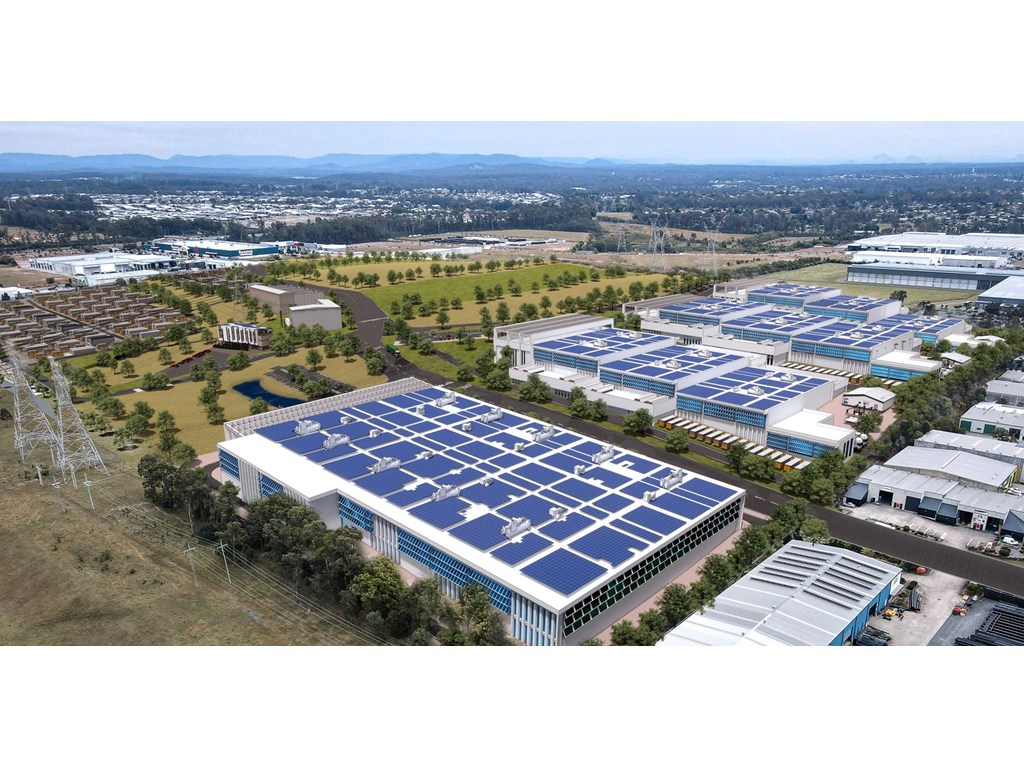
Consolidating computing into large data centers, collocated with renewable energy storage, as is being done at the Berndale Supernode in Queensland, provides the opportunity to reduce carbon emissions from computing. These systems can also be used to replace activities which are carbon emitting. As an example, the recent COVID-19 pandemic has shown that much business travel can be replaced with video conferences. However this requires learning new skills, and habits.

Reference

Supernode set for Moreton Bay, Steven Miles, Deputy Premier of Queensland, 8 July, 2022. URL https://statements.qld.gov.au/statements/95682


We can teach how to measure and reduce emissions, with a smart phone

Small Chunks of Learning Delivered to Handheld Devices


Green course home page in landscape mode on a mobile device
ICT Sustainability Course on a desktop computer,
by Tom Worthington, CC-BY, 2007
Green course home page in landscape mode on a mobile device
ICT Sustainability Course on a phone,
by Tom Worthington, CC-BY, 2007
Vocational education at TAFE, and courses at university are now routinely provided online. What is not generally appreciated is that students don't have to sit down at a desk-top computer, to learn. The learning management systems used for teaching TAFE and university students automatically adjust to smart phone screens. It takes a little more work to design the course content for this mode, and to allow students to study while working.

In 2008, the Australian Computer Society commissioned me to design an online course to teach how to estimate and reduce carbon emissions from computers. This was implemented using the Australian developed Moodle Learning Management System, and has been running at Australian and North American universities since 2009.

Reference

Worthington, T., "A Green computing professional education course online: Designing and delivering a course in ICT sustainability using Internet and eBooks," Computer Science & Education (ICCSE), 2012 7th International Conference on , vol., no., pp.263,266, 14-17 July 2012 URL: http://dx.doi.org/10.1109/ICCSE.2012.6295070

Same Approach, Other Challenges

Needed Tech Skills for Defence by Smartphone


Event canvas from Navy Warfare Innovation
Workshop (NWIW), by Paul Telling, 2020
Australian government face the challenge of recruiting and training sufficient personnel for technical roles. Training using mobile devices can assist with this, by allowing in service professional development in new and interesting ways. One example are the hackerthons which I have assisted with in the last few years. Two  were hosted by the Australian Computer Society, for the ADF & NZDF, and one by the Australian Navy. These helped participants learn to collaborate online rapidly in a high stress environment.

Reference

Worthington, Tom (2022): Designing for scale: How to use mobile devices to recruit, train and equip the extra 18,500 defence personnel. University of Melbourne. Media. https://doi.org/10.26188/20742451.v1 Notes at: https://blog.highereducationwhisperer.com/2022/08/expanding-canberra-defence-training.html


Saturday, July 30, 2022

Green IT and Electrically Actuated Microbeams

A piezoelectric microbeam with rectangular
cross-section and its coordinate system. 
R. Ansari et. al. doi:10.1155/2014/598292
CC BY 4 2014
I am delighted any time my work is cited. But I feel like I have become a character in The Big Bag Theory, after a mention in "Electrically Actuated Microbeams: An Explicit Calculation of the Coulomb Integral in the Entire Stable and Unstable Regimes Using a Chebyshev-Edgeworth Approach" (Schenk,  Melnikov, Wall, Gaudet, Stolz, Schuffenhauer, & Kaiser, 2022). If you are wondering, as I did, what a Microbeam (or Coulomb actuated microbeam) is, this microelectromechanical system is a tiny strip of material which is made to bend when electricity is applied. These are used by the million in optical displays, and in sensors. Requiring only a tiny electrical current, they reduce the energy needed, and so the authors cited  my book on ICT Sustainability (Worthington, 2017).

References

Schenk, H. A., Melnikov, A., Wall, F., Gaudet, M., Stolz, M., Schuffenhauer, D., & Kaiser, B. (2022). Electrically Actuated Microbeams: An Explicit Calculation of the Coulomb Integral in the Entire Stable and Unstable Regimes Using a Chebyshev-Edgeworth Approach. Physical Review Applied18(1), 014059. https://journals.aps.org/prapplied/pdf/10.1103/PhysRevApplied.18.014059

Worthington, T. (2017). ICT Sustainability: Assessment and strategies for a low carbon future. Lulu. com. https://www.tomw.net.au/ict_sustainability/introduction.shtml

Sunday, August 15, 2021

Asynchronous vs Synchronous Delivery

One of the rewards for the effort of having peer reviewed papers published, is the delight in finding you have been being cited. Usually the papers I have written on teaching computing are cited in IT or education journals.  But the latest citation is in the American Journal of Lifestyle Medicine. I did not even know there was such as thing as lifestyle medicine. ;-)

As it is not my field I can be entirely sure what Munroe, Moore, Bonnet, Rastorguieva, Mascaro, Craighead, Haack, Quave, and Bergquist (2021) are writing about. But it appears they have designed a course to promoting healthier eating, by teaching how to cook. One section of their paper is "Asynchronous vs Synchronous Delivery", where I get a brief mention (Worthington,  2013). A little worryingly the location of the conference I presented at has been incorrectly given as "Columbia", when it was Colombo (Sri Lanka). 

As the authors note, asynchronous delivery depends more on the student. As many students and teachers have found during the pandemic induced lock-downs over the last 18 months, this can be stressful with students feeling lost and alone. My experience of being a student and teaching this way, suggests that students need frequent feedback on how they are doing. It helps to be rewarded with a few marks for completing each small task in the course.

As the authors note, the alternative synchronous mode of teaching, where the students and teacher interact in real time is something many students expect. But one mode is not better than the other and they can be combined in the “flipped classroom”. This has the student studying alone in preparation for a teacher lead class. However, I suggest a small inducement, such as a mark, is still useful for keeping students working.

An emergency move to online teaching has seen many instructors providing long hours of synchronous teaching. This direct translation of the traditional classroom experience, I suggest, is not the best approach. A flipped approach, with shorter synchronous sessions, is a better use of student and staff time, but requires careful design and new skills of everyone. Teachers need to learn to provide quick feedback to students & anticipate their questions, or be overwhelmed with student queries. Students need to learn to plan their study.

Until last week, I was helping teach 200 students in a flipped hybrid mode. Students were provided with text and videos online to study in advance of class. Those who could get to the campus could take part there and others via video. But Canberra was locked down at 5pm last Thursday, due to a COVID-19 outbreak, so this week all students will be attending via video. However, other than the lack of a physical classroom, nothing about the teaching changes: the exercises and interaction are the same, just via a digital medium.

References

Munroe, D., Moore, M. A., Bonnet, J. P., Rastorguieva, K., Mascaro, J. S., Craighead, L. W., Haack, C. I., Quave, C. L., & Bergquist, S. H. (2021). Development of Culinary and Self-Care Programs in Diverse Settings: Theoretical Considerations and Available Evidence. American Journal of Lifestyle Medicine. https://doi.org/10.1177/15598276211031493

Worthington, T . Synchronizing asynchronous learning. Combining synchronous and asynchronous techniques2013 8th International Conference on Computer Science Education26-28 April 2013Columbia, Srilanka618-621, doi:10.1109/ICCSE.2013.6553983.
Google Scholar


American Journal of Lifestyle Medicine

Friday, July 26, 2019

Canberra Teaching Renewable Energy to India

Greetings from the ACT Renewables Showcase, at the Renewables Innovation Hub in  Canberra. The ACT Chief Minister is closing the event. He mentioned that the ACT will achieve 100% Renewable Energy in next year. However, as the population is increasing, the energy consumption will increase. The government will be looking at transport and buildings energy reduction. 
The Chief Minister mentioned he will be showicasing Canberra's expertise in renewable energy to India, at an upcoming visit. Earlier in the day I facilitated a workshop on "How Green is My Computer?". This was a taster for the course I designed on ICT Sustainability, run by the Australian National University. Many of my students are already from India, and the course is run online, so there is scope for more providing of such training.

High-Performance-Desktop-Replacement-Slim-Laptop by cmccarthy8  cc-by-sa nicubunu acquired from OCAL (Website) CC0 1.0
Computers > electricity > fossil fuel > CO2 > global warming.


This is an exercise from the short version, of the award winning university course "ICT Sustainability". Commissioned by the Australian Computer Society. The course has also been offered by the Australian National University, and Athabasca University (Canada).

Friday, July 12, 2019

How Green is My Computer? 26 July Canberra

I will be facilitating a workshop on "How Green is My Computer?", at the ACT Renewables Showcase, 10:30am, 26 July. This is at the Renewables Innovation Hub in  Canberra. Participants will estimate energy use, and carbon emissions, caused by a typical laptop computer.


High-Performance-Desktop-Replacement-Slim-Laptop by cmccarthy8  cc-by-sa nicubunu acquired from OCAL (Website) CC0 1.0
Computers > electricity > fossil fuel > CO2 > global warming.


This is an exercise from the short version, of the award winning university course "ICT Sustainability". Commissioned by the Australian Computer Society. The course has also been offered by the Australian National University, and Athabasca University (Canada). I am a member of the ANU Energy Change Institute.

Tom Worthington presenting.
Photo courtesy of Walkiria Perez
General Manager, Entry 29

Friday, September 21, 2018

Ten Years Teaching Graduate Students Online: Some Hard Lessons


I will be speaking on "Ten Years Teaching Graduate Students Online: Some Hard Lessons", at ANU TELFest, in Canberra, 5 November 2018. Here is the extended outline:

Ten Years Teaching Graduate Students Online: Some Hard Lessons

Tom Worthington, MEd FHEA FACS CP
Honorary Lecturer
ANU Research School of Computer Science, Australian National University

Summary

The online graduate course "ICT Sustainability" was first run in 2009 and has been offered each year since by ANU, two other institutions in Australia and in North America. Course designer Tom Worthington discusses how the needs of global industry and academia were incorporated and the changes made in the ten years this award winning course has been running. Tom discusses how to keep students working online and keep study relevant to the workplace. Adapting the course for industry, open universities and as a free open online module are covered.

The Course

The Australian Computer Society identified a need for training of computer professionals in environmental issues in 2008. Tom Worthington was commissioned to design a 12 week online course on what was then called “Green Computing”  (Worthington, 2012). This was intended to be delivered as part of an industry graduate certificate for computer professionals. The course was designed for the Moodle learning management system and released under a Creative Commons license. The first cohort of students started the course in early 2009. At this time the Australian National University had transitioned to the Moodle system and the porting of the course from ACS to ANU was found to be relatively simple. The first cohort of ANU students commenced in second semester 2009.

Two cohorts of students (ACS and ANU) progressed through the course a few weeks apart with the same tutor, who was also the course designer. While the course content was identical for the two cohorts, there were subtle differences in assessment for the vocational and university cohorts. Later one of the graduates of the ANU course adapted the material for Athabasca University Canada, creating a third version (Stewart, ?). Athabasca staff later created self paced MOOC-like version of the course, resulting in four known versions (the course materials are open access, so more may exist). All known versions are listed in the introduction to the published course notes for the ANU course, along with details of revisions (Worthington, 2017b).

Addressing Global Requirements

The course was designed for the needs of the global computer industry and international qualifications standards. Course content and assessment is aligned with the Skills Framework for the Information Age (SFIA Foundation, 2009). The course is also designed for the requirements of the international accreditation of computer professional qualifications under the Soul Accord (2011).

Evolving Teaching and Assessment Techniques

The course was designed for online delivery, not having been adapted from a face-to-face course.  A set of text based notes are provided to students electronically (also published as a book), along with readings and optional videos. Unlike many online courses there are no recorded lectures, instead students are guided through the text with weekly discussion questions. Students were initially given a weekly grade by the tutor based on their answering and discussion in a text based forum. This was later changed to peer assessment using Moodle's forum module. Athabasca's self paced version of the course introduced weekly automated quizzes and these were adopted for ANU using Moodle's quiz module. The latest version of the course assessment has 20% for weekly forum contributions (2% per week, best 10 of 12 weeks, by peer assessment), 10% automated quizzes (10 x 1% each) and two assignments of 35% each (each in two parts: 5% plan, 30% do).

Some of the hard lessons

1. Online Teaching is a Skill to Learn: The initial course design was adapted from an existing ACS online course by a university lecturer with no formal training in course design and no experience as an online student. Subsequent formal training in course design and particularly experience of being an online student, made the process much easier (Worthington, 2017a).

2. Videos Are Not Necessary for Online Courses: The course was developed using traditional distance education techniques, with text based notes,  text based asynchronous communication between students and with staff. This has proved robust and successful. Students undertaking the online course achieve similar results to those for their conventional lecture based on-campus courses.

3. Peer Assessment Works: Peer assessment of students produced similar results to tutor assessment. Students accepted this form of assessment, provided it was made clear a tutor was checking the process.

4. Marks Are Needed to Keep Online Students Working: The course assessment scheme has marks awarded every week for discussion and a quiz. This was found necessary to keep students studying. Without the routine of a face-to-face class to attend it is too easy for students to neglect their online studies. The assessment scheme has been adjusted several time to attempt to find the correct balance between small rewards for weekly work, and large assessment items for evaluating deeper knowledge. The current scheme limits the grade a student can achieve from the weekly work to a “Credit”.

5. A little feedback goes a long way: Students are provided with weekly feedback. This consists of their mark for the week and one or two sentences. This has been found to be effective, as students look out for the mark. The weekly marks have also been found to be a good indicator of student progress. Students at risk can be identified from their low marks in the first few weeks of the course.

6. Provide Accessible Notes to Student's Phones: Learning Management Systems, such as Moodle, are now capable of providing  most of their functions to a student via a mobile phone. However, the course content has to be suitably formatted. Much time and trouble can be saved by formatting the course materials as accessible HTML documents, which will scale to fit on the student's phone or laptop. There is then no need for a special mobile version of the software or course materials. As the course materials are in a standard web format they can also be  easily ported to other software, and produced as an eBook or printed book

Demonstration

  1. Globals skills definitions translated to Learning Outcomes and Assessment Tasks.
  2. Text based course eBook also published book.
  3. Content reflows for Mobile devices.
  4. Automated quizzes.
  5. Peer assessed forums.

Course eBook and Published Book


Responsive & reflowing for mLearning


Automated quizzes


Peer assessed forums

 References 

  1. Seoul Accord Secretariat, (2011). Seoul Accord. URL: http://www.seoulaccord.org/
  2. SFIA Foundation. (2009). Skills Framework for the Information Age. URL: http://www.sfia.org.uk/
  3. Stewart, B (?). Green ICT Strategies, COMP 635, Athabasca University, Canada. URL: http://www.athabascau.ca/syllabi/comp/comp635.php
  4. Worthington, T. (2012, July). A Green computing professional education course online: Designing and delivering a course in ICT sustainability using Internet and eBooks. In Computer Science & Education (ICCSE), 2012 7th International Conference on (pp. 263-266). IEEE. URL: https://doi.org/10.1109/ICCSE.2012.6295070
  5. Worthington, T. (2017a). Digital Teaching In Higher Education: Designing E-learning for International Students of Technology, Innovation and the Environment. URL: http://www.tomw.net.au/digital_teaching/introduction.shtml#user_goals
  6. Worthington, T. (2017b). ICT Sustainability: Assessment and Strategies for a Low Carbon Future. URL: http://www.tomw.net.au/ict_sustainability/introduction.shtml