Showing posts sorted by relevance for query open access. Sort by date Show all posts

Sunday, June 28, 2015

Open Scholarship

Open Scholarship seems an odd term to me: when was scholarship "closed"?

Willinsky (2009) offers a division of publishers into Independent Journals, Scholarly Societies and Commercial Publishers. They then trace open access back to the 1990s. But what might have been more useful would be to look at when academic publishing started to be closed. I would assume this might be around the time of the industrialization of scientific research in WW2.

Weller (2011) looks at scholarship from a more points of view than Willinsky (2009), looking at application and teaching as two scholarly activities which benefit from open access. Curiously neither author seems to worry much about scholarly discourse, which I thought was the whole point of the academic exercise. That is, you are not so much trying to set something in stone by publishing an academic paper, but continuing a discussion.

I am a member of the US based IEEE, who are a major publisher of engineering standards and papers. While IEEE is a scholarly society, their publishing arm is so big it is more like a commercial publisher, although they have a tradition of also supporting quirky little journals, which are more like independents.

The IEEE Open Access Publishing Options gives an interesting insight into how a publisher sees open access. Essentially, in IEEE's world "open access" is synonymous with "author pays". That is, the question from the publisher's point of view with open access is "who pays us?". If the reader is not paying for publication, then the next best option for the publisher is to get the author to pay.

The IEEE divides its open access publishing into:
  1. Topical: Only three of IEEE's thousands of journals are fully open access, the first of which, IEEE Photonics Journal, was only started in 2012.
  2. Hybrid: Authors have the option of paying to make content in otherwise closed journals open. The advantage for the author is that they avoid their paper being ghettoized in an "open" publication. IEEE point out that papers in high impact factor subscription based journals can be made open.
  3. Mega: IEEE has created new "rapid-decision, open access mega journal" called IEEE Access. In some ways this is an attempt to reverse the trend which has seen increasingly specialized journals. The most interesting point with IEEE Access is the emphasis on rapid publication (4 weeks for review). However as a paper costs the author US$1,750.00 to publish, this is not open, in the sense of being available to the majority of authors (who could not afford the fee).
What seems curious is that, as far as I can tell, the review process for IEEE's papers is still unpaid, even where the author pays for rapid publication. Why should I, as a reviewer, give one of these papers priority, when I am not getting paid more (or anything at all) for this work?

Normally academia operates on an informal system of favors: do this for me and I will do something for you later. But if a commercial publisher, or quasi-commercial publisher (like IEEE), is charging a premium up-front fee for a rush service, what is the incentive for me to cooperate?

References

Willinsky, J. (2009). The stratified economics of open access. Economic Analysis and Policy, 39(1), 53-70. Retrieved from http://www.sciencedirect.com/science/article/pii/S0313592609500434/pdfft?md5=03632c0fbabd6d1dbb70133d756ff05a&pid=1-s2.0-S0313592609500434-main.pdf
 
Weller, M. (2011). The digital scholar: How technology is transforming scholarly practice. A&C Black. Retrieved from https://www.bloomsburycollections.com/book/the-digital-scholar-how-technology-is-transforming-scholarly-practice/ch4-the-nature-of-scholarship

Friday, January 5, 2018

Papers, papers everywhere, but not a lot to read

I spent the morning sifting though one hundred papers published in the last year on "ICT Sustainability". I found three of interest: "ICT and environmental sustainability"  (Hign, Gholami and Shirazi, 2017), "ICT Reduces National Carbon Emissions?" (Wagner, 2017) and  "Online Educaiton Reduces Carbon Emissions" (Versteijlen, Salgado, Groesbeek and Counotte, 2017).

There were about a dozen more papers which looked interesting, but I could not locate the full text of, despite having access to the library at a world leading university. There were many other papers where the grammar of the article was so hard to follow it was difficult to work out what the author was trying to say. Then there were the bulk of papers which did not seem to be saying much at all, at least nothing new.

One thing which would help such a search would be the ability to limit it to open access publications. Unfortunately, Google Scholar does not appear to have this option. Adding the phrase "open access" to the search doesn't really help: some papers are open access, but others are about open access and others are from a publisher which mentions other papers are (but no the one cited). A search using a specialized open access search tool "OAIster"  resulted in only eighteen papers on ICT sustainability for 2017. Of these eighteen papers there were five of interest, but three had no link to download and two were behind paywalls of for-profit publishers (thus not open access). The publications which appear to be most readily available are Masters theses from European open universities.

Reference

An Hign, D., Gholami, R., & Shirazi, F. (2017). ICT and environmental sustainability. Telematics and Informatics, 34(4), 85-95. URL https://doi.org/10.1016/j.tele.2017.01.001

Versteijlen, M., Salgado, F. P., Groesbeek, M. J., & Counotte, A. (2017). Pros and cons of online education as a measure to reduce carbon emissions in higher education in the Netherlands. Current Opinion in Environmental Sustainability, 28, 80-89. URL https://doi.org/10.1016/j.cosust.2017.09.004
Wagner, K. C. (2017). Towards a Green Global Golden Age?: ICT enabled cornucopian sustainability and a suggestion for its reform. Master Thesis Series in Environmental Studies and Sustainability Science. URL http://lup.lub.lu.se/student-papers/record/8912373

Saturday, November 2, 2019

Open Access, Funding and International Student Numbers at Australian Universities


Dr Danny Kingsley,
Scholarly Communication Consultant
Kingsley and Vandegrift (2019) suggest that open access scholarly publishing has has been held back in Australia, in part because of universities reliance on revenue from international students.

Micah Vandegrift,
Open Knowledge Librarian
at NC State University Libraries.
Kingsley and Vandegrift  point out that, unlike their UK equivalents, Australian universities are reliant on government funding for research. The two main government funding bodies, the National Health and Medical Council (NHMRC) and the Australian Research Council (ARC), have been less than enthusiastic on open access. These bodies have polices which encourage open access, but does not require it. Even that relatively weak policy took a lot of prodding.

But what does any of this have to do with international students?
Kingsley and Vandegrift  point out that Australia has a much higher proportion of international students than other countries. The revenue from these enrollments is much greater than that from government for  research. The authors then make the link between international enrollments and university rankings: students enroll at universities which rank well. The quality of research, as measured by publications, makes up a significant part of the international rankings of universities. Australian academics are therefore under pressure to publish often, and in high ranking journals, which tend to not be open access ones.

Kingsley and Vandegrift conclude by asking "Is it possible to uncouple decisions about research practice from financial or political/ideological considerations?". I suggest it is not, but it is possible to adjust the financial incentives to give more socially desirable outcomes.

International university rankings are heavily weighted towards the quality of research, as measured by publishing in commercial for-profit journals. Students are attracted to universities with high research rankings, even though this has nothing to do with the quality of the teaching. One way to fix this problem is to create ranking systems which value education, and open access, more highly. One example is the Webometrics Ranking of Wold Universities, which includes "openness". This produces a slightly different ranking of Australian universities. Also Webometrics includes many small vocational institutions, excluded from other ranking schemes. Many of these vocational institutions provide quality education.

From a national policy point of view, how many international students should Australia have? International students make up about 23% of the total for Australian universities (Ferguson & Sherrell, 2019). There have been concerns in Australia that the number of international students lowers the quality of education. Perhaps Australia should aim for a similar figure to Canada, at 14% (Usher, p. 21, 2019). Canada may have hit the sweet-spot for international students. Usher suggests the international students in Canada "burnish" (increase) institutions perceived quality, rather than diminish it (Usher, p. 21, 2019).

References

Ferguson, H., and Sherrell, H., (2019). Overseas students in Australian higher education: a quick guide, Parlimentary Library, Parliment of Australia, URL https://www.aph.gov.au/About_Parliament/Parliamentary_Departments/Parliamentary_Library/pubs/rp/rp1819/Quick_Guides/OverseasStudents


Kingsley, D. & Vandegrift, M. (2019). Chasing cash cows in a swamp? Perspectives on Plan S from Australia and the USA, in Unlocking Research, Office of Scholarly Communication, University of Cambridge. URL https://unlockingresearch-blog.lib.cam.ac.uk/?p=2698

Usher, A., (2019). The State of Postsecondary Education in Canada,
2019. Toronto: Higher Education Strategy Associates. URL http://higheredstrategy.com/wp-content/uploads/2019/08/HESA-Spec-2019-Final_v2.pdf 

Tuesday, January 19, 2016

Open Access Identifiers for Australian Researchers

Australia's most effective open access advocate, Arthur Sale, Emeritus Professor of Computer Science at University of Tasmania, has circulated a document to help academics implement ORCID Open Access Identifiers for Australian Researchers, entitled "Everyone needs an ORCID" on the Australian Open Access Support Group discussion list:
All academics, all researchers, and all librarians should have an ORCID. It is an essential part of keeping track of your identity as you publish material, get grants, and gain impact, and it is an open process (not proprietary). The following outlines what an ORCID is, why you need one and why you should populate the ORCID database, and suggests what all Open Access advocates should do about ORCIDs.

You need to keep all your research publications and datasets linked and identified to you. If you ever change employment you will quickly realize the value of this. Commercial systems such as ScopusID, Researcher ID and LinkedIn are also inadequate as they are proprietary. People whose names are very common (like Robert Smith, John White, Nguyen T) will especially find an ORCID invaluable. At the time of writing, ORCID had issued close to 2 million IDs worldwide. ...
  1. Every academic staff member and volunteer in your university should have an ORCID. Pressure your VC and DVC (Research). Automation can help.
  2. No academic person should be appointed unless they have or register an ORCID before taking up the position, as a condition of appointment and registered in the staff database. Ideally, the requirement should be noted in the position description and the data should accompany the application.
  3. Every PhD candidate in the university should also be required to gain an ORCID as a component of the confirmation process.
  4. The ORCID should be included in every email signature in the university... 
  5. The ORCID should be cited in all communications regarding the person in relation to research or publication, especially grant applications. It should be associated with all publications and datasets. The QR code may be used on print publications, but in email and websites the URL is preferred. In particular, the performance evaluation form should require a field for the staff member’s ORCID.
  6. Members of the university should be required to commit to populating their ORCID records with new publications, grants, alternative names, etc. They should also link their ScopusID and Researcher IDs to the ORCID. This can be automated. ... 
From "Everyone needs an ORCID", by Arthur Sale
Also Dr Danny Kingsley, Head of Scholarly Communications at University of Cambridge will be speaking on "Open Access: Putting an octopus into a string bag" at University of Bedfordshire (UK), 17 February 2016. Danny uses the metaphor of an Octopus to describe the difficulty of dealing with the many aspects publications policy at universities.

Sunday, July 21, 2013

Ranking Web of Universities

Various rankings of universities have been published. These use a combination of research publications, status of university staff and some measures of teaching quality. This can influence a student's choice of an institution and so is taken very seriously by university administrators. One interesting variation is the Ranking Web of Universities (Webometrics Ranking), which bases it assessment on the university's web presence. Apart from making the process more automated, this more closely mimics a world where academics get information on-line, not from traditional publications. Interestingly the results from Webometrics are not so different from the ranking produced by more labor intensive and traditional methods.

In the latest Webometrics, the top ranking Australian university is the Australian National University (ANU) at 76 in the world. The overall rank is compued from three components: Presence Rank: 335, Impact Rank: 96, Openness Rank: 110, Excellence Rank: 131.

ANU is followed in the Webometrics list for Australia by: University of Melbourne, University of Sydney, Monash University, University of Queensland. The Times Higher Education World University Rankings  has University of Melbourne before ANU,  then University of Sydney, University of Queensland and University of New South Wales, with Monash University relegated to sixth place. The Academic Ranking of World Universities has the University of Western Australia displacing Monash for fifth place.

While universities would need to make large investments in research over many years to improve their ranking in traditional systems, it should be much simpler and cheaper for university administrators to improve the Webometrics rank. This is because web "presence" and "openness" are two of the four criteria used.

Administrators may not be able to get researchers to do research any quicker or to write better papers, but they can improve the university's web site and access to on-line publications. The web sites can be improved by using web accessibility guidelines, so that web pages are easy to access. Also universities can pay the additional publication fees to have journal papers made open access, so that readers don't need to pay a subscription to read them.

Often marketing and graphic design staff produce complex, hard to access web designs, in the mistaken belief these will appeal more to readers. What in fact happens is that web search engines can't index the content and people, particularly using mobile devices can't read the documents. It is better to use simple web formats.

Researchers will choose the most prestigious journals to publish their papers. However, these publications tend not to be "open access" and require a subscription to read the articles. Some journals offer to make individual papers open access if an additional fee is paid by the author. But academic are reluctant to pay these fees, unless there is a requirement from their institution (and a special grant) to do so. As a result these closed access papers tend to be read and cited less than open access ones, simply because they are harder to get on-line.

Sunday, December 10, 2017

Failure of UK Research Open Access Policy

Dr Danny Kingsley, Head of Scholarly Communication at Cambridge University Library has concluded that the UK's policy for free and open access to publicly-funded research has failed: "Manipulation of embargo periods, confusing information, and a graduated charging system for different licenses all work towards ensuring a second income stream. Far from moving to an open access future we seem to be trapped in a worse situation than we started." (Kingsley, 2017).

I was intrigued by Danny's inclusion of "scheduled tweets" to accompany the presentation. 

To answer the question at the end of the presentation "How do we get out of this mess?", I suggest a modestly funded initiative to encourage new Open Access publishers. This could use the start-up infrastructure already established around universities, such as Cambridge

Academic staff and students could be trained and funded to set up new companies to provide OA publishing in competition with existing closed-access ones. These new companies would aim to be profitable, in the long term, while providing publications without a fee to the subscriber. The main question to be answered by any such start-up would not be publishing infrastructure (which there is plenty of free-open-access software for), or revenue streams (which are feasible), but what incentives could be provided to induce academics to choose a new, unproven publisher.

Reference


Kingsley, D. (2017). So did it work? Considering the impact of Finch 5 years on [Presentation file]. https://www.repository.cam.ac.uk/handle/1810/269913

Tuesday, April 26, 2016

Open Universities of the Commonwealth

Garrett's  The State of Open Universities in the Commonwealth is a detailed 56 page examination of pioneering institutions, starting with the Open University (UKOU), Indira Gandhi National Open University (IGNOU) and the University of South Africa (UNISA). The study then looks at Athabasca University (AU), National Open University of Nigeria (NOUN), Open Universities Australia (OUA), Open University Malaysia (OUM), Open University of Sri Lanka (OUSL), University of the South Pacific (USP) and University of the West Indies (UWI). Other institutions with open access are also examined in passing, including University of Southern Queensland (USQ), which I have been a student of (along with Athabasca).


As Garrett notes, these open institutions were intended to increase access and at lower cost, than conventional universities. An apparent trend is that the larger institutions (100,000 to 500,000 students) are growing, whereas smaller ones (less than 20,000) are declining. The report also notes that open university can be a difficult experience for students, especially for undergraduates. Another interesting point is that innovations, such as MOOCs, are not being lead by the open universities.

One area the report does not address is the experience for academic staff at open universities. Like students these institutions can be frustrating for the staff.

One point the report does not make is that open universities tend to be cooperative in nature. As an example, Open Universities Australia is not a university, but a group of mostly conventional campus based institutions which come together to offer on-line programs. Even OUA, which was created as a separate institution, found it had to call on the resources and staff of existing universities, particularly in the early years.

The report also does not address the vocational nature of open university, with students mostly enrolling to get a better job. It is perhaps this, which makes the character of open university different. Also many open universities teach courses which would be considered below university level, at least in Australia.

The major problem with this report is that it limits analysis to institution based in countries which are members of the "Commonwealth".  It is not clear that previous British colonies have enough in common to form a meaningful group. Also this excludes countries with interesting and important open universities. As an example, the Open University of Hong Kong is excluded, as while it was established in 1989 during British rule, Hong Kong left the Commonwealth in 1997.

My reading of this, and other reports, suggest that for a successful open university you need at least 100,000 students and a focus on vocationally relevant postgraduate programs. A good place to start are graduate courses for teachers.

Universities are reassessing their teaching techniques and what they teach. Employers are demanding graduates with more work relevant skills and students not from a conventional academic background require different teaching and support. Along with the move to on-line education, this is likely to result in conventional universities taking on the characteristics of open universities.

Small, high cost, campus based universities, focused on producing academics, will no doubt continue to have a role, but a very limited one. Just as paper mail and paper money still exist in a digital world, but are of limited use, "campus" universities will exist as a specialized service.

References


Garrett, R. (2016). The State of Open Universities in the Commonwealth: A perspective on performance, competition and innovation. Retrieved from: http://dspace.col.org/bitstream/handle/11599/2048/2016_Garrett_State-of-Open-Universities.pdf?sequence=1&isAllowed=y

Monday, January 2, 2017

Some Recent Open Access Books on Higher Education

The Directory of Open Access Books (as mentioned in The Imaginary Journal of Poetic Economics) indexes several thousand scholarly books. As with DOAJ for journals, this is useful if you are looking for readings for a course and you want students to be easily able to obtain them. Not only can the students access the papers without having to worry about paying a fee, but they also tend to be in formats which are easier to read. In many cases, book chapters are available as separate downloads, so a students does not have to get the entire book, just for the few pages you want them to read. Interestingly, unlike the journal papers, which tend to be in open access journals produced by non-profit groups, there are open access books from conventional for-profit publishers (who also sell paper, and in some cases electronic, copies of the same free books).

A search for book on Higher Education returned 48, of which here are a few recent ones which look interesting:


Becoming a World-Class University: The case of King Abdulaziz University
Authors: --- ---
ISBN: 9783319263793 9783319263809 Year: Pages: 190 Language: English
Publisher: Springer
Subject: Education


The Dream Is Over: The Crisis of Clark Kerr’s California Idea of Higher Education
Author:
ISBN: 9780520292840 9780520966208 Year: Pages: 260 Language: English
Publisher: University of California Press
Subject: Education


Open Education: International Perspectives in Higher Education
Author:
ISBN: 9781783742783/9781783742806 Year: Volume: 1 Pages: 378 Language: English
Publisher: Open Book Publishers
Subject: Education


Higher Education Reforms in Romania: Between the Bologna Process and National Challenges
Authors: --- --- ---
ISBN: 9783319080536 9783319080543 Year: Pages: 226 Language: English
Publisher: Springer
Subject: Education


Knowledge Production and Contradictory Functions in African Higher Education
Authors: --- ---
Book Series: African Higher Education Dynamics Series ISBN: 9781920677855 Year: Volume: 1 Pages: 310 Language: English
Publisher: African Minds
Subject: Education


Mergers and Alliances in Higher Education: International Practice and Emerging Opportunities
Authors: --- --- ---
ISBN: 9783319131344 9783319131351 Year: Pages: 307 Language: English
Publisher: Springer
Subject: Education


Monday, August 3, 2020

Open Content for e-Learning in Response to the Coronavirus, 8am Wednesday

I will talk on "Open Content for e-Learning in Response to the Coronavirus" 5 August, 8-9 am, AEST (Canberra Time) as part of the Microlearning Series curated by Manisha Khetarpal at Maskwacis Cultural College in Canada. This is the second of six weekly sessions.  Register now.

Higher Education After COVID-19

  1. Responding to the Coronavirus Emergency with e-Learning
  2. Open Content created
  3. Assessments in online delivery
  4. Tools used to engage students in online delivery
  5. Mentoring student group work onlin.
  6. Higher education after COVID-19: Not business as usual
These are online, open to all and free, but please  register now. Suggestions are welcome.

Part 2: Open Content for e-Learning in Response to the Coronavirus

Slides and notes (2 Mbytes PDF)

Openness in education can apply to the way education is provided  as well as the course materials. This is not just about using free stuff to save money. The Open Source movement in computing and the Wikipedia show a way of contributing, as well as using, content. This second talk in the series is based on the chapter "Use of Open Education Resources" in my free e-book "Digital Teaching In Higher Education". Also I will cover some requests from the first talk.

Openness in Education

  1. Open University
  2. Open Educational Resources
  3. Open Business Models
  4. OER Example: ICT Sustainability
  5. Questions from last week:
    1. Is elearning more time consuming?
    2. Hackerthons & Group Project Work Converging

Open University

  • UK Open University established in 1969
  • Provide access for disadvantaged students
  • Confronted today's issues decades before COVID-19
The UK Open University (OUUK) was established in 1969. Walter Perry, the first Vice Chancellor's 1976 account of the formation of the intuition is a must read for those interested in online university education in the face of COVID-19 today. Many of the issues now being addressed with learning during COVID-19 came up 50 years ago.
"Open" in OUUK terms is about providing access to a university education to those who do not have access to traditional university, due to a lack of formal education, money, location, gender or membership of a minority group. Open universities have used whatever communication technology is available: paper mail, radio and TV broadcast, video and audio tapes, now computers, the Internet, and smart phones.
The Open Universities Australia (OUA) consortium has been delivering on-line courses from some of Australia's most respected universities for decades. Australia's University of New England (UNE) was one of the models for OUUK and there are hundreds of open universities around the world.

I find it frustrating when I hear of concerns expressed about remote learning today as if these are new and novel: problems identified, and for which solutions were found, decades ago.
References
Perry, W. (1976). Open University: a personal account. Milton Keynes: Open University Press. 


Remove Barriers to Australian On-line Universities (Blog Post),  Tom Worthington, September 21, 2013, The Higher Education Whisperer

Open Educational Resources

"Think free as in free speech,
not free beer."
Richard Stallman
(quoted by
Lessig, Lawrence 2006).
Photo
Galuel / CC BY-SA
"digitised materials offered freely and openly for educators, students and self-learners to use and reuse for teaching, learning and research"

From OECD, Centre for Educational Research and Innovation, 2007 (in CETIS, 2008).

MIT's OpenCourseWare can be modified for reuse, unlike most MOOCs.


The Microlearning Series has had many presentations about the concept of Open Learning, so I will not go into much detail here. The idea is appealing, but the practice is difficult.

Two examples of OER are MIT's OpenCourseWare  and more recent Massive Open Online Courses (MOOCs). An important distinction is that MIT allowed their content to be modified and reused. Many other providers don't allow modification, and some limit reuse.

References:

CETIS, J. (2008). Open educational resources-Opportunities and challenges for higher education. http://wiki.cetis.ac.uk/images/0/0b/OER_Briefing_Paper.pdf

Open Business Models

The major failing in many OER projects has been how to sustain them. Projects are usually funded by a government, an institution or a corporation in a burst of autistic enthusiasm, but the funding runs out and the project folds. There has to be a way for OER as to provide a reward to those undertaking it, so they can keep doing it.

The Open Source movement in computing provides one model. Individuals, corporations, governments and universities work on software which can be modified and used for free. They do this partly for the common good, but also so they can make use of the resulting software, including commercial companies for profit.

An alternative approach is where a not-for profit organization can solicit ongoing donations to cover the cost, while making use of mostly donated labor. While not working fr profit, The Wikimedia Foundation, which runs the Wikipedia, and the Apache Software Foundation, which provides much of the software for the Internet, are sophisticated organizations with significant revenue.

OER Example: ICT Sustainability


  1. Graduate online course
  2. Run by ACS and ANU in 2009
  3. Also offered through Open Universities Australia
  4. Adapted for Athabasca University by Brian Stewart
  5. Moodle file, e-book under a CC BY-SA open license.

The Australian Computer Society (ACS) me to design an e-learning course in “Green ICT Strategies” in 2008, to train computer professionals in how to estimate and reduce CO2 emissions. The ACS allowed me to retain the intellectual properly, so I released it under a Creative Commons license. It was run as part of the ACS graduate level certificate in February 2009, and the Australian National University (ANU) Masters of Computing from July 2009. ACS also offered the course through Open Universities Australia. A North American version of the course was developed by Brian Stewart for Athabasca University (Canada) in 2011 and is still running as "Green ICT Strategies". 
The course was developed in Moodle, with an e-book of notes, under a CC BY-SA open license. A traditional distance education asynchronous approach was used with quizzes, discussion questions and assignments.

Originally ACS created the course for public benefit. Each time I ran the course for ANU I would make improvements, which could be used by others.


Reference:

Worthington, T., "A Green computing professional education course online: Designing and delivering a course in ICT sustainability using Internet and eBooks," Computer Science & Education (ICCSE), 2012 7th International Conference on , vol., no., pp.263,266, 14-17 July 2012 URL: http://dx.doi.org/10.1109/ICCSE.2012.6295070  Preprint available at: http://hdl.handle.net/1885/9013

Is e-learning more time consuming?

  • Not if you know what you are doing, as a student or teacher.
  • Don't waste time talking at students while they passively listen.
  • Budget staff and student time on what is important: student activities and assessment.
  • OER and Open Access Software can help

Last week one of the questions asked in the forum was: "Is e-learning more time consuming". If you have learned how to learn, or teach, online and a disciplined in what you do, then the answer is "no". However, there can be much frustration, and time-wasting, where teachers try to replicate a classroom experience and students expect that.

A common complaint by students (one I read in a Facbook post today) is that the teachers are not teaching them online, but instead leaving them to work out what to do themselves.

The teachers job is to guide the student's learning, not tell them what to do in detail. Live "lectures" online, or in a classroom, are about the least useful form of instruction for this. A tutor talking to a small group of students is also of little educational value. Instead the teacher needs to focus on getting students to do things, and reflect on what they have done.

OER and Open Access software can help. These can not only save time, but also provide useful pointers to ways of working better. Rather than prepare materials yourself, alone, work with others. Rather than studying alone, work with others. Decide in advance to share your results, acknowledging everyone's contribution.

Hackerthons & Group Project Work Converging

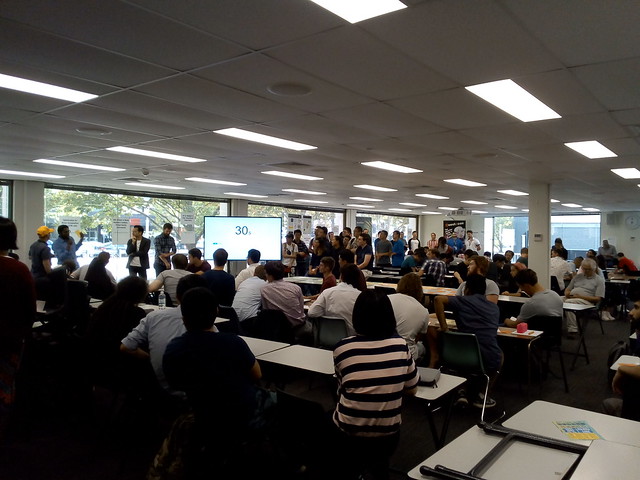
A flat floor large classroom at ANU, with large mobile LCD screens used to relay presentation to the back of the room.
ANU TechLauncher,
Team Formation Exercise, 2018

Australian & NZ Defence Forces Logistics Hackathon: by ACS, 72 hours in May, 70 mentors and 500 participants online.

ANU TechLauncher team formation: 300 students and 40 clients for two hours online.

Same tools and techniques used: Slack, Zoom and GitLab.


One way to get students to engage with their studies is with projects. However, group projects can impose a large administrative overhead for teachers. For years I have been supervising formal university group projects, usually as part of a capstone: required to be completed before the student can graduate. These projects take 12 or 24 weeks, with students in class with a tutor for two hours a week.

At the same time I have been mentoring teams in hacker competitions, which typically take 72 hours, run at a venue 12 or 24 hours a day, usually over a weekend. The hackerthon participants are mostly students, but these are are extra-curricular with no course credit, but some prizes.

The photo shows how these large scale exercises used to be done: in a large room over many hours at a time (Worthington, 2020). Some large hackerthons took over whole university buildings, or floors of corporate headquarters. There is considerable excitement generated by the close physical proximity and fast pace.

With COVID-19 both the project courses and the hackerthons have moved online using the same project management and communication tools. There is the possibility to use hackerthons as a form of group teaching technique. This approach emphasizes the participants organizing their own work and those who participated previously running later events.

Steve Nouri organized a Secure Supply Chains COVVID-19 Hackerthon for the Australian and NZ Defence Forces, hosted by the Australian Computer Society in May 2020. I was one of the Lead Mentors, providing advice to 70 mentors, who in turn helped 500 participants, over 72 hours. 

Last week I helped with the two hour team formation exercise for ANU Techlauncher. There are about 300 students, who formed teams of about seven students each live online after listing to pitches from clients. The students will now spend one or two semesters working on projects for about forty clients. Each team has a tutor who they meet with weekly, but the emphasis is on students working togehter.

Both the hackerthon and Techlauncher used Slack, Zoom and other communication tools, plus project tools, such as GitLab. There is potential to make more use of OER templates for such group work and Open Source software.


References:

Lessons Learned From Executing Successful Virtual Hackathons, Steve Nouri, Forbes, Jun 11, 2020. URL https://www.forbes.com/sites/forbestechcouncil/2020/06/11/lessons-learned-from-executing-successful-virtual-hackathons/

Online real time student project team formation with Zoom and Slack,  Tom Worthington (Blog post), The Higher Educaiton Whisperer, 1 August 2020. URL https://blog.highereducationwhisperer.com/2020/08/online-real-time-student-project-team.html

Worthington, T. (2020, June). Blend and Flip for Teaching Communication Skills to Final Year International Computer Science Students. Paper accepted for the IEEE International Conference on Teaching, Assessment and Learning for Engineering (TALE), 10-13 December 2019, Yogyakarta, Indonesia. URL https://openresearch-repository.anu.edu.au/handle/1885/204833


Tuesday, February 5, 2019

Future of Scholarly Publishing

The EU has released "Future of Scholarly Publishing and Scholarly Communication", by a panel of experts, including from the Bill and Melinda Gates Foundation, Wellcome Trust, Elsevier, and Springer Nature. Not surprisingly, Springer Nature and Elsevier did not agree to the rest of the experts' recommendation to move to open access publishing as soon as possible.

I don't agree with one of the panel's unanimous recommendations: not to use journal-based metrics for hiring, promotion and tenure, and funding decisions. In my view, metrics are essential, but the right metrics.

Several recommendations urge balanced and diverse representation (gender, geography and career stage). Using blind reviews, not just for papers, would go some way to achieving this.

The expert group proposes a set of principles for scholarly communication:
"... accessibility, maximum usability, and accommodating an expanding range of scholarly contributions (data, software, new documentary forms, etc.).  ... a distributed infrastructure based on open standards to ensure access and interoperability. ... equity, diversity and inclusivity, and to the need for community building. ... quality and the integrity of scholarly contributions ... flexibility and innovations while also retaining its focus on cost effectiveness."
From "Future of Scholarly Publishing andScholarly Communication" (EU, P. 6, 2019).

Recommendations to researchers and research communities:

  1. "When participating in research assessment, for example in hiring, promotion and tenure, and funding decisions, focus on the merits and impact of a researcher's work and refrain from the use of metrics - particularly journal-based metrics - as a proxy. In particular, they should incorporate the recommendations from DORA and the Leiden Manifesto into the assessment process.
  2. Take responsibility for ensuring that all research contributions are made openly available, discoverable, and reusable according to agreed community standards (including the FAIR principles).
  3. Increase awareness of, and sense of responsibility for, implications of choices and actions in roles as authors, reviewers and members of decision-making groups.
  4. Strive for a balanced and diverse representation (in terms of gender, geography and career stage) when seeking collaborations, organizing conferences, convening committees, and assigning editors and peer-reviewers, and building communities such as learned societies.
  5. Work towards increased recognition and appreciation of peer-review work as core research tasks. To this end, support greater transparency, including the publishing of signed reports. Support better training and inclusion, and focus on quality of the research in peer review.
  6. In the case of communities of researchers, such as learned societies, develop policies and practices that support modes of scholarly communication in line with the vision outlined above. Along with universities, learned societies and other research communities need to alert and train their researchers to the importance and the responsibilities of communicating knowledge, either formally, through publishing, or through other means."

Universities and research institutions should:

  1. "Develop policies and practices to ensure that all research contributions are made openly available, discoverable, and reusable according to agreed community standards (including the FAIR principles).
  2. Promote and implement the recommendations of DORA and the Leiden manifesto to ensure that research assessment takes into account a wide range of scholarly contributions including research articles, preprints, datasets, software, patents and materials (e.g. in hiring, tenure, and promotion decisions).
  3. In deciding which infrastructures to use, support, and contribute to, choose platforms using free or open source software, offering open data via an open license, and leveraging open standards where possible. Acting in this fashion will also reinforce researcher-led initiatives that aim to facilitate scholarly communication and publishing.
  4. Strive for a balanced and diverse representation including, but not limited to, gender, geography and career stage) when hiring, seeking collaborations, when organizing conferences, when convening committees, and when assigning editors and peer-reviewers, and building communities such as learned societies.
  5. In negotiations with service-providers refuse non-disclosure clauses and include clauses which enable cost and price control, and compliance monitoring. Strive to facilitate collective action with other institutions by e.g. sharing cost and price data through joint initiatives (e.g. OpenAPC)."

Research funders and policy-makers should:

  1. "Develop policies - along with appropriate funding mechanisms - to ensure all research contributions arising from their funding are available to everyone, everywhere, without any barriers to access or restrictions on reuse.
  2. When evaluating researchers, ensure that a wide range of contributions (scholarly publications, but also data, software, materials etc) and activities (mentoring, teaching, reviewing etc) are considered, and that processes and criteria of evaluation are both appropriate to the funder’s research programme, and transparent.
  3. Develop funding mechanisms to support the development of open, interconnected and distributed scholarly publication infrastructures, and for their maintenance over the long term.
  4. Consider how funding policies affect diversity and inclusivity of research on a global scale. In particular, funders should work to ensure that review boards, committees, panels, etc., are diverse - in terms of gender, geography, and career stage.
  5. Work with the other actors in the scholarly communications ecosystem to ensure that the total costs of enabling research to be openly available to everyone, everywhere, without barrier or restriction, be also open and transparent."

Publishers and other service providers:

  1. "Develop and publicly announce transition plans to move as soon as possible to comprehensive open access (Springer Nature and Elsevier have differing views with respect to this recommendation, a result of extensive disscusions in the expert group.)
  2. Develop, use, and support interoperable tools (including open source software wherever possible) and services not only to facilitate access and reuse of scholarly outputs, but also to facilitate innovative interventions of new entrants.
  3. Strive for balanced diversity (including, but not limited to, gender, geography and career stage) among authors, reviewers, and editors who work with publications.
  4. Foster transparency and accountability in peer review, for example by publishing peer review reports and author responses alongside the published articles
  5. Make all publishing charges public (including special pricing and waivers), and provide full descriptions of services provided, in order to enable the development of a transparent and cost-effective marketplace designed to support the open communication and reuse of all scholarly contributions.
  6. Experiment with new approaches to the evaluation and communication of research outputs, and share the outcomes so that a body of evidence can help to optimise future systems."
Practitioners, educators, and other societal groups:
  1. "Organize and advocate for free access to, and right to reuse of, publicly funded research results.
  2. Reach out to funders, research institutions, and policy makers in order to develop new communication channels, new forms of co-creation and co-planning of research, and new forms of funding in response to needs, concerns and issues emanating from the population at large.
  3. Look for opportunities to engage with research topics / results that are of interest to societal groups and their communities.
  4. Bring forward research topics/questions that are mis- or underrepresented (e.g. by contacting relevant researchers, attracting the attention of other actors in the science system, or mobilising action in organised interest groups)."

Thursday, February 9, 2017

Open Access Policy Draft from Australian Research Council

The Australian Research Council (ARC) have released a draft Open Access Policy for comment. The current policy was adopted in 1 January 2013. The policy requires researchers receiving a grant to make their research papers available in open access format within a year of publication, or tell the ARC why they can't. What is missing from the review are any statistics on how successful the current policy is. I suggest the new policy require institutions to publish a list of all publications on their web site, indicating which are open access and an annual count of the number open and closed, along with the amount of public funding received for those open and closed. The ARC should then use this information to produce statistics on openness of Australian research, in terms of numbers of publications and proportion of funding, along with the full list of institutions ranked by openness.

Friday, September 7, 2018

Academic Open Access Publishing Needs Education and Auditing

A move to open access research publishing will need, I suggest, a well resourced information campaign, and a well staffed anti-fraud unit. European and UK research funding bodies have decided to move to open access publishing by 2020. As a condition of receiving funding researchers will be required to publish papers from that research where they are available free. The researchers will be provided with finding to pay for publication. However, it is likely that some academics and publishers will attempt to game the new system, placing public money and the integrity of research at risk.

In 2014 the Australian Government expanded student loans from universities to non-government  vocational and educational training (VET) colleges. A 2015 Parliamentary inquiry heard "... harrowing and concerning evidence of misconduct by private VET providers ...". Education providers, and brokers, offered students inducements such as laptops to sign up for courses. This came at a cost of hundreds of millions of dollars to the Australian community and harmed the reputation of Australian vocational education.

Similar scams are likely with open access publishing, unless controls are in place from the start of the scheme. Academics are under pressure to publish and will be tempted to accept inducements from publishers and brokers, to place their business with them. We will likely see offers of free equipment and trips in return for publishing. We are also likely to see offers to the heads of research organizations for all research by their staff to be directed to one publisher in return for favorable treatment.

It should be made clear to publishers and researchers from the outset that offering, or accepting, cash and gifts in return for publishing is a crime. It should be made clear there are trained criminal investigators looking for such behavior and those responsible with be prosecuted.

Friday, March 4, 2016

Include Textbooks to Reduce Cost of Courses


Roxanne Missingham, Australian National University Librarian writes "Students say textbooks are too expensive – could an open access model be the answer?" (The Conversation, To encourage this, I suggest the Australian Government require universities to include the cost of textbooks in course fees.

ICT Sustainability: Assessment and Strategies for a Low Carbon Future


Friday, June 3, 2016

Review of the ANU Press

The Australian National University (ANU) is inviting submissions for a review of ANU Press.  The press started in 2003 (for a while it was called the "ANU ePress", but the "e" was dropped). ANU Press produces books in free open access electronic versions and print-on-demand.

I have found ANU Press of use for teaching. The web compatible format, stable web addresses and the lack of access control allow me to include the material as a reading for a course without having to worry if the student will be able to get it.

One suggestion is that ANU should consider creating free open access journals alongside its e-books. My favorite example of an on-line journal is the International Review of Research in Open and Distributed Learning. IRRODL uses the free open access OJS software and provides articles in HTML and as audio files, as well as the more usual PDF. This makes them very useful for students.

Saturday, August 31, 2013

Digitally Certified University Certificates

Thomas (Tom) Worthington's Graduate Certificate in Higher Education from the Australian National University (ANU) 19 July 2013. Please note that the signatures and some other details have been obscured for security. Original at: https://certifieddocs.anu.edu.au/verifier/servlet/DocumentVerifierApp/template/VerifyDAT.vm?datid=uabywlqxl1
The Australian National University now issues Certified digital documents, to graduates. Provided in electronic form  are the academic transcript, Australian Higher Education Graduation Statement (AHEGS) and testamur. These are provided at no charge to the students (in contrast, USQ charges a fee for paper transcripts and provide no electronic certificates).

One of the problems for students and university administrators alike is producing certificates, transcripts and other evidence of study. Paper documents are easily forged and despite anti-copy features I find that laser printed copies of university certificates often look more genuine than the originals. One solution is digital certificates verified on-line.

The ANU certificates are distributed through  the Digitary service, which was a spin-off of Dublin City University. Instead of providing a certified paper copy or a scan of it, students can provide a hypertext link to the document in the on-line service. Copies printed from the service have instructions on them of how to verify the details.

This is a much more secure and convenient system, than trying to verify a paper copy of a document, or a facsimile of it. A university can provide such a service directly, via its own web site, but using a service shared by other universities (including the University of Cambridge and the London School of Economics) increases the credibility of the documents.

In practice the system has a few problems. There are several weeks delay between graduation and the documents being provided on-line. Also there is no notification to the students that the documents are available, they have to keep checking the system. Given that a student is likely to want to make us of their qualifications for applying for positions immediately, this delay would be frustrating and result in much of the value of the system being negated.

The student uses their university user-id and password to access the Digitary system, via the university website. The student has control over who can access their documents. They can choose to have open access, limit access to users registered with the Digitary system or only a specific email address. Also the access can be set to expire after a specified period (default is 90 days). For limited access, Digitary sends an email to the recipient with details of how to get the document.

The documents when "printed" is a PDF file consisting of a cover sheet explaining the digital security process, followed by a facsimile of the university's printed certificates. By emulating the printed certificate, the reader of the electronic version will feel more comfortable. However, there is nothing on the facsimile (or the paper original) to aid verification. It would be preferable if all the certificates included a URL (and perhaps a machine readable QR Code) which could be used to verify the document. Also a photograph of the student, would be useful.

One problem is that my email system warned the message Digitary sent may be Spam. The company might want to reformat its messages so they do not look suspicious.

So as to demonstrate the system, I have set open access for my ANU Graduate Certificate in Higher Education (for the next 90 days). There seemed to be no harm in making this document public as the fact that I received a qualification from the university is not something I want to hide. However, the details of my marks for specific subjects is something I may not want to make so readily available.

Thursday, December 29, 2016

How Open is Australian Higher Education?

Open Education: International Perspectives in Higher Education
The e-book of "Open Education: International Perspectives in Higher Education", edited by Patrick Blessinger and TJ Bliss is available free in PDF and HTML. In Chapter 6 "Educational Policy and Open Educational Practice in Australian Higher Education", Adrian Stagg and Carina Bossu give a not very glowing report card. The authors note that low socio-economic background students at university increased only 1.29% from 2001 to 2014. Regional university students have fared slightly better, increasing from  15.4% (2001) to 19.3% in 2014. However, it should be noted that Stagg and Bossu do not include students in Vocational Education and Training (VET, which make up a significant part of Australian Higher Education. The VET sector has the potential to better address equity issues than universities.

Stagg and Bossu point to the Australian National Data Service (ANDS) and the use of Creative Commons licenses by universities as examples of open access policies. They suggest OER policies can have benefits for institutions, such as improved reputation by showcasing educational content and techniques. However, the authors do not explain what the benefits would be for individual academics who's promotions are based on how much research and course revenue they can bring in. Some vague improvement in reputation makes a weak case compared to revenue from students paying for courses using proprietary materials.

Stagg and Bossu try to make a case for Open Education in terms of access and equity. However, they do not really make the case for openness translating into access. Also the authors fail to address the motivations of individual academics and of institutional government policy. Most of those teaching in Australian universities are on short term contracts: how will they earn a living through Open Education? The few permanent long term academics in universities also need to meet financial targets from their research and teaching. Education is a major export industry for Australia: how can this income be increased through Open Education? I suggest that Open Education will not advance by simply ignoring this reality. A case can be made for Open Education enhancing individual careers and national education exports. However, Stagg and Bossu have not made that case.

Tuesday, April 5, 2016

Online Colombo Plan

Unconference Canberra is this Saturday. So I am taking the opportunity to work up a presentation proposing an "Online Colombo Plan" for training Australian and Indian teachers jointly on-line in digital technology and entrepreneurship.

Online Colombo Plan

Proposal for Distance Education in Technology and Entrepreneurship to Train Teachers Jointly in Australia and India

By Tom Worthington FACS CP

IT Education for Sustainable Development

Australia and India can cooperate on e-learning to implement the UN Sustainable Development Goals to:
  1. Train teachers in technology
  2. Further understanding between the nations
  3. Provide new education export industry for Australia

UN Sustainable Development Goals


Seventeen United Nations Sustainable Development Goals (SDGs):
"... end poverty ... protect the planet ... ensure prosperity for all ... foster peaceful, just and inclusive societies ... based on a spirit of strengthened global solidarity ..."
UN General Assembly resolution 70/17, Transforming our world: the 2030 Agenda for Sustainable Development, A /RES/70/1 (21 October 2015). Retrieved from https://documents-dds-ny.un.org/doc/UNDOC/GEN/N15/291/89/PDF/N1529189.pdf

Quality Education

UN Sustainable Development Goal 4: Quality Education
"Ensure inclusive and equitable quality education and promote lifelong learning opportunities for all".
UN SDG 4, General Assembly resolution 70/17, p. 17, 2015.


General Assembly resolution 70/17, p. 17, 2015.

Partnerships for the Goals

UN SDG Goal 17: Revitalize the global partnership for sustainable development

SDG 17: "Enhance North-South, South-South and triangular regional and international cooperation on and access to science, technology and innovation and enhance knowledge sharing ..."

General Assembly resolution 70/17, p. 26, 2015.


India-Australia Cooperation on Education


“Supporting the mobility of students ... Sharing best practice education materials ... Supporting skills development ...”

(2015, August 24). Memorandum of understanding Between the Government of Australia and The Government of the Republic of India on Cooperation in the Fields of Education, Training and Research. Retrieved from http://www.australiaindiaeducation.com/app/webroot/img/userfiles/MOU_2015.pdf

Skills Development Initiatives in Indian Budget

  • 1500 Multi Skill Training Institutes (MSTIs) as Public Private Partnerships (PPPs) 
  • National Skill Certification Board (MSDE, 2016)
Ministry of Skill Development and Entrepreneurship Budget Highlights 2016-2017. 29 February 2016 New Delhi: Government of India. Retrieved from http://pib.gov.in/newsite/erelease.aspx?relid=137484

Free E-Learning Materials


Australian Curriculum Technologies


Four Colombo Plans

  1. Colombo Plan, 1951: Western nations Cold War strategy against USSR, during which 20,000 university students from region educated in Australia (Oakman, p. 3, 2010).
  2. Virtual Colombo Plan, 2001: $230M from Australian Government to support of DE programs based in developing countries, including the African Virtual University (Wolff, p.25, 2002).
  3. New Colombo Plan, 2013: $100M for scholarships over five years to send Australian students to study in Indo-Pacific universities (New Colombo Plan Secretariat, 2013).
  4. Digital Colombo Plan, 2015: AARnet proposal for fibre-optic link to region's educational institutions and for direct e-learning (AARnet, 2015).

Propose Certificate Programs for Indian Teachers


Align courses to Australian AITSL teaching standards
Deliver to smart phones using off-the-shelf free open access learning management system

More Information

Disclaimer: this is a proposal by the author and does not represent the views of any of the organizations mentioned.

References

(2015, August 24). Memorandum of understanding Between the Government of Australia and The Government of the Republic of India on Cooperation in the Fields of Education, Training and Research. Retrieved from http://www.australiaindiaeducation.com/app/webroot/img/userfiles/MOU_2015.pdf


New Colombo Plan Secretariat. (2013). New Colombo Plan: Guidelines Scholarship Program. Canberra:Australian Government. Retrieved fromhttp://www.dfat.gov.au/new-colombo-plan/downloads/ncp-guidelines-scholarship-program.pdf
Oakman, D. (2010). Facing Asia: a history of the Colombo Plan (p. 323). ANU Press. Retrieved from http://press.anu.edu.au/wp-content/uploads/2011/05/whole7.pdf

UN General Assembly resolution 70/17, Transforming our world: the 2030 Agenda for Sustainable Development, A /RES/70/1 (21 October 2015). Retrieved from https://documents-dds-ny.un.org/doc/UNDOC/GEN/N15/291/89/PDF/N1529189.pdf

User:Tom Worthington/Books/Commercialisation and Entrepreneurship. (2016, April 3). In Wikipedia, The Free Encyclopedia. Retrieved from https://en.wikipedia.org/w/index.php?title=User:Tom_Worthington/Books/Commercialisation_and_Entrepreneurship&oldid=713313890

Wolff, L. (2002). The African Virtual University: the challenge of higher education development in sub-Saharan Africa.  TechKnowLogia, International Journal of Technologies for the Advancement of Knowledge and Learning, 4(2). Retrieved from http://www.techknowlogia.org/TKL_Articles/PDF/384.pdf

Worthington, T. (2015, April 10). An Introduction to Innovation. Canberra:The Higher Education Whisperer. Retrieved from http://blog.highereducationwhisperer.com/2015/04/designing-innovation-course-part-3.html#ch419