
Showing posts with label ANU Crawford School of Public Policy. Show all posts
Showing posts with label ANU Crawford School of Public Policy. Show all posts
Friday, January 31, 2025
Film screening - EveryOne, EveryWhere, EveryWhen

Thursday, March 12, 2020
Sustainable energy Planning for Indigenous Communities

Greetings from the Australian National University where Professor Paul Parker, University of Waterloo is speaking on "Sustainable energy planning in Canada: recognising diversity and the need for Indigenous voices". There are significant lessons for providing energy to remote Australian communities, in terms of consulting the local community on what they need. Surprisingly, solar energy is viable in Canada, along with wind. I asked Professor Parker about the role of for-profit companies in alternative energy, as most of the examples given were government funded not-for-profit initiatives. The problem is that these are limited by the availability of public finding. I suggest some training in startups for those involved may be useful, so they can seek out what the customer is will to pay for, so they can be self funding.
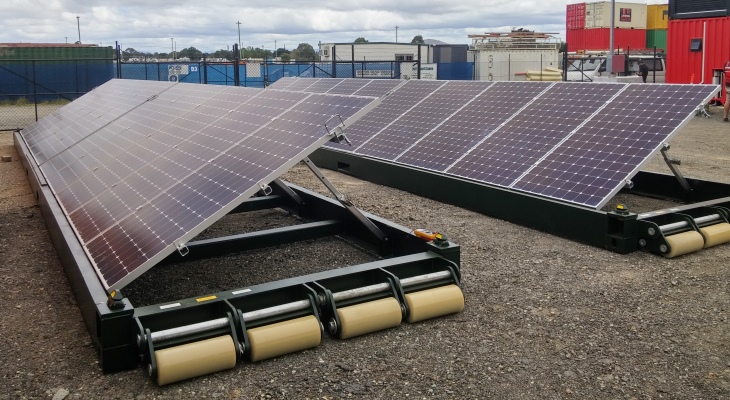 One of the audience asked about portable energy systems for Australasian abourginal communities. I pointed out that ECLIPS Engineering built a Container Roll-Out Solar System
(CROSS) for the Australian military. This is a very rugged system of standard solar panels attached to a
hinged framework mounted on a shipping container compatible platform. It would be able to provide power for a small town. Smaller versions could be built for family groups, which could be packed into a trailer and towed behind a car.
One of the audience asked about portable energy systems for Australasian abourginal communities. I pointed out that ECLIPS Engineering built a Container Roll-Out Solar System
(CROSS) for the Australian military. This is a very rugged system of standard solar panels attached to a
hinged framework mounted on a shipping container compatible platform. It would be able to provide power for a small town. Smaller versions could be built for family groups, which could be packed into a trailer and towed behind a car.
Wednesday, November 19, 2014
Australian Government Open Data Repository Focusing on Real Data

ps: Recently the Australian Prime Minister said "Coal is good for humanity ...", perhaps we can get Malcolm Turnbull , Minister for Communications to say: "Data is good for humanity, data is good for prosperity, data is an essential part of our economic future, here in Australia, and right around the world". ;-)
Climate Governance

Eliza commented that she initially stated her research on Australian organizations, but found these were not indicative of the international situation. When interviewing people in other countries she is asked "Why are these weird things going on in Australia with climate change?
I suggested Eliza contact Paul Thomas and the people at CSIRO researching information retrieval.
Citizen Mapping in Indonesia

Subscribe to:
Posts (Atom)