Showing posts with label professional development. Show all posts

Tuesday, November 15, 2022

More Flexible Macro-Credentials Needed

The new Australian Government is going ahead with a modest micro-credential initiative of the previous government.  But we also need some reforms to conventional degrees. Recently I have been helping assess applications from students for course credit. One thing about these is the wide range of institutions people have studied at. Another is the impressive depth of work experience some students have. However, students who change institution tend to be penalised, with not all prior studied recognised, due to the difficulty of finding equivalencies. This is not a problem in the vocational sector in Australia, where modules are nationally standardised, but each university in the world tends to do its own thing. There is some university standardisation through requirements for professional accreditation. One approach might be to give a standard amount of credit for a professional membership, or having completed a professionally accredited qualification.

Professional experience also tends to get limited recognition at university. Someone who has spent years working on projects at a major international computer company likely knows more than the university lecturers teaching them. A better approach then giving them some credit and making them do courses is to have them write up their work experience, align it to the qualification requirements, and assess that as an e-portfolio. However, that requires training which most university lecturers don't have (I learned it at CIT, and Athabasca University).

Tuesday, May 14, 2019

Getting academics to do professional development

In the last few days I have been approached by several people asking for help to use ed-tech for academic professional envelopment. One of the paradoxes of higher education is that while academics insist that training and testing is needed by their students, they are reluctant to do any training themselves in how to teach.

Botham (2018) looks at the issue of engagement in a professional development scheme to develop teaching skills. They concluded that institutional policies encouraging, or requiring, PD got staff into such programs, but it was not enough to get them to completion. I suggest this may require a change in doctoral education, and university hiring practices. If universities want good educators, they will need to include teacher training in graduate  programs, and select staff based on their teaching qualifications. Selecting the best researchers and then trying to turn them into educators does not work.

At a practical level it should be possible to train academics, using the same sort of blended techniques which are used to get students through a course they do not have an aptitude for, or interest in. That may not turn the average academic into an enthusiastic expert educator, but can at least make them reluctantly competent.

Reference


Botham, K. A. (2018). An analysis of the factors that affect engagement of Higher Education teachers with an institutional professional development scheme. Innovations in Education and Teaching International, 55(2), 176-189. URL blob:https://www.tandfonline.com/bbabfffd-2eb4-42a9-ad72-a1300abb9d64

Thursday, May 24, 2018

Improving Teaching and Learning at ANU

ANU has released " A Vision for Teaching and Learning at The Australian National University" prepared by consultant Diane Joseph (2017). This recommends consulting the University community on a Teaching and Learning Strategy. Teaching development and building programs were two areas to be explored.

The draft Vision for Teaching and Learning at the ANU is (p. 3):
"Our students are future ready, capable of solving problems not yet imagined to improve their lives, the lives of others and their communities."
 This is covered by four pillars (p. 4):
  1. "Determined Students
  2. Inspiring Academics 
  3. An Enriching Environment
  4. A Connected Community
  5. High quality teaching and learning is underpinned by the ANU values"
The interesting question then is how to achieve these. There are nineteen recommendations of the report (p. 4), including:
"... 4.1 Identify, encourage and support lead practitioners to model and share effective collaborative learning pedagogies in the CLE Building ...
5.1 Develop a Teaching and Learning Strategy ...
6.1 Support and encourage distinctive approaches to education, including technology-enhanced learning ...
7.1 Develop a Teaching Professional Development and Resourcing Plan ...
8.1 Identify requirements for potential building programs to enable the Vision for Teaching and Learning ..."

Suggestions for the ANU Teaching and Learning Vision


As a member of the ANU community (former student, donor and honorary lecturer) with an interest in teaching, I have six suggestions for advancing the vision:
  1. Increase teaching effectiveness with good course design
  2. Increase student engagement with real-world challenges
  3. Teach university academics to teach
  4. Give teaching staff a modern student experience
  5. Personalize the student experience without reducing the student to staff ratio
  6. Prove flexible new buildings and adapt old ones 
In detail:

1. Increase teaching effectiveness with good course design

Teaching effectiveness can be increased by designing courses and programs using project design techniques. First consult the prospective employers as to what skills and knowledge graduates will require. Then translate those requirements into learning objectives.  Design assessment to test for those objectives. Lastly provide educational materials and learning activities to prepare students for the assessment tasks. The time of the staff and students need to be carefully budgeted to achieve the required assessment results.

An example of this top-down design is the course "ICT Sustainability", offered as COMP7310 by ANU and COMP635 by Athabasca University, Canada. This is designed around the Skills Framework for the Information Age (SFIA), used for international accreditation of computer professionals. The SFIA skills are mapped to learning objectives in the course, with major assignments for each objective. There are small weekly exercises to help students build the skills and knowledge needed for the assignments.

The time needed for students to undertake readings, videos, quizzes and discussion activities where estimated for ICT Sustainability and budgeted to fit in the available study time. This included an estimate of the words in readings multiplied by the average reading time of a graduate student (from published research). The time needed for the instructor to run the course and conduct assessment was also budgeted. In this course lectures are not used and the weekly work is by automated quizzes and peer assessment, to free up the teacher's time to help students.

2. Increase student engagement with real-world challenges

Student engagement can be increased by providing real-world problems for students to solve and authentic assessment (not end of term examinations). Every task we ask students to undertake can be mapped to the problem solving exercises they will have to undertake. To keep students on task, learning skills and knowledge for this challenge, they can be given frequent small assessment tasks with rapid feedback.

The students in ANU TechLauncher have to work in teams building an engineering or software solution for a real client. Students are evaluated on their teamwork and problem solving by their peers, the tutors and the client.
Students also have the option of working on a start-up in the Innovation ACT competition. This approach has been utilized at other universities, such as UBC Electrical and Computer Engineering, with their "New Venture Design" course (APSC 486).

3. Teach University Academics to Teach

Those teaching at university need to know how to teach. However, university academics are reluctant to enroll in conventional classroom based training courses. The same approaches used to improve student engagement can be applied to staff: providing real-world problems to solve in the workplace, with authentic assessment.

Education for staff can be conducted using the techniques the institution aims to use for students. In particular learning should be primarily on-line, supplemented with blended and flipped classes in flat floor classrooms. Group activities, capstone projects and e-portfolios should be used for learning and assessment. There should be a minimum of lectures and no paper based examinations.

Short courses and online tips can be provided (ACU have some good ones). However, as with school and  vocational teachers, those teaching at universities would benefit from having formal qualifications in education. The aim should be to have junior teaching staff with an AQF Level 8 Graduate Certificate in education (or a Certificate IV in training for those who also teach in the VET sector), mid-level academics a Diploma of Education (or Graduate Diploma), and senior academics a Bachelor Degree or Masters Degree of Education (Coursework).

Staff should also be encouraged to join learned societies, such as HEA and HERDSA, as a supplement to formal qualifications in education.

4. Give Teaching Staff a Modern Student Experience

Local workplaces should provide support and encouragement for staff to undertake study for educational qualifications. In particular staff need to do "Dog-Fooding": experience what it is like to be a university student in the modern environment, so they have an understanding of the pressures imposed on their students. Staff on education courses should be encouraged to undertake projects for their studies in the workplace and to immediately apply what they have learned in their teaching. It should be noted that academics who supervise research students are also engaged in education.

5. Personalize the student experience without reducing the student to staff ratio

The student to staff ratio is unrelated to the quality of learning. High quality education can be provided with large classes, if the learning is well designed by qualified educators using proven techniques. Providing realistic tasks for students to undertake in groups, with the use of peer feedback and assessment, supported by automated tools helps.

6. Prove Flexible New Buildings and Adapt Old Ones

Interactive group learning requires new classrooms. Tiered lectures theaters are unsuitable for interactive group activities. Large rooms with flat floors, and preferably with furniture on wheels, are required. These can be new built, or adoptions of existing buildings.

Multipurpose Auditorium at Fitzwilliam College Cambridge
An example of such a facility is the Auditorium at Fitzwilliam College Cambridge (UK). Electrically operated, retractable tiered searing allows rooms to be used for flat floor teaching and, and at the push of a button, convert to a lecture theater. This design is now being implemented for the ANU Kambri Development.

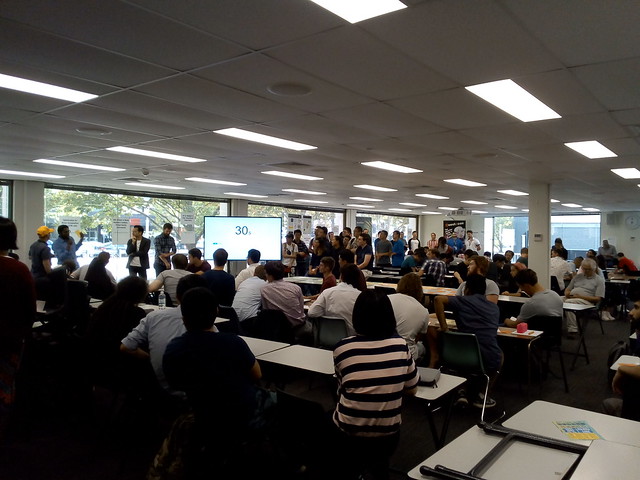
A flat floor large classroom at ANU, with large mobile LCD screens used to relay presentation to the back of the room.
 However, the new teaching spaces will require staff to be trained in new teaching techniques, including the on-line elements which support the classroom experience. Also this may require some minor items of equipment.

Experience with the existing temporary large flat floor classrooms at ANU shows that a room with 300 students working in groups is feasible, but requires good teaching team coordination. Some of the equipment can be low tech, such as a whistle to get student's attention when they were deep in discussion.

Australian Department of Foreign Affairs Diplomatic Academy
The recently opened Foreign Affairs Diplomatic Academy  shows that an exiting office building can be converted to attractive flexible flat floor classrooms. The Academy's impressive new premises have large rooms which can be divided for smaller classes.

See also:

  1. A Green Computing Professional Education Course Online, 2012
  2. Digital Teaching In Higher Education (e-book), 2017.
  3. Educating the Future Workforce, Submission  to the Senate Select Committee on the Future of Work and Workers, 2018.
  4. Education for Sustainable Development, Submission to the Senate Foreign Affairs, Defence and Trade Committee on the United Nations Sustainable Development Goals (SDG), March 2018.

Thursday, January 12, 2017

Are Professional Development Questionnaires Any Use?

Recently I was asked about questionnaires for evaluating professional development (PD) courses, specifically: attitudes, behaviors and efficacy. I suggest not wasting resources on this. If the institution has a standard course survey, then use it, but don't set much store in it.  Instead, focus on testing what the PD is intended to teach and not worrying so much about attitudes, or evaluation.  If the PD is to teach students how to collaborate and communicate, then test if they can collaborate and communicate, using conventional assessment techniques in the course.

Questionnaires are of little use in evaluating courses. Ebert-May et. al. (2011) found little correlation between what people said they did and what they actually did, after PD. One interesting finding was that "... novice teachers implemented inquiry-based, learner-centered instruction to a greater extent than experienced teachers ...". With limited resources it might be better to provide training for early career academics.

References

Ebert-May, D., Derting, T. L., Hodder, J., Momsen, J. L., Long, T. M., & Jardeleza, S. E. (2011). What we say is not what we do: effective evaluation of faculty professional development programs. BioScience, 61(7), 550-558. https://doi.org/10.1525/bio.2011.61.7.9

Thursday, January 28, 2016

Internet Use by Australian School Students

Goodwin, K. (2016) interviewed just over one thousand parents in Australia on their children's use of the Internet for learning. Half were from capital cities, half with primary school age children and half secondary school. Three quarters of parents said that Internet at home helped children learn. About half said their children use the Internet at home for research, watch tutorials and collaborate with other students.

The research was commissioned by NBN Co, an Australian government owned company set up to provide a national broadband network. NBN Co obviously have an interest in talking up the value of digital technology for education. In particular the interview questions appear to have been designed to support the assertion that high speed broadband is needed at home to provide video for education. No questions appear to have been asked about the need to provide Internet for students outside the home.

It should be noted that NBN Co is providing high speed broadband, which is far in excess of the speed required just for educational video. The ABS (2015) notes that the OECD definition of broadband used by the Australian government is 256kbps. In contrast the minimum speed being offered by NBN Co. is 20 Mbps, more than seventy five times the OECD minimum and many times the speed required for educational video.

NBN Co. is only providing fixed broadband for homes and small businesses, it is not providing mobile wireless data, as used by smart phones and tablet computers outside the home. Mobile devices equipped with 3G and 4G wireless modems might render NBCo's multi-billion dollar fiber and fixed wireless network obsolete before it can be completed.

For comparison, Pegrum, Oakley and Faulkner (2013) report on the adoption of mobile devices in ten Western Australian non-government schools in 2011. iPads were most popular, followed by iPod Touches (a small tablet device) and iPhones. Lower level classes had shared devices in the classroom, while older students each had their own device. M-learning, was still being integrated into the teaching.

Pegrum, Oakley and Faulkner (2013) identify professional development (PD) for teachers in the educational use of computers as a major need. One program set up to provide PD is the CSER Digital Technologies MOOC (Falkner, Vivian & Falkner, 2015). This is a series of free on-line courses from the University of Adelaide to teach about the new Australian Digital Technologies curriculum. The course is initially being offered for teaching in Kindergarten to year six (K-6) but is being expanded to cover later years.

Teaching digital technology to teachers on-line is challenging. (Falkner, Vivian & Falkner, p. 66, 2015) note that the average Australian primary  teacher is a 42 year old generalist (secondary teachers are a few years older). These teachers are likely to have had minimal exposure to computers in their teacher training. Teachers are reportedly working 46 hours per week and 8 to 9 days a year on PD. Asking teachers to spend extra time to use IT to learn to use IT to teach IT is a challenge. CSER prepared seven MOOC Modules:
  1. Introduction
  2. Data – Patterns & Play
  3. Data - Representation
  4. Digital Systems
  5. Information Systems
  6. Algorithms & Programming
  7. Visual Programming
Falkner, Vivian an Falkner (p. 68, 2015) report that the first offering of the course had 1378 enrolled, 438 of who did not engage in the course and 99 completed. This is a 7.2% completion rate (10.5% of those encouraging), which is reasonable for a MOOC. The same course, offered with a tutor as a conventional e-learning course may be expected to have a much higher completion rate.

References

ABS. (2015, May). Discussion Paper: Consultation on topics emerging from submissions to the Information and Communication Technology Statistics Review, Australian Bureau of Statistics. Retrieved from http://webcache.googleusercontent.com/search?q=cache:uyH8X-8-ieoJ:www.abs.gov.au/ausstats/abs%40.nsf/Lookup/8179.0.55.002Main%2BFeatures3May%2B2015+&cd=10&hl=en&ct=clnk&gl=au

Falkner, K., Vivian, R., & Falkner, N. (2015, January). Teaching Computational Thinking in K-6: The CSER Digital Technologies MOOC. In Proceedings of the 17th Australasian Computing Education Conference (ACE 2015) (Vol. 27, p. 30). Retrieved from https://www.researchgate.net/profile/Rebecca_Vivian/publication/277022717_Teaching_Computational_Thinking_in_K-6_The_CSER_Digital_Technologies_MOOC/links/556000e308ae6f4dcc9273e9.pdf
 
Goodwin, K. (2016). nbn Digital Parenting Report, NBN Co. Retrieved from  https://www.dropbox.com/sh/6oyb4klf9k5k8wy/AAANBdLx0ZuuLzriOBOolPIUa/nbn%20Digital%20Parenting%20Report.pdf?dl=0
 
Pegrum, M., Oakley, G., & Faulkner, R. (2013). Schools going mobile: A study of the adoption of mobile handheld technologies in Western Australian independent schools. Australasian Journal of Educational Technology, 29(1). Retrieved from http://www.ascilite.org.au/ajet/submission/index.php/AJET/article/viewFile/64/25