Speaking at the launch of the ACS Digital Pulse report John Griggs, ACS CEO, said "Every business is a tech business". This is at the National Press Club in Canberra. The point wat that all businesses need technical staff. The problem is that as the report details, universities cannot produce enough graduates and school leavers don't want to enrol anyway.
The ACS solution is non-traditional paths, through certification, and microcredentials. One problem I can see is convincing the workers, employers and regulators that the alternative pathways are as good as traditional education. This is similar to the poor reputation online learning has had: research shows it is as good, if not better than classroom based learning, but there is still a perception it is inferior.
The new Australian Government is going ahead with a modest micro-credential initiative of the previous government. But we also need some reforms to conventional degrees. Recently I have been helping assess applications from students for course credit. One thing about these is the wide range of institutions people have studied at. Another is the impressive depth of work experience some students have. However, students who change institution tend to be penalised, with not all prior studied recognised, due to the difficulty of finding equivalencies. This is not a problem in the vocational sector in Australia, where modules are nationally standardised, but each university in the world tends to do its own thing. There is some university standardisation through requirements for professional accreditation. One approach might be to give a standard amount of credit for a professional membership, or having completed a professionally accredited qualification.
Professional experience also tends to get limited recognition at university. Someone who has spent years working on projects at a major international computer company likely knows more than the university lecturers teaching them. A better approach then giving them some credit and making them do courses is to have them write up their work experience, align it to the qualification requirements, and assess that as an e-portfolio. However, that requires training which most university lecturers don't have (I learned it at CIT, and Athabasca University).
Jason Clare, Australian Minister for Education has announced $18.5M for a Microcredentials Pilot in Higher Education (9 November 2022). This is targeted at skills shortages in areas including teaching, engineering, health, and technology. This year, only public universities will be able to apply for the first $2 M to develop, & $2M to deliver, microcredentials. Next year, Australia's private and for profit universities (Bond, Divinity and Torrens), along with Carnegie Mellon University of Pennsylvania, will be able to apply for the balance of the funds, along with non-university Higher Education providers (such as Box Hill Institute, and some TAFEs). Applications for Round 1 are now open.
This is a useful initiative, but giving priority to public universities is a mistake. The institutions best equipped to deliver short, vocationally focused, flexible programs are Australia's public TAFEs, and private vocational education providers. They have staff trained and experienced in this form of education, whereas universities generally do not. Some universities are dual stream and have associated vocational arms. However, these tend to be run separate from the university arm, with different staff teaching university and VET courses.
Creating microcredentials is very, very difficult. It is especially difficult for Australian universities which have research, not teaching, as their primary focus. It will take the universites multiple attempts to create microcredentials which work. This will require new staff, with new skills.
Government should be cautious overpromising with microcredentials. These are, in the main, not for school-leavers, bit for experienced staff who already have post-school qualifications, wishing to up-skill. As an example you can't take a school leaver and make them a cyber security expert with a microcredential. That person needs to already have a computer related qualification, and experience. Australia will need to invest in old fashioned VET and university qualifications, as well as microcredentials, to meet the skills shortage.
The government of the Canadian province of Alberta has announced a CA$8M, two year micro-credential program. This follows a CA$5.6M 2021 pilot program. But how successful was the pilot? How much shorter, cheaper, and successful are the micro-credentials, compared to existing vocational and university short qualifications? Do these help disadvantaged students, or primarily help those already better off?
Who Gets the Help?
I was unable to find any report on the outcomes of Alberta's pilot microcredentials program. It would be useful to know the completion rate for low socioeconomic status students. Also a useful rubric would be the increase in income of graduates, compared to those who undertook existing conventional short vocational and university qualifications.
One of the problems which has occurred with previous initiatives, such as Distance Education, and Massive open online courses (MOOCS), is that they tend to benifit those who are already well off, and well credentialed. Funding bodies, and educational institutions tend to underestimate the resources needed, and the cost of supporting the students who need the help.
How micro are the microcredentials?
The previous Australian government talked about microcredentials, but what they actually funded were conventional 12 week vocational & university certificates. Those are useful qualifications, but were not really new, or micro, credentials. The Australian government funded six month undergraduate certificates. These were a new credential, but were mostly implemented by universities packaging up existing courses from the first semester of a degree. That allowed for rapid implementation, and nesting with degrees, but not much in the way of helping disadvantaged students, or addressing new industry needs,
UNESCO titled their 31 page Draft Preliminary Report "A conversation starter: Towards acommon definition of micro-credentials" (September 2021). Unfortunately the proposed definition is unusable, as it doesn't address what makes a microcredential different to other credentials: it is much smaller.
The UNESCO report proposes a micro-credential:
"1. is a record of focused learning achievement verifying what the learner knows, understands or can do;
2. includes assessment based on clearly defined standards and is awarded by a trusted provider;
3. has stand-alone value and may also contribute to or complement other micro-credentials or macro-credentials, including through recognition of prior learning; and
4. meets the standards required by relevant quality assurance."
However, every credential should have these characteristics. UNESCO seemed to have missed the hint in the name micro-credential. These are much smaller, but not necessarily literally one millionth, of a conventional qualification. I have, not entirely seriously, suggested these be called Deci or Centi-credentials, as in practice they tend to be one tenth to one hundredth of a three year degree.
Keith Heggart and Camille Dickson-Deane have published an important paper on the rationale behind the UTS Graduate Certificate in Learning Design (Heggart & Dickson-Deane, 2021). This is valuable, as the authors not only make the case for there being a need for a course in learning design, but also show they applied a rigorous, systematic process to design it. This is not one of those depressingly common examples of academics telling others to do something, these are practitioners actually doing what they say: an excellent example of dogfooding (Harrison, 2006).
The authors point out that while learning designers are in demand worldwide and in Australia, it would help to clarify what they actually do. Also they point out that COVID-19 has promoted universities to make their teaching more efficient. However, I question if this result in a demand for staff who have specific digital and learning design qualifications. While the vocational sector routinely requires formal educational qualifications of staff, Australian universities have not.
The authors discuss the differences between a learning designer and a teacher. It seems to me that teachers and learning designers are both educators. It is likely a typical learning designer will have some teaching experience and qualifications. It terms of design skills, I have found that learning design has much in common with the design of computer software. There is the same need to collect user requirements, undertake a systematic process, do tests and provide maintenance.
The authors claim there were no programs explicitly addressing learning design before theirs. That is perhaps overstating the situation, as there have been many graduate certificates and masters programs in education, which offered learning design as a component (I did one at ANU including content from USQ).
The authors also suggest universities could not quickly train learning designers. However, while they may not have programs called "learning design", they could easily assemble one, if needed, from existing components. Australian universities could follow Athabasca University's example, and re-badge their existing education qualifications. In 2017 I completed a MEd in Distance Education at AU. This year they decided to add "Open, Online and Distance Education" and I paid a few dollars for a new certificate. Australian universities could similarly add learning design, to their Grad Certs and MEds.
The authors have detailed an approach to designing a program for learning designers which I suggest could be a good model for other Australian qualifications. In particular an emphasis on "Flexibility in delivery and progression". Unfortunately Australian universities have offered program mostly on the assumption the typical student is studying full time, with no other commitments. Part time students are treated as a special case. As the authors suggest students "have a number of competing life commitments, (e.g., work and caring responsibilities).". Even with COVID-19 forcing learning online, and students to extend their studies, many academics and administrators appear to be longing to return to a simpler time, when they did not need to bother worrying about the messy details of student's lives.
Another point the authors make is the importance of "communication and collaboration skills". As a student of education I feared communication exercises and especially group work (my students also don't like it), but these are necessary skills which you can only get through practice.
The authors also have tacked the difficult issue of microcredentials. In this case a program has been assembled from components half the usual size, each badged as a microcredential of 60 to 75 hours learning. This I suggest is a very workable strategy. It should be noted that this is not a case of saying that students can just do any random collection of micro-credentials and that makes up a program. The students have to choose from a specific set, designed to form a coherent whole.
One point I disagree with is the authors assertion that the reflective portfolio undertaken could be presented to employers. As a student I have had to undertake reflective portfolio exercises several times (using Lego, as well as portfolio software). But these portfolios have never been of use for employment. I still have a large physical folder with examples of my work, from a pre-computer portfolio exercise. I now teach students using portfolios and also assess portfolios for one of the international recognition schemes, but these portfolios are no of use for more than this assessment task. The one exception is the ANU Techlauncher program, where the student is explicitly instructed to choose a a real job advertisement and then write their portfolio in the form of an application for that job.
The Australian government has encouraged universities to offer shorter qualifications to provide vocational skills which are in demand, in areas such as cyber security. This includes certificates (taking about 12 weeks full time study) and microcredentials (around 3 weeks, or less). This requires getting students focused on study quickly, as there is not time to waste on an orientation week, or students wandering around finding out what to do. Also learning designers can't afford to spend as much time on a short program as a lone one.
When I first tried teaching online, a decade ago, I tried to emulate a face to face lectures and tutorials. This is a mistake many first time online teachers make, as these are the only formats they are familiar with. Lectures and tutorials are not a very effective teaching techniques, offline or online.
The approach I developed over ten years teaching online was to design first for pure asynchronous online delivery, then add synchronous components, which could alternatively be delivered face to face. This approach could be extended to micro-credentials which could then be used for conventional courses in a certificate.
What every teacher has to keep in mind is that the task is not to work very hard, it is to get the student to work very hard. Some teachers respond to students who don't seem to be learning by talking at them more, which makes the situation worse. Instead they have to set goals for the students. The only way I have found to do this is with assessment: if you want a student to do something, give them marks for it.
So we first have to set learning objectives for the microcredential or course (preferably based on external widely recognized standards, not something developed at the university), then translate these into assessment tasks, then provide activities for students to learn the skills and knowledge required and lastly provide materials to help. Most of the budget of student learning time should be taken up with individual and group activities, not time spent in "class". Most of the budget for instructor time should be for helping student with their assessed tasks, not giving presentations or leading discussions.
Greetings from the Designing Micro-credentials and Professional Short Courses at the Marie Reay Teaching Centre at the Australian National University. This is my first time in a classroom since March, either as a teacher or student, due to COVID-19.
It was exciting to be in a room with colleagues (a very large room with a lot of space and other COVID precautions). The instructor took some time to get used to teaching in a classroom, using online terminology and techniques (which was amusing).
The ANU introduced aMicro-credentials Procedure (5 October 2019). The term has no set definition so ANU has defined the specific way it sees these short qualifications being used, for postgraduate studies which offer credit to a degree, over days or weeks, not months. ANU will be using the same Moodle platform as used for courses, by customized for micro-credentials.
A micro-credential could be delivered in a classroom, blended, or fully online. However, the assumption is that most will be at least partly, if not entirely online. The coursers will use a mix of synchronous and asynchronous approaches (that is some in real time with the students in the room or a video conference online at the same time, but mostly the student studying materials in their own time).
The key issue I see for success with micro-credentials is avoiding attempting to duplicate a traditional university campus academic experience. This is because, in part, that experience is a myth and much of that which is real is not suitable for mature students who would undertake a micro-credential. Traditional university teaching has lectures and tutorials, where the teaching staff do most of the talking and students spend their time listening (or in fact not listening). In reality most students did not attend the lectures and if required to attend tutorials do not actively participate. What a micro-credential, or any good university course, needs to do is get students working.
At the workshop we were shown several online tools designed to get studnts active and communicating with each other. Examples were a simulated posit note wall using mural.co , a quiz using kahoot.it, and voting using menti.com. I did not find any of these particularly useful or engaging. These will be particularly unappealing to more mature learners, assuming they can get the interface to work, and their poor accessibility features do not prevent use. One of the participants at my table mentioned the use of Slack.com, and I suggest that is more the type of application which will be of value for advanced learners. The emphasis should be on students interacting with each other on substantial projects over time, not quick exercises driven by an instructor.
The particular micro-credentials I have in mind are tech-teaching. This would provide an introduction to teaching for those in technology fields, such as computing. These could be university tutors, or those doing small amounts of training in a workplace. This would be aligned with the Skills Framework for the Information Age SFIA, such as Learning delivery ETDL.
One point is that with this type of educational offering meeting other course participants is as important as the content. This may require more than the usual icebreaker activities.
The ANU staff introduced aspects of the micro-credentials policy, as well as how to go about designing a course, with leaning objectives for a target audience. How to design a course I am familiar with, having been formally trained to do this. However, micro-credentials have their own requirements, being short and for a very specific audience. It occurs to me that the ideation process used in product development could be of use.
Micro-credentials introduce restrictions on the educational design and delivery process, beyond those of conventional courses. My practice has been to design pure online courses, and then add face to face elements. I will try adding a third step: first designing a set of microcredentials, which can be combined to create a conventional course, run in blended, or online mode. This should be easier than starting with a conventional course and then trying to modify it to be a set of microcredentials.
One area where I suggest more guidance is needed on micro-credentials is timing and structure. A typical Australian university student would be expected to do about 40 hours study a week for 12 weeks. Microcredentials are meant to be short, however, university lecturers have a tendency to try to cram too much into a course.
It may take several attempts for any organisation to come up with a workable strategy for micro-credential. I suggest treating the first version as a pilot.
Following the adage "never let a good crisis go to waste" the Australian Government is introducing reforms to higher education. While proposals to charge different fees for different degrees has received attention, those promoting shorter qualifications may have more long term impact. The Australian government funded graduate certificates and a new undergraduate certificate (equivalent of about 12 weeks full time study). These were introduced as a short term measure due to COVID-19. The government is also encouraging microcredentials, which university are implementing by re-purposing units of about three weeks of full time degree content.
Both certificates and short courses do not seem a radical change for universities, however, if students start enrolling in these in place of degrees, it could have a profound effect. Universies would hope students would take some microcredentials, then use these for a certificate, then a diploma or degree at the same institution. But students may find they don't really need the degree, or that they want to mix and match microcredentials from different institution for their degree. This is routine in the vocational education sector, where training units are standardized. But universities have been miserly in granting credit for study elsewhere, arguing their programs are unique.
This presentation contains images that were used under a Creative Commons License. See the full list of images and attributions: https://link.attribute.to/cc/1584533
The Australian government is to build a and online microcredentials marketplace, but I am not sure it is needed. The existing Courseseeker website is adequate for searching among 344 relatively homologous short courses, which have similar outcomes, duration, mode of delivery, and credit point value.
This project is not quite as exciting, or complex, as it might first appear. The "micro-credentials" the Australian government is currently funding are not really microcredentials, they are conventional university bachelor and graduate certificates, requiring a half year of study. To be eligible for funding the government required the courses to be delivered online. They were required quickly to retrain people made jobless by COVID-19, and so are made up of introductory courses from existing university degrees. As a result there will not be much for students to choose from in terms of outcomes, duration, mode of delivery, or credit point value between the qualifications from different providers. This, of course, assumes the suppliers will be limited mostly to not-for-profit universities.
There is no reason why VET sector institutions, both government and private sector (non and for-profit), could not offer such certificates. The VET sector might be able to bring some innovation to this category of qualification, which is lacking in the university sector. VET has a more flexible approach to education, with recognition of prior learning and competency based assessment.
The Minister for Education, Hon Dan Tehan MP, announced changes to Australian Government funding of university courses last Friday in a National Press Club address (). The Minister characterized this as "... educating
Australians for the jobs that will be in demand in the future". However, the government has focused on universities, and not addressed the vocational education sector, which is intended to provide and shorter, cheaper more flexible forms of education, and better equipped to deliver "micro-credentials".
Minister Tehan pointed out that research showed the "... majority of
new jobs will require tertiary qualifications" and suggested "... almost half of all
new jobs will go to someone with a bachelor or higher qualification". However, I suggest student's first qualification should not be a degree, and need not be at an institution which conducts research.
Growth areas the minister identified were: health care, Science and Technology, Education, and Construction. The government will also include agriculture, although it was not one of the growth areas identified.
The government will provide 39,000 more university places by 2023 and 100,000 by 2030, but without any increase in funding. Instead this will be done by shifting government subsidies for different subject areas. The ANU VC did point out that funding will again be indexed for
inflation, which will help universities.
In his speech the minister said "It’s a similar model to the one we used rolling out our
microcredential initiative that offers short, online courses in areas of
expected job demand.". However, the program referred to was not for micro-credentials, but bachelor and graduate certificates (equivalent to half a year long diploma). Microcredentials are much shorter qualifications.
At the time of the previous announcement, I assumed the Minister had misspoken in interviews referring to certificates as "microcredentials". However, the latest press club speech refers to micro-credentials seven times, so this is no accident. Graduate certificates already existed, and while undergraduate equivalents of these were new, they were hardly revolutionary. However, they did herald a more interventionist approach by Government, as they were for specific priority areas.
Under the new funding approach students of agriculture and mathematics pay 62% less than before, in teaching, nursing, clinical psychology, English and languages 46% less, and science, health, architecture, environmental
science, IT, and engineering will pay 20% less. There is no chnage for medicine, dental, and veterinary science. To balance the cost, students in Humanities pay 113% more, Law and Commerce 28%.
The Government strategy assumes more students will enroll in the cheaper degrees, but the ANU VC suggests this may not happen. Most domestic student receive a HECS government loan, and research says they therefore do not see a strong price signal. The result could be that just as many students enroll in the higher cost degrees, resulting in more loans and cost for government.
An important point to note is that while most of the speech refers to the cost of degrees, the costs are per unit (or what is called a "course" in US terminology). So what an individual student pays depends on what units they choose each semester. The Minister emphasized an Arts student could save money by doing IT units. This will create an added level of complexity and potential for gaming the system by re-categorizing units. As an example, law courses categorized as "IT", to make them cheaper, or IT courses categorized as law to make them more expensive.
One aspect of the new policy not discussed by the minister is if a university degree is the best preparation for a job, or are there better cheaper, more flexible, alternatives? The "micro-credentials" mentioned by the minister are made up of introductory units from traditional inflexible degree programs. This differs from the training provided by Australia's Vocational Education and Training (VET) sector.
State government TAFEs and private VET organizations are specifically designed to provide fast flexible job specific training, unlike university degrees. As an example, after completing a Graduate Certificate in Higher Education in the university system, in undertook the equivalent Certificate IV in Training and Assessment in the VET sector.
For university I completed traditional semester long units. In contrast, there were no conventional classes for the much shorter modules which made up the VET Cert IV. Instead I met with an assessor, who helped me prepare evidence of my prior learning, and then select short online units for missing skills. It would be possible to use a similar approach at university for a degree, but this would require retraining staff and re-imagining what university is for. The Australian Government's approach appears to be to nudge universities in this direction.
The Government will also provide funding for regional, remote and Indigenous students, with a Tertiary Access Payment of $5,000 to relocate
to study and a Fares
Allowance. Interestingly, this will apply to a Certificate IV, as well as university degrees. However, no funding was announced to improve the quality of online learning, which could improve the education of many more regional, remote and Indigenous students. A$500 m fund to support Indigenous, regional
and low SES students into and through university might be able to be applied to e-learning. There is also $21 m for Regional University Centres which support regional students.
Near the conclusion of his speech, the Minister said he expected demand for international education
will "remain strong post COVID-19, if borders start to open by 2021". Unfortunately there was no mention of any initiatives to help universities expand new forms of international education. In 2016 and 2017 I warned an international crisis could stop students getting to Australian campuses and suggested an online option be made ready for this contingency.
The Australian government did not take up this suggestion and Australian export revenue has suffered as a result. There are other longer term trends threatening the Australian international and domestic education industries, which unfortunately the government and universities are not addressing. In the decade after COVID-19 it is likely we will see competition for students from new forms of institutions around the world.
The Australian Government announced funding for short online university programs, in response to the COVID-19 Coronavirus, on 12 April 2020. There are 77 programs offer from today on the Courseseeker website (look for course category: "Short course"). These are undergraduate certificates (46) and graduate certificates (31), requiring six months full time study. While welcome, I suggest government make some improvements to the scheme, to allow for part-time study, nested programs, and mutual recognition of the certificates. Also I suggest incorporation of compulsory peer support training in all certificates, to address the elevated mental health risk, particularly for young people isolated at home, studying online, during a pandemic.
Study Areas
The emphasis in the announcement was on areas of study to help with the COVID-19 emergency. This is reflected in the programs offered. With health, including aged care and biomedical science, the largest offering, followed by education:
Study Area
Number of Programs
Health
25
Education
18
Information Technology
10
Engineering & Related Technologies
9
Agriculture, Environment & Related Studies
5
Natural & Physical Sciences
5
Architecture & Building
3
Society & Culture
2
Total
77
Acceptance of Certificates
The Minister for Education, Dan Tehan, caused confusion at the time of the announcement by describing these as "micro-credentials" and "diploma certificates". What are being offered are six month full time programs. A micro-credential is much shorter, requiring only hours, days or weeks of study, not six months. A diploma requires a year of study.
A Graduate certificate is a well known, well understood, and legally recognized term. Such programs have been used in the past as a way for someone from a discipline to gain extra skills and knowledge to work in a specialization. A Graduate Certificate in Australian Migration Law is one path to registration as a migration agent. A certificate in cyber security is useful for an IT professionals to work in security. It can also be an entry point to further studies. As an example, I undertook a Graduate Certificate in Higher Education, to help me learn to teach, and to then go on to a Masters of Educaiton.
Graduate certificates are a low risk, low cost, well understood option for universities to provide. The students are more mature than undergraduates, so are easier to teach. The course materials and classes can be shared with graduate diploma and masters programs.
Legality and Acceptance of Undergraduate Certificates
While graduate certificates are well known, as Andrew Norton points out ‘undergraduate certificates’ are not currently recognized in the Australian education system. If a private for-profit educational institution was to offer such a qualifcaiton, they could expect legal action from regulators. However, public universities are offering these with the blessing of government, with legal status to be conferred retrospectively.
While legal status may not be a major problem, industry acceptance and pedagogy may, with undergraduate certificates. It is likely that the certificates will have been created in the same way as graduate certificates, from components of longer diplomas and bachelor programs. As an example, UWS with its Undergraduate Certificate in Information and Communication Technology offers the possibility of credit towards a degree, and presumably the certificate is built from that degree. However, unlike graduate students, these undergraduate students may be new to university study, as well as to online study. It takes time for a young person (the minimum age is 17 years) to get used to study at university, as well as life in general.
While the undergraduate certificates are being offered as standalone qualifications, I suggest they would be better as the first part of a nested qualification. That is, it would be assumed the student was intending to go on to undertake a diploma, and from there a degree. Ideally this would allow for blended learning. That is the student would undertake some study online and some on campus. My rule of thumb is that a typical student would be on campus for 20% of their study, about one day a week (obviously where COVID-19 restrictions allow).
Do We Need Undergraduate Certificates When We Have VET Ones?
While graduate certificates have been accepted as a qualification for particular roles, undergraduate certificates have not. The Vocational Education and Training (VET) sector already has a well established set of qualifications for jobs in the fields the undergraduate certificates are being offered in. These VET qualifications have been recognized in laws, and in industry hiring practices. The VET sector is experienced in turning out students who are ready with practical skills needed for a very specific workplace role. However, universities have focused on much longer programs and more general higher level skills. In some cases universities have formed partnerships with VET institutions (or have VET arms), where the student does enough training in VET sector to get a job, then then transitions to university for a degree. It is not clear there is really a need for vocationally useful undergraduate certificates, or than Australia's universities are equipped to provide them.
There is also a lack of alignment between VET sector and university qualifications. As an example, to be able to teach in the VET sector, I was required to complete a Certificate IV in Training and Assessment. This was despite already having a Graduate Certificate in the field of education. In practice I was able to obtain 80% of the VET certificate based on my university experience and education. Even so this took months of elapsed time and payment of additional fees.
Will Universities Value They Own Certificates?
Within the VET system qualifications are mutually recognized, but this does not apply between VET and university, between or within universities. A student who has completed a unit of study at a public or private VET institution has that automatically accepted at any other for credit. However, the UWS Undergraduate Certificate in IC&T"may be credited towards the degree". In this case the university is not guaranteeing to recognize its own certificate for further study, let alone one from another university. If the undergraduate certificates are to continue beyond the next six months, I suggest the government make funding conditional on universities accepting their own certificates, and those from other universities, for advanced standing.
Need Part Time Certificates
I suggest government allow certificates, undergraduate and graduate, to be part time.
The certificates offered under the government COVID-19 funding are all full time.
This makes sense as a short term emergency measure. The nation
needs health and other workers quickly to deal with the
pandemic. It is also a way to keep young people occupied while forced to
remain at home. It provides them with a qualification to get a job much
quicker than a degree. However, undertaking full time study online is
very difficult, especially for a young inexperienced student. Adding to
that isolation due to COVID-19 greatly increases the difficulty, and the risk of mental health issues.
It has been common practice for Graduate Certificates to be offered part time. This is useful for working professionals, who cannot take six months off work to study. It is particularly useful with online study. Even so, as an online graduate student I found I could not do more than one quarter of a full time course load comfortably. This was under almost ideal conditions, where I was a mature student with very good IT skills, studying with some of the world's top online educators, and already experienced in the field I was studying. The typical young undergraduate is going to have considerable difficulty studying full time.
Address the elevated mental health risk
Even with all the advantages I had as an online student, it was not the fun depicted in university advertisements: it was a frightening, painful, frustrating experience. The Australian Government ,and universities, need to address the elevated mental health risks, particularly for young people isolated at home, studying online full-time, during a pandemic.
Students are encouraged to take part in extra-curricular and co-curricular activities on campus. This can't be assumed for online students, especially not with COVID-19 measures in place. I suggest universities need to teach students how to form and maintain peer support groups online, and make this an assessed compulsory part of studies. Leaving this as something optional and voluntary, is an unacceptable risk to the health, and the lives, of students. In addition, not teaching students how to support each other will result in a higher dropout rate, and so a waste of public money.
The Australian Minister for Education, Dan Tehan, and the Minister for Employment, Michaelia Cash, announced a Higher Education Relief Package, in response to the COVID-19 Coronavirus, 12 April 2020. Overall the intention of the package is good, but some of the details will need considerable work. Andrew Norton has produced a very useful commentary on this, but here are some additional comments of my own.
The package envisages Australians studying online to improve their job skills, while waiting for pandemic control measures to be reduced allowing a general return to work. Areas of study mentioned are nursing,
teaching, health, IT and "science". Short, online courses, from universities and private providers will be subsidized, from May for six months (initially). Strangely missing from the list of areas of study is any specific mention of engineering, or manufacturing, given the need for Australia to rapidly produce strategic products to meet the current emergency.
The announcement refers to the short courses being from "world-class universities", but presumably that is a rhetorical flourish and the intention is not to limit the program to the top half dozen Australian research universities which rank highly internationally. That would be unfortunate as it is the lower ranking regional teaching universities which have more expertise and experience with online learning in Australia. I studied how to do online learning (via online learning), at the University of Southern Queensland, which while providing good courses and is highly regarded in that field, is not a "world class" university.
In addition, government funding for universities will be "at
current levels, even if there is a fall in domestic student numbers". There is no offer of government funding to make up a shortfall in international student fees.
How the new funding for short courses will be administered is not detailed in the announcement. It should be remembered that previously about $2.2B was paid to private trainer providers for courses of dubious quality, or in some cases, not delivered at all. While "innovative micro-credentials delivered flexibly online" is a worthy goal, there are no agreed definition as to what a micro-credential is. Micro-credentials are not currently part of the Australian Qualifications Framework, and some have formal coursework, while some do not. Short courses can range from one hour's study, to about the length of a typical university unit (about 100 hours).
I have worked in this area of education for ten years, designing and delivering short online courses. I have been involved in several micro-credential projects and on professional standards bodies overseeing these, presented papers at international conferences, given evidence to a Senate inquiry, and blogged on the topic, but I am still not sure what a micro-credential is. Or it may be that micro-credentials mean many different things to university, and vocational providers.
I suggest universities should take a cautious approach to micro-credentials, due to the high reputational risk from over-promising. As an example, it is common for universities to offer short courses which do not count for credit towards a degree, are not aligned with the AQF, and are not specific to a job. However, a "micro-credential" is clearly intended to be a type of credential: that is a qualification. In the context of the government announcement, by issuing this qualification, the university has certified the holder has the skills needed to undertake a specific workplace task. Universities cannot use disclaimer to say the credential is not a credential, and those so qualified are not qualified. One way I suggest universities can navigate this legal and ethical minefield, is to integrate short courses in existing AQF qualifications. As an example, in 2016 I set out to design a teaching course for IT professionals. Teaching is a recognized skill in the computing discipline internationally. Australian universities are accredited to provide degrees under well established national procedures. So what I proposed was to create a teaching course within that framework. This way the familiar quality controls of the university system and professions could be applied.
To make a university course into a set of "micro-credentials" I proposed dividing it into three or four parts, with each part aligned with a set of externally defined skills. A student would receive a micro-credential for completing each part. Those who completed all the micro-credentials would receive one course credit towards a degree. None of this will be new to the vocational education sector, which has been routinely producing nationally standardized job relevant short courses for decades. However, this is a new skill for many university educators (some of us are dual qualified in by VET and university sectors).
Selvaratnam and Sankey (2019) concluded that the low-hanging fruit for
Micro-credentialing in Australian higher education are short courses and
postgraduate programs. That is the approach adopted by the Australian National University (ANU) in its a Micro-credentials Procedure (5 October 2019). This allows the creation of credentials based on short courses, for
lifelong learning. These are not Certificates, or Degrees, but are assessed and can provide credit towards ANU post-graduate qualification.
Unlike some micro-credentials, the ANU ones involve an actual course, you can't just fill in a form, do a test and get your credential. Also ANU micro-credentials require in-person face-to-face contact (online synchronous mode may be used in limited circumstances). As with vocational education, assessment is pass/fail (no credit, distinction ...).
References
Selvaratnam, R., & Sankey, M.
(2019, 15 November). Micro-credentialing as a sustainable way forward for universities in
Australia: Perceptions of the landscape. White paper for ACODE 80, Wellington, New Zealand. URL https://www.acode.edu.au/pluginfile.php/6495/mod_resource/content/1/ACODE%20White%20Paper%20SankeySelvaratnam.pdf
Athabasca University (Canada) has launched "PowerED"™, a set of online self paced short courses for workplace skills. Brian Stewart, Deputy CIO of the University of Alberta, is leading the Crafting a Digital Strategy course (and former student in my ICT Sustainability course). The announcement is well timed, with reports such as Deloitte Access Economic's "Premium Skills" pointing out the value of soft and digital skills. However, like other "microlearning modules", offered by universities, it is not clear how this education fits with current offerings: Does this count towards a degree? Is it recognized by industry?
The Digital Transformation Leadership Certificate in Cloud (shortening the name to save time), consists of five courses: Decoding Disruptive Technologies, Crafting a Digital Strategy, AWS Cloud Foundations, Leading Transformational Change, and Implementing a Digital Future. Each of these requires a minimum of 16 hours work, over two weeks. So the certificate would require 80 hours work, over 10 weeks. That is a little shorter than an Australian university semester-long course. This is much larger than the Zealand Qualifications Authority (NZQA) recognized micro-credentials which start at about 40 hours study. But it is shorter than proposed in the European MOOC Consortium (EMC) a Common Microcredential Framework(CMF), which envisages 100 to 150 hours study.
The report uses the example of the EdX Micromasters, where students can obtain credit towards up to one-quarter of a Masters (six
months of the two years full-time study) for completing a series of online
courses. This is a curious choice, as
the EdX MicroMasters is comparable to a Graduate Certificate in the AQF, and so not very "micro", compared to recognition of much smaller microcredentials in New Zealand. The NZ micro-credentials are equivalent to 1 to 8 weeks study, whereas the EdX MicroMasters is 12 weeks of study. Also the Report's endorsement of the term MicroMasters (an EdX trademark), is troubling. What is next, Masters degrees rebranded as "DemiDoctorates"? ;-)
The report claims a national credit points system "would make learning outcomes more comparable between different institutions". However, that is likely to be opposed by institutions which strive to differentiate themselves, in particular universities wanting to be be seen to be superior to Vocational Educaiton and Training (VET) institutions, contrary to the report's wish for a credit point scheme to "contribute to parity of esteem between VET and higher education by expressing the equivalence in value of learning from both systems". Also research intensive universities are unlikely to want to be part of a scheme which equates their offerings with that of education focused universities, let alone the VET sector.
I put some thoughts on how to reform Australian higher education last year when invited to give evidence to the an Australian Senate Committee on the Future of Work and Workers, at Parliament House in Canberra, alongside Rob Fitzpatrick, CEO of the Australian Information Industry Association (AIIA), and just after the ANU VC.
Except from the Review of the AQF Final Report 2019:
"The Panel has proposed a comprehensive set of reforms and an implementation plan that would see a future AQF evolve as follows:
A less complex AQF structure with a primary focus on the qualification types in the AQF (Degrees, Certificates etc.).
A single and clearer taxonomy comprising eight bands of knowledge and six bands of skills more flexibly applied. Application is not rigidly locked to other bands (or levels).
Contemporary definitions of knowledge and skills are used. Knowledge, Skills and Application are defined in terms of action – the information to inform action, the capabilities to take action and the context for action.
Using these features, the AQF is refocused on the design of qualifications linked to learning outcomes for individual qualifications.
Additional information is included to help define qualification types, particularly for qualifications leading to Nationally Recognised Training delivered through the VET sector, for apprenticeships and for research-oriented qualifications.
General capabilities (such as digital literacy and ethical decision making) are identified for use in individual qualifications.
A prototype national credit points system is developed for voluntary adoption by institutions and sectors.
Qualification types are realigned against the revised taxonomy (based on options outlined in this Report) including the addition of a higher diploma qualification. VET certificates can be more meaningfully titled to reflect their purpose.
The Senior Secondary Certificate of Education is more clearly defined and represented in the AQF in terms of its role in preparing young people for a range of pathways into VET and higher education (including with credit).
Volume of learning is expressed in terms of hours, not years, and applied as a benchmark for compliance and quality assurance.
An ongoing governance body for the AQF is established to give effect to decisions of the Review of the AQF and to provide advice on revisions to the AQF where required in the future.
AQF policies are updated or assigned to the relevant agency, with redundant policies removed. The AQF is more consistently referenced and applied in VET and higher education sector standards and guidelines."
From: AQF Review 2019 (numbering and emphasis added).
A consortium of universities is proposing a common standard for digital credentials for degrees, professional certificates and online course. There have been many such proposals, butDelft, Harvard, MIT, UC Berkeley, and University of Toronto, have a tack record in tech based education with EdEx, which might make this proposals more viable.
A digital credential could use public key infrastructure, public ledgers, and blockchain to be technically secure, but it also has to be accepted. Some years ago I was delighted to be issued with a digital certificate, for graduate studies by a leading Australian university. But when I applied to study in North America, the digital certificate was not accepted, and I had to pay to have a paper copy certified and sent by courier. This was all a bit silly, as I could have easily faked the paper certificate.
However, the biggest challenge for Australian universities which take part in such standardized credential activities is how it cuts across their existing business model. Australian universities use their reputation for excellence, particularly in research, to attract students. They also use degree programs to retain students. If students can shop around, selecting courses from different institutions, and selecting where to study based on the quality of the education offered, that will require Australian universities to change what they do.
It might be argued that the overall improvement in quality will be good for everyone: "a rising tide will lift all boats". But this might be more like a tsunami: smashing the unprepared. ;-)
The European MOOC Consortium (EMC) has proposed a Common Microcredential Framework(CMF). This would allow for mutual recognition of small qualifications between institutions. These small qualifications are about the same amount of study as a typical university course (100 to 150 hours).
While funded by the European Commission, EMC is a consortium of online education providers, not a government agency. The CMF does not have any legal or regulatory status. However, the consortium has respected members, and the CMF may well be formally adopted, or operate successfully without legal backing.
The CMF is very different to NZ and Australian proposals for micro-credentials. The CMF is more aligned with degree programs, whereas ANZ micro-credential proposals are derived from vocational education and industry certifications.
CMF appears to be a way to recognize individual university courses. Students would study online, and undergo summative assessment, as they do now, but could be issued with a qualification after just one such course. At present, students in the EU, Australia, and much of the world, have to accumulate many courses before being awarded a qualification. Also the micro-credentials would be mutually recognized between institutions, whereas recognition of individual courses is currently limited.
The CMF is aligned with Level 6 and 7 in the European
Qualification Framework. That is equivalent to a Bachelor Degree (level 7), or Masters Degree (level 8), in the Australian Qualifications
Framework 9AQF).
The New Zealand Qualifications Authority (NZQA) recognized micro-credentials from tertiary education organizations in August 2018. The minimum NZ micro-credential is about 40 hours study, which is much smaller than the 100 hours of the CMF. Also the NZQA seems to
have avoided equating their micro-credentials to any existing formal
qualification. The NZ approach appears to be designed to recognize industry certifications, rather than provide for smaller university qualifications.
Australia has not recognized micro-credentials in the AQF. There are some micro-credentials offered outside the AQF, such as DeakinCo's Professional Practice Credentials. These place an emphasis on "soft" skills, with an approach to skills recognition similar to that of the vocational
education and training (VET) sector. With this
approach those applying for a credential do not undertake formal
coursework, and instead collect evidence of their existing skills. This
process is referred to as Recognition of Prior
Learning (RPL) in the VET sector. The emphasis is on skills to complement university degrees, rather than provide building blocks for them.
The CMF is similar to the approach I proposed in "Mobile Learning with Micro-Credentials for International Students", at EduTECH 2019. University degree courses would be converted to micro-credentials, with minimal changes. Students would study online in courses designed using existing distance education techniques. These courses would count towards a degree.
Greetings from EduTECH in Sydney. Yesterday I talked on Mobile Learning with Micro-Credentials for International Students, and today chaired three round-table discussions on the topic.
It was exciting to be presenting on the main expo stage, in the middle of the exhibition. This has the noise and distraction of people walking past, but is much more lively that a conventional presentation room.At one stage I had not had any questions, so did what I do in workshops with students: sprang down from the stage and up to one of the audience who looked like the wanted to ask a question, which they then did, into my microphone.
The Council of Australian Postgraduate Associations (CAPA) President took a couple of photos and tweeted about my having graduate students respond to a real job ad, and suggesting applying vocational "TAFE-like" approaches for university micro-credentials.
The round-table discussions were also lively, with about seven people who are actively involved and engaged, around the table for half an hour. The round tables attracted about one third people from schools, a third from universities and the remainder from government agencies, vocational education, professional bodies and consultancies. This made for a lively discussion. I was surprised at the interest in micro-credentials for schools, having assumed it is a higher education issue. Teachers wanted to provide students with more vocationally relevant qualifications, but which were not labeled "VET". Universities, accreditation agencies and professional bodies were all struggling with what micro-credentials are, and how they fit with traditional degrees. The VET people said "we already do this stuff".
Compared to the expo and round-tables, unfortunately the conventional presentations at EduTECH, especially those from senior people, were a bit dull. These were made even less exciting by the lack of question time. The important person would come in, give a canned talk, and leave.
I suggest that the EduTECH organizers, and others running similar industry events, should encourage questions. A tradition which the ACS Canberra Branch has with its annual conference is to take questions from delegates, even for keynotes. It can be a shock for a senior government minister, or industry leader, to be asked a detailed question by a relatively junior professional, but they rise to the challenge and find it refreshing. This takes the presentation to a new level, like good teaching, from one way communication, to interaction.
A format which worked very well at EduTECH Asia 2018, was an online, mobile-enabled system, where the audience could propose questions, and then vote on which should be asked. It was useful in overcoming the embarrassment of asking someone "important" a question.
I will be speaking on "Mobile Learning with Micro-Credentials for International Students", at EduTECH in Sydney, 4pm 6 June 2019. The next day I am chairing a round-table on the same topic. My talk is on the Expo Main Stage and is free, whereas the roundtable discussions are for delegates only (use the code: TomWorthington20 for 20% off the registration fee.)
Just finalizing my presentation: suggestions welcome. Last year I attended EduTech Sydney, and Singapore, which were good.
"Mobile Learning with Micro-Credentials for International Students
4pm, 6 June 2019
Design courses to be mobile ready, while campus compatible
Micro-credentials delivered off-shore
Blockchain for degree credit onshore
Roundtable: Is it time for Micro-Credentials and Mobile Learning for International Students?
3 discussions, from 11 am, 7 June 2019
Join Tom Worthington at this roundtable to discuss the importance of connecting with international students through effective and classroom compatible courses."
First design your course for online delivery. Use course software, with a responsive web interface, such as Moodle. This will then work on a mobile device, a conventional computer, oreven on paper.
Add campus based activities for students, where appropriate. Keep the campus activities flexible.
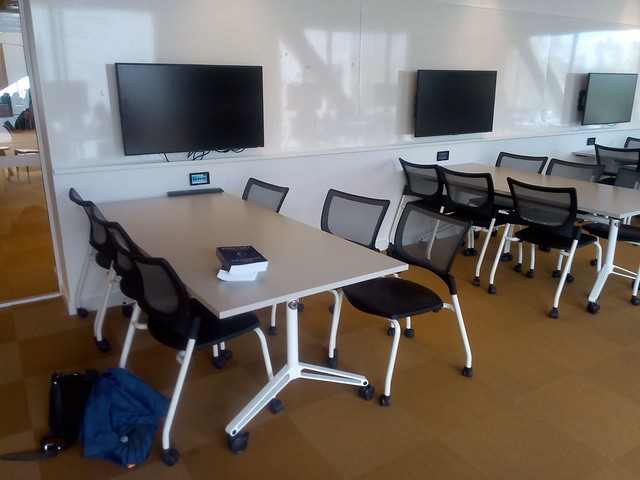
This is flipped, blended learning. It helps to have a purpose designed building, like the ANU Marie Reay Teaching Centre opened March 2019, by Architects BVN. The Centre has only flat floor classrooms, for 30, 60, or 120 students. The flexibility here is provided by retractable walls, furniture on wheels, and electronic screens on multiple walls.
Learning to Reflect
Flipped module for teaching international masters students to write a job application:
Wall mounted LCD screens & desks on wheels at ANU Marie Reay Teaching Centre
Online notes
Videos
Quizzes
Peer assessed online forums
Peer assessed assignments
Classroom discussion in flat floor room
The module is designed to help students to develop capabilities expected of working professionals to identify their development needs, how they will acquire these and to reflect on what they have learned.
An overview of the development of the module, and an open access version of the notes are available.
2. Micro-credentials delivered off-shore
NZQA micro-credentials: 1 to 8 weeks study
AQF Review: considering micro-credentials
Attractive for international and STEM students.
3 x 1 week study modules = 1 semester course?
M-learning can be over shorter periods and targeted at specific skills. The New Zealand government is recognizing micro-credentials from tertiary education organizations as of 22 August 2018. The NZ credentials can be the equivalent of 1 to 8 weeks study. The shortest qualification typically issued by Australian universities is a 12 week graduate certificate.
An AQF Review: considering micro-credentials. This could allow much shorter, and more flexible, credentials. These would particularly appeal to international students, and those in STEM areas.
Even in advance of any official recognition of micro-credentials, institutions can create smaller units of instruction, for example, dividing a semester course which is notionally three weeks full time study into three one week units. Students could undertake the three units separately, or as part of a qualification.
3. Blockchain for degree credit onshore
Lifelong learning and micro-credentials will result in worker having several hundred qualifications. This would be unmanageable with paper certificates and even with web based e-certificates, such as those issued by "My eQuals" in Australia (the image shows my Graduate Certificate in Higher Education, issued by ANU). Employers will want to be able to automatically check qualifications against job requirements, to ensure they are genuine (the other image shows one of the many web advertisements for fake qualifications). One technology which may be used is block-chain. There is an ACS Blockchain technical committee looking at this, as one use for the technology.
China's Belt and Road Education Plan envisages students from the Indo-Pacific region studying at campuses in China, and also on regional joint venture campuses. Australian institutions will have difficulty competing for international students with these campuses. However, the plan appears to cover only on-campus face-to-face education. This provides the opportunity for Australian institutions to offer online learning using mobile devices, supplemented with on-campus education. This could complement, rather than seek to directly compete with, China's Initiative.