Showing posts with label coronavirus. Show all posts

Sunday, May 3, 2020

Undergraduate Certificates to be Added to AQF

The Australian Government announced funding for short online university programs, in response to the COVID-19 Coronavirus, on 12 April 2020. There are 77 programs offer from today on the Courseseeker website (look for course category: "Short course"). These are undergraduate certificates (46) and graduate certificates (31), requiring six months full time study. While welcome, I suggest government make some improvements to the scheme, to allow for part-time study, nested programs, and mutual recognition of the certificates. Also I suggest incorporation of compulsory peer support training in all certificates, to address the elevated mental health risk, particularly for young people isolated at home, studying online, during a pandemic.

Study Areas

The emphasis in the announcement was on areas of study to help with the COVID-19 emergency. This is reflected in the programs offered. With health, including aged care and biomedical science, the largest offering, followed by education:

Study Area Number of Programs
Health 25
Education 18
Information Technology 10
Engineering & Related Technologies 9
Agriculture, Environment & Related Studies 5
Natural & Physical Sciences 5
Architecture & Building 3
Society & Culture 2
Total 77


Acceptance of Certificates


The Minister for Education, Dan Tehan,  caused confusion at the time of the announcement by describing these as "micro-credentials" and "diploma certificates". What are being offered are six month full time programs. A micro-credential is much shorter, requiring only hours, days or weeks of study, not six months. A diploma requires a year of study.

A Graduate certificate is a well known, well understood, and legally recognized term. Such programs have been used in the past as a way for someone from a discipline to gain extra skills and knowledge to work in a specialization. A Graduate Certificate in Australian Migration Law is one path to registration as a migration agent. A certificate in cyber security is useful for an IT professionals to work in security. It can also be an entry point to further studies. As an example, I undertook a Graduate Certificate in Higher Education, to help me learn to teach, and to then go on to a Masters of Educaiton.

Graduate certificates are a low risk, low cost, well understood option for universities to provide. The students are more mature than undergraduates, so are easier to teach. The course materials and classes can be shared with graduate diploma and masters programs.

Legality and Acceptance of Undergraduate Certificates


While graduate certificates are well known, as Andrew Norton points out ‘undergraduate certificates’ are not currently recognized in the Australian education system. If a private for-profit educational institution was to offer such a qualifcaiton, they could expect legal action from regulators. However, public universities are offering these with the blessing of government, with legal status to be conferred retrospectively.

While legal status may not be a major problem, industry acceptance and pedagogy may, with undergraduate certificates. It is likely that the certificates will have been created in the same way as graduate certificates, from components of longer diplomas and bachelor programs. As an example, UWS with its Undergraduate Certificate in Information and Communication Technology offers the possibility of credit towards a degree, and presumably the certificate is built from that degree. However, unlike graduate students, these undergraduate students may be new to university study, as well as to online study. It takes time for a young person (the minimum age is 17 years) to get used to study at university, as well as life in general.

While the undergraduate certificates are being offered as standalone qualifications, I suggest they would be better as the first part of a nested qualification. That is, it would be assumed the student was intending to go on to undertake a diploma, and from there a degree. Ideally this would allow for blended learning. That is the student would undertake some study online and some on campus. My rule of thumb is that a typical student would be on campus for 20% of their study, about one day a week (obviously where COVID-19 restrictions allow).

Do We Need Undergraduate Certificates When We Have VET Ones?


While graduate certificates have been accepted as a qualification for particular roles, undergraduate certificates have not. The Vocational Education and Training (VET) sector already has a well established set of qualifications for jobs in the fields the undergraduate certificates are being offered in. These VET  qualifications have been recognized in laws, and in industry hiring practices. The VET sector is experienced in turning out students who are ready with practical skills needed for a very specific workplace role. However, universities have focused on much longer programs and more general higher level skills. In some cases universities have formed partnerships with VET institutions (or have VET arms), where the student does enough training in VET sector to get a job, then then transitions to university for a degree. It is not clear there is really a need for vocationally useful undergraduate certificates, or than Australia's universities are equipped to provide them.

There is also a lack of alignment between VET sector and university qualifications. As an example, to be able to teach in the VET sector, I was required to complete a Certificate IV in Training and Assessment. This was despite already having a Graduate Certificate in the field of education. In practice I was able to obtain 80% of the VET certificate based on my university experience and education. Even so this took months of elapsed time and payment of additional fees.

Will Universities Value They Own Certificates?


Within the VET system qualifications are mutually recognized, but this does not apply between VET and university, between or within universities. A student who has completed a unit of study at a public or private VET institution has that automatically accepted at any other for credit. However, the UWS Undergraduate Certificate in IC&T "may be credited towards the degree". In this case the university is not guaranteeing to recognize its own certificate for further study, let alone one from another university. If the undergraduate certificates are to continue beyond the next six months, I suggest the government make funding conditional on universities accepting their own certificates, and those from other universities, for advanced standing.

Need Part Time Certificates

I suggest government allow certificates, undergraduate and graduate, to be part time.

The certificates offered under the government COVID-19 funding are all full time. This makes sense as a short term emergency measure. The nation needs health and other workers quickly to deal with the pandemic. It is also a way to keep young people occupied while forced to remain at home. It provides them with a qualification to get a job much quicker than a degree. However, undertaking full time study online is very difficult, especially for a young inexperienced student. Adding to that isolation due to COVID-19 greatly increases the difficulty, and the risk of mental health issues.

It has been common practice for Graduate Certificates to be offered part time. This is useful for working professionals, who cannot take six months off work to study. It is particularly useful with online study. Even so, as an online graduate student I found I could not do more than one quarter of a full time course load comfortably. This was under almost ideal conditions, where I was a mature student with very good IT skills, studying with some of the world's top online educators, and already experienced in the field I was studying. The typical young undergraduate is going to have considerable difficulty studying full time.

Address the elevated mental health risk


Even with all the advantages I had as an online student, it was not the fun depicted in university advertisements: it was a frightening, painful, frustrating experience. The Australian Government ,and universities, need to address the elevated mental health risks, particularly for young people isolated at home, studying online full-time, during a pandemic.

Students are encouraged to take part in extra-curricular and co-curricular activities on campus. This can't be assumed for online students, especially not with COVID-19 measures in place. I suggest universities need to teach students how to form and maintain peer support groups online, and make this an assessed compulsory part of studies. Leaving this as something optional and voluntary, is an unacceptable risk to the health, and the lives, of students. In addition, not teaching students how to support each other will result in a higher dropout rate, and so a waste of public money.

Monday, April 13, 2020

Australian Higher Education Relief Package for COVID-19

The Hon Dan Tehan MP
Minister for Education
The Australian Minister for Education, Dan Tehan, and the Minister for Employment, Michaelia Cash,  announced a Higher Education Relief Package, in response to the COVID-19 Coronavirus, 12 April 2020. Overall the intention of the package is good, but some of the details will need considerable work. Andrew Norton has produced a very useful commentary on this, but here are some additional comments of my own.


The package envisages Australians studying online to improve their job skills, while waiting for pandemic control measures to be reduced allowing a general return to work. Areas of study mentioned are nursing, teaching, health, IT and "science". Short, online courses, from universities and private providers will be subsidized, from May for six months (initially). Strangely missing from the list of areas of study is any specific mention of engineering, or manufacturing, given the need for Australia to rapidly produce strategic products to meet the current emergency.

The announcement refers to the short courses being from "world-class universities", but presumably that is a rhetorical flourish and the intention is not to limit the program to the top half dozen Australian research universities which rank highly internationally. That would be unfortunate as it is the lower ranking regional teaching universities which have more expertise and experience with online learning in Australia. I studied how to do online learning (via online learning),  at the University of Southern Queensland, which while providing good courses and is highly regarded in that field, is not a "world class" university.

In addition, government funding for universities will be "at current levels, even if there is a fall in domestic student numbers". There is no offer of government funding to make up a shortfall in international student fees.

How the new funding for short courses will be administered is not detailed in the announcement. It should be remembered that previously about $2.2B was paid to private trainer providers for courses of dubious quality, or in some cases, not delivered at all. While "innovative micro-credentials delivered flexibly online" is a worthy goal, there are no agreed definition as to what a micro-credential is. Micro-credentials are not currently part of the Australian Qualifications Framework, and some have formal coursework, while some do not. Short courses can range from one hour's study, to about the length of a typical university unit (about 100 hours).

I have worked in this area of education for ten years, designing and delivering short online courses. I have been involved in several micro-credential projects and on professional standards bodies overseeing these, presented papers at international conferences, given evidence to a Senate inquiry, and  blogged on the topic, but I am still not sure what a micro-credential is. Or it may be that micro-credentials mean many different things to university, and vocational providers. 

I suggest universities should take a cautious approach to micro-credentials, due to the high reputational risk from over-promising. As an example, it is common for universities to offer short courses which do not count for credit towards a degree, are not aligned with the AQF, and are not specific to a job. However, a "micro-credential" is clearly intended to be a type of credential: that is a qualification. In the context of the government announcement, by issuing this qualification, the university has certified the holder has the skills needed to undertake a specific workplace task. Universities cannot use disclaimer to say the credential is not a credential, and those so qualified are not qualified.

One way I suggest universities can navigate this legal and ethical minefield, is to integrate short courses in existing AQF qualifications. As an example, in 2016 I set out to design a teaching course for IT professionals. Teaching is a recognized skill in the computing discipline internationally. Australian universities are accredited to provide degrees under well established national procedures. So what I proposed was to create a teaching course within that framework. This way the familiar quality controls of the university system and professions could be applied.

To make a university course into a set of "micro-credentials" I proposed dividing it into three or four parts, with each part aligned with a set of externally defined skills. A student would receive a micro-credential for completing each part. Those who completed all the micro-credentials would receive one course credit towards a degree.

None of this will be new to the vocational education sector, which has been routinely producing nationally standardized job relevant short courses for decades. However, this is a new skill for many university educators (some of us are dual qualified in by VET and university sectors).

Tuesday, March 24, 2020

K12 EdTech Showcase

My third video meeting for the day was a K12 EdTech Showcase hosted by EduGrowth, an Australian educational technology innovation hub. There were quick presentations from education entrepreneurs. Interestingly, these were not just online platforms for delivering content, but also curated libraries of content. This could be particularity useful for teachers looking for stuff to keep students at home occupier.

What worked particularly well for this event were the moderator using an interview technique, where they asked questions. As with previous events, Zoom was used. This worked better when the video was turned off, with just the presenter's voice and slides.One frustration was that each time the presentation shifted to a new presenter, the display switched to full screen video. It would be useful if Zoom could be configured to stop this happening.

Work Integrated Learning in the Age of COVID-19

The Australian Collaborative Education Network (ACEN) held a video meeting today to discuss what to do about Work Integrated Learning (WIL) in response to the COVID-19 Coronavirus. Post secondary educational institutions (and some secondary), have students who undertake part of their program gaining practical experience in a workplace. This is required for some accreditation to work in industry. But what happens to these students with workplaces closed?

Part of the answer to that was provided by ACEN, leading by example, in convening a video conference. This was attended by about 280 people around Australia, and some from other countries.

I help teach ANU TechLauncher students who undertake group software development projects for a real client. This is a little easier to manage, as these students are normally not on the client's premises. Also computing professional routinely do much of their work using computer based tools, and the students have already been introduced to coordinating their work online. I have provided some tips on how to work remotely, from the client, from their tutor, and from each other.

The ACEN video conference suffered from some technical glitches. I have provided some tips on what to do to place less strain on our digital infrastructure. This was my second video meeting for the day, with two to go.

Use Recorded Videos and Small Online Tutorials

It is time for lecturers to swallow our pride and accept the "sage on the stage" is not that important to student learning. In place of large live events, I suggest the flipped approach. Provide videos and other materials for students to study in advance (you can provide quizzes to help). Then have online tutorials for small groups. The lecturer can record some short videos for them to use during the tutorials (I suggest around 60 seconds each).

Video conference systems, such as Zoom, allow for hundreds of students to take part in an online interactive events (Webinar). During the event the class can be divided into smaller groups, to work on a task for a few minutes, then the class brought back togehter. This is an excellent teaching method, however, it places demands on the technology, and staff which may be too much due to the COVID-19 Coronavirus. There is likely to be very high utilization of videoconferencing, straining resources. Also large complex real-time events are harder to organize.

University Researchers Need to Implement COVID19 Measures NOW

Staff of universities and research organizations should have by now been issued guidelines for them to limit face to face meetings, and move activities on-line, due to the COVID-19 Coronavirus. University teachers have needed to make changes to accommodate students, but there has perhaps been less pressure on researchers to change their work habits.

Stop Gathering in the Common Room


One of the delights of being on the academic staff of a university has been gathering in the common room for regular morning tea. This is a very good way to find out what is going on, and to sound out colleagues about ideas. However, this must now stop.

Move Seminars On-line

Over the last few weeks I have been asking each organizer of a meeting, seminar, or conference I have been invited to attend or speak at to provide an online option. This started happening gradually, with notices from organizers saying they have either moved events entirely online, or at least added an online option. However, it is now time to drop the in-person option for events, and focus on providing good online alternatives.

Online events need to start on time, with someone to welcome arrivals, and assure them the audio is working. Also the number of people together running the event needs to be limited. There is no need for all the presenters to be together in the one room.

The Research Project You Save May Be Your Own

For those who are unconcerned about their own safety, I urge them to consider their colleagues and their families. If for no other reason, they need to change their behavior to protect their research, which will suffer if their research team is the center of a COVID-19 outbreak.

COVID-19 Infection Control Training Online from Australian Government

The Australian Department of Health is providing COVID-19 Infection Control Training online for healthcare and related workers.  The module was produced by Aspen Medical. An introductory page warned "Due to the high demand of the Infection Control Training course, you may experience timeouts. We are working with our training partner to resolve the issue as quickly as possible.". The approach I suggest to get around this is to provide a version of the course materials outside the Learning Management System (LMS). The LMS allows the progress of each student to be tracked and t=for them to be provided with the appropriate materials and tests at each stage. However, all that takes computing resources, limiting the number of students. Much of the demand is likely to be from people who do not need, or want, to complete the entire course. Typically, only 5% to 10% of people who sign up for a free online course complete it. Many just want to see what is in the course, or have a general interest. For these people a sample of the course materials can be provided outside the LMS. It is also possible to provide all the materials so that the course can be run in house.
The COVID-19 training does offer some material outside the LMS already:

Thursday, March 19, 2020

Free Online Teaching Course Starting 20 March

Dr. Martha Cleveland-Innes,
Instructor
Athabasca University (Canada), is offering a free five-week online course Learning to Learn Online, starting 20 March. This is the university where I undertook a Master of Educaiton in Distance Educaiton. I was an online international student, and Athabasca certainly know how to use e-learning to teach digital teaching.
"In this , you will explore the fundamentals of the learning process and various models of online courses to determine your learning preferences and which forms of online learning are best for you. Activities will address common misconceptions, frustrations and fears about online learning, and introduce techniques to help overcome such obstacles and gain confidence as a learner.

Throughout the course you will be guided through an interactive and reflective process by a team of online learning specialists, with the opportunity to join in live sessions with leading researchers in online education.
COURSE OBJECTIVES 
On completion of this course, you will be able to:
  • Describe what it means to learn - anywhere, anytime.
  • Clarify personal learning preferences.
  • Identify common components of an online learning environment.
  • Compare differences between online and traditional learning.
  • Plan for areas of personal adjustment required for success in online learning.
  • Analyze different types of learning environments including a personal learning environment.
  • Explore and employ effective online communication tools and strategies.
  • Describe the role of an online learning community in supporting learning.
Certificates of completion are available for participants who pass all five module quizzes."

Wednesday, March 18, 2020

Transition to On-line Study: Example message to team project students

The Australian National University is to pause all coursework teaching for one week from Monday 23 March and then deliver online for the remainder of the semester. Here is an example of a message I prepared for Techlauncher computer group project students about the change to e-learning. These students receive few conventional lectures, instead they work in teams on a project, and meet with a tutor regularly.

Transition to Online Study


The TechLauncher program is now being delivered online, due to COVID-19. I have some experience with online education, and so will be providing some tips for students, and tutors, over the coming weeks. Here are the first:

Use the tools you have: You already have an array of online collaboration resources available to you. With most of these, an individual can contribute at any time, and it is stored so others can view it later. In education, this is called asynchronous mode. Many software development teams, who are spread across the world, work this way. However, to get a sense of being a team, and when quick decisions are needed, nothing beats real-time synchronous communication, with everyone contributing at the same time.

For online tutorials, ANU has provided Zoom Videoconferencing. There is a Zoom "Meeting" for each tutorial group. You can use the meeting-id via the web, or download the client for your computer, or smartphone. With the agreement of your tutor, you can use an alternative conferencing product for tutorials. Teams can use whichever tool they find most useful for their own meetings.

You may not need video: While it is called a video conferencing tool, Zoom, and similar products, work well with audio, slides, and screen sharing. As team members already know each other well, you do not necessarily need to see each other. You can also use your asynchronous tools in a near real-time mode, talking together via Zoom, while looking at, and modifying shared documents. A headset greatly improves the quality of sound, and also using a smartphone, rather than a computer for audio tends to have fewer problems. You can use your smartphone for sound and your computer for documents, at the same time.

Meeting preparation is important: Whatever tool you use, keep in mind that good meeting preparation is even more important online than for a face-to-face meeting. You need to solicit items for the agenda well in advance, and preferably circulate the agenda, and any documents for discussion, well beforehand. It can become very confusing if documents participants have not seen before popup online during the meeting.

The tool you are using to distribute documents and images may fail during the meeting, leaving just audio (and perhaps text chat). During the face to face presentations, you have been encouraged to be ready to keep talking if the video display fails and the same applies online: if the video fails you need to be prepared to keep going, referring to documents the participants already have, or painting them a picture with your voice.

The Campus still open but be prepared: At present ANU has not closed the campus, so physical meeting rooms are available. However, this could change without notice, so please prepare now for on-line working. Also while you should take sensible precautions, there is no general requirement to self-isolate at this stage.

Don't Panic: I have been delivering on-line education at ANU for a decade, using the same proven techniques we are implementing for Techlauncher. From 2013 to 2017 I was a graduate student of education, refining these techniques for delivering international distance education. From this experience, I learned which techniques work, but more importantly, how it is key we remember there is a person on the other end of the network connection, and to treat them as such.

I would welcome comments, suggestions, and corrections.

Tom Worthington
Instructor for Learning to Reflect

Sunday, March 15, 2020

All educators must offer e-learning now

I was asked recently what to do if a student who is enrolled on campus asks to switch to online study, due to fear of COVID-19 Coronavirus. Should this only be allowed if the student has a medical condition which places them at risk, or they are unable to get to campus due to travel bans? No, I suggest all students be offered an online alternative now. Educators need not, and should not, wait for their institution, or a government authority, to order, or endorse this action. As e-learning is already having to be provided to some students, offering it to all is not a large cost or inconvenience. Teachers have an ethical, and legal, obligation to act in the interests of their students, their colleagues, and in the public interest.

E-learning for Schools Pitch

Last week I attended a Service Design Meetup at the Canberra Innovation Network, sponsored by Evolve & Amplify. We went through the standard entrepreneurial start-up value proposition process. I worked on the idea of expanding my e-learning services from university to business, in response to the  COVID-19 Coronavirus emergency. I produced a pitch, and submitted it to a start-up competition. Also I produced a video, but then discovered they completion did not allow videos, so here it is.

Images under a Creative Commons License.

Saturday, March 14, 2020

Designing in an On-line Learning Option

One of the benefits of computers in education is that this makes distance education a richer experience and feasible for more students. It also can remove the need for special provisions for when some, or all, students cannot get to campus, such as in the current COVID-19 Coronavirus emergency.

Pictographs by
Carlos Sarmento

from the Noun Project
(CC BY 3.0 US).
As part of my graduate studied in education, and informed by my background in defence and emergency management, in 2016 I concluded that international students could be prevented from coming to Australian campuses at short notice due to an international crisis. In 2017 I suggested that universities provide blended learning, which allowed for students who could not get to campus to study online. Since then I have been designing and delivering courses this way: on-line, with classroom activities for those students who can get to campus.


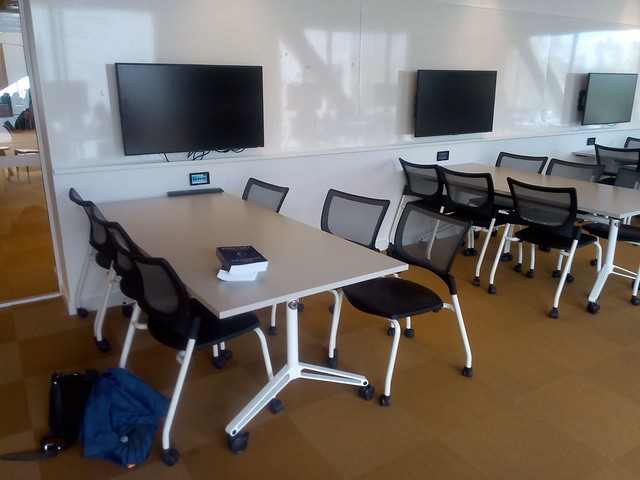
Wall mounted LCD screens and desks on wheels at ANU Marie Reay Teaching Centre
Wall mounted LCD screens
& desks on wheels at
ANU Marie Reay Teaching Centre
An example is the "Learning to Reflect" module for Australian National University computer project management students. This has an e-book, videos, online quizzes, and online student forums. There is also provision for face-to-face workshops. But in the current circumstances, it seems likely these will be switched to online as well. There is no need to change the course content, or assessment processes, as they are all already online. 

It should also be possible to offer both classroom and online real-time (synchronous) sessions for students. This would use the same software as for distance education, but tied into the classroom's audio-visual system. There should be no need for any special additional hardware or software.

Friday, March 13, 2020

The Idea of the University Has Not Been Canceled

Zen and the Art of Motorcycle Maintenance,  Robert M. Pirsig, 2006
Zen and the Art of Motorcycle
Maintenance, Robert M. Pirsig, 2006
Universities are canceling events to minimize the risk of the transmission of COVID-19 Coronavirus. For the present, face-to-face teaching and research will continue, with precautions in place. Ironically among the events cancelled is "The Idea of the University - Crisis or Adaptation?".  I was reminded of Pirsig:
 "...the real university exists not as the physical campus, but as a body of reason within the minds of students and teachers ..."
From Chapter 13, Zen and the Art of Motorcycle Maintenance, Robert M. Pirsig, 2006
Decades later this idea has been made a practical reality by adopting teleworking and telelearning. I suggest those organizing events at universities should not cancel or postpone them, assuming the current emergency will end soon: it will not. Instead, just as with teaching, organizers of events should provide blended, or fully online, options. The idea of the university can continue, despite the crisis, through adaption. This will be important to the well-being of staff and students, who need something to keep them occupied, other than worrying about a pandemic. It is also important that the university continue to provide a valuable service to the community, through research, education, and community outreach.

Don't Postpone Examinations: Replace Them With Realistic Tests

Media reports indicate that some universities are postponing examinations due to the about the COVID-19 Coronavirus. Unfortunately this emergency will not be over quickly, so this is not an effective strategy. It is technically possible to run online invigilated examinations. Athabasca University (where I studied education), uses the product ProctorU for this. However, even with a tool, the administrative burden is high. Running pass/fail oral exams via videoconferencing is also possible (I did one of these for my MEd), but these are time consuming, and stressful for the students.
 

The approach I suggest is to use multiple assignments, and tests (with provision to deter cheating), to determine the student's grade. If some form of supervised test is required to verify the student is not cheating, then this could be a pass/fail one, to confirm the previously established grade.

Paper based end of course examinations are not an effective form of assessment of real world skills. I suggest instead changing to other forms of assessment which realistically assess skills and knowledge. The best way to do this is to have the student carry out the tasks they are being trained to do, either in a real workplace or a simulation, and see how they do. As an example, I help train computer students in project management. This is assessed by having students work in teams on a computer project for a real client, and seeing how they do. The assessment is, in part by their peers, but mostly by staff.

Wednesday, March 11, 2020

KEEP CALM AND CARRY ON-LINE

Poster generated using Keep Calms.
Since the COVID-19 Coronavirus started causing difficulties for Australian education a few weeks ago, I have lost track of the number of emergency meetings, and written thousands of words of advice on how to change to e-learning. Here is an attempt to sum up what to do in five words "KEEP CALM AND CARRY ON-LINE".


Tuesday, March 3, 2020

Online Courses on Coronavirus from World Health Organization


The World Health Organization has released a series of web based courses about the COVID-19 Coronavirus. These are intended for  health professionals, and incident managers. The courses are self-paced and available in multiple languages. As an example " ePROTECT Respiratory Infections" takes 2 hours and has four parts:
  1. Introduction
  2. How to protect yourself ...
  3. Basic hygiene measures
  4. Wearing a medical mask
Each part consisted of a video of about 20 minutes.  The English versions have English closed captions, plus a transcript and audio download. There is a small amount of a talking head, interspersed with slides. There is a discussion forum, with topics for discussion, under the video. The layout is clear and the interface is responsive.

I suggest the training could be improved by breaking the videos up into smaller segments. Ten minutes is usually considered about as long as a training presentation, should be, and preferably much shorter. The talking head in the video are useful to give authority, but less could be used: this is only needed at the start (and a simple still photo would do).  The slides used have too much text, and it might be good to break these up with some stock video footage.

Monday, March 2, 2020

Conference Organizers Need to Plan for Infectious Disease Outbreak

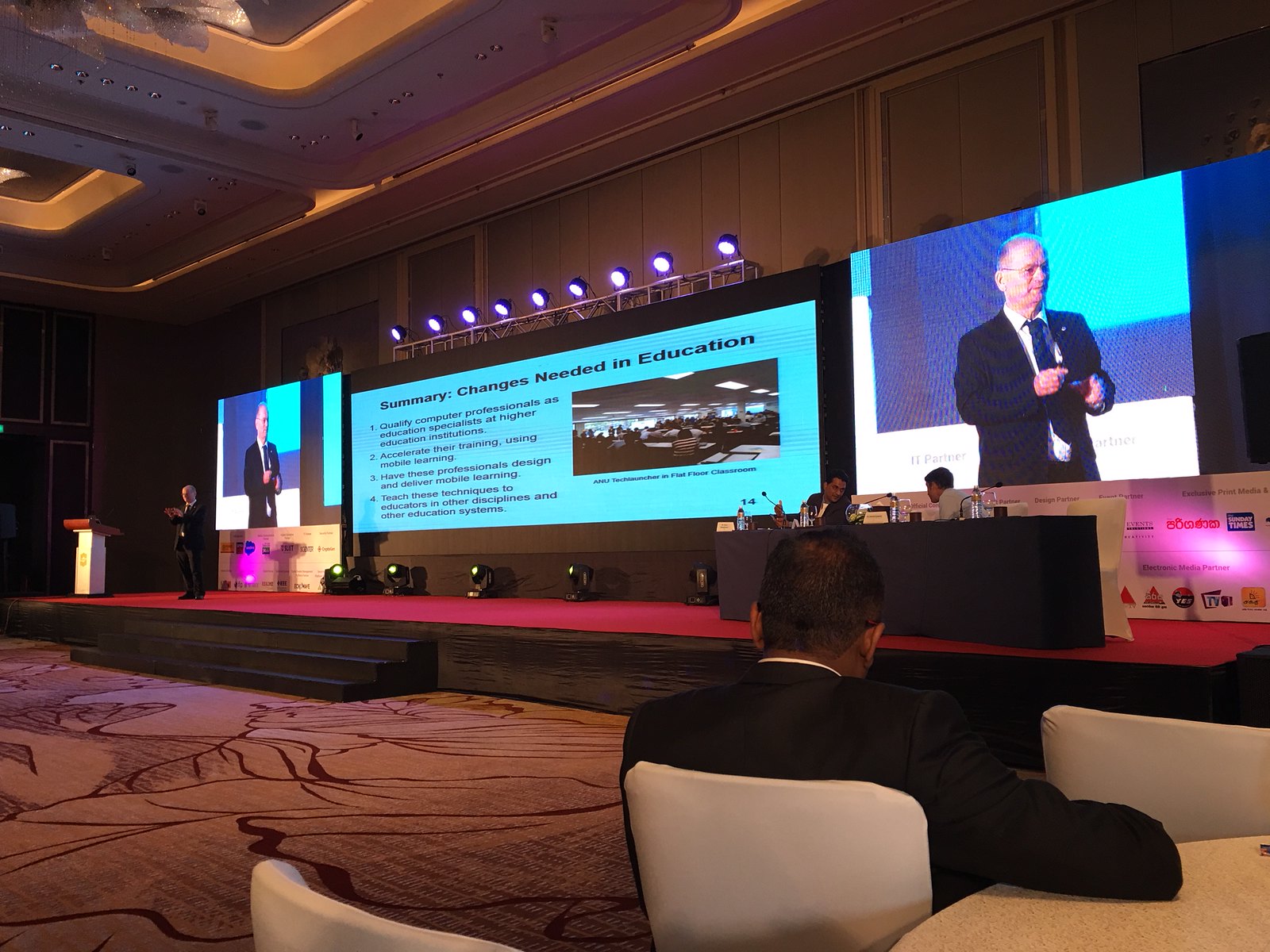
Tom Worthington Speaking at NICT 2018 in Colombo
Tom Worthington speaking at NITC 2018
Those organizing international conferences in the next few months need to have a blended, or fully online, option available, due to COVID-19 Coronavirus restrictions. One option is to offer venues distributed around the world, which delegates can travel to locally. They will be able to interact face to face with colleagues. They can participate in local presentations face-to-face, and those from other venues via a video link. The moderator at the speaker's venue can relay questions submitted thorough the conference's chat facility, and queue audio questions.

A conference can be run 24 hours a day, with three venues spread equally around the world's time zones, to "follow the sun". With this format each venue takes turn running the conference during their daylight hours, handing over at sunset.

As someone who speaks at international conferences several times a year, I would miss the  travel to interesting places and meeting new people. But sometimes it can be a relief when you travel for many hours, to get to the same old place, and see the same old people. ;-)

ps: Not that I will be refusing invitations to interesting places just yet. I just accepted one for June.

Saturday, February 29, 2020

Australian Government Guide for Online Education into China

A short Guide for delivery of online education into China has been released by the Australian Trade and Investment Commission (17 February 2020), for international students who have been unable to get to campus due to the COVID-19 Coronavirus. This reports that Australian "edu.au" websites are working in China, but if third party websites are also required there could be problems.

Also students access may be slower, for multimedia and large files in China. The guide suggests hosting of content in, or near China, such as Hong Kong, Macau or Korea, may help. Austrade provide a list of online platform providers. Before looking at onshore options, I suggest reducing the size of multimedia files. This can be as simple as saving a video with reduced resolution, reducing files to one tenth the size. Usually it it the video files which take up most of the space, but occasionally a poorly formatted PDF file can cause problems..

The Austrade report points out that China does not recognize foreign online qualifications. The acceptability of blended learning, a mix of online and classroom based, is unclear, and is being investigated. When I studied the topic of online education in China and India, I found there was a suspicion of this, even where such qualifications were officially approved. This is not just an administrative hurdle to be overcome but a cultural one.

In practice on-campus full time Australian university students, including international ones,  are already studying in blended mode. They spend more than half their time studying online. However this is a very fine blend, with the student in a classroom several times a week. Also major assessment tasks are face-to-face and proctored. Replacing more of the face-to-face instruction with online equivalents is likely to be acceptable. However, remote unsupervised assessment, is less likely to be accepted.

Thursday, February 27, 2020

Educators Need to Plan for Infectious Disease Outbreak

This is to suggest educational institutions revise, or create, their Infectious Disease Outbreak Response Plan, now. Australian universities, vocational education and some schools have already had to make arrangements for international students who have been unable to get to campus due to the COVID-19 Coronavirus travel restrictions. However, much more may need to be done in the coming months, with remote education provided to students across Australia, on a scale not seen before.

Individual educators need to become familiar with the precautions they need to take to protect their own health, and that of their staff, so they are then able to help their students. Educators also need to learn remote education delivery techniques, in the event their students can't come to class. Also educators need to ensure they are equipped to work from home, in the event campuses are closed.

The Australian Department of Health has activated their Australian Health Sector Emergency Response Plan for Novel Coronavirus. This has little practical effect for the general public, as most health resources and powers are state based. However, it is an indication that federal health officials consider the situation with the COVID-19 Coronavirus in Australia to be serious, and  are indicating to their state colleagues to activate their emergency plans. The US CDC has issued Interim Guidance for Businesses and Employers to Plan and Respond to Coronavirus Disease 2019 (COVID-19).

CDC now recommend employers actively encourage sick employees to stay home,those with symptoms should be separated and sent home immediately. Posters to encourage staying home when sick, cough and sneeze etiquette, and hand hygiene are recommended, and other measures are recommended.

CDC also recommended planning for a COVID-19 outbreak, with businesses considering how to reduce transmission among staff, protecting people at higher risk, while maintaining business operations, and minimizing effects on businesses in their supply chains.

At a Press Briefing, February 26, CDC highlighted some of the measures in the "Community Mitigation Guidelines to Prevent Pandemic Influenza United States" (2017):
"Students in smaller groups or in a severe pandemic, closing schools and using internet-based teleschooling to continue education.  For adults, businesses can replace in-person meetings with video or telephone conferences and increase teleworking options.  On a larger scale, communities may need to modify, postpone, or cancel mass gatherings."

With a reliance on teleschooling and teleworking, there will be a need for technical and teaching staff to be able to support many more students and clients. Australian universities have already made adjustments to the way they teach to deliver courses to students not on campus. However, these adjustments have been made for some students, whereas plans now need to assume most, or all students are unable to be in a classroom. There also has to be provision for only a small essential support staff on campus, with teaching and administrative staff at home, online. Key to this, I suggest, is the use educational technology to train staff and students in in what to do. Education is not an essential service, like food, water and power, however it can have a very useful public health benefit in keeping staff, and students occupied.

Update 4 March: I was interviewed by Casey Tonkin, this morning: "Will coronavirus make you work from home? Remote working takes off as the virus spreads" (Information Age, 3 March).

Happy to talk more on this and how we teach students online who can't get to class due to the Coronavirus.

Previously I have had some involvement in planning IT for emergencies at the Department of Defence, and pandemic response. In my book "Digital Teaching In Higher Education" (2017), I warned that the flow of international students to Australia could be disrupted very quickly and set out the steps for e-learning. I have been teaching this way at ANU since 2009.

Sunday, February 23, 2020

Online Teaching is Here Now

Casual teaching staff at some Australian universities are reported to be “panicking” over the implications of students who are unable to get to campus due to the COVID-19 Coronavirus. Last week I was helping teach one hundred tutors how to teach, and there were no signs of panic. Well, no more panic than any group of teaching assistants about to face their first class.

If students can't get to campus, then there will be less need for sessional staff to teach face to face (F2F). However, if some of those students are studying online, they may need more tutor support.

The same principles and techniques used in F2F teaching apply online. The practicalities are a little different online, depending on the communications technology available. But the same tools already used by Australian universities for blended learning can also be used for online learning. Staff and students are already familiar with these tools.

Universities are providing additional training and support for teaching online, to supplement that already in place. As an example, ANU provides Coffee Courses with short snippets of learning about teaching (not just for ANU staff: anyone can access these). Also, there are the usual self-paced courses on particular tools. For those planning to teach as a career, there are longer, more formal programs. As an example, ANU's "Principles of Tutoring & Demonstrating", starts on 3 March.

Relatively few Australian university courses have been delivered entirely online. More often courses are blended with materials delivered online, alongside face-to-face lectures, tutorials, and workshops. Students typically watch videos of lectures, submit assignments online, and may also do some quizzes. As staff and students are already using online tools for some of a course, a change to all online mode is not as difficult as it might first appear.

The tools already in use at Australian universities for blended learning can provide online learning. Typically a mix of tools provides announcements to students, materials for, and output from, students. Using multiple tools is more complex, but provides some resiliency: if one is not working, another can be used.

Asynchronous Tools


There may be one tool for general announcements, and another to deliver course notes and collect assignments, plus a tool for videos of lectures. These tools are used asynchronously: students work through the material in their own time, and then submit a response. This makes them  convenient to use, and communication glitches less of a problem. However, tutors do not get instant feedback from students, so they need to anticipate what students might need, and when they might need it. Also, students need to understand they will not get instant feedback from tutors.

As an example of the sort of forums, posts and FAQs for an online course, see the tutor guide for "ICT Sustainability" (offered by ANU and by Athabasca University in Canada) and the module Learning to Reflect (for ANU's Techlauncher program). Students read the course notes, watch videos, do quizzes, contribute to forums, and do assignments. They get text-based feedback from peers, and instructors (audio and video are possible, but text is simpler). The full notes, videos, and tutor guides are available online.

Synchronous Tools


Universities also use synchronous tools: live video lectures, and video tutorials. With these, the instructor and students are connected at the same time, simulating a lecture theater or tutorial room. These tools are occasionally used to supplement F2F sessions. However, these tools take considerably more effort by staff and students to use. Because everyone has to be online at the same time, any glitch with the software, network, or the student's computer, results in them not being able to take part.

Usually, a live sessions is recorded for students who could not take part. However, this is not as good as the real thing. As an online learner myself for seven years, I found I was unable to connect to about one-quarter of the live sessions. With the current circumstances, I expect international students will be unable to connect to a session at an Australian university about half the time. So each session should be offered two or there times.

COVID-19 Coronavirus Response


As some students may be unable to get to campus this semester due to the COVID-19 Coronavirus, some universities have decided to offer remote access. Which of the tools will be usable, and what alternatives are possible, is being investigated by technical staff at universities across Australia. So far it appears the asynchronous tools already in daily use will work. These tools are also less susceptible to intermittent problems: if it doesn't work today, try again tomorrow.

The synchronous tools are more of a problem. The usual tools may not work, or require workarounds, and may suddenly stop working. It may be necessary to conduct some courses with no synchronous communication at all. My approach for the last few years has been to design courses for online asynchronous delivery, then blend in add F2F, or synchronous, elements. This offers maximum flexibility for remote and on-campus students. Also I had in mind the possibility that international students would be suddenly unable to attend campus.

Being a student can be a very lonely and frustrating experience, and even more so for a distance education student. Tutors can give the students the sense you are there for them, through regular posts to the class. Staff time is limited, so messages to individual students have to be used sparingly. If they have the time and the technology, to provide video, staff can do so. However, research (and my experience), shows video is not necessary.

Technology-based distance education is not new, or a fad, it has been part of university education for decades. How to use technology for teaching is something all university educators should learn, as part of their basic training. Universities offer such training free. But those with ambitions of making this a career should be willing to undertake further formal study.

Equipment for teaching online is cheap and readily available. A web camera and a quality headset/microphone cost less than $100. This is something those who teach can have as part of their professional equipment, in their bag, with their laptop computer.

In ten years of teaching online, I have had deep and satisfying interactions with students around the world, who I have never seen, and never spoken to. As an international online student for three years, I was able to complete a degree from the other side of the planet, without setting foot on campus. It was not easy or fun, but being a university student is not easy or fun. This experience is documented in an e-portfolio, a blog post, and a book.