Showing posts with label video lectures. Show all posts

Friday, May 15, 2020

Universities Should Not Plan a Return to Lectures-as-Usual

Recently US colleagues asked about plans for the return to the university campus for students, after COVID-19 lock-downs. The consensus emerging seems to be to provide for students remote online, as well as in the class at the same time. Classrooms would be equipped with microphones, cameras, screens and computers (many already are), so remote students could see and hear the instructor, as well as those in the room.

However, I will still be taking the laptop and web camera I have been  using for teaching at home, along as a backup. That might be a useful  approach for institutions which don't have all classrooms equipped for live video.

In Australia we are fortunate to receive reasonably consistent advice from local, state and federal authorities on COVID-19 measures. Some of this has the force of law, through health and safety legislation, as well as specific COVID-19 emergency regulations. However, there are currently no specific guidelines for universities (the ones for schools are clearly not applicable), so the closest is for workplaces.

A prudent approach, I suggest, would be to have staff return to work first, then small group teaching, and lastly large groups. However, there are some difficult legal and ethical dilemmas, particularly with large group teaching.

Conventional lectures, with large numbers of students, in a cramped lecture theater, probably pose the highest infection risk. Also this is the least effective form of teaching. A conventional face to face lecture is no better for student learning than watching a video. So there is no good reason to resume lectures, ever (I stopped giving lectures ten years ago). There will still be scope for a presentation by a celebrity guest speaker, and for interactive learning with a group of people,. However, I suggest universities do not plan a return to conventional lectures, with someone speaking for an hour to hundreds (most students gave up attending these years ago, anyway). Instead universities should start decommissioning, re-purposing, or demolishing, lecture theaters, to make way for flexible learning spaces.

ANU Marie Reay Teaching Centre
The ANU Kambri complex, opened in February 2019, provides an example of an alternate approach to large university teaching spaces. The Marie Reay Teaching Centre has six floors of entirely flat floor classrooms, with movable chairs and tables. This allows occupants to be more easily spread out, than in a fixed seating lecture theater. If conditions allow, the tables can be pushed aside and chairs arranged close togehter lecture style. During construction, I asked the engineers if the prefabricated manufactured wood panels allowed the building to be modified more easily modified than in a concrete building. The reply was that this would need just a structural engineer, and a chainsaw: in other words the building could be easily modified.

The adjacent Culture and Events Building has multipurpose rooms with retractable theater seating. At the push of a button the tiered seating retracts into the wall, leaving a flat floor space for chairs and tables to be placed. The foresight of those who planned these buildings is to be commended.

Friday, March 13, 2020

The Idea of the University Has Not Been Canceled

Zen and the Art of Motorcycle Maintenance,  Robert M. Pirsig, 2006
Zen and the Art of Motorcycle
Maintenance, Robert M. Pirsig, 2006
Universities are canceling events to minimize the risk of the transmission of COVID-19 Coronavirus. For the present, face-to-face teaching and research will continue, with precautions in place. Ironically among the events cancelled is "The Idea of the University - Crisis or Adaptation?".  I was reminded of Pirsig:
 "...the real university exists not as the physical campus, but as a body of reason within the minds of students and teachers ..."
From Chapter 13, Zen and the Art of Motorcycle Maintenance, Robert M. Pirsig, 2006
Decades later this idea has been made a practical reality by adopting teleworking and telelearning. I suggest those organizing events at universities should not cancel or postpone them, assuming the current emergency will end soon: it will not. Instead, just as with teaching, organizers of events should provide blended, or fully online, options. The idea of the university can continue, despite the crisis, through adaption. This will be important to the well-being of staff and students, who need something to keep them occupied, other than worrying about a pandemic. It is also important that the university continue to provide a valuable service to the community, through research, education, and community outreach.

Don't Postpone Examinations: Replace Them With Realistic Tests

Media reports indicate that some universities are postponing examinations due to the about the COVID-19 Coronavirus. Unfortunately this emergency will not be over quickly, so this is not an effective strategy. It is technically possible to run online invigilated examinations. Athabasca University (where I studied education), uses the product ProctorU for this. However, even with a tool, the administrative burden is high. Running pass/fail oral exams via videoconferencing is also possible (I did one of these for my MEd), but these are time consuming, and stressful for the students.
 

The approach I suggest is to use multiple assignments, and tests (with provision to deter cheating), to determine the student's grade. If some form of supervised test is required to verify the student is not cheating, then this could be a pass/fail one, to confirm the previously established grade.

Paper based end of course examinations are not an effective form of assessment of real world skills. I suggest instead changing to other forms of assessment which realistically assess skills and knowledge. The best way to do this is to have the student carry out the tasks they are being trained to do, either in a real workplace or a simulation, and see how they do. As an example, I help train computer students in project management. This is assessed by having students work in teams on a computer project for a real client, and seeing how they do. The assessment is, in part by their peers, but mostly by staff.

Tuesday, March 3, 2020

Online Courses on Coronavirus from World Health Organization


The World Health Organization has released a series of web based courses about the COVID-19 Coronavirus. These are intended for  health professionals, and incident managers. The courses are self-paced and available in multiple languages. As an example " ePROTECT Respiratory Infections" takes 2 hours and has four parts:
  1. Introduction
  2. How to protect yourself ...
  3. Basic hygiene measures
  4. Wearing a medical mask
Each part consisted of a video of about 20 minutes.  The English versions have English closed captions, plus a transcript and audio download. There is a small amount of a talking head, interspersed with slides. There is a discussion forum, with topics for discussion, under the video. The layout is clear and the interface is responsive.

I suggest the training could be improved by breaking the videos up into smaller segments. Ten minutes is usually considered about as long as a training presentation, should be, and preferably much shorter. The talking head in the video are useful to give authority, but less could be used: this is only needed at the start (and a simple still photo would do).  The slides used have too much text, and it might be good to break these up with some stock video footage.

Friday, February 7, 2020

Ten Tips for Quickly Converting Courses for Online Delivery

Yesterday I was asked for some tips on how to provide courses for online delivery, for students who are unable to get to class due to the Novel Coronavirus. Here are ten tips (plus a video), added to those previously provided.
  1. Don't panic: Courses have been delivered online by universities around the world for decades. This includes the Green Computing Course from Computer Science at ANU since 2009 (also offered by Athabasca University in Canada). ANU has a series of short Coffee Courses on how to do this.
  2. Focus on student communication, not content: I spent three years as a postgraduate international online student, learning how to provide online education from Australia to China and India. While there were frustrations with ebooks and videos, the major problem was the crushing loneliness. Being an online student amplifies all the worries students have at the best of times, and these are not the best of times. We need to give students the sense there is someone out there worrying about them. Also, we need to encourage them to communicate with each other. You can build such teacher-to-student and student-to-student communication in as part of a course.
  3. Learning To Reflect VideoIt is Not About Video:  The easiest, but least important thing you can do, is to convert face-to-face lectures to recorded video. Students like having recorded video lectures available. However, don't waste time making high-quality videos: it makes no difference to learning. Provided students see a still image of you occasionally, you do not have to appear in the video lectures: powerpoint slides with audio are fine. Unedited recordings of live lectures are also okay. For the "Learning to Reflect" module of ANU TechLauncher last year, I used video automatically created from the course notes, with a synthetic voice.
  4. eBook for Green Computing Course
    Text-Based Notes Are Key: Provide students with notes detailing what they have to do, and when they have to do it. Ideally, provide this all at the beginning of the course. You will be sending them reminders and updates, but students feel more secure if they have everything at the start. My preference is an e-book, but the format doesn't matter as much as the student being able to download everything, easily.
  5.  Target Smartphones: Students are increasingly using smartphones for study, so make sure your material is suitable. Learning Management Systems, such as Moodle, now supports smartphones, but make sure the formatting you use does not stop this working.
  6. Prompt students to study: Students will be distracted and so you need to tell them what to do, and when to do it. Don't assume the student can find the relevant material, or resource: give them a link directly to what you want them to look at. You can start with subtle nudges, such as "Thank you to the 49 students who have already completed the quiz", them more direct: "You have until 1 pm Canberra time, to complete the quiz, for 1% of your grade". Peer pressure, and marks, are very effective ways to motivate students.
  7. Rationalize assessment: Consider what assessment you can reliably deliver online, and in what size chunks. Are you providing the assessment for formative purposes, to help with study, for summative purposes (the final grade), or both? Consider simple short assessment items and make them easier to mark. Make use of the automated assessment delivery and marking options built into the Learning Management System. I particularly like short regular quizzes (with questions drawn from a bank at random, to make it harder to cheat).
  8. Provide Asynchronous Communication, Supplemented by Synchronous:  I was an online graduate student of education for seven years. Of thousands of hours of study, only a couple of hours were real-time (synchronous) communication with a teacher or other students. Most communication for online courses is asynchronous: you post a message and someone reads it later. This is partly due to the difficulties of getting people together at the same time. It is also due to inevitable problems with online communication. So focus on the asynchronous posts to forums. These can be supplemented with short video recordings. If you have the resources, then add some live webinars, but record these sessions, for those who can't attend.
  9. Use the tools your colleagues use:  Educational institutions provide learning management systems, video recording, webinar, and other tools for online teaching. There may also be other tools in use by your colleagues. These may not be the best tools, but you can get help with them, so it should be your first choice.
  10. Look after yourself and colleagues: Burnout of online teachers is very common. Online students expect instant replies from staff 24 hours a day, and can be scathing in their criticism. Give students reasonable expectations of how quickly they will receive a reply and ensure there are sufficient staff to do this. Try to answer common questions via a forum, rather that to each student individually. Do not reply to intemperate language from a student in haste, or anger.
This presentation contains images that were used under a Creative Commons License.

Thursday, February 6, 2020

TARDIS to Record for Off-campus Students

ANU One-Button-Studio
If educational institutions need to record audio podcasts or videos, due to the Novel Coronavirus, they can use a TARDIS, as ABC Radio refer to their small soundproof recording booths. Educational institutions can purchase such booths in kit form, or build one in a small store room, lined with sound absorbing panels. The booth may have recording equipment installed, with easy to operate controls, for a One-Button-Studio: insert a flash drive, push the button, and start talking. But before building a booth, or studio, look around your campus and see if there is one already set up.

Wednesday, October 23, 2019

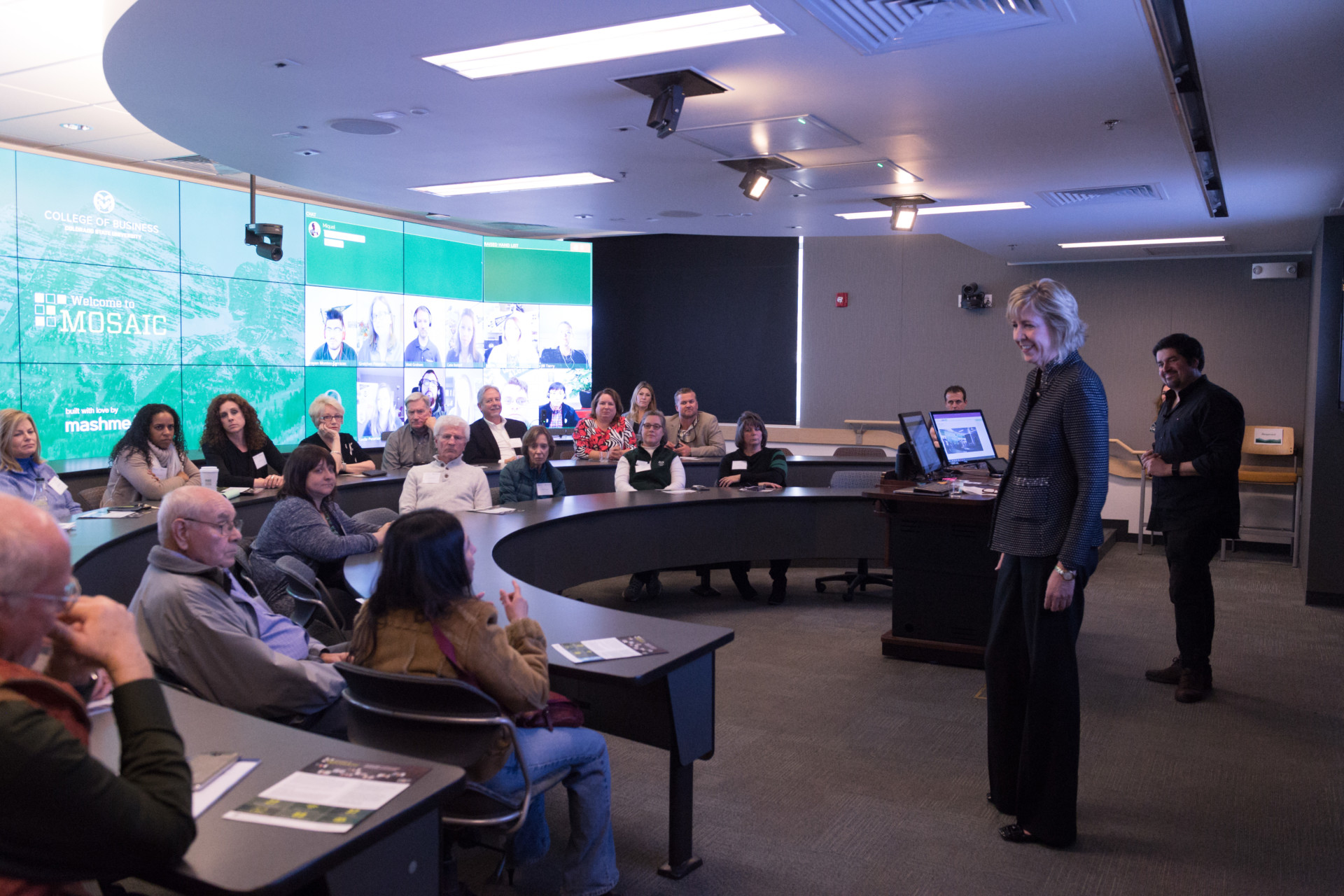
A wall of screens is not the classroom of the future

CSU College of Business collaborative classroom.
Photo by CSU Photography
Colorado State University’s College of Business has installed 27 high-video screens to create "the classroom of the future". The screens are on the back wall of a classroom, which accommodates 37 students in the room and 88 remote on the screens. Some universities have gone further with a curved screens 360 degrees around the walls. However, I suggest these are a gimmick, a like flying cars, and are a future of the past.

HD screens and cameras are now not reasonably inexpensive, so it is tempting to fill classrooms with them. However, we should use the technology to overcome the limitations of physical classrooms, not perpetuate them.

If each student is displayed on screen life size, then this is only going to work for a small class, of less than one hundred students. For hundreds of students you would need a huge wall, and the instructor would not be able to clearly see any of them. Also the students in the room can't easily see the remote ones, even in a small room for a hundred students (in Colorado State's example, the screens are behind the students).  This would accurately emulate a large lecture theater, where the instructor can't see most of the students clearly, and students can't see each other, but is that a good thing?

Plan of Jeremy Bentham's
panopticon prison
,
drawn by Willey Reveley 1791.
From Wikipedia
In the modern classroom we don't want students passively sitting listening to the lecturer. We want students talking to each other. Building an electronic version of Bentham's panopticon, with the all-seeing teacher in the middle, and each student isolated, is not the way to do this.

The obvious solution is not to try to mimic the bad features of a physical classroom. Rather than dozens of screens, just have one on each wall, with the image of whoever is speaking enlarged, and everyone else reduced to thumbnails. This is what readily available, cheap or free, videoconferencing software already does. It is what most of the students in  “Room of the Future” see anyway, as they do not have a wall of screens at home.

Monday, December 31, 2018

Social Media for Researchers

Some time ago, one of my colleagues suggested I join ResearchGate, describing it as "social media for researchers". I was skeptical, but signed up. I am still skeptical, but occasionally it surprises me.

This morning I noticed a large number of suggestions for researchers to follow. These were authors of papers I had cited in a recent paper (a short paper, but with a lot of references). The reasonable assumption seems to be that if I was interested enough in their past work to cite it, I would be interested in future work of these researchers. There were also alerts about two papers from authors I had cited: Yusuf and Prasad (?),  and Ouadoud, Chkouri, and Nejjari (2018).

Yusuf and Prasad  report on the use of videos in an undergraduate course at the University of the South Pacific (USP). Interestingly, the editor added a comment to the paper pointing out that films were widely used for training from World War II on-wards. However, the authors found that while the students they surveyed liked the videos and thought them useful, viewing dropped off sharply after the first week of a course.

The attendance at live lectures also drops off rapidly (Hughes-Warrington, 2015). It might be interesting to look for the common factors between the two. It would be tempting to see this as a failure on the part of the students, or the instructor. However, it may just be that students only need the presentations, live or recorded, early in a course. It may be that universities are wasting a considerable proportion of the resources, by providing unused, and unnecessary lectures.

Ouadoud, Chkouri, and Nejjari (2018) looked at how Behaviorist, Cognitivist and Social constructivist theory applies to the use of a Learning Management Systems. There was not much new here, but the authors provided very useful diagrams showing the roles of those involved, and how each model applies to this.

ps: One problem with ResearchGate is that you get an alert of new papers, but these may be so new it is hard to work out where they have been formally published and how to cite them.

Reference


Ouadoud, M., Chkouri, M. Y., & Nejjari, A. (2018). Learning Management System and the Underlying Learning Theories: Towards a new Modeling of an LMS. International Journal of Information Science and Technology, 2(1), 25-33. URL http://www.innove.org/ijist/index.php/ijist/article/viewFile/24/17

Hughes-Warrington, M.  “That Sinking Feeling: Counting the Cost of Live Lectures,” Making Sense of University Business, 2015. [Online]. URL
https://missunitwocents.tumblr.com/post/123364615920/
thatsinking-feeling-counting-the-cost-of-live

Yusuf, J., & Prasad, D. Using instructor-generated short videos in an undergraduate accounting information system course. URL https://core.ac.uk/download/pdf/154347626.pdf

Wednesday, July 25, 2018

Are live lectures better than videos?

A study by Trenholm, Hajek, Robinson, Chinnappan, Albrecht, and Ashman (2018) found that students who watched videos, rather than attend live lectures, had a more surface approach to learning. However, I suggest this may be a correlation, not a causal relationship. It may be that the students who were less engaged with the material chose not to attend lectures and those lectures may not have helped them.

The study appears to have used face-to-face courses, to which recorded lectures were added. The researchers did not offer the students a purpose designed online course.

The question the researchers asked, if recorded lectures are better than face-to-face ones, shows the unhealthy fixation with "lectures" which many academics have. Video recordings of lectures are the least useful part of online education, but then "lectures" are the least useful part of an on-campus education.

Reference


Trenholm, S., Hajek, B., Robinson, C. L., Chinnappan, M., Albrecht, A., & Ashman, H. (2018). Investigating undergraduate mathematics learners’ cognitive engagement with recorded lecture videos. International Journal of Mathematical Education in Science and Technology, 1-22. URL https://www.tandfonline.com/doi/abs/10.1080/0020739X.2018.1458339