Showing posts with label 2019-nCoV. Show all posts

Sunday, April 11, 2021

Online Education is More Flexible But Not Necessarily Cheaper

David Annand, has asked "How do we make university education more affordable and accessible?". He is a professor at Athabasca University, one of Canada's leading online institutions, but he is not just advocating for abolishing campuses.

Annand suggests face-to-face is needed for some new undergraduate students. He also points out the importance of informal social interactions for these students. However, he questions if this is really worth the cost of the campus and points out that online learners do just as well as face-to-face ones.

I suggest that while online learners do just as well academically, this is missing the point. Study is also a social experience. As an online student of Athabasca myself, I experienced a sense of loneliness. This is despite being a very experienced student, who was also on the staff of a leading Australian university at the time. But even so, online study was a less lonely experience for me than previous face to face study: just because you are on a campus, in a room full of people, doesn't result in social ties.

Athabasca's online courses had forms of group activity built in. Also was not assumed that you would somehow meet other students outside class, with ways to meet people online. 

The assumption that eliminating the campus will make courses much cheaper also needs to be challenged. According to a report for the UK DoE, only about 10% of the cost of a course at a conventional university is the campus (KPMG, 2019). A third of the cost is teaching staff and another third central student service costs. Most of the rest are overheads in running an institution. So eliminating the campus is not going to make courses from a conventional university much cheaper. Ways to provide student services, and reduce other overheads, online might be more cost effective than eliminating the campus. 

Also, even before COVID-19, at least in Australia, most students had voted with their feet and were not attending lectures. Universities campuses were already evolving to be business parks with commercial tenants and leisure centers with fee gyms, bars, and cafes, plus accommodation. The University of Canberra's 2025 plan is an example of this.

Annand points out that there is a high financial and social burden for those remote from a campus. There are also barriers due to child minding and employment. These are the areas distance education, and in its recent form, online education, were primarily developed for and have been delivering to for decades. 

Online students tend to pay about the same fees as on-campus ones, as Annand points out. It did annoy me when a student of the University of Southern Queensland, that I was paying to maintain playing fields which I had never seen, let alone played on. But this was only a small proportion of the fees. As it happens I paid slightly less in Canada, about the amount of the cost of the playing fields. ;-)

Athabasca University has no classrooms, and most staff now work off-campus, Annand points out. However, most teaching at conventional universities was done by part time and casual staff who didn't have their own offices before COVID-19, so their is little scope for savings in this way.

Athabasca University receives a subsidy from the Alberta provincial government, Annand points out, at a rate about a third that of conventional universities. However, those universities may be providing courses where costs are higher, such as medicine. The issue of the applicability of government funding models to online universities is one which has come up in Australia, most particularly at the University of New England (UNE), an institution which has been pioneering distance education for more than 50 years. UNE staff have expressed frustration that the federal funding model limits their ability to provide innovative programs. 

The Australian government did force through a change which increased the cost of less employment related degrees (ironically making some cheaper to provide courses more expensive). So there is some appetite by legislators to use product differentiation for university fees. However, if based just on campus cost, the difference in fees would be small, and the political cost of the reform may not be worth the effort.

Perhaps a better reform to import from Australia would be to provide more funding for shorter programs. In response to the pandemic, the Australian government introduced undergraduate certificates, and  increased funding for graduate certificates. These were focused on areas relevant to the emergency, particularly health, and have proved popular. Universities did previously provided some sub-degree programs, but there was no incentive for them to offer these.

Online universities may do better lobbying government for a different funding model, because they provide superior, more flexible, more vocationally relevant forms of education, rather than focusing on the costs of conventional universities.

Reference

KPMG, "Understanding costs of undergraduate provision in Higher Education, Costing study report", UK Department for Education, May 2019, Page 21. URL https://assets.publishing.service.gov.uk/government/uploads/system/uploads/attachment_data/file/909349/Understanding_costs_of_undergraduate_provision_in_higher_education.pdf#page=21

Saturday, April 3, 2021

Planning the future of international education in Australia

Hon Alan Tudge MP
The Hon Alan Tudge MP, Minister for Education and Youth issued a media release "Shaping the future of international education in Australia" (31 March 2021). The Minister was launching consultations for the Australian Strategy for International Education 2021-2030. I suggest a key part of the strategy should be to make international students feel welcome and appreciated. However, the Minister suggested maximizing the long-term benefits of international students for Australia. Unfortunately this may further discourage internaional students from enrolling in Australia, with them feeling exploited, rather than helped. This comes after the Prime Minister suggested that if students already here were short of funds, due to the COVID-19 pandemic, they should go home.

The Minister suggested "... the disruption of COVID provides an opportunity to look at the sector and ensure it is working for students and for Australia in the long-term ...". This appears to suggest that international students in some way interfere with Australia students education and are a determent to the Australian economy. I don't understand how this can be the case, given that international students contribute billions of dollars to the Australian economy and also contribute to university intellectual life. Also I am not aware of any other sector where Australian government ministers set out to insult our major export customers in this way.

The Minister also suggested targeting international enrollments to Australia's skills needs. However, I suggest the students may object to being exploited in this way and the nations the students are citizens of may object to this form of reverse brain drain. We should offer education to the benefit of the students and their nation.

The Minister suggests investigating new delivery models in new markets. However, I suggest there is considerable scope for expansion of existing markets with already well understood delivery models. As an example, pre-pandemic, I studied the potential of distance education from Australia to students in our region. Markets which could be expanded are India, Sri Lanka and Indonesia. In the last few years I have visited Sri Lanka, and Indonesia, meeting with their academics and government officials,. Australia is known and well regarded. One issue was the need to satisfy national authorities, business and students that online learning was legitimate.

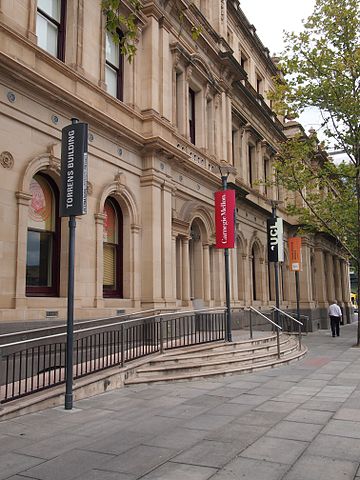
Torrens Building Adelaide,
Photo by Bahudhara, CC BY-SA 3.0,
via Wikimedia Commons
One approach proven by Australian universities is a partnership with institutions in-country. An example is the the Sri Lanka Institute of Information Technology (SLIIT). This private institution is affiliated with several Australian universities. I visited SLIIT in 2013 and it is accredited to deliver programs in Sri Lanaka.

Another approach would be to replicate the Torrens Building Adelaide in countries of the region. This building is shared by multiple international universities, to provide them with a local presence. There may be value in universities using Australia as a brand, while competing for international students. An example of this approach is Open Universities Australia, which provides a single brand for multiple institutions offering online education. That approach could be extended to naming rights for buildings in the region. International students could undertake face to face classes for part of their studies while attending other classes online at the Australian institution of their choice.

Some initiatives from the Australian Government for domestic students may be of interest to international ones. Last year an undergraduate certificate was introduced as a response to COVID-19. This allowed students to receive a formal qualification after only one semester of full time study. Universities could offer this to international students, with the option to go on to a degree. Flexibility to allow for this and online study while on a student visa would also help attract international students. The students could be undertaking work integrated learning, with an Australian employer, while studying at an Australian university.

Wednesday, March 31, 2021

Providing Students With More Job-Ready Skills

Lynlea Small
University of the Sunshine Coast
Lynlea Small, Amie Shaw and Ruth McPhail asked "1 in 4 unemployed Australians has a degree. How did we get to this point?". They rightly point out that Australian government policy aimed to increase number of Australians with university degrees. That has been a success, however, not all degrees provide vocational skills and a degree is not necessarily the best way to get a job. I suggest students can be encouraged to select shorter more vocationally relevant university programs and those in the VET sector (vocational education & training). A certificate, rather than a degree, from a university or a TAFE can provide quicker, cheaper result for a student looking for a job.

I teach computing and engineering students, where the degree programs are accredited by professional bodies. Major employers came to the campus last week, to recruit the students I teach. These students undertake project based work, internships, group projects for real clients and other forms of work integrated learning. The last assessment task I take students through is to write an application for a currently advertised job, explaining how the skills and knowledge they have gained can be used in the workplace. This makes the students more employable.  However, not all degrees are so vocationally focused and a degree may not be the best path to a career.

Rather than calling on graduates to be "resilient, determined and adaptable", as Small, Shaw and McPhail do, I suggest we need to change the policy. The Australian government has made an attempt to do that, by making degrees which lead to jobs cheaper and also introducing six month undergraduate certificates for high demand job areas. However, I suggest also encouraging more school leavers to take up a VET program. These VET graduates can then contemplate further study, perhaps at university, after they have employment.

Academics can also play a part in making graduates more employable. They can do this by building practical skills into the curriculum, which help students demonstrate they are "resilient, determined and adaptable". It is not enough to encourage students to undertake extracurricular activities and hope somehow this will make up for the deficiencies in their degree program. It requires teaching staff to learn new teaching skills, so they can provide a less theoretical, more practical form of education, where students learn to solve real problems for real people, by solving real problems for real people

It is not easy to teach or to assess real world skills. But it does help if you have received that form of training yourself recently and have been trained to teach it. It also helps if you have real world experience, and team up with those who have for teaching. I found training in both the VET and university sectors in new ways to teach very useful. Also useful was being able to relate my experience working in the computer industry, designing systems, working in teams and reviewing failed projects. It also helps to have experience of being an international online student, so I can better understand what my students are experiencing.

Monday, October 5, 2020

Will Microcredentials and Certificates Change Australian Higher Education?


Following the adage "never let a good crisis go to waste" the Australian Government is introducing reforms to
higher education. While proposals to charge different fees for different degrees has received attention, those promoting shorter qualifications may have more long term impact. The Australian government funded graduate certificates and a new undergraduate certificate (equivalent of about 12 weeks full time study). These were introduced as a short term measure due to COVID-19. The government is also encouraging microcredentials, which university are implementing by re-purposing units of about three weeks of full time degree content.

Both certificates and short courses do not seem a radical change for universities, however, if students start enrolling in these in place of degrees, it could have a profound effect. Universies would hope students would take some microcredentials, then use these for a certificate, then a diploma or degree at the same institution. But students may find they don't really need the degree, or that they want to mix and match microcredentials from different institution for their degree. This is routine in the vocational education sector, where training units are standardized. But universities have been miserly in granting credit for study elsewhere, arguing their programs are unique.


This presentation contains images that were used under a Creative Commons License. See the full list of images and attributions: https://link.attribute.to/cc/1584533

Sunday, May 3, 2020

Undergraduate Certificates to be Added to AQF

The Australian Government announced funding for short online university programs, in response to the COVID-19 Coronavirus, on 12 April 2020. There are 77 programs offer from today on the Courseseeker website (look for course category: "Short course"). These are undergraduate certificates (46) and graduate certificates (31), requiring six months full time study. While welcome, I suggest government make some improvements to the scheme, to allow for part-time study, nested programs, and mutual recognition of the certificates. Also I suggest incorporation of compulsory peer support training in all certificates, to address the elevated mental health risk, particularly for young people isolated at home, studying online, during a pandemic.

Study Areas

The emphasis in the announcement was on areas of study to help with the COVID-19 emergency. This is reflected in the programs offered. With health, including aged care and biomedical science, the largest offering, followed by education:

Study Area Number of Programs
Health 25
Education 18
Information Technology 10
Engineering & Related Technologies 9
Agriculture, Environment & Related Studies 5
Natural & Physical Sciences 5
Architecture & Building 3
Society & Culture 2
Total 77


Acceptance of Certificates


The Minister for Education, Dan Tehan,  caused confusion at the time of the announcement by describing these as "micro-credentials" and "diploma certificates". What are being offered are six month full time programs. A micro-credential is much shorter, requiring only hours, days or weeks of study, not six months. A diploma requires a year of study.

A Graduate certificate is a well known, well understood, and legally recognized term. Such programs have been used in the past as a way for someone from a discipline to gain extra skills and knowledge to work in a specialization. A Graduate Certificate in Australian Migration Law is one path to registration as a migration agent. A certificate in cyber security is useful for an IT professionals to work in security. It can also be an entry point to further studies. As an example, I undertook a Graduate Certificate in Higher Education, to help me learn to teach, and to then go on to a Masters of Educaiton.

Graduate certificates are a low risk, low cost, well understood option for universities to provide. The students are more mature than undergraduates, so are easier to teach. The course materials and classes can be shared with graduate diploma and masters programs.

Legality and Acceptance of Undergraduate Certificates


While graduate certificates are well known, as Andrew Norton points outundergraduate certificates’ are not currently recognized in the Australian education system. If a private for-profit educational institution was to offer such a qualifcaiton, they could expect legal action from regulators. However, public universities are offering these with the blessing of government, with legal status to be conferred retrospectively.

While legal status may not be a major problem, industry acceptance and pedagogy may, with undergraduate certificates. It is likely that the certificates will have been created in the same way as graduate certificates, from components of longer diplomas and bachelor programs. As an example, UWS with its Undergraduate Certificate in Information and Communication Technology offers the possibility of credit towards a degree, and presumably the certificate is built from that degree. However, unlike graduate students, these undergraduate students may be new to university study, as well as to online study. It takes time for a young person (the minimum age is 17 years) to get used to study at university, as well as life in general.

While the undergraduate certificates are being offered as standalone qualifications, I suggest they would be better as the first part of a nested qualification. That is, it would be assumed the student was intending to go on to undertake a diploma, and from there a degree. Ideally this would allow for blended learning. That is the student would undertake some study online and some on campus. My rule of thumb is that a typical student would be on campus for 20% of their study, about one day a week (obviously where COVID-19 restrictions allow).

Do We Need Undergraduate Certificates When We Have VET Ones?


While graduate certificates have been accepted as a qualification for particular roles, undergraduate certificates have not. The Vocational Education and Training (VET) sector already has a well established set of qualifications for jobs in the fields the undergraduate certificates are being offered in. These VET  qualifications have been recognized in laws, and in industry hiring practices. The VET sector is experienced in turning out students who are ready with practical skills needed for a very specific workplace role. However, universities have focused on much longer programs and more general higher level skills. In some cases universities have formed partnerships with VET institutions (or have VET arms), where the student does enough training in VET sector to get a job, then then transitions to university for a degree. It is not clear there is really a need for vocationally useful undergraduate certificates, or than Australia's universities are equipped to provide them.

There is also a lack of alignment between VET sector and university qualifications. As an example, to be able to teach in the VET sector, I was required to complete a Certificate IV in Training and Assessment. This was despite already having a Graduate Certificate in the field of education. In practice I was able to obtain 80% of the VET certificate based on my university experience and education. Even so this took months of elapsed time and payment of additional fees.

Will Universities Value They Own Certificates?


Within the VET system qualifications are mutually recognized, but this does not apply between VET and university, between or within universities. A student who has completed a unit of study at a public or private VET institution has that automatically accepted at any other for credit. However, the UWS Undergraduate Certificate in IC&T "may be credited towards the degree". In this case the university is not guaranteeing to recognize its own certificate for further study, let alone one from another university. If the undergraduate certificates are to continue beyond the next six months, I suggest the government make funding conditional on universities accepting their own certificates, and those from other universities, for advanced standing.

Need Part Time Certificates

I suggest government allow certificates, undergraduate and graduate, to be part time.

The certificates offered under the government COVID-19 funding are all full time. This makes sense as a short term emergency measure. The nation needs health and other workers quickly to deal with the pandemic. It is also a way to keep young people occupied while forced to remain at home. It provides them with a qualification to get a job much quicker than a degree. However, undertaking full time study online is very difficult, especially for a young inexperienced student. Adding to that isolation due to COVID-19 greatly increases the difficulty, and the risk of mental health issues.

It has been common practice for Graduate Certificates to be offered part time. This is useful for working professionals, who cannot take six months off work to study. It is particularly useful with online study. Even so, as an online graduate student I found I could not do more than one quarter of a full time course load comfortably. This was under almost ideal conditions, where I was a mature student with very good IT skills, studying with some of the world's top online educators, and already experienced in the field I was studying. The typical young undergraduate is going to have considerable difficulty studying full time.

Address the elevated mental health risk


Even with all the advantages I had as an online student, it was not the fun depicted in university advertisements: it was a frightening, painful, frustrating experience. The Australian Government ,and universities, need to address the elevated mental health risks, particularly for young people isolated at home, studying online full-time, during a pandemic.

Students are encouraged to take part in extra-curricular and co-curricular activities on campus. This can't be assumed for online students, especially not with COVID-19 measures in place. I suggest universities need to teach students how to form and maintain peer support groups online, and make this an assessed compulsory part of studies. Leaving this as something optional and voluntary, is an unacceptable risk to the health, and the lives, of students. In addition, not teaching students how to support each other will result in a higher dropout rate, and so a waste of public money.

Tuesday, April 14, 2020

Online Graduation Ceremonies

Tom Worthington with MEd
at a DIY ceremony
One issue which has been raised by both university administrators and students is how to conduct graduation ceremonies while maintaining social distancing for COVID-19. This may seem trivial, but it is important emotionally, and practically for students. In 2017 I conducted my own remote graduation ceremony. I was awarded an MEd in Distanced Education by Athabasca University. Appropriately, I studied entirely online from Australia. On graduation Athabasca mailed me a masters hood in an envelope. I added the hood over a standard black academic gown from my last graduation, and wore them in the academic procession at the institution where I teach in Canberra. Then I paid to have my photo taken along with the local graduates.

1. Award Degrees As soon as Students Qualify


I suggest adopting the practice of online universities, where degrees are awarded as soon as the student meets all requirements. The student has the option of attending a ceremony later. Awarding of degrees should not be delayed for ceremonies, and there should not be just a one off special case for COVID-19.

2. Send Students a Certificate and Ask for a Photo

Send the graduates their certificate, and something to wear or show.  Encourage students to conduct their own local ceremony, where their parent, or loved one, presents them with their certificate. Where social distancing rules allow, they could have a local ceremony with students of other institutions, conducted by a local dignitary. Have the student send a photo to the university to be used in their ceremony.

3. Stream an Academy Awards Style Ceremony Online


I suggest the university conduct an academy awards style ceremony streamed online. This would have speeches live, recorded videos from major award winners, and the rest of the graduates appearing in a montage of the images they provided.

4. Digital Certificates

This would also be a good time for universities to introduce digital certificates. Prospective employers will be reluctant to accept paper certificates from candidates, for health and logistical reasons. Applicants who can provide digitally authenticated evidence of their qualification, rather than just an easily faked paper or scanned copy, will have an advantage in the job market. As well as providing digital certificates, universities should also put in place procedures for accepting them.

5. Standing Invitation to Later Ceremony

Universities could invite students who can't get to that year's graduation ceremony to attend one next year, or any time in the future, even decades later. In my case I could not afford to fly 13,000 km to attend, but if I happen to be on that side of the planet some time in the future it would be nice to have some pomp and circumstance.

Monday, April 13, 2020

Australian Higher Education Relief Package for COVID-19

The Hon Dan Tehan MP
Minister for Education
The Australian Minister for Education, Dan Tehan, and the Minister for Employment, Michaelia Cash,  announced a Higher Education Relief Package, in response to the COVID-19 Coronavirus, 12 April 2020. Overall the intention of the package is good, but some of the details will need considerable work. Andrew Norton has produced a very useful commentary on this, but here are some additional comments of my own.


The package envisages Australians studying online to improve their job skills, while waiting for pandemic control measures to be reduced allowing a general return to work. Areas of study mentioned are nursing, teaching, health, IT and "science". Short, online courses, from universities and private providers will be subsidized, from May for six months (initially). Strangely missing from the list of areas of study is any specific mention of engineering, or manufacturing, given the need for Australia to rapidly produce strategic products to meet the current emergency.

The announcement refers to the short courses being from "world-class universities", but presumably that is a rhetorical flourish and the intention is not to limit the program to the top half dozen Australian research universities which rank highly internationally. That would be unfortunate as it is the lower ranking regional teaching universities which have more expertise and experience with online learning in Australia. I studied how to do online learning (via online learning),  at the University of Southern Queensland, which while providing good courses and is highly regarded in that field, is not a "world class" university.

In addition, government funding for universities will be "at current levels, even if there is a fall in domestic student numbers". There is no offer of government funding to make up a shortfall in international student fees.

How the new funding for short courses will be administered is not detailed in the announcement. It should be remembered that previously about $2.2B was paid to private trainer providers for courses of dubious quality, or in some cases, not delivered at all. While "innovative micro-credentials delivered flexibly online" is a worthy goal, there are no agreed definition as to what a micro-credential is. Micro-credentials are not currently part of the Australian Qualifications Framework, and some have formal coursework, while some do not. Short courses can range from one hour's study, to about the length of a typical university unit (about 100 hours).

I have worked in this area of education for ten years, designing and delivering short online courses. I have been involved in several micro-credential projects and on professional standards bodies overseeing these, presented papers at international conferences, given evidence to a Senate inquiry, and  blogged on the topic, but I am still not sure what a micro-credential is. Or it may be that micro-credentials mean many different things to university, and vocational providers. 

I suggest universities should take a cautious approach to micro-credentials, due to the high reputational risk from over-promising. As an example, it is common for universities to offer short courses which do not count for credit towards a degree, are not aligned with the AQF, and are not specific to a job. However, a "micro-credential" is clearly intended to be a type of credential: that is a qualification. In the context of the government announcement, by issuing this qualification, the university has certified the holder has the skills needed to undertake a specific workplace task. Universities cannot use disclaimer to say the credential is not a credential, and those so qualified are not qualified.

One way I suggest universities can navigate this legal and ethical minefield, is to integrate short courses in existing AQF qualifications. As an example, in 2016 I set out to design a teaching course for IT professionals. Teaching is a recognized skill in the computing discipline internationally. Australian universities are accredited to provide degrees under well established national procedures. So what I proposed was to create a teaching course within that framework. This way the familiar quality controls of the university system and professions could be applied.

To make a university course into a set of "micro-credentials" I proposed dividing it into three or four parts, with each part aligned with a set of externally defined skills. A student would receive a micro-credential for completing each part. Those who completed all the micro-credentials would receive one course credit towards a degree.

None of this will be new to the vocational education sector, which has been routinely producing nationally standardized job relevant short courses for decades. However, this is a new skill for many university educators (some of us are dual qualified in by VET and university sectors).

Tuesday, March 24, 2020

K12 EdTech Showcase

My third video meeting for the day was a K12 EdTech Showcase hosted by EduGrowth, an Australian educational technology innovation hub. There were quick presentations from education entrepreneurs. Interestingly, these were not just online platforms for delivering content, but also curated libraries of content. This could be particularity useful for teachers looking for stuff to keep students at home occupier.

What worked particularly well for this event were the moderator using an interview technique, where they asked questions. As with previous events, Zoom was used. This worked better when the video was turned off, with just the presenter's voice and slides.One frustration was that each time the presentation shifted to a new presenter, the display switched to full screen video. It would be useful if Zoom could be configured to stop this happening.

Work Integrated Learning in the Age of COVID-19

The Australian Collaborative Education Network (ACEN) held a video meeting today to discuss what to do about Work Integrated Learning (WIL) in response to the COVID-19 Coronavirus. Post secondary educational institutions (and some secondary), have students who undertake part of their program gaining practical experience in a workplace. This is required for some accreditation to work in industry. But what happens to these students with workplaces closed?

Part of the answer to that was provided by ACEN, leading by example, in convening a video conference. This was attended by about 280 people around Australia, and some from other countries.

I help teach ANU TechLauncher students who undertake group software development projects for a real client. This is a little easier to manage, as these students are normally not on the client's premises. Also computing professional routinely do much of their work using computer based tools, and the students have already been introduced to coordinating their work online. I have provided some tips on how to work remotely, from the client, from their tutor, and from each other.

The ACEN video conference suffered from some technical glitches. I have provided some tips on what to do to place less strain on our digital infrastructure. This was my second video meeting for the day, with two to go.

Use Recorded Videos and Small Online Tutorials

It is time for lecturers to swallow our pride and accept the "sage on the stage" is not that important to student learning. In place of large live events, I suggest the flipped approach. Provide videos and other materials for students to study in advance (you can provide quizzes to help). Then have online tutorials for small groups. The lecturer can record some short videos for them to use during the tutorials (I suggest around 60 seconds each).

Video conference systems, such as Zoom, allow for hundreds of students to take part in an online interactive events (Webinar). During the event the class can be divided into smaller groups, to work on a task for a few minutes, then the class brought back togehter. This is an excellent teaching method, however, it places demands on the technology, and staff which may be too much due to the COVID-19 Coronavirus. There is likely to be very high utilization of videoconferencing, straining resources. Also large complex real-time events are harder to organize.

University Researchers Need to Implement COVID19 Measures NOW

Staff of universities and research organizations should have by now been issued guidelines for them to limit face to face meetings, and move activities on-line, due to the COVID-19 Coronavirus. University teachers have needed to make changes to accommodate students, but there has perhaps been less pressure on researchers to change their work habits.

Stop Gathering in the Common Room


One of the delights of being on the academic staff of a university has been gathering in the common room for regular morning tea. This is a very good way to find out what is going on, and to sound out colleagues about ideas. However, this must now stop.

Move Seminars On-line

Over the last few weeks I have been asking each organizer of a meeting, seminar, or conference I have been invited to attend or speak at to provide an online option. This started happening gradually, with notices from organizers saying they have either moved events entirely online, or at least added an online option. However, it is now time to drop the in-person option for events, and focus on providing good online alternatives.

Online events need to start on time, with someone to welcome arrivals, and assure them the audio is working. Also the number of people together running the event needs to be limited. There is no need for all the presenters to be together in the one room.

The Research Project You Save May Be Your Own

For those who are unconcerned about their own safety, I urge them to consider their colleagues and their families. If for no other reason, they need to change their behavior to protect their research, which will suffer if their research team is the center of a COVID-19 outbreak.

COVID-19 Infection Control Training Online from Australian Government

The Australian Department of Health is providing COVID-19 Infection Control Training online for healthcare and related workers.  The module was produced by Aspen Medical. An introductory page warned "Due to the high demand of the Infection Control Training course, you may experience timeouts. We are working with our training partner to resolve the issue as quickly as possible.". The approach I suggest to get around this is to provide a version of the course materials outside the Learning Management System (LMS). The LMS allows the progress of each student to be tracked and t=for them to be provided with the appropriate materials and tests at each stage. However, all that takes computing resources, limiting the number of students. Much of the demand is likely to be from people who do not need, or want, to complete the entire course. Typically, only 5% to 10% of people who sign up for a free online course complete it. Many just want to see what is in the course, or have a general interest. For these people a sample of the course materials can be provided outside the LMS. It is also possible to provide all the materials so that the course can be run in house.
The COVID-19 training does offer some material outside the LMS already:

Sunday, March 22, 2020

Don't Depend on Live Video for Teaching: Flip It

I suggest a flipped approach for on-line educaiton, which supplements text and pre-recorded material with live participation. While video conferences, webinars, and live streaming of video with synchronous participation are popular, these makes demands on the national network infrastructure, which may not be sustainable over the coming months. This not to say don't use video conferences and live streaming, but don't depend on them working.

ps: Last year I had a project for streaming with synchronous participation, in a way which would be tolerant of network problems. Unfortunately this work has been suspended due to the pandemic emergency, so I don't have a usable product.

Wednesday, March 18, 2020

Transition to On-line Study: Example message to team project students

The Australian National University is to pause all coursework teaching for one week from Monday 23 March and then deliver online for the remainder of the semester. Here is an example of a message I prepared for Techlauncher computer group project students about the change to e-learning. These students receive few conventional lectures, instead they work in teams on a project, and meet with a tutor regularly.

Transition to Online Study


The TechLauncher program is now being delivered online, due to COVID-19. I have some experience with online education, and so will be providing some tips for students, and tutors, over the coming weeks. Here are the first:

Use the tools you have: You already have an array of online collaboration resources available to you. With most of these, an individual can contribute at any time, and it is stored so others can view it later. In education, this is called asynchronous mode. Many software development teams, who are spread across the world, work this way. However, to get a sense of being a team, and when quick decisions are needed, nothing beats real-time synchronous communication, with everyone contributing at the same time.

For online tutorials, ANU has provided Zoom Videoconferencing. There is a Zoom "Meeting" for each tutorial group. You can use the meeting-id via the web, or download the client for your computer, or smartphone. With the agreement of your tutor, you can use an alternative conferencing product for tutorials. Teams can use whichever tool they find most useful for their own meetings.

You may not need video: While it is called a video conferencing tool, Zoom, and similar products, work well with audio, slides, and screen sharing. As team members already know each other well, you do not necessarily need to see each other. You can also use your asynchronous tools in a near real-time mode, talking together via Zoom, while looking at, and modifying shared documents. A headset greatly improves the quality of sound, and also using a smartphone, rather than a computer for audio tends to have fewer problems. You can use your smartphone for sound and your computer for documents, at the same time.

Meeting preparation is important: Whatever tool you use, keep in mind that good meeting preparation is even more important online than for a face-to-face meeting. You need to solicit items for the agenda well in advance, and preferably circulate the agenda, and any documents for discussion, well beforehand. It can become very confusing if documents participants have not seen before popup online during the meeting.

The tool you are using to distribute documents and images may fail during the meeting, leaving just audio (and perhaps text chat). During the face to face presentations, you have been encouraged to be ready to keep talking if the video display fails and the same applies online: if the video fails you need to be prepared to keep going, referring to documents the participants already have, or painting them a picture with your voice.

The Campus still open but be prepared: At present ANU has not closed the campus, so physical meeting rooms are available. However, this could change without notice, so please prepare now for on-line working. Also while you should take sensible precautions, there is no general requirement to self-isolate at this stage.

Don't Panic: I have been delivering on-line education at ANU for a decade, using the same proven techniques we are implementing for Techlauncher. From 2013 to 2017 I was a graduate student of education, refining these techniques for delivering international distance education. From this experience, I learned which techniques work, but more importantly, how it is key we remember there is a person on the other end of the network connection, and to treat them as such.

I would welcome comments, suggestions, and corrections.

Tom Worthington
Instructor for Learning to Reflect

Sunday, March 15, 2020

All educators must offer e-learning now

I was asked recently what to do if a student who is enrolled on campus asks to switch to online study, due to fear of COVID-19 Coronavirus. Should this only be allowed if the student has a medical condition which places them at risk, or they are unable to get to campus due to travel bans? No, I suggest all students be offered an online alternative now. Educators need not, and should not, wait for their institution, or a government authority, to order, or endorse this action. As e-learning is already having to be provided to some students, offering it to all is not a large cost or inconvenience. Teachers have an ethical, and legal, obligation to act in the interests of their students, their colleagues, and in the public interest.

E-learning for Schools Pitch

Last week I attended a Service Design Meetup at the Canberra Innovation Network, sponsored by Evolve & Amplify. We went through the standard entrepreneurial start-up value proposition process. I worked on the idea of expanding my e-learning services from university to business, in response to the  COVID-19 Coronavirus emergency. I produced a pitch, and submitted it to a start-up competition. Also I produced a video, but then discovered they completion did not allow videos, so here it is.

Images under a Creative Commons License.

Saturday, March 14, 2020

Designing in an On-line Learning Option

One of the benefits of computers in education is that this makes distance education a richer experience and feasible for more students. It also can remove the need for special provisions for when some, or all, students cannot get to campus, such as in the current COVID-19 Coronavirus emergency.

Pictographs by
Carlos Sarmento

from the Noun Project
(CC BY 3.0 US).
As part of my graduate studied in education, and informed by my background in defence and emergency management, in 2016 I concluded that international students could be prevented from coming to Australian campuses at short notice due to an international crisis. In 2017 I suggested that universities provide blended learning, which allowed for students who could not get to campus to study online. Since then I have been designing and delivering courses this way: on-line, with classroom activities for those students who can get to campus.


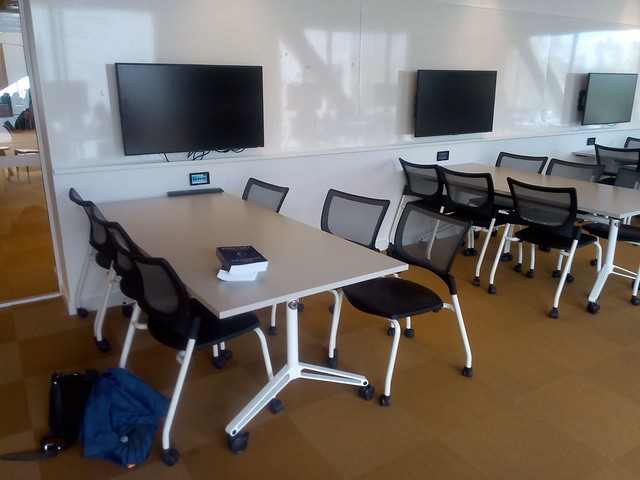
Wall mounted LCD screens and desks on wheels at ANU Marie Reay Teaching Centre
Wall mounted LCD screens
& desks on wheels at
ANU Marie Reay Teaching Centre
An example is the "Learning to Reflect" module for Australian National University computer project management students. This has an e-book, videos, online quizzes, and online student forums. There is also provision for face-to-face workshops. But in the current circumstances, it seems likely these will be switched to online as well. There is no need to change the course content, or assessment processes, as they are all already online. 

It should also be possible to offer both classroom and online real-time (synchronous) sessions for students. This would use the same software as for distance education, but tied into the classroom's audio-visual system. There should be no need for any special additional hardware or software.

Friday, March 13, 2020

The Idea of the University Has Not Been Canceled

Zen and the Art of Motorcycle Maintenance,  Robert M. Pirsig, 2006
Zen and the Art of Motorcycle
Maintenance, Robert M. Pirsig, 2006
Universities are canceling events to minimize the risk of the transmission of COVID-19 Coronavirus. For the present, face-to-face teaching and research will continue, with precautions in place. Ironically among the events cancelled is "The Idea of the University - Crisis or Adaptation?".  I was reminded of Pirsig:
 "...the real university exists not as the physical campus, but as a body of reason within the minds of students and teachers ..."
From Chapter 13, Zen and the Art of Motorcycle Maintenance, Robert M. Pirsig, 2006
Decades later this idea has been made a practical reality by adopting teleworking and telelearning. I suggest those organizing events at universities should not cancel or postpone them, assuming the current emergency will end soon: it will not. Instead, just as with teaching, organizers of events should provide blended, or fully online, options. The idea of the university can continue, despite the crisis, through adaption. This will be important to the well-being of staff and students, who need something to keep them occupied, other than worrying about a pandemic. It is also important that the university continue to provide a valuable service to the community, through research, education, and community outreach.

Don't Postpone Examinations: Replace Them With Realistic Tests

Media reports indicate that some universities are postponing examinations due to the about the COVID-19 Coronavirus. Unfortunately this emergency will not be over quickly, so this is not an effective strategy. It is technically possible to run online invigilated examinations. Athabasca University (where I studied education), uses the product ProctorU for this. However, even with a tool, the administrative burden is high. Running pass/fail oral exams via videoconferencing is also possible (I did one of these for my MEd), but these are time consuming, and stressful for the students.
 

The approach I suggest is to use multiple assignments, and tests (with provision to deter cheating), to determine the student's grade. If some form of supervised test is required to verify the student is not cheating, then this could be a pass/fail one, to confirm the previously established grade.

Paper based end of course examinations are not an effective form of assessment of real world skills. I suggest instead changing to other forms of assessment which realistically assess skills and knowledge. The best way to do this is to have the student carry out the tasks they are being trained to do, either in a real workplace or a simulation, and see how they do. As an example, I help train computer students in project management. This is assessed by having students work in teams on a computer project for a real client, and seeing how they do. The assessment is, in part by their peers, but mostly by staff.

Wednesday, March 11, 2020

KEEP CALM AND CARRY ON-LINE

Poster generated using Keep Calms.
Since the COVID-19 Coronavirus started causing difficulties for Australian education a few weeks ago, I have lost track of the number of emergency meetings, and written thousands of words of advice on how to change to e-learning. Here is an attempt to sum up what to do in five words "KEEP CALM AND CARRY ON-LINE".