Showing posts with label VET. Show all posts

Wednesday, September 10, 2025

VET Option Can Lower Student Stress

Ben Edwards & Jessica Arnup have detailed the stresses Year 12 students face in choosing a career in"New research shows Year 12 students face many pressures – far beyond study and exams (The Conversation, September 8, 2025). However, the situation is not as bleak as the researchers depict. The key to this optimism is the the last part of the article, where the authors note more interest in Vocational Education and Training (VET). This aligns with the government's target for study, which is not for 80% completing university by 2050, but "... 80 per cent of the workforce will have a TAFE qualification or a university degree" (Jason Clare, 18 December 2024). 

More young people want to, and can, go to VET, instead of, or as a preparation, for university. Having a VET option reduces the stress for young people, providing a lower cost option, without high stakes exams, with nested, nationally standardised programs. 

VET students can take a low cost, or free, short course to get an entry level job. They know study & what they do at work, will count towards further qualifications. VET competency based assessment removes the pressure to excel, which exams induce.

There is still an important role for universities. But they should learn from the VET approach. 

Saturday, May 13, 2023

Should students be trained in cheaper and better higher education options

In "Studying can be a costly choice", Tracey West (Griffith University, May 12, 2023) argues that students should be educated about ways to reduce their study loan cost. I suggest this could go further, educating students about cheaper and quicker non-university study options, and ways to accelerate their studies.

As an example, students can do part of their studies in the vocational education and training (VET) sector, which has lower fees, & shorter programs. These programs have been shown to lead to higher incomes than university courses. Students could be shown how to plan their studies strategically, to receive a VET qualification and credit for university studies.

Students can also be trained in how to get credit for prior work, & learning. Work Integrated Learning is another option studnts could be encouraged in, so they earn while learning. These options are more common in the VET sector than universities. The federal government might put in place programs to encourage them in university, and train staff to run them.

While universities might have a moral obligation to educate students about these options, it would be contrary to their financial interests. Given that Australian universities have occasionally stolen wages from staff, and carried out other illegal acts, they can't be relied on to act morally. So some form of incentive from government, or legal penalty, would be needed for them to give them an incentive. The exception would be the dual system institutions, which already combine VET and university education. 

Wednesday, May 25, 2022

Shorter-term Technical Certificates as a Path to Higher Income

In "If College Isn't the Pathway to the Middle Class It Once Was—What Is?"
, Lindsay Daugherty, Senior Policy Researcher at RAND, suggests that there may be better options than a four-year degree program for students seeing a job with a middle class salary. In Australia the answer is, or should be, easy: if you want a well paying job quickly and easily, got to TAFE. The government, and non-government VET providers in Australia offer sub-degree programs, which are nationally recognized. Some of these are required for entry into regulated jobs, while others are in high demand job categories with subsidized fees. The VET sector has forms of education and assessment designed to suit less academically accomplished students. However, even in Australia, this form of education has an unwarranted poor reputation, being seen as second best, compared to university. Australia's new government should be  boosting the reputation of the VET sector, and ending the downgrading of TAFEs, so this is seen as the first option for those wanting a step up in employment.

Wednesday, October 13, 2021

Integration with Universites Proposed by Private Training Providers

The Independent Tertiary Education Council Australia has proposed  "Seven Priorities For A Skilled & Educated Workforce". ITECA is made up of private sector vocational training providers, and their proposals aim to integrate that sector with the mostly government funded university sector. The federal and state governments run separate funding and regulatory systems for the university (which are mostly public) and the vocational sectors (which has more private providers, both not and for-profit). Part of the difference is due to Australia's universities having dual roles of both research and education, and a resulting level of autonomy which neither the public or private sector vocational institutions enjoy.

Australia already has an integrated tertiary education system, at least conceptually. Universities and vocational education are part of the ten level Australian Qualifications Framework, with VET at the lower levels, university at the upper end and an overlap in the middle. Some Australian universities are dual sector, typically offering students a vocational qualification with the option of articulation to university. However, the level of standardization which exists in the VET sector, does not apply to university. As a result a student who has undertaken studies at VET, can't be assured of receiving full recognition at a university (or even from one university to another).

While a fully integrated system with student choice, and less red tape is appealing, it would not come without risks and costs. The Australian government previously expanded funding of student loans for VET without putting in place adequate controls. This resulting in billions of dollars being wasted, by unscrupulous providers, signing up students who had no hope of completing their courses. As well as a loss of public money, and damage to Australia's reputation as an education provider, this caused harm to thousands of students. Any new system will need to ensure there are checks and balances in place to prevent a repeat of this happening again. The use of real time online reporting, and industry self regulation would help.

The seven priorities proposed by the ITECA are:

  1. "An integrated tertiary education system: That the Australian Government develop a five-year strategy to deliver an integrated tertiary education system, in which the higher education and vocational education and training sectors operate as one, yet retain their separate and distinct strengths and identities.
  2. A more cohesive approach to regulation and reporting: That the Australian Government places tertiary education red tape reduction on the agenda at National Cabinet to develop a strategy that delivers a convergence of regulatory and reporting obligations, eliminating duplicative, redundant and burdensome regulation and reporting at a state/territory and national level.
  3. An investment that strengthens students choice in higher education: That the Australian Government expand the highly successful investment it has made, enabling students to study in a Commonwealth-subsidised place with a quality independent higher education provider and engage in the critical thinking and learning needs they choose.
  4. An approach to skills funding that empowers student choice: That the Australian Government’s investment in skills be provided only to those jurisdictions that award funding on the basis of empowering student choice, allowing students to study with a provider (whether independent or public) that has a demonstrated ability to help them achieve their life and career goals.
  5. An approach that funds courses where the skills shortages are: That the National Skills Commissioner, working with states and territories, identify where an increase to skills funding is required by identifying the qualifications to be subsidised with the support for students (and made available to an RTO) reflecting the cost of achieving excellence in training outcomes.
  6. A single student loan program that supports lifelong learning: That the Australian Government overhaul tertiary education student loans programs, creating a single lifelong learning account (incorporating FEE-HELP and VET Student Loans), enabling students to access income-contingent loans, without the existing Student Loan Tax, available from Certificate IV through to post-graduate level study in a seamless way, throughout their working lives.
  7. A bold new plan for international education: That the Australian Government immediately put in place a plan to rebuild Australia’s capacity and reputation to support international students, backed by a new International Education Commission tasked with implementing the new Australian international education strategy."


Thursday, May 6, 2021

Two Phase Approach to Australian International Education: Offshore VET Plus Onshore University

One useful source of migrants for Australia has been international graduates of Australian universities. It will be interesting to see what effect COVID-19 and the resulting shift to online education has. This may result in a two phase process, where international students do their initial training offshore online in the Australian Vocational Education and Training (VET) system, then come to Australia for further study at university, and to work.

Dirk Mulder
There are some indications this is happening. It may involve students studying first at a vocational institution offshore, before moving to a university onshore ("International student growth – it’s all in VET and it’s all from India", Dirk Mulder, Campus Morning Mail, May 5, 2021). While international enrollments are falling at Australian universities, VET is growing, especially from India at Victorian institutions.

The option of starting study in the VET sector and then moving to university is a sound approach for vocational qualifications. Some Australian universities have the option of doing this in-house, offering VET qualifications as well as university degrees. The student can first enroll in VET, complete a diploma and then go straight to the second year of their degree. I was asked by one of these institutions to be on a review panel for their computing degree and was impressed by how it worked.

There are differences in how and what VET and universities teach. VET focuses on vocational skills, offers recognition of prior learning (RPL) and "competency" based assessment. You learn what you need for a job, and if you have evidence already have that skill you don't need do that part of the course. University tends to teach more theory, it is harder to get credit for prior experience and the assessment looks for excellence.

But in terms of learning how to do something both VET and university approaches work. I undertook a certificate in education at  both university and VET, with more similarities than differences. Also the move to online learning over the last year by universities has made their courses more like VET (which is not a bad thing). 

Wednesday, March 31, 2021

Providing Students With More Job-Ready Skills

Lynlea Small, 
University of the Sunshine Coast
Lynlea Small, Amie Shaw and Ruth McPhail asked "1 in 4 unemployed Australians has a degree. How did we get to this point?". They rightly point out that Australian government policy aimed to increase number of Australians with university degrees. That has been a success, however, not all degrees provide vocational skills and a degree is not necessarily the best way to get a job. I suggest students can be encouraged to select shorter more vocationally relevant university programs and those in the VET sector (vocational education & training). A certificate, rather than a degree, from a university or a TAFE can provide quicker, cheaper result for a student looking for a job.

I teach computing and engineering students, where the degree programs are accredited by professional bodies. Major employers came to the campus last week, to recruit the students I teach. These students undertake project based work, internships, group projects for real clients and other forms of work integrated learning. The last assessment task I take students through is to write an application for a currently advertised job, explaining how the skills and knowledge they have gained can be used in the workplace. This makes the students more employable.  However, not all degrees are so vocationally focused and a degree may not be the best path to a career.

Rather than calling on graduates to be "resilient, determined and adaptable", as Small, Shaw and McPhail do, I suggest we need to change the policy. The Australian government has made an attempt to do that, by making degrees which lead to jobs cheaper and also introducing six month undergraduate certificates for high demand job areas. However, I suggest also encouraging more school leavers to take up a VET program. These VET graduates can then contemplate further study, perhaps at university, after they have employment.

Academics can also play a part in making graduates more employable. They can do this by building practical skills into the curriculum, which help students demonstrate they are "resilient, determined and adaptable". It is not enough to encourage students to undertake extracurricular activities and hope somehow this will make up for the deficiencies in their degree program. It requires teaching staff to learn new teaching skills, so they can provide a less theoretical, more practical form of education, where students learn to solve real problems for real people, by solving real problems for real people. 

It is not easy to teach or to assess real world skills. But it does help if you have received that form of training yourself recently and have been trained to teach it. It also helps if you have real world experience, and team up with those who have for teaching. I found training in both the VET and university sectors in new ways to teach very useful. Also useful was being able to relate my experience working in the computer industry, designing systems, working in teams and reviewing failed projects. It also helps to have experience of being an international online student, so I can better understand what my students are experiencing.

Thursday, September 17, 2020

China Upgrades the Education Action Plan for the Belt and Road Program

Greetings from the Carbon Energy for the Asia-Pacific Project Workshop at the Australian National University. One topic is the role of renewable energy and carbon emission reduction in China's Belt and Road Program. However, the plan is not just abut building power stations, there is also an Education Action Plan for the Belt and Road Program. The Australian Department of Education issued a summary of an update of the plan in June and changes to education policy. China plans to share lessons learned during the COVID-19 pandemic and continue to support developing nations. One aspect which might be of interest to Australian higher education is that Chinese vocational training teachers will have more scope to study overseas. This has relevance to renewable energy as the cost of wind and solar equipment has now dropped so low that labor for installation is a major part. There is scope for specialized skills to speed installation and so lower cost.

Thursday, December 19, 2019

Getting a job in Information Technology

Company PWC is undertaking a review of the Certificate I, Certificate II, and Certificate III in Information, Digital Media and Technology, for the Australian Government, under the title "Getting a job in Information Technology". Provided in one zipped file, are a "Summary of draft
training product changes: Information and Communications Technology
Training Package", a spreadsheet of the changes, and drafts of each unit of competency. Proposed are nested qualifications: Certificate III, IV, Diploma, and Advanced Diploma in IT. Before this, students can start out with the Certificate I & II in Digital Literacy. Notable additions are units in: Blockchain, Internet of Things (IoT), Cyber Security, and Data Analytics. The deadline for feedback on the draft is 14 February 2020.

Tuesday, December 3, 2019

Review of the National Agreement for Skills and Workforce Development

Josh Frydenberg MP,
Treasurer
On 15 November, the Australian Treasurer requested the Productivity Commission undertake a review of the National Agreement for Skills and Workforce Development (NASWD), by March 2020. There is a 48 page Issues paper.  The NASWD is a state/federal agreement on skills and workforce development, through the vocational education and training (VET) system. Successive state and federal governments have sown a lack of interest and ability in coordinating VET education, at great cost to the Australia economy, and individual students. If that was not difficult enough, there are the competing interests of universities, and private for-profit education providers. It will be interesting to see how the Productivity Commission navigates the quagmire of rent seekers and vested interests, which has derailed previous attests at reform.

"Scope

In the context of the VET system, the review will consider:
  1. achievement of the objectives, outcomes, performance indicators, targets, reform directions and roles and responsibilities set out in the NASWD and their ongoing suitability
  2. options for governments to coordinate and streamline their support for vocational education in the future
  3. options for nationally consistent government funding and pricing arrangements that maximise efficiency, transparency and the supply of trained workers for the economy and promote consistency of incentives
  4. options to promote consistency in funding and loan arrangements between the VET and higher education sectors, and on any cross sector impacts that there might be
  5. options to ensure government investment in VET encourages increased participation in training by all Australians and is commensurate with the outcomes and benefits derived by individuals, business, industry, the local and national economy and society more generally
  6. potential for future funding arrangements to achieve further targeted reforms, including extending Language, Literacy, Numeracy and Digital Literacy (LLND) programs to all Australians and other relevant recommendations from the Expert Review of Australia's Vocational Education and Training System (the Joyce review) 2
  7. options for improved performance indicators, data and information sharing arrangements to enable all governments to assess the effectiveness of VET investment and delivery."
From: Terms of reference, Skills and Workforce Development Agreement, The Hon Josh Frydenberg MP, Treasurer, 15 November

The Issues Paper asks a series of questions. Here are some comments on these:

INFORMATION REQUEST 3

"whether the objectives and policy directions for the VET sector set out in the NASWD are suitable for the future and why" (p. 8)

The paper sets out the objective for VET as:
"A VET system that delivers a productive and highly skilled workforce and which enables all working age Australians to develop the skills and qualifications needed to participate effectively in the labour market and contribute to Australia’s economic future; and supports the achievement
of increased rates of workforce participation. (COAG 2012b, para. 18)"
I suggest there is more emphasis needed on entry level skills for VET students at secondary school. The objectives of VET could be broadened, by removing "highly", "all working age".

INFORMATION REQUEST 5

"How well does the NASWD describe the roles and responsibilities of governments in skills and workforce development? Could this be improved?" (P. 11)

INFORMATION REQUEST 7

"Does the current division of joint and jurisdiction-specific policy approaches ..." (p. 17)

INFORMATION REQUEST 8

"... are there ways to improve VET service quality and responsiveness ..." (p. 19)

I suggest the NASWD is fundamentally flawed, as it omits the important role of non-government educational organizations in VET and the technological change which has happened. Most post-secondary education, both in the VET and university sector, is now delivered online, not in a classroom, and is ripe for "disruption" by new entrants. This is similar to the way government transport regulators ignored the effect of online ride share companies, until after they had entered the market and "disrupted" the taxi industry, then having to react and retrospectively regulate. Much the same is happening with online learning disrupting the education industry. The Australian state and federal government can spend years coming to an agreement which will be irrelevant by the time it is adopted.

Sunday, November 24, 2019

Blockchain Skills

The Australian Computer Society (ACS) is one of the bodies supporting work on blockchain in Australia. ACS uses the Skills Framework for the Information Age (SFIA). Skills for Blockchain, Distributed Ledger Technology, and Smart Contracts, have been requested for the next version of SFIA (Version 8). But this is up to the SFIA Foundation based in the UK. The Foundation is reasonably responsive: I asked for ICT Sustainability skills to be added and got them. 

In terms of vocational skills standards for blockchain, Australia already has an Advanced Diploma of Applied Blockchain (10747NAT).  There are nine blockchain specific course modules for this:

BLKPER010 - Analyse performance of a business model deployed on a blockchainAnalyse performance of a business model deployed on a blockchain Current
BLKSMC004 - Create trust and activate a blockchain with smart contractsCreate trust and activate a blockchain with smart contracts Current
BLKDBM002 - Develop a blockchain business modelDevelop a blockchain business model Current
BLKERE008 - Develop a blockchain governance model for stewardshipDevelop a blockchain governance model for stewardship Current
BLKFRS003 - Develop a blockchain network functional requirements specificationDevelop a blockchain network functional requirements specification Current
BLKOBN005 - Develop a framework for operating a blockchain networkDevelop a framework for operating a blockchain network Current
BLKEBF001 - Establish a blockchain framework for decentralised peer to peer consensus and innovationEstablish a blockchain framework for decentralised peer to peer consensus and innovation Current
BLKRFB009 - Lead recruitment strategy for blockchain projectsLead recruitment strategy for blockchain projects Current
BLKTBO007 - Prepare the organisation for transitioning operations to a blockchain networkPrepare the organisation for transitioning operations to a blockchain network Current
 

Thursday, October 31, 2019

Co-design of the National Skills Commission

Greetings from the Department of Employment, Skills, Small and Family Business, in Canberra, where I am taking part in a Co-design of the National Skills Commission Workshop. There are about 40 people from government agencies, vocational training bodies and industry, around tables with sticky notes and colored pens. I am here as Tomw Communications Pty Ltd, an education consulting company, but I am also an Honorary Lecturer at ANU (across the road), and a member of the Australian Computer Society Professional Educaiton Governance Committee.

There is a National Skills Commission co-design Discussion paper. Adam Boyton was appointed the Interim National Skills Commissioner on 24 October 2019. This followed the release of the Joyce Review of Australia's Vocational Education and Training System and government response.

The questions for the Co-design for the Commission are:
  • "Are the roles and responsibilities proposed for the National Skills Commission appropriate?
  • What organisational capabilities will the National Skills Commission need?
  • What governance is needed to give the National Skills Commission the legitimacy and impact it needs?"
 However, these questions are mired in decades of state-federal political disputes, funding and mismanagement of the VET sector by state and federal governments. It is very difficult to look past this history, to consider how vocational education should be done. Of course even if we work out what the new commission should do, it will need to do it within the state-federal politics.

There is a further workshop this-afternoon on Skills Package co-design workshop. There is a further workshop tomorrow.

For those from universities wondering what this is all about, alongside universities, Australia has a parallel  vocational education and training (VET) sector.  This trains plumbers, bakers and mechanics, but also overlaps the lower end of what universities do. In my discipline of computing, students can start with a VET qualification to enter the profession (usually then going to university for a degree, with credit for their VET study). VET an be provided by private for-profit companies, government TAFEs, units within companies training their own staff, the Department of Defence for military personnel, and universities offering VET education, alongside degrees.

My contribution to the workshop so far was to suggest introducing an international considerations. Most of the discussion is about coordinating between states and the federal government. I pointed out that IT is driven by international standards, and others said this was the case in industries such as aviation. What Australia does needs to be aligned internationally.

A controversial issue is the National Skills Priority List: who does it, is it useful and possible. Different parts of the country may have different priorities, and education has a benefit for individuals in addition to vocational needs. My worry is that the ability of anyone to accurately predict skills needs long enough into the future to be of use for planning is limited. Even if this can be predicted, the peaks and troughs in industry demand will still result in shortages and surpluses of personnel with particular skills. A better approach might be to provide broader training, so workers can adapt to what is required at a particular time.

Despite my cynicism, the tables did come up with positive useful suggestions as to what the commission should do, including promoting VET. The major issue was who the commission should report to.

One worry I have is that Australian training needs to have a more digital and global perspective. Even "blue collar" jobs increasingly require digital skills, meeting international requirements.

One comment at the workshop was about the need to coordinate VET with the university sector on jobs forecasts. This has now largely been abandoned in the university sector, and the example given was why do we have so many more law graduates than there are jobs for lawyers?

The issue of microcredentials, also came up.

Submissions are still being accepted until 15 November.

Saturday, October 5, 2019

EY Suggests More University Completions for Productivity Increase

The Productivity Uplift from Better Outcomes for Our University Students was commissioned by the Australian Government from EY. The report suggests more university completions would increase economic productivity. However, I suggest the report's authors made some unjustified assumptions, and if implemented the report's recommendations would reduce, rather than increase productivity. 

The 27 page report emphasizes "job-ready" graduates, suggesting a productivity uplift from improved graduate outcomes. I teach work skills to undergraduate and postgraduate students, so would welcome any way to improve these, but EY's approach makes a few questionable assumptions.

EY's report suggests that aligning graduate skills with workforce needs would boost economic growth. However this leaves out the Australian Vocational Education and Training (VET) sector. VET is specifically intended to provide intimidate skills for jobs. In contrast vocational education is only a part of what universities do. Abandoning research and the fostering of advanced skills by universities, and instead focusing on short term job skills will harm the Australian economy in the long term. This focus will turn out graduates who can meet intimidate needs, but not create new industries, or have the skills to work in them.

The EY report points out that the proportion of students completing their degree after nine years has fallen from 75% in 2009 to 66% in 2017. The claim is that improving
completion rates, could save money. However, this assumes that these students learned nothing useful in their non-completed studies, and that the three year degree is the best way to learn vocationally relevant skills.

There are some easy and inexpensive ways to increase the completion rates of students. I suggested some in my submission to the Senate last year.  

 The simplest way to increase completion is to have students undertake shorter, nested university programs, combining VET and university. Students can be encouraged to undertake shorter certificate and diploma programs at TAFE, before university. Government can also encourage universities to offer nested programs, where the students get vocationally useful qualifications, on their way to a degree.

Other ways to increase completion rates are to provide quality online part-time programs, and improve the teaching skills of university academics. At present, online education is seen as a poor substitute for on-campus face-to-face education. However, research shows there is no significant difference between the two.

In reality most Australian university students who are officially enrolled on campus are not attending most of their classes. These are really blended mode students. Unfortunately university academics have not been trained to teach in this mode and are instead giving lectures to mostly empty classrooms, with the recordings of the lectures being watched by students. This is a poor quality form of online education, but most academics have not been given the training to do any better.


Wednesday, September 18, 2019

Education Minister Wants Vocational Educaiton and Universities Seamless

Dan Tehan, Minister for Education, is reported to want seamless vocational education and training (VET) and university education (Leaders on board for policy push, Tim Dodd, The Australian, 18 September 2019). Also the minister was reported to want school students to undertake more VET programs. I suggested better alignment of this in my submission to the Senate last year.

However, VET and university can't be seamless, as they have different roles, and so provide different forms of education. Also while VET programs are nationally standardized, university courses and degrees are not. University offerings would need to be standardized between institutions, before they could be made seamless with VET. Universities offer courses and programs to meet different needs, making national standardization impractical, and not useful.

However, there could be some limited alignment within specific vocational discipline areas, such as computing. Australian universities and VET providers broadly follow international  skills requirements for computing. Many universities are accredited by the Australian computer society. However, the computing body of knowledge is broad and can be offered in many different ways. It may be possible for a VET student who has completed an AQF qualification to get credit for a university degree, but detailed competencies and courses are not going to translate one for one.

Universities could move away from course structures to make their offerings more flexible. This would also make them more compatible with VET, by adopting some VET techniques. In particular universities could provide students with a table of skills and knowledge on enrollment. The student would be required to populate the table with evidence of having achieved everything required, to graduate. The student could enroll in conventional courses, and undertake research projects, presenting their assessment results as evidence. Alternatively the student could provide evidence of prior study, or work experience. 

This approach is routinely used in VET, but is challenging for university academics, as they are not trained in how to assess in this way. Also university assessment is primarily designed to select students for advanced research work, with very finely graduated marking systems. VET mostly assesses students as "Competent" or "Not yet competent", with anything beyond competent being a waste of effort.

Reference

Worthington, Tom. (2018, March). Educating the Future Workforce, Submission 145, Inquiry into the impact of technological and other change on the future of work and workers in Australia, Senate Select Committee on the Future of Work and Workers, Australian Parliament. URL https://www.aph.gov.au/DocumentStore.ashx?id=83499a3a-5de3-4ed2-9a7e-84a96b02f4a2&subId=564671

Monday, August 12, 2019

Vocational Education as an Alternative to University

The Grattan Institute has released a report which suggests vocational education and training (VET), as an alternative to university, for  students with low school results. Research by Norton, Cherastidtham, and Mackey (2019), suggest that, for those with a low low-ATAR, VET produces higher lifetime incomes than university, particularly for males.

The authors views on female education perhaps may be more controversial. They point out that engineering occupations are male-dominated. They then seem to suggest that women would be better off sticking to traditional female occupations of  teaching and nursing. In terms of public policy, I suggest we need to be changing this situation and not reinforcing existing discrimination through education policy.

Reference


Norton, A., Cherastidtham, I., and Mackey, W. (2019).
Risks and rewards: when is vocational education a good alternative to higher education?. Grattan Institute.

Saturday, August 10, 2019

Australian Governments Agree to Reform Vocational Education

Representatives of Australia's federal, state and territory governments issued a Communique yesterday committing to work to reform Vocational Education and Training (VET). This claimed that "VET and higher education are equal and integral parts of Australia’s post-secondary education system". Unfortunately that has not been the policy or practice of Australian governments. The Federal government mismanaged VET funding, allowing rorting by private training providers, while while state governments starved their TAFEs for funding. A new COAG Skills Council will provide a reform roadmap "in early 2020". The same meeting also discussed boosting infrastructure. A major impediment to this is enough skilled labor, trained by the VET sector.
"A vision for skills in Australia

A strong Vocational Education and Training (VET) sector is critical for our economy and ensuring Australians are equipped for the workforce now and in the future. Leaders agreed to a shared vision for VET delivering high quality education and training that meets the needs of students and employers. VET and higher education are equal and integral parts of Australia’s post-secondary education system. The Commonwealth and states and territories will work together to deliver a system which helps all Australians – for those getting first qualifications or re-training – get the skills they need for employment. Skills ministers will work together through a new COAG Skills Council, in consultation with education ministers, to advise leaders on future reform priorities by the end of 2019 and provide a reform roadmap to COAG in early 2020."
From: COMMUNIQUÉ, MEETING OF THE COUNCIL OF AUSTRALIAN GOVERNMENTS, CAIRNS 9 AUGUST 2019

Friday, June 7, 2019

EduTECH Sydney on Now

Tom Worthington presenting on microcredentials at EduTECH 2019 Australia. Photo by CAPA President
Photo by CAPA President
Greetings from EduTECH in Sydney. Yesterday I talked on Mobile Learning with Micro-Credentials for International Students, and today chaired three round-table discussions on the topic.
It was exciting to be presenting on the main expo stage, in the middle of the exhibition.  This has the noise and distraction of people walking past, but is much more lively that a conventional presentation room.At one stage I had not had any questions, so did what I do in workshops with students: sprang down from the stage and up to one of the audience who looked like the wanted to ask a question, which they then did, into my microphone.

The Council of Australian Postgraduate Associations (CAPA) President took a couple of photos and tweeted about my having graduate students respond to a real job ad, and suggesting applying vocational "TAFE-like" approaches for university micro-credentials.

The round-table discussions were also lively, with about seven people who are actively involved and engaged, around the table for half an hour. The round tables attracted about one third people from schools, a third from universities and the remainder from government agencies, vocational education, professional bodies and consultancies.  This made for a lively discussion. I was surprised at the interest in micro-credentials for schools, having assumed it is a higher education issue. Teachers wanted to provide students with more vocationally relevant qualifications, but which were not labeled "VET". Universities, accreditation agencies and professional bodies were all struggling with what micro-credentials are, and how they fit with traditional degrees. The VET people said "we already do this stuff".

Compared to the expo and round-tables, unfortunately the conventional presentations at EduTECH, especially those from senior people, were a bit dull. These were made even less exciting by the lack of question time. The important person would come in, give a canned talk, and leave.

I suggest that the EduTECH organizers, and others running similar industry events, should encourage questions. A tradition which the ACS Canberra Branch has with its annual conference is to take questions from delegates, even for keynotes. It can be a shock for a senior government minister, or industry leader, to be asked a detailed question by a relatively junior professional, but they rise to the challenge and find it refreshing. This takes the presentation to a new level, like good teaching, from one way communication, to interaction.

A format which worked very well at EduTECH Asia 2018, was an online, mobile-enabled system, where the audience could propose questions, and then vote on which should be asked. It was useful in overcoming the embarrassment of asking someone "important" a question.

Wednesday, May 1, 2019

Mobile Learning with Micro-Credentials for International Students


I will be speaking on "Mobile Learning with Micro-Credentials for International Students", at EduTECH in Sydney, 4pm 6 June 2019. The next day I am chairing a round-table on the same topic. My talk is on the Expo Main Stage and is free, whereas the roundtable discussions are for delegates only  (use the code: TomWorthington20 for 20% off the registration fee.)
Just finalizing my presentation: suggestions welcome. Last year I attended EduTech Sydney, and Singapore, which were good. 
"Mobile Learning with Micro-Credentials for International Students
4pm, 6 June 2019
  • Design courses to be mobile ready, while campus compatible
  • Micro-credentials delivered off-shore
  • Blockchain for degree credit onshore

Roundtable: Is it time for Micro-Credentials and Mobile Learning for International Students?

3 discussions, from 11 am, 7 June 2019 Join Tom Worthington at this roundtable to discuss the importance of connecting with international students through effective and classroom compatible courses." 
From: "Speakers", EduTECH 2019.


Some notes for the presentation:


1. Mobile ready, campus compatible


ANU Marie Reay Teaching Centre

First design your course for online delivery. Use course software, with a responsive web interface, such as Moodle. This will then work on a mobile device, a conventional computer, oreven on paper.

Add campus based activities for students, where appropriate. Keep the campus activities flexible.
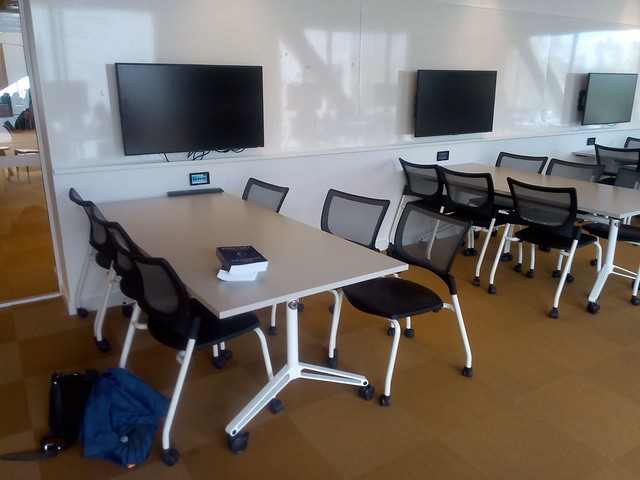
This is flipped, blended learning. It helps to have a purpose designed building, like the  ANU Marie Reay Teaching Centre opened March 2019, by Architects BVN. The Centre has only flat floor classrooms, for 30, 60, or 120 students. The flexibility here is provided by retractable walls, furniture on wheels, and electronic screens on multiple walls.

Learning to Reflect

Flipped module for teaching international masters students to write a job application:


Wall mounted LCD screens and desks on wheels at ANU Marie Reay Teaching Centre
Wall mounted LCD screens
& desks on wheels at
ANU Marie Reay Teaching Centre

  1. Online notes
  2. Videos
  3. Quizzes
  4. Peer assessed online forums
  5. Peer assessed assignments
  6. Classroom discussion in flat floor room


The module is designed to help students to develop capabilities expected of working professionals to identify their development needs, how they will acquire these and to reflect on what they have learned.

An overview of the development of the module, and an open access version of the notes are available.


2. Micro-credentials delivered off-shore

NZQA micro-credentials: 1 to 8 weeks study
AQF Review: considering micro-credentials
Attractive for international and STEM students.
3 x 1 week study modules = 1 semester course?


M-learning can be over shorter periods and targeted at specific skills. The New Zealand government is recognizing micro-credentials from tertiary education organizations as of 22 August 2018. The NZ credentials can be the equivalent of 1 to 8 weeks study. The shortest qualification typically issued by Australian universities is a 12 week graduate certificate.

An AQF Review: considering micro-credentials. This could allow much shorter, and more flexible, credentials. These would particularly appeal to international students, and those in STEM areas.

Even in advance of any official recognition of micro-credentials, institutions can create smaller units of instruction, for example, dividing a semester course which is notionally three weeks full time study into three one week units. Students could undertake the three units separately, or as part of a qualification.

3. Blockchain for degree credit onshore

Lifelong learning and micro-credentials will result in worker having several hundred qualifications. This would be unmanageable with paper certificates and even with web based e-certificates, such as those issued by "My eQuals" in Australia (the image shows my Graduate Certificate in Higher Education, issued by ANU). Employers will want to be able to automatically check qualifications against job requirements, to ensure they are genuine (the other image shows one of the many web advertisements for fake qualifications). One technology which may be used is block-chain. There is an ACS Blockchain technical committee looking at this, as one use for the technology.


Why worry about this?


China's Belt & Road Education Plan


  1. Two-Way Student Exchange
  2. Co-Operation in Running Educational Institutions
  3. Teacher Training
  4. Joint Education and Training
China Ministry of Education. Education Action Plan for the Belt and Road Initiative, 2016. URL https://eng.yidaiyilu.gov.cn/zchj/qwfb/30277.htm


China's Belt and Road Education Plan envisages students from the Indo-Pacific region studying at campuses in China, and also on regional joint venture campuses. Australian institutions will have difficulty competing for international students with these campuses. However, the plan appears to cover only on-campus face-to-face education. This provides the opportunity for Australian institutions to offer online learning using mobile devices, supplemented with on-campus education. This could complement, rather than seek to directly compete with, China's Initiative.

See also: Australian Department of Education. China's Belt and Road Initiative – Education, 2017.


More Information

Friday, April 19, 2019

E-Trainers free online training for vocational educators

E-Trainers is an EU supported project providing free online training for educators in the vocational education and training (VET) sector. There are three courses:  creating digital content, life and career skills, and  digitally competent and confident teacher. The courses are implemented in Moodle, with an appealing clean, no fuss design. However, the details of the course and quiz design is confusing.

Entry Test


I registered and took the entry test. My score was 12/14. But in a couple of cases I had to guess. The courses are provided in nine languages, so there are bound to be some translation difficulties. At one point the system lapsed into Italian.

Some questions were confusing, for example: "Which of these are video sites?", had two right answers, but I was only allowed to pick one. Another was a free text entry asking for an answer from some competency framework, which was not cited, so I had no idea what the answer might be. Another question said that a "flipped course" was an "online course", which I suggest is incorrect (it combines online and face-to-face).  But these are all minor quibbles.

I started with the first course:

Creating Digital Content


The course content itself is divided into very small web pages, with an image and a sentence or two, with about a dozen of these pages making up one lesson. These appear to be designed to fit on a smartphone screen without scrolling. However, this makes for very disjointed reading, especially on a larger tablet, laptop, or desktop screen. Even on a smartphone I would prefer larger chunks.

The first course, on  creating digital content, references the Co Building a Good Guidance project. This aims to improve students "active involvement" in school. It is an interesting approach to do this via online techniques.

The course suddenly takes a change of pace, going from offering single sentences to complex instructions for suggests entering a co-building international contest. I suggest not encouraging students, as their first exercise, to creating online content which will be made public and judged. 

Also, I suggest students should be introduced to content creation with text, and still images, first, and video later. Text and images are an easier introduction to preparing online content, these are the foundation for video, and are far more useful than video. However, the course frames the use of of text, and images as just a way to plan and prepare videos, not an important commutations media in themselves.

The course suggests using the Tricider free brainstorming tool. It gets a little confusing at this point, as brainstorming seems to be a broach in the course. Also, I could not work how to proceed without actually registering for a Tricider account. There is a similar branch for Padlet. This is not to say these are not good products, but I did not want to register at this time, and a student may want to use another product, or not be permitted to use these by their employer, or government. 

It is curious this EU endorsed project is promoting the use of Facebook and Google, given concerns the body has had concerning these companies. In particular the course recommends for teachers with students having special needs: "Teachers should help students to create Facebook and/or Google accounts."

I had completed 7% of the course when I gave up. I was not sure what exactly I still had to do.


Life and Career Skills


The second course is for VET  teaching. A survey of european employers is quoted as finding they want employees who have:
  1. Positive attitude
  2. Problem solving
  3. Communication
  4. Working under pressure / Resilience
  5. Learning to learn
  6. Flexibility
  7. Personal discipline
  8. Time management
  9. Teamwork
  10. Responsibility
Unfortunately there is no citation to where these results came from.  Also I have doubts about teaching behaviors, such as a "positive attitude". As an extreme example, I don't want the computer professionals I am training to say software is going to work, when their judgement is otherwise, especially for safety critical systems.

At the second step of this course I started to get a little frustrated. The second section "planning" started with a quiz question about competencies which had not yet been discussed, so how was I supposed to know the answer. Based on my knowledge of education (I have several qualification, and a couple of decades of experience) I guessed, and got it wrong.  I don't mind getting a question wrong, but I was not offered any remedial material to help me learn, but was offered another nine attempts at the same true/false question. I got the question right at the second attempt, but was none the wiser as to what this was about.

Then the details of a "PERSONAL COMPETENCE CARD" were detailed. However, the concept of what this was for, who developed or used it was not provided. I can guess that from the context, but a course should explain this explicitly.

8% into the course I gave up.

Wednesday, June 27, 2018

Review of Australian Education Qualifications Framework

The Australian government today announced a review Australia’s education qualifications framework. This will be headed by Professor Peter Noonan, Victoria University. A Contextual Research for the Australian Qualifications Framework Review paper has been prepared by PhillipsKPA. The paper compares the AQF with other nations qualifications frameworks. One positive finding was more employer engagement in accreditation, than in Europe. A point against the AQF is regulation of the use of Recognition of Prior Learning (RPL) and micro-credentials. The authors suggest removing administrative detail from the AQF where this is covered by regulation and legislation elsewhere.

Less usefully, the authors suggest moving to "credit points" as a measure of the volume of learning rather than years of study. Apart from helping international comparisons, this would make no practical difference, as the notional years can easily be converted to notional hours.

Saturday, June 23, 2018

Report on Australian Vocational Education and Training Regulation

The Australian Government today released the review of  Vocational Education and Training (VET) regulation, by Professor Valerie Braithwaite (2018). Professor Braithwaite made 23 recommendations the to government on 31 January 2018. The government has announced it will progress 10 recommendations, and "support in-principle" another 11. However, is not clear what the government doesn't support, or why it has taken almost five months to release the report.

The report provides useful recommendations (collected below) for improving the legislation under which VET operates. However, what is needed is a broader review of vocational education, as an industry and as a service to the community. Also the relationship between VET and the university sector. There are calls for universities to provide more job ready skills for graduates and more responsive to industry needs, which up until now has been the role of VET.

Professor Braithwaite begins by pointing out what has been achieved with VET regulation in Australia, with national regulation introduced in 2011. A patchwork of state oversight was replaced by the Australian Skills Quality Authority (ASQA). No major deficits were found preventing  ASQA from regulating VET, However, the report recommends "... a higher bar for gaining and maintaining registration as a VET provider". 
The report notes that 81.4% of VET students are part time, with business services the most popular program. Students may be at a large TAFE campus, small RTO, or online. Unfortunately the report does not detail what proportion are at each. While there have been concerns over VET quality, the report notes in 2017 that 87% of students were satisfied with their provider.
"Recommendation 1: ASQA develop and implement processes to enhance its capabilities and opportunities to proactively engage in regulatory conversations with students, teachers, RTOs, industry and other interested stakeholders. The desired outcomes are to improve the value of the student-focused regulatory approach and involve the sector in developing the regulatory culture that drives ASQA’s use of its legislative powers.


Recommendation 2: In order to enhance transparency and consistency in the use of the legislative framework, ASQA should build on its regulatory conversations and practice reflections to develop and clearly articulate to the regulatory community the principles applied to the interpretation of legislation and the use of powers.


Recommendation 3: ASQA works with RTOs to develop positive assurance flags to include in the ASQA risk matrix and develop a mutually agreed method of communicating this information publicly without increasing the compliance burden on RTOs.


Recommendation 4: The Australian Government amends the legislative framework to ensure that entrants to the registered training market be required to clearly demonstrate educational commitment and knowledge of how to provide best practice support to students. This statement of commitment should be required as a condition of registration and include quality performance objectives, which, if breached, could lead to sanctions and ultimately de‑registration.

Recommendation 5: The Australian Government strengthens the fit and proper person requirements and change notification requirements under the NVETR legislation and where appropriate aligns them with TEQSA and ESOS Act provisions and any other relevant legislation.


Recommendation 6: The Australian Government amends the legislative framework to ensure greater scrutiny of new providers to:
  • provide that where an RTO without reasonable justification does not commence providing training within 12 months of being registered, or during its registration ceases to provide training for a 12-month period, its registration automatically lapses, meaning that it would no longer be registered.
  • prevent RTOs changing the scope of the courses they deliver where an RTO has been operating for less than 12 months.

Recommendation 7: The legislative framework be revised to require an RTO to assess the quality of its teaching workforce and develop teacher quality improvement actions, which must be submitted to ASQA annually as a part of the Quality Indicator Annual Summary report.

Recommendation 8: The Training and Education Training Package be reviewed with the purpose of creating a career path for teaching excellence in vocational education and training.

Recommendation 9: The Australian Government leads a process to raise the standards of teaching and training excellence and professionalism in the sector through creation of the role of Master Assessor. A Master Assessor would be placed at the pinnacle of the VET teacher/trainer career path with the responsibility to mentor through professional development programs and assess the quality of an RTO’s next cohort of graduating students.

Recommendation 10: The legislative framework be amended to increase the frequency of data provision to the National Centre for Vocational Education Research to quarterly for all RTOs.

Recommendation 11: The Australian Government prioritises the improvement of policies and systems that allow for transfer of real-time data for timely use by other agencies with regulatory responsibilities for identifying and responding to emerging sectoral and provider‑based issues.

Recommendation 12:
  1. The Australian Government and the National Centre for Vocational Education Research explore ways to increase student response rates to the Student Outcomes Survey, and
  2. The National Centre for Vocational Education Research, ASQA, and the sector identify a module of questions that directly addresses the quality of the student journey in the Student Outcomes Survey.

Recommendation 13: The legislative framework be amended to enable the National Centre for Vocational Education Research to make the RTO level data it holds publicly available and identifiable.

Recommendation 14: The Australian Government explores ways to strengthen the regulatory framework by expanding the circle of dialogue around improving the quality of the student journey pre- and post-audit to include all stakeholders who could contribute to future improvement in an RTO’s performance.

Recommendation 15: The National Vocational Education and Training Regulator Act 2011 be amended to require ASQA to publicly release audit reports.

Recommendation 16: The legislative framework be amended to require RTOs to publish nationally consistent consumer information that is accessible and meaningful to students and meets the basic needs for decision making (for example, course entry requirements, course length, employment outcomes, and fees, including subsidies and course cancellation fees).

Recommendation 17: The legislative framework be amended to strengthen ASQA’s ability to take action under a general prohibition against misleading or deceptive conduct which reflects Australian Consumer Law requirements.

Recommendation 18: The legislative framework be amended to require RTOs to strengthen consumer protection in student enrolment agreements through the adoption of contracts that avoid unfair terms as defined in Australian Consumer Law.

Recommendation 19: The legislative framework be amended to require RTOs to keep electronic records showing a minimum of student completions of units, courses and qualifications over the life of the RTO, preferably using an AVETMISS-compliant student management system.

Recommendation 20: The Australian Government investigates ways in which, in cases of administration and liquidation, priority is given to the timely provision of student records to ASQA and the protection of students’ investment in their education.

Recommendation 21: The legislative framework be amended to explicitly address student safety and wellbeing in alignment with the Higher Education Standards Framework (Threshold Standards) 2015.

Recommendation 22: The Australian Government considers strengthening tuition assurance by assuming responsibility for the operation of all tuition assurance and protection arrangements and ensuring that the scope of these arrangements protects all VET students.

Recommendation 23: The Australian Government establishes a national Tertiary Sector Ombudsman."
From Braithwaite, 2018

Reference

Valerie Braithwaite, All eyes on quality: Review of the NationalVocational Education and Training Regulator Act 2011 report, (Canberra: Australian Government, 2018). URL https://docs.education.gov.au/system/files/doc/other/all_eyes_on_quality_-_review_of_the_nvetr_act_2011_report.pdf