Showing posts with label Reflective Portfolio Course. Show all posts

Wednesday, October 16, 2024

Podcast on E-portfolios for Education

Recently I was delighted to be interviewed for a podcast by Kristina Hoeppner on the use of e-portfolios in Mahara's  'Create. Share. Engage' series.  We talked about how these are used in the ANU Techlauncher program, using techniques I learned as a student of Debra Hoven at Athabasca University. With this approach the student is guided through the development of the portfolio, including peer feedback, and as part of their coursework, rather than being left as something extracurricular to complete later. 

A slight variation on this, is to have the student prepare the portfolio in the form of an application for a real job which they would like on graduation. This makes sense as a capstone exercise, at the end of a program of study, as many students are then looking for jobs. This transforms the portfolio from something which might be of use to the student one day, to something of vital importance right now. At the moment I am overseeing the assessment of 400 student portfolios by a dozen tutors.

Wednesday, October 19, 2022

Using a Job Application as the Capstone Exercise for Work Integrated Learning

On the Yogyakarta Train,
after TALE 2019 
On a visit to Singapore for EduTech Asia 2022, I will stopping off at a university to talk about using a job application as the capstone for work integrated learning. I would be happy to talk at other institutions, while in Singapore, or elsewhere. This is an update to a paper I gave at the 2019 IEEE International Conference on Engineering, Technology and Education (TALE). That was a few months before the COVID-19 pandemic, and I had no idea that my idea of designing a blended learning module which could be quickly converted for full online delivery in an emergency would be needed so soon. I will discuss how it went and what universities should do next post-pandemic.

Original paper:

Worthington, T. (2019, December). Blend and Flip for Teaching Communication Skills to Final Year International Computer Science Students. In 2019 IEEE International Conference on Engineering, Technology and Education (TALE) (pp. 1-5). IEEE. https://doi.org/10.1109/TALE48000.2019.9225921

Tuesday, July 26, 2022

ANU Techlauncher Learning to Reflect Introduction


Today I had the delight of being in a classroom with the Australian National University's Techlaucher students, as well as those joining online (video available). Normally I stick to the mechanics of how the "Learning to Reflect" module I supervise is run. The staff of ANU Careers provide the actual content, running students through exercises to help them think about a career. However, after reading Becoming by Michelle Obama, I was inspired to talk a little about my own career. The point wasn't big-noting myself (well not entirely), it was to show a career is rarely a straight linear path. I happened to join ABS, just as they had millions of dollars for IT training I joined the DoD computer division only to have it abolished ending up in the nation's military HQ. I nominated for VP of the ACS, but ended up President. I joined ANU to do research and ended up teaching. The latest coincidence is that I went to an ACS meeting last night, and it was the launch of the new version of a computer job analysis used in Techlauncher. The person launching it happened to have an interest in training computer people in Indonesia, as do I ...

Thursday, August 19, 2021

Learning to Reflect Module Version 5.0: Hybrid Edition


"Learning to Reflect" is a module for the ANU TechLauncher program, where students reflect on what they have learned, by writing an application for a real job, as their last assessed task before graduating. This was developed in late 2018 and first run in semester 1, February 2019. It was designed for blended delivery, with the option of easy conversion to full online delivery. That option was needed for Semesters 1 & 2 in 2020, and Semester 1 2021 due to COVID-19. This version 5 is designed for hybrid delivery, with students in a physical classroom linked to those online, using the MidFlex Minimal Hybrid FormatUnfortunately COVID-19 again required a return to pure online delivery, but without any changes required to the material.

Two additional workshops were added from Version 4, at student request, bringing the total to four. The first three have exercises for a 2% mark each (not for the last when a major assignment is due). The optional student logbook has been dropped due to lack of use. The middle two workshops are half the length of the others with the first hour used for the new ANU Computing Showcase, featuring prominent ANU alumni, speaking about their careers.

Please note that the course notes only supply the structure for the module and the assessment. The detailed content for the workshops is provided by Tempe Archer, Careers Consultant at ANU Careers, and the students undertake exercises using the ANU Careers Toolkit.

A paper on the design and blended delivery of the module is available:

Wednesday, February 24, 2021

Learning to Reflect Module Version 4.0 the 2021 Blended Edition


"Learning to Reflect" is a module for the ANU TechLauncher program, where students reflect on what they have learned, by writing an application for a real job, as their last assessed task before graduating. This was developed in late 2018 and first run in semester 1, from February 2019. This was designed for blended delivery, with the option of easy conversion to full online delivery. That option was needed for Semesters 1 and 2 in 2020 due to COVID-19. The 2021 version is intended to be run online, with a blended delivery option ready for a return to the classroom and is available under a CC-BY licence.

Two small workshop exercises have been added for a 2% mark each, in place of the quizzes and forums used previously. The first assignment has been dropped, to make the assessment less complex. An optional student logbook has been added, to aid student reflection and deter plagiarism. 

A paper on the design and blended delivery of the module is available:


Saturday, December 26, 2020

Learning to Reflect Module Version 3.0 the 2020 COVID-19 Pandemic Edition

"Learning to Reflect" is a module for the ANU TechLauncher program developed in late 2018 and first run in semester 1, from February 2019. This was designed for blended delivery, with the option of easy conversion to full online delivery. That option was needed for Semester 1, February 2020 due to COVID-19,. The two face to face workshops were replaced with Zoom video conferences. The online content and activities were unchanged.

The assessment was removed from two online quizzes and forums, leaving just two assignments to provide 20% of Techlauncher assessment. This was done in an attempt to reduce the burden on students, and staff, who were suddenly required to change from face-to-face to online learning. The students still had their tutors at Zoom video-conferences, to help them keep up with their studies.

About 90% of students still completed the quizzes, despite them not counting towards assessment. In contrast, about 90% of students did not post regularly to the online forums. The difference may be because the quizzes were quick and easy to complete, being multiple choice, whereas the forum posts required composing text. Also the quizzes returned instant feedback in the form of connect/incorrect and a numeric score, whereas there was no automated feedback in the forums. When the forums are assessed, there is feedback from students (which is also assessed). However, some form of tutor-bot might be useful to give instant feedback.

A paper on the design and blended delivery of the module is available:

Worthington, T. (2019, December). Blend and Flip for Teaching Communication Skills to Final Year International Computer Science Students. In 2019 IEEE International Conference on Engineering, Technology and Education (TALE) (pp. 1-5). IEEE. https://doi.org/10.1109/TALE48000.2019.9225921

Sunday, March 15, 2020

E-learning for Schools Pitch

Last week I attended a Service Design Meetup at the Canberra Innovation Network, sponsored by Evolve & Amplify. We went through the standard entrepreneurial start-up value proposition process. I worked on the idea of expanding my e-learning services from university to business, in response to the  COVID-19 Coronavirus emergency. I produced a pitch, and submitted it to a start-up competition. Also I produced a video, but then discovered they completion did not allow videos, so here it is.

Images under a Creative Commons License.

Saturday, March 14, 2020

Designing in an On-line Learning Option

One of the benefits of computers in education is that this makes distance education a richer experience and feasible for more students. It also can remove the need for special provisions for when some, or all, students cannot get to campus, such as in the current COVID-19 Coronavirus emergency.

Pictographs by
Carlos Sarmento

from the Noun Project
(CC BY 3.0 US).
As part of my graduate studied in education, and informed by my background in defence and emergency management, in 2016 I concluded that international students could be prevented from coming to Australian campuses at short notice due to an international crisis. In 2017 I suggested that universities provide blended learning, which allowed for students who could not get to campus to study online. Since then I have been designing and delivering courses this way: on-line, with classroom activities for those students who can get to campus.


Wall mounted LCD screens and desks on wheels at ANU Marie Reay Teaching Centre
Wall mounted LCD screens
& desks on wheels at
ANU Marie Reay Teaching Centre
An example is the "Learning to Reflect" module for Australian National University computer project management students. This has an e-book, videos, online quizzes, and online student forums. There is also provision for face-to-face workshops. But in the current circumstances, it seems likely these will be switched to online as well. There is no need to change the course content, or assessment processes, as they are all already online. 

It should also be possible to offer both classroom and online real-time (synchronous) sessions for students. This would use the same software as for distance education, but tied into the classroom's audio-visual system. There should be no need for any special additional hardware or software.

Monday, February 10, 2020

Reflecting on Reflecting on Learning

Learning to Reflect" blended module. This is the last assessed task for students undertaking the ANU Tech Launcher program before they graduate. Last semester the students read notes, watched videos, did an online quiz, participated in an on-line forum (with peer assessment), then a face-to-face workshop (run by Tempie Archer, from ANU Careers). They then submitted and assignment (with peer feedback), and repeated the process. That all worked well, but was seem by the students, and my colleagues, as too complex, and too much work. There was too much to read, too many assessment items, and too much peer assessment. Also the tutors, who the students have for face-to-face tutorials, felt excluded from the process.


Saturday, October 19, 2019

Blending Soft Skills for University Graduates

Wall mounted LCD screens and desks on wheels at ANU Marie Reay Teaching Centre
Wall mounted LCD screens
& desks on wheels at
ANU Marie Reay Teaching Centre
On 20 November I am speaking at the ANU TELFest technology-enhanced learning conference, on How to blend and flip a course for a flatpack classroom. This is for ANU staff, but I would be happy to speak on this elsewhere. In particular I will be in Sydney 28 to 29 October, and Perth on Wednesday 13 November, if anyone would like to provide a venue and an audience.

Wednesday, August 14, 2019

Learning to Reflect Module Version 2.0

I have updated my "Learning to Reflect" learning module for the ANU TechLauncher program this semester. The students are guided in how to prepare a job application. In the process they learn long term professional skills to identify their development needs, how they will acquire these and to reflect on what they have learned. The materials are available under a creative commons license for modification and reuse.

Introduction


The notes and videos contain content intended for instructors, as well as students, to be used in conjunction with online exercises, and face-to-face workshops. Students will be prompted by the Moodle Learning Management System, as to which parts to read, and when to read them.


1. Learn


In this first of two parts, you will investigate what you need to learn for your project, and long term for your career. In scope here, are both technical skills and also professional and teamwork skills. The aim is to prepare you to be a professional in your field, which includes the ability to take charge and responsibility for your future professional development.


2. Report and reflect


In this second and last part, you will reflect on what you have learned. The assignment task is to select a real position to prepare an application cover letter for, and revise the responses to selection criteria prepared in assignment 1.


Appendixes

Tuesday, August 6, 2019

Learning to Reflect Videos


Having revised the "Learning to Reflect" module notes for ANU TechLauncher students, it was time to revise the video. This is a time-consuming and exacting process, even for someone with training in video production.

Last semester I produced this by first making a slideshow presentation, which was also used live in the classroom. I prepared a script based on what was in the module notes, rearranged to match the sequence in the video. I then turned each slide into an image, and the script into synthetic speech. The slides and audio were then imported into a video editing package and timed to match the audio. The results were not perfect, but like Samuel Johnson's piano playing dog: "It's not done well; but you are surprised to find it done at all."  ;-)

This time I decided to try Content Samurai, after it was demonstrated at PitchEd NSW. This is a web based tool which takes a script, and searches for suitable video clips, or still images,  based on the key phrases. The service will then turn the script into synthetic speech timed to the video. This process works remarkably well. The Australian accented male voice provided is much better than those I have used previously. I did have to slow down the narration to 80% of full speed, and lower the volume of the background music to 5%.

After some experimentation I found I could set the system to add a new scene for each paragraph in the script. I could then hide the text, otherwise it would put it as a caption on screen. Also I could upload my slides in place of some of the auto suggested clips. This way my slides are interspersed with the suggested filler scenes.

Here is what the video looks like generated by automatically, with the defaults (video selected from keywords, scene transitions, animated text). This version was not usable:


I then changed the settings, to use only still images, and have one per paragraph, with no animation, or scene transitions:


One problem was that rendering was very slow (but video rendering is always slow). I found it could be faster by using still images, rather than video clips. The rendering took about six minutes for a six minute video. Also I created a plain black template for the slides, with no shaded pattern.

One option I would like is to reduce the bit-rate of the audio. For an educational video you need only low quality mono sound.

One tip is to set your slide maker (I use LibreOffice) for 16:9 format slides, to match a modern widescreen TV. Then generate the slides images at the resolution required. Full HD TV is 1,920x1,080. Content Samurai produced the lower resolution 1,280x720HD TV format typically used for broadcast TV, but down sampled my higher resolution slides very cleanly.

I could not find a way to prepare closed captions within Content Samurai, so I uploaded the video to YouTube, and then downloaded the VTT file it produced. I then uploaded this to the Moodle website, for the students.

Thursday, June 27, 2019

Learning to Reflect Course Module Worked


This is the tenth of a series of posts, on how to provide students with help when preparing a reflective portfolio. A class of 78 graduate computing students completed the module, as part of ANU Techlauncher. The flipped, blended, peer assessed approach worked well, and produced outcomes comparable to conventional lectures with instructor assessed assignments. A copy of the updated course notes are available. I can also provide a Moodle backup file including all course materials, and quiz questions, to instructors.

ANU Marie Reay
Teaching Centre
In 2008 I decided to stop using lectures as part of university courses. I then spent 2009 to 2018 designing and delivering purely online courses. In February 2019 the Australian National University unveiled the Marie Reay Teaching Centre, a flexible teaching building. I was able to use the building to try out the approach of an online course supplemented with face to face workshops. This I suggest could be generally applied in higher education. I have submitted a paper on this to an international computer education conference.

Friday, April 5, 2019

Audio Slideshow for Job Application Reflection Module


This is the ninth of a series of posts , on how to provide students with help when preparing a reflective portfolio. This is an audio slideshow. The slides are based on the course notes and the audio is computer generated.

This is intended to be a demonstration of how to produce multi-media for education, quickly, and easily. The slides were produced using LibreOffice "Impress" (a free alternative to Microsoft Powerpoint). To generate slides suitable for HDTV, the presentation was exported as PNG images at 1280×720 pixels. These slides were copied into the KDEinLive digital video package, and adjusted to fit with the audio commentary. The video was rendered as 720p MPEG 4,  at 200 kbps, 24 frames per second, with 64 kbps audio.

The computer generated audio is monotonous, and the text based slides not very interesting. However, this is a good start before trying anything more ambitious. Also students are not undertaking study to be entertained, but to be educated.

ps: This is for students of  ANU Tech Launcher.

Thursday, April 4, 2019

Audio Slideshow for Job Application Learning Module


This is the eighth of a series of posts , on how to provide students with help when preparing a reflective portfolio. This is specifically for students of  ANU Tech Launcher.


Mazen Al-Ismail
Previously I provided an audio podcast for part 1 "learn". However, research by Ismail (2018) suggests some students prefer audio with slides. So I have added slides to the audio. The student can still listen to the audio, without looking at the slides, which some prefer. This is easier to create and maintain than separate video and audio versions.

Tuesday, March 12, 2019

How to Blend and Flip a Course for a Flatpack Classroom

Next Friday, 15 March I will be speaking on "Blend, Flip, and Back to the Classroom". So I thought I should collect my thoughts on what to say. Here are some note, so far:

In 2008 I ended my last lecture for the year at ANU by announcing it would be my last lecture, ever. Having become disillusioned with the lecture format, I have been teaching online for the last ten years, with an award winning course offered by three institutions, in Australia and North America. During that time I looked at alternative classroom designs in Australia and around the world.

In February 2019 the Australian National University unveiled the Marie Reay Teaching Centre, a flexible teaching building. So this year I am going back to the classroom, to apply what I have learned, with a blend of online and classroom teaching in the new building. This is intended to be a model for how academics can easily convert conventional courses to new interactive ways of learning, and allow each student to choose the blend of online and classroom learning to suit their needs.

Overview of the Learning Module


I produced slides, and a video for the revised learning module, on how to provide students with help when preparing a reflective portfolio. This is for students of  ANU Tech Launcher, but intendeds to be able to be used more widely. The module has two parts, with the same format: read the notes, do an online quiz, participate in an on-line forum with peer assessment, then a face-to-face workshop, lastly do an assignment with peer feedback.

New Flexible Teaching Spaces at ANU

ANU Marie Reay Teaching Centre
The Marie Reay Teaching Centre opened at ANU 25 March, along with the Culture & events building opposite, both by Architects BVN. These buildings have flexible teaching spaces, but flexible in different ways. The culture and events building has a 500-seat auditorium, and a 200 seat flexible space. Both of these have tiered lecture theater style seating, but which retracts electrically, providing large flat floor spaces, with high ceilings.

In contrast, the Marie Reay Teaching Centre has only flat floor classrooms, for 30, 60, or 120 students. The flexibility here is provided by retractable walls, furniture on wheels, and electronic screens on multiple walls.

147 seat seminar room,
ANU Sciences Teaching Building


This approach of one building with lecture theaters, and one with flat floor classrooms, differs from attempts to combine the features of the two. As an example, the ANU Sciences Teaching Building has a 147 seat tiered seminar room. The room has wide tiers with fixed tables for groups of seven students. This is designed so students can watch a presentation at the front of the room, and then discuss it in a group, around their table. However, the tables take a lot of space and are fixed in place. Display screens on the tables block some of the view.

In contrast, the ANU Kambri complex has two buildings with specialized seating for specific pedagogy. The ANU Cultural Centre Building has high density tiered theater fixed seating for lectures. Opposite is the Marie Reay Teaching Centre with low density flat floor movable seating and tables for group work. This has the advantage that both format rooms can be used simultaneously. and offer a greater overall seating capacity, than would general purpose lecture/group rooms.
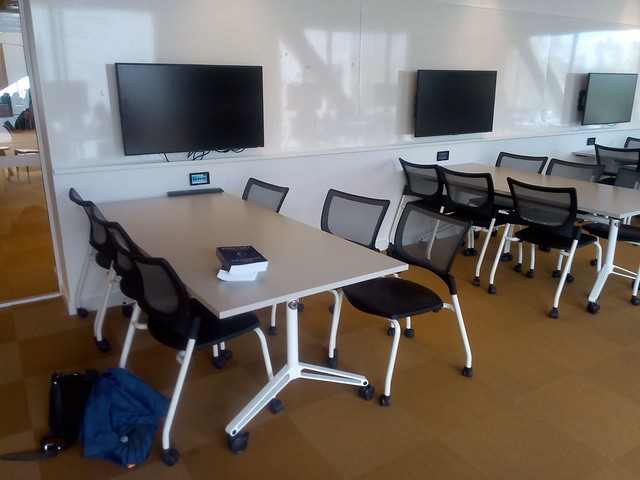
Wall mounted LCD screens and desks on wheels at ANU Marie Reay Teaching Centre
Wall mounted LCD screens
& desks on wheels at
ANU Marie Reay Teaching Centre
While the tables in the Marie Reay Teaching Centre are on wheels, one room (4.02) has five electronic screens on each side wall, spaced to allow each of five desks to have a screen (for a total of sixty students). This overcomes the problem of the desks becoming immovable, when computer screen are installed on them.

Students doing a Lego Serious Play exercise at the Australian National University in Canberra
Screen of Wheels, in use at the
ANU Barry Drive classrooms,
for ANU TechLauncher group activity
Other rooms have two projection screens for presentations. I have suggested these be supplemented with screens on wheels, which can be positioned for group work, or to display what is on the main screens. Such screens on wheels have been used at the ANU Barry Drive classrooms for an ANU TechLauncher group activity.

Top Down Course Design

My approach to course design reflects the limited flexibility of the new buildings. Flexibility is provided, but not at the expense of efficiency.

The learning is designed top down: start with the learning objectives, or externally set requirements. These set, in broad terms, the knowledge and skills the student must have on completion of the course.  Often these objectives are not provided to the educational designer, or are so vague they are of little use, so they have to be found, or invented.

For the Reflective Learning module, I first tried adapting skills definitions from the Skills Framework for the Information Age:
"Upon completion of this module, students will be able to:
  1. Determine their own learning needs and possible sources, to develop individual skills for a project and for their career development.
  2. Identify appropriate accreditation and qualification paths. 
  3. Manage the learning, and evaluate its effectiveness through through reflection."
 From the skill "Learning and Development" (ETMG), Level 6, SFIA, Version 7, 2017. As used in "Learning to Reflect" (Version 0.1), February 4, 2019.
SFIA is used by the Australian Computer Society for accreditation of Australian university degrees, and by some employers in defining jobs. It is useful to have course objectives aligned with SFIA, to make accreditation quicker, and so graduates can easily show employers they have required skills.

However, as I writing a module for use in an existing course, and that course was not aligned with SFIA, this approach did not work. In a later draft I replaced the SFIA objectives, with ones from the course definition:
"The module is aligned with two of the outcomes for the course:
3. 'learn any specific technical skills required by their topic, and apply them to project work.
4. apply and deepen skills in oral and written communication, and apply these in a project context.'
From Computing Project, Course COMP8715, ANU, 2019. URL https://programsandcourses.anu.edu.au/course/comp8715" as cited in "Introduction", of Learning to Reflect, Version 1, February 13, 2019.

Aligning Assessment with Leaning

My usual approach is to continue the top down development, by providing one major assessment task for each learning objective. However, in this case the final assessment task was already set by the existing course the module. So I have to set other assessment around this.
The main issue the module was intended to address was the difficulty Masters of Computing students had with the large assessment task at the end of semester. The obvious solution was to break this assignment into pieces delivered in sequence. However, the same assessment task is undertaken by students in multiple courses, all of whom are in the same tutorial group with the same tutor. Having different versions of the assignment for different students would be confusing for tutors and students.

Chunky Blended Learning

Designing learning takes time. I started designing the learning module in late 2018. At that time I was not sure if the new classrooms would be completed for first semester 2019. Even the week before semester started in February 2019, there was construction equipment around the building. However, this was quickly cleared away and the building opened on time, with the classroom equipped.

However, in late 2018 I could not be certain everything would be ready. So I used a conservative approach to blended course design, using what  Fleck (2012) refers to as "chunky" blended learning:
'The term "blended learning" usually refers to a mix of conventional face-to-face elements combined with on-line elements. However, this is at too general a level for in depth analysis, while the term "blend" perhaps suggests too homogeneous a mix: in practice the mix is more "lumpy", more a chunky fruit salad than a blended smoothie. At one extreme it is becoming routine for campus-based virtual learning environments (VLEs) to be used to provide additional notes and materials supporting conventional lectures.'
From Fleck (2012).
 The design is essentially a distance education course, with face-to-face workshops added. The learning management system (LMS), in this case Moodle (part of ANU's Wattle system) is used for providing students with course notes, videos, podcasts and other materials. The LMS is also used for routine announcements to the class, and individual communication with students. Small assessment tasks (quizzes and forum posts) are provided via Moodle's quiz and forum modules. Assignments are similarly done using the workshop module of Moodle.
As it was not clear what classroom would be available, the workshop design was kept general, and drawing on the preceding online activities.
  1. Announcements: General announcements while students set up the room.
  2. General Questions: Students can ask for clarification on administrative, content and assessment questions. Groups first discuss the question and if they are not  sure of the answer it can be put to the whole room.
  3. Forum Questions: Discuss your answers to this week's forum questions.
  4. Assignment Master Class: Bring along your draft assignment, ask for feedback from your group. Be prepared to put it up on the big screen for group feedback.
  5. Wrap-up: Any concluding remarks by students and instructors.
The same  format is used for all workshops, so that staff and students can become familiar with it. This avoids limited class time being taken up with explanations of complex exercise formats.

Chunky Online Learning

As well as the blended and online learning being chunky, the online component is in large chunks. The student is provided with a package of material for two weeks. This has notes, suggested readings, a quiz, discussion questions, workshop, and assignments. While the student is expected to undertake the work in this order, exactly what they do when in the two weeks is left largely to the individual.

This contrasts with tightly scripted online learning modules which give the student a few paragraphs to read and perhaps a video, then an automatically marked question they have to answer before proceeding to the next item. Such packages require considerable design and testing if they are not to hold up and frustrate students. Also these tend to require a high speed reliable network connection to function. In contrast the chunky approach allows students to download material, and use it offline.

References


Fleck, J. (2012). Blended learning and learning communities: opportunities and challenges. Journal of Management Development, 31(4), 398-411. http://dx.doi.org.virtual.anu.edu.au/10.1108/02621711211219059 
Worthington, T. My Last Lecture, Net Traveller (Blog), August 20, 2008. URL https://blog.tomw.net.au/2008/08/my-last-lecture.html 
Worthington, T., "A Green computing professional education course online: Designing and delivering a course in ICT sustainability using Internet and eBooks," Computer Science & Education (ICCSE), 2012 7th International Conference on , vol., no., pp.263,266, 14-17 July 2012 URL: http://dx.doi.org/10.1109/ICCSE.2012.6295070 Preprint available at: http://hdl.handle.net/1885/9013 
Worthington, T. Learning to Teach in the New ANU Teaching Building, Higher Education Whisperer (Blog), February 11, 2019. URL https://blog.highereducationwhisperer.com/2019/02/learning-to-teach-in-new-anu-teaching.html 
Worthington, T. Helping Computing Students Prepare a Reflective Portfolio: Parts 1 to 7, Higher Education Whisperer (Blog), November 28, 2018 to February 13, 2019. URL https://blog.highereducationwhisperer.com/search/label/Reflective%20Portfolio%20Course

Wednesday, February 13, 2019

Shorter Learning Module for Teaching Students to a Write Job Application

This is the seventh of a series of posts , with a revised learning module, on how to provide students with help when preparing a reflective portfolio. This is specifically for students of  ANU Tech Launcher

Previously I provided three parts (1. Plan, 2. Learn, & 3. Report and reflect). However, that was far more work than a student could do in the available four hours study. So I have deleted part 1. Some of the content on learning has been moved to the next part "Learn", but the rest has been deleted. Also I have made all readings "suggested", not required. The SFIA learning objectives have been replaced with two from ANU Techlauncher (which the module is part of).

Also I have added a video with commentary to introduce the module, and audio podcasts for parts 1 & 2. The audio is text-to-speech, using Animaker's Australian English voice "Russell". I am not that good a speaker, and it would take a long of time to come up with a good narration. As it is, I can copy the notes to a text file. I then insert pauses at the ends of paragraphs, and replace abbreviations (such as "ANU", which would be pronounced as "Arrnoo"). I can simply edit the text and regenerate the audio, in a few minutes.

Table of contents

Introduction
1. Learn
2. Report and reflect

Appendixes

Monday, February 4, 2019

Learning Module for Teaching Students to a Write Job Application

This is the sixth of a series of posts on how to provide students with help when preparing a reflective portfolio. This is specifically for students of  ANU Tech Launcher. Previously I looked at using the STAR approach for responding to selection criteria (Cockburn, Carver, Shirley, & Davies, p. 71, 2007). Since then I have prepared the web page cor the module, quiz and forum questions, assignment rubrics and notes. Appended are the table of contents and introduction, from the notes.

One of the issues arising was how much the student would have to read, and do, in preparation for the actual assignment. The idea is that the exercises are integrated to preparing the assignments. The full notes for "Learning to Reflect" (Version 0.1) are available. Here is the introduction:


Table of contents


Introduction

Overview

This module will enable students to develop capabilities expected of working professionals to identify their development needs, how they will acquire these and to reflect on what they have learned.

Learning Outcomes

Upon completion of this module, students will be able to:
  1. Determine their own learning needs and possible sources, to develop individual skills for a project and for their career development.
  2. Identify appropriate accreditation and qualification paths. 
  3. Manage the learning, and evaluate its effectiveness through through reflection.
Adapted from the skill "Learning and Development" (ETMG), Level 6, Skills Framework for the Information Age, Version 7, 2017.

Indicative Assessment

Three online quizzes, 10% (5% per quiz, with best two counted). Contributions to three discussion forums, 20% (10% per forum, with best two out of three counted). Three assignments, 70% (35% each, best two out of three counted). Peer feedback from students in the forums, and on assignments, will be taken into account in grading by the examiners.

For each quiz students will answer three to five questions, with multiple choice and short answers. The quizzes will be automatically marked by the system. Questions will be randomly selected from a question bank, with ordering of multiple choice answers randomized.

For each forum students will be asked to answer two or three set questions with a few sentences (the questions are listed in the notes at the end of each part). Students are then asked to reply to the post by another student. Students will then give ratings for the answer (0, 1, or 2). The Instructor will provide a mark for each student, taking into account the student ratings.

For each assignment students will be given a question and a marking rubric. After submitting their own answer, for the first two assignments, students will rate three others using the rubric, and provide feedback. The instructor will review the student feedback, making any changes needed. The examiner will then allocate 90% of the grade for the student's work and 10% for their feedback. For the last assignment students are not required to rate or provide feedback.

Overall mark calculation

Mark = best two quizzes + best two forums + best two assignments.

Course specific policies 

Late submission of assessment is not accepted.

Workload

Twenty hours of student learning time, consisting of participation in online forums and assessment activities. A one hour face-to-face workshop will be provided to assist with each assignment (three hours in total).

Prescribed Texts

An eBook is supplied with the course. In addition, from ANU Academic Skills:  Reflective writing, reflective essays, learning journals. From ANU Careers:, cover lettersaddressing selection criteria, resumes, and ANU Careers Guide (2018).
An expanded STAR-L approach is used: Situation, Task, Action, Result, and lessons Learnt. (Cockburn, Carver, Shirley, and Davies (p. 71, 2007). ANU also provides samples of cover letters, selection criteria, and resumes for students.

Course schedule

The course consists of three parts, one topic per part, with one quiz, forum, and assignment, for each:
  1. Plan the learning needed. In this part the student investigates what they need to learn for their project, and for long term career plans. Assignment task is to produce a first draft of their CV, and learning goals.
  2. Learn. The student learns about different ways of learning, and identifies appropriate accreditation and qualification paths for their future. Assignment task is to address a typical set of selection criteria.
  3. Report and reflect. The student reflects on what they have learned. Assignment task is to prepare an application cover letter, and revise the other parts prepared previously.

Communication platform

The ANU Wattle system is used for communication. Students and instructor will use Moodle Learning Management system tools:
  1. Dialogue for one-to-one communication.
  2. Forum for group communication and discussion.
  3. Quiz tool for quizzes.
  4. Workshop for assignments.

References

ANU Careers Guide: A practical guide to planning your career and maximising your employability, Version 7, ANU Careers (2018). URL http://www.anu.edu.au/files/resource/DSA173813%20Careers%20Guide%20v7%20WEB.pdf

Tina Cockburn; Tracey Carver; Melinda Shirley; Iyla Davies, Using E-Portfolio to Enable Equity Students toReflect on and Document Their Skill Development, 15 Waikato L. Rev. 64 (2007) URL https://heinonline.org/HOL/P?h=hein.journals/waik15&i=68

Reference


Tina Cockburn; Tracey Carver; Melinda Shirley; Iyla
Davies, Using E-Portfolio to Enable Equity Students toReflect on and Document Their Skill Development, 15
Waikato L. Rev. 64 (2007) URL https://heinonline.org/HOL/P?h=hein.journals/waik15&i=68

Thursday, December 20, 2018

STAR-L for Teaching Students to Write Job Applications


This is the fifth of a series of posts on how to provide students with help when preparing a reflective portfolio. This is specifically for students of  ANU Tech Launcher. Previously I looked at how to structure the learning. ANU's Student Experience and Career Development unit suggests using the STAR approach for responding to selection criteria. Cockburn, Carver, Shirley, and Davies (p. 71, 2007), discuss an expanded STAR-L approach used at Queensland University of Technology (QUT): Situation, Task, Action, Result, and lessons Learnt.
  1. "Situation - The situation is the context in which the experience occurred. ...
  2. Task - The task is what was actually required of you in the situation. ...
  3. Action - Action refers to the steps that you personally took in response to the task. ...
  4. Result - Result refers to the outcome of your actions. How did your actions contribute to the completion of the task? How did your actions affect the final outcome of the situation? ...
  5. Learnt - Learnt refers to the things you have learned from the experience. Highlight any skills or abilities that you have developed or improved as a result of the experience. ..."
From:  Cockburn, Carver, Shirley, and Davies (p. 71, 2007)
ANU provides samples of cover letters, selection criteria, and resumes for students.


Reference


Tina Cockburn; Tracey Carver; Melinda Shirley; Iyla
Davies, Using E-Portfolio to Enable Equity Students toReflect on and Document Their Skill Development, 15
Waikato L. Rev. 64 (2007) URL https://heinonline.org/HOL/P?h=hein.journals/waik15&i=68

Wednesday, December 12, 2018

Learning to Reflect

This is the fourth of a series of posts on how to provide students with help when preparing a reflective portfolio. This is specifically for students of  ANU Tech Launcher and the ANU Computer Science Internship. Previously I looked at how to structure the learning, use the student study time and assess a portfolio.

With this I propose to split the module up into three equal size sections, which would be delivered at equidistant points during a 12 week university course, near the beginning, mid-semester and the end.  There would be similar assessment and activities for each of the three segments, with the student revisiting, and revising their work each time. The idea of this regular structure is to make it simpler for instructors and students to understand. The sections are spread through the semester to aid learning, at the expense of an increase in complexity.

The assessment has small tasks (quizzes and discussion postings), to aid students with surface knowledge and assignments for the deeper learning. The assessment is all summative, in that it all counts towards the final result, to encourage students to study. Similarly, peer input to the assessment is used to aid study, with the instructor retaining the final decision on grades.

The grading scheme is designed to reduce the stress on students by being best two out of three for each assessment task. To encourage students to complete the small assessment tasks, they must to get at least 15/30 on these, or their overall grade is capped at 49/100. To prevent the small, relatively easy tasks inflating the final result, the student has to achieve at least 70/100 on the assignments, to get 70/100 or higher, overall.

Module title: Learning to Reflect

Overview


This module will enable students to develop competencies expected of working professionals to plan what skills and knowledge they need to develop, acquire those skills and reflect on what they have learned.

Learning Outcomes:


Upon completion of this module, students will be able to:

  1. Determine the learning needed and possible sources, to grow individual skills for a project,  and career plans.
  2. Identify appropriate accreditation and qualification paths. 
  3. Manage the learning, evaluate outcomes through reflection.
Adapted from the skill "Learning and Development" (ETMG), Level 6, Skills Framework for the Information Age, Version 7, 2017 
 

Indicative Assessment


Three online quizzes, 10% (5% per quiz, with best two counted). Contributions to three discussion forums, 20% (10% per forum, with best two out of three counted). Three assignments, 70% (35% each, best two out of three counted). Peer feedback from students in the forums, and on assignments, will be taken into account in grading by the examiners.

For each quiz students will answer three to five questions, with multiple choice and short answers. The quizzes will be automatically marked by the system. Questions will be randomly selected from a question bank.

For each forum students will be asked to answer a set question with a few sentences and then reply to another student. Students will then give ratings for the answer (0, 1, or 2). The tutor will provide a mark for each student, taking into account the student ratings.

For each assignment students will be given a question and a marking rubric. After submitting their own answer, students will mark three others using the rubric, and provide feedback. The instructor will review the student feedback, making any changes needed. They will then allocate 90% of the grade for the student's work and 10% for their feedback.

Overall mark calculation


Small tasks = best two quizzes + best two forums
Assignments = best two assignments
Mark = Small tasks + Assignments

If Small tasks is less than 15/100, the final grade is capped at 49%.

Grades of 70% and over, will be based on Assignments only.

Course specific policies 


Late submission of assessment is not accepted.


Workload


Twenty hours of student learning time, consisting of participation in online forums and assessment activities. A one hour face-to-face workshop will be provided to assist with each assignment (three hours in total).

Prescribed Texts


An eBook is supplied with the course.

In addition, from the ANU Academic Skills & Learning Centre:  Reflective writing, reflective essays, learning journals. From ANU Career Hub: cover lettersaddressing selection criteria, and resumes.

Course schedule


The course consists of three parts, one topic per part, with one quiz, forum, and assignment, for each:
  1. Plan the learning needed. In this part the student investigates what they need to learn the project, and for long term career plans. Assignment task is to produce a first draft of their CV, and learning goals.
  2. Learn. The student learns about different ways of learning, and identifies appropriate accreditation and qualification paths for their future. Assignment task is to address a typical set of selection criteria.
  3. Report and reflect. The student reflects on what they have learned. Assignment task is to prepare an application cover letter, and revise the other parts prepared previously.


Communication platform


ANU's Wattle system is used for communication. Students and instructor will use Moodle Learning Management system tools:
  1. Dialogue for one-to-one communication.
  2. Forum for group communication and discussion.
  3. Quiz tool for quizzes.
  4. Workshop for assignments.