Greetings from the Carbon Energy for the Asia-Pacific Project Workshop at the Australian National University. One topic is the role of renewable energy and carbon emission reduction in China's Belt and Road Program. However, the plan is not just abut building power stations, there is also an Education Action Plan for the Belt and Road Program. The Australian Department of Education issued a summary of an update of the plan in June and changes to education policy. China plans to share lessons learned during the COVID-19 pandemic and continue to support developing nations. One aspect which might be of interest to Australian higher education is that Chinese vocational training teachers will have more scope to study overseas. This has relevance to renewable energy as the cost of wind and solar equipment has now dropped so low that labor for installation is a major part. There is scope for specialized skills to speed installation and so lower cost.
Showing posts with label Zero-Carbon Energy for the Asia-Pacific Project. Show all posts
Showing posts with label Zero-Carbon Energy for the Asia-Pacific Project. Show all posts
Thursday, September 17, 2020

Back on Campus at a Hybrid Event Combatting Global Warming

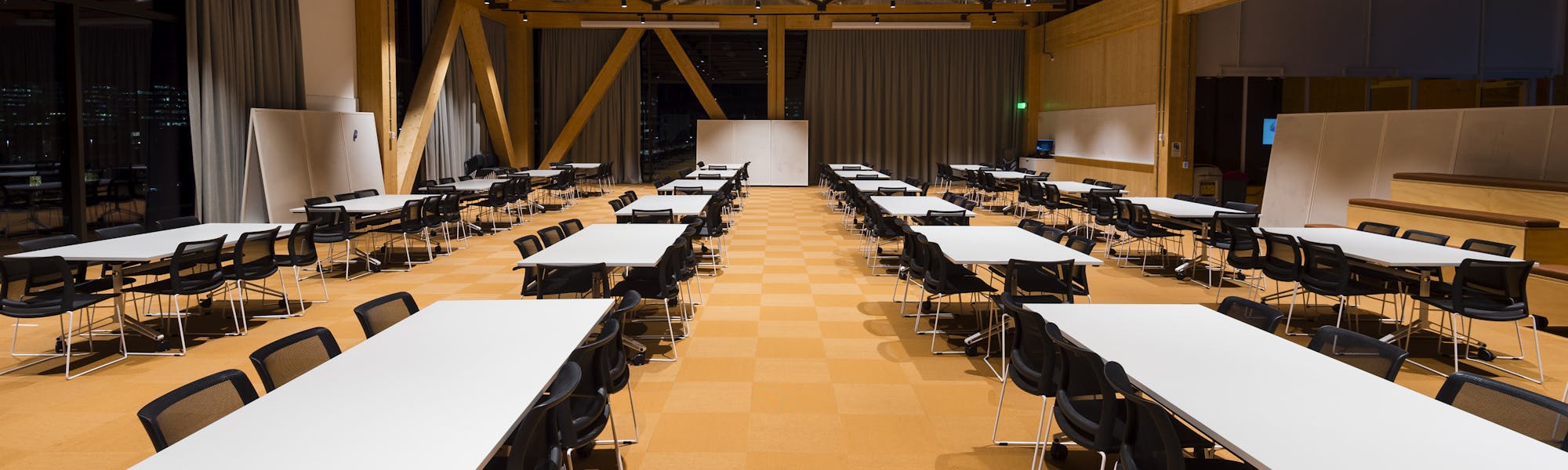
The Marie Reay building is suited to social distancing, as the floors are flat and the furniture is movable. The superfloor has been set out with tables which normally accommodate seven people (as shown in the stock image). Today each two rectangular tables have been pushed together to a make large square one, with one or two people on each side. This reduces the room's capacity in the already low density cabaret format by half.
A hand held microphone was used for audience input. This presented the problem of sterilizing the microphone between users. Microphone on a stands at fixed location would be an alternative (with an optional foot switch). A telepresence robot would be a more complex option.
This workshop is using the traditional format with a series of speakers with slides, each followed by questions from the audience. There is a slight modification, with the MC inviting remote participants to turn on their microphone to ask a question, or post it to the chat. The image of the speaker is not being transmitted, just slides. Switching from a presenter in the room to a remote one required some verbal negotiation, much like using a two-way radio. This slowed down proceedings a little, but is perhaps a good thing as it can at times be difficult for the audience to keep up with highly technical presenters.
As for the content of the workshop, one point of interest is that large renewable energy projects on indigenous land will, ironically, be unable to provide power to the local community. There will be mega watts of power being exported, but none can be provided from the large systems for the locals. The obvious solution is to require those putting in large projects to provide small independent local systems. The problem then is how are these systems maintained?
Wednesday, July 24, 2019
Coal transition: power sector, regional adjustment and policy
The chair just invoked the Chatham House rule, so I can tell you what the speakers say, but not who says it. I have been to industry events on regional defence strategy under the rule, so military and government personnel could speak freely, but this is unusual for an academic conference.
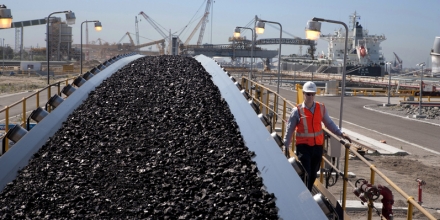
The first speaker talked about Germany's transition out of coal, with the last mine closed. However, Germany imports coal, including from Australia, as it has the EU's largest proportion of coal fired electricity generation. It is planned to phase it out by 2038. While the speaker said Germany had phased on coal, then then said that Lignite is still mined. The form of poor quality brown coal is mined in the former East Germany, where there is high unemployment. Some of the newer coal fired power stations in Germany have a lifetime out to beyond 2060, so closing them by 2038 will require government intervention (by regulation or a auction mechanism).
The speaker pointed out that Germany was the only European country aiming to phase out coal, without use of nuclear power. This creates a problem of how to provide continuity of supply when there is limited sun and wind. An extreme form of this is Nuclear Winter, mentioned by Professor Schmidt, Vice Chancellor of the Australian National University, last Thursday, when in introducing the energy entrepreneur Dr Lachlan Backhall. Professor Schmidt suggested that nuclear power might be needed during a nuclear winter. Dr Blackhall seemed taken aback at the suggestion, and quipped he was delighted Professor Schmidt thought humanity could survive a nuclear winter.
The next speaker this morning outlined the use of coal for power generation in Australia. They described any new coal power station in Australia as a "white elephant", with renewables quickly supplanting coal. With no new coal fired power investment the question is when the existing plants will be economically non-viable. Exiting plants are earning good returns for their owners, due to market power, however, many could be uneconomic by the end of the 2020s. The problem is the sudden closure of a few large plants will cause price spokes benefiting the few remaining plants, and requiring expensive government intervention. The speaker proposed an auction based mechanism for orderly exit from coal. They derided the idea that a three year notice by plant owners was sufficient, as it takes many more years to provide a replacement.
The third speaker focused on what would be needed for the transition from coal in Victoria. This included a complex map showing the main energy generation plants and inter-connectors. This was a very matter-of-fact presentation, planning the transition, within the limitations of only a three year notice from coal fired power station owners. They point out that just planning new faculties could take five years, before construction started. An additional problem is that old power stations become unreliable, long before they are closed, and this also needs to be planned for. What was proposed was forward planning in anticipation of closure. What I found interesting was that the discussion was limited to the planning of the transmission networks, with the provision of actual generating capacity left to the market. One issue they are addressing is the 14 days capacity needed to complement renewable energy. Their analysis was that if there is more than a 20% chance of a major Victorian power station closing early, it would be worth building an extra in-connection early. However, they were still not planning actual generating capacity.
The next speaker suggested that rooftop solar was being installed at such a rate, it would allow earlier closure of coal fired power stations. It is hard to imagine that householders installing a few panels on their roof can replace a huge power station, but Australia leads the world with home solar power. This is being complemented by construction of wind farms, many of which are being built as private company initiatives, so their full impact has not been apparent. This is a very positive picture, especially for governments, which would need to do little except see that a network was in place to carry the power. The last part of the puzzle was storage needed for when the wind is not blowing or sun shining.
The last speaker discussed coal jobs and the transition to renewable. They first pointed out that coal mining jobs are very different to work in power stations. Government policy had mostly addressed power station jobs, not coal mining, and the speaker questioned the viability of this. Job statistics conflict as to the trend of jobs in coal mining, but it is clear that coal mining is not a major employer. Coal miners are younger than power station workers ("They are aging with their plant"). About half of coal miners are low skill machinery operators, whereas power station workers are more highly skilled, making them more employable. The experience of other countries is that only about one third of redundant coal miners get secure jobs, with a third becoming casual, and one third retiring. The Australian experience from the Hazelwood closure, which had government funding, showed a similar pattern.
Statistics for renewable energy employment are less clear, but it appears half the jobs are in roof top solar installation. Employment per kwh of energy are lower than for coal. The low skill proportion of jobs is similar to coal mining (for installers, rather than machine operators). Large scale wind projects tend to be more distributed than coal mining, and not in the same locations. What the speaker did not discuss was that most of the jobs for renewable energy are installation. Once a solar panel or wind turbine is installed, not much maintenance is needed over the decades of life. Of course this also increasing applying to a coal mine, where after construction the mines are increasingly automated, and operated remote from the mine site.
Tuesday, June 11, 2019
Creating a Renewable Energy Export Industry for Australia
 |
There are researchers from many disciplines, working questions such as markets, geopolitical issues, development for Indigenous communities, value-added manufacturing in the Pilbara.
I am one of the "cloud" participants on the periphery of the project, interested in how ICT can help, and how online education of the research outputs can be created (I teach ICT Sustainability). One issue is how to freely work with academics, while protecting valuable intellectual property, especially from hacking attack.
There was a pitch session at the retreat, where ideas of what we could do were put up. I had not asked to speak at this but realized my work on online education was relevant. One of the issues with introduction of renewable energy is that many people have to learn new skills. This ranges from some one installing and maintaining solar panels, up to industry executives and government policy makers.
The traditional way to provide training and education is with classroom courses. However, that requires taking people away from their workplace for days or weeks. In the case of renewable energy for the Asia-pacific, the training center could be thousands of km from the trainee. Another issue is that the training is not perceived as of value to the individual or their organisation.
Instead of classroom courses, training can now be delivered in the workplace, online, via a mobile phone. This training can meet industry and national quality standards, and provide credit to further vocational, or university study. It happened I talked about this at EduTECH 2019 in Sydney last week, so pined my presentation up on the pitch board. This attracted some interest from colleagues.
What looked most relevant was the issue of training for remote indigenous communities in Australia and islands of the Pacific. While a multi-billion dollar energy project with thousands of workers on one site can schedule training, this is much more difficult with thousands of personnel scattered over about one quarter of the world.
In his PHD thesis, Philip Townsend (p. 26, 2017), pointed out there has been rapid adoption of mobile devices in remote Aboriginal and Torres Strait Islander communities. He looked at how to use these devices for the education of pre-service teachers.

Reference
Townsend, Philip, 2017 Travelling
together and sitting alongside: How might the use of mobile devices
enhance the professional learning of Aboriginal and Torres Strait
Islander pre-service teachers in remote communities?, Flinders
University, School of Education. URL
https://flex.flinders.edu.au/items/7a690838-1ce2-4a3e-bc1c-510289161e3c/1/?.vi=file&attachment.uuid=eaeb3a0a-8ce3-4dd8-bb3d-33c99a3fa5ef
Thursday, January 17, 2019
ANU Hiring Researchers to Transition the Asia-Pacific to a Zero-Carbon Economy
 |
| Dr Paul Burke, Professor Kylie Catchpole, and Dr Emma Aisbett of the Zero-Carbon Energy for the Asia-Pacific Project. |
"... Appointees will contribute to world-leading, high-impact research, underpinning Australia’s transition to becoming a renewable energy super-power. ... We are hiring researchers in:From Candidate Information Booklet - Research Fellows: Grand Challenge, 2019
- Economics and energy market economics;
- Law;
- Political science;
- International relations;
- Sustainability transitions;
- Chemical engineering;
- Computational chemistry; and,
- Energy systems modelling. ..."
Subscribe to:
Posts (Atom)