Showing posts with label sustainability. Show all posts

Friday, August 30, 2024

VitiVolatics: Vineyards with Photovoltaics

Greetings from the University of Adelaide where I am attending the Sustainability spotlight series (seminar 1) on VitiVolatics, with Professors Cassandra Collins, Armando Corsi and their students. Professor Collins defined VitiVolatics as being about optimising solar power generation and wine quality. In retrospect, the idea seems obvious, and deceptively simple: use solar panels to shade grape vines, providing power while improving growing conditions.

AgrVolatics (Agriculture under PhotoVoltaics) have considerable potential in Australia. As well as the practical aspects, this could be politically useful, by allowing large solar farms which do not stop agricultural production and provide additional income for farmers. This approach is applicable to berries, fruit and leafy vegetables, as well as smaller livestock, but not grains.

An amusing aside in the seminar was that most of the carbon footprint of winemaking comes from packaging, so drink casks wine! ;-) More seriously, the temperature in winemaking regions is increasing, which PV could address. 

It would be interesting to see if the same pre-wired folded panels to be used on the large scale project to export power to Singapore could be used for agriculture. It would also be interesting to see if AgrVolatics are viable in Northern Australia, at a large scale. Interestingly the students have designed an approach to attaching lightweight flexible solar panels to a framework using common off the shelf hardware (steel from local hardware store and electronics from the local hobbyist store). This allows manual installation, compared to the machinery required for heavier rigid panels and the steel mountings used by the solar industry. 

One issue is the aesthetics of large expanses of solar panels across traditional wine growing regions. This seems a little odd, as shade cloth and plastic sheets are already used on a large scale for protecting grapes. However, renewable energy can be triggering for some, so requires research.

Interestingly University of Adelaide is not just researching the engineering and viticulture of PV panels over grape vines, but how to market this to wine drinkers. The idea is to sell the resulting wine using a positive environmental message about carbon emissions. 

At question time I asked if green coloured solar panels would be more acceptable. This is possible using coloured film over conventional blue cells, without a large loss in efficiency. It would make the panels much less visible.

Monday, December 11, 2023

Sixteen Australian Universities in the top 100 for Sustainability Worldwide

Australian universities have done very well in the QS World University Rankings for Sustainability 2024. There are 16 Australian universities in the top 100, based on environmental, social and governance (ESG) challenges. This includes many large capital city universities, which I would have assumed would have more difficulty with sustainability, due to densely built inner city campuses. The regional universities have ranked lower. This may reflect the amount of specialist expertise needed to document sustainability, rather than level of sustainability itself. One way around that would be for students to undertake this as part of their coursework.

  1.  7 University of Sydney
  2.  9 University of Melbourne
  3. 11 University of New South Wales (UNSW Sydney)
  4. 23 Monash University
  5. 30 Australian National University (ANU)
  6. 36 University of Queensland
  7. 40 Griffith University
  8. 43 University of Technology Sydney
  9. 49 University of Adelaide
  10. 57 Macquarie University
  11. 62 RMIT University
  12. 62 University of Wollongong
  13. 66 Deakin University.
  14. 74 University of Newcastle, Australia (UON)
  15. 89 Curtin University
  16. 100 Queensland University of Technology (QUT)

Thursday, August 29, 2019

Global Urban Sustainability Science

Greetings from the Australian National University in Canberra, where Professor Felix Creutzig from Technical University Berlin is speaking on "Data-scientific approaches for a global urban sustainability science". This is very relevant to Australia, where, we have rapid unplanned growth of cities.

Professor Creutzig began by pointing out that cities are growing, and a large proportion of their carbon emissions are from building the cities. He then pointed out the New York City Green New Deal (OneNYC 2050). However, Professor Creutzig pointed out that most cities are too small to employ specialists to work on such strategies. Studies carried out by researchers, he argued,  tend to be on a large scale, without the fine scale specifics to be of practical use, while small local studies do not have the needed scale. We then got the pitch on how "typologies" with machine learning could be used to fill the gap.

Professor Creutzig started with some simple statistical analysis of cities characteristics. He the introduced a simple topology of cities, by characteristics features such as energy use, GDP, and population density. What I found odd was that the data analysis for this was carried out using published case studies, not actual data from the cities. It worried me this did not seem to e "big data" or machine learning, just a conventional meta-analysis. Also this has built in the biases of whoever collected the data, as to what they though important about cities. Researchers and statistical agencies collect data based on existing theories of cities.

What "big data" and machine learning now offers is the opportunity to use much more fine grained data. I thought Professor Creutzigwas going to go on to discuss this. But instead he talked about an analysis of papers on the use of machine learning applied to climate change mitigation. This might be of some use for someone who was considering setting out to apply AI to urban planning. However, it is not actually applying AI to urban sustainability.

Professor Creutzig has published extensively on the topic.

Thursday, January 17, 2019

ANU Hiring Researchers to Transition the Asia-Pacific to a Zero-Carbon Economy

Dr Paul Burke, Professor Kylie Catchpole,
and Dr Emma Aisbett of the
Zero-Carbon Energy for
the Asia-Pacific Project.
The Australian National University is recruiting researchers for  its Zero-Carbon Energy for the Asia-Pacific Project.
"... Appointees will contribute to world-leading, high-impact research, underpinning Australia’s transition to becoming a renewable energy super-power. ... We are hiring researchers in:
  • Economics and energy market economics;
  • Law;
  • Political science;
  • International relations;
  • Sustainability transitions;
  • Chemical engineering;
  • Computational chemistry; and,
  • Energy systems modelling. ..."
From Candidate Information Booklet - Research Fellows: Grand Challenge, 2019

Thursday, September 13, 2018

Bomb Proof Timber Buildings

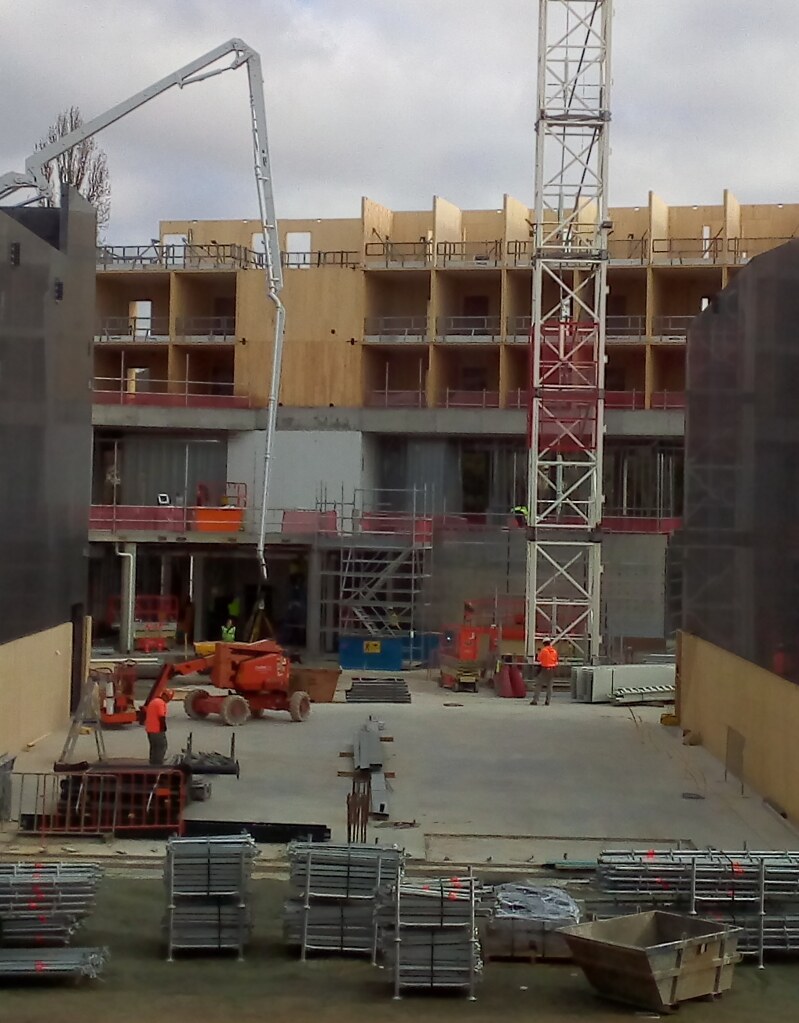
Greetings from the Mass Timber Building Seminar at the Australian National University. The new ANU teaching building is being constructed from timber, which is still unusual for large modern buildings. One aspect of this building technique which was pointed out by Andrew Smith from Lendlease DesignMake, is that it has been tested as bomb proof for the US Army.

What might have wider applicability is that Andrew suggested the use of a technique similar to that used by automobile manufacturers to produce a wide range of different cars from the same set of engineered components. With this a set of steel connectors and wooden panels would be used to quickly produce custom buildings. But perhaps from car making as an analogy, flat-pack furniture would be more applicable.

I asked Andrew if timber provided flexibility for a teaching building. He said that they settled on a 8 x 8 m module for the new ANU Flexible Teaching building would provide a good balance between flexibility and cost. The wood floor of the building is stiffened with wood ribs.

I was one of those who argued for eliminating conventional lecture theaters, but exactly what size or shape space might be best is still not yet clear. It is also likely this will change over time. Six years ago I looked at remodeling the ANU's Computer Science and Information Technology Building (CSIT) for flexible learning. However, this was difficult to do due to the placement of the columns in the building. These had been placed to suit the computer workstations in common use when it was built. The computers were long gone, being obsolete, but the concrete columns could not be moved.

Andrew Smith also emphasized "volumetrics". Buildings are mostly empty space and so it is not necessarily economic to build them in modules.  It is more efficient to assemble them from pre-cut panels and beams. The panels can then be "nested" for delivery: carefully laid out like a jigsaw puzzle to reduce wasted space. He pointed out that the panels must be smaller than the shipping containers they are transported in. However the panels are very strong and it occurred to me they might be stacked on a logistics platform.

Later speakers at the seminar will discuss how the Cross Laminated Timber (CLT) building panels are made (Sean Bull, XLAM) and how to prevent Mould & Fire (Andreas Luzzi, Laros Industries).

While the construction of large buildings from timber appears challenging,  Rohan George from Equatorial Launch Australia mentioned they were looking at it for their Arnhem Space Centre in the Northern Territory.


ps: I will be speaking on "Learning to use new  tech-infused teaching spaces" at EduBuild 2018 in Singapore, 9 October, 5:20pm.

Sunday, August 19, 2018

Quickly Constructing University Buildings from Timber

ANU Timber Student
Building Construction
A free half day seminar on how the Australian National University's newest student accommodation and teaching buildings are built in Canberra from timber, will be held 12:30 pm, 13 September 2018. This includes a guided walk to the building site.
"The Union Court Redevelopment project includes a 450 bed student accommodation and 7,000 m2 teaching building to be built using cross laminated timber (CLT) and glulam (GLT).
Mass Timber in the form of Cross Laminated Timber and Glulam has finally come to Canberra, with the recent redevelopment occurring within the campus of the Australian National University.
Lendlease DesignMake, the designer and fabricator of the engineered timber structures for this project will discuss the design and construction of this redevelopment. Other speakers will discuss mass timber use, CLT and fire rating of timber. The seminar will also include a guided walk to view the actual construction on the ANU site.
This half-day seminar is a must for all building and design professionals including architects, engineers, building designers, certifiers, developers, builders, regulators and educators. ...

Program

12.30pm Welcome
  • Welcome and WoodSolutions Update and Mass Timber - Andrew Dunn, TDA
  • Building’s use in Australia to date
12.45pm Union Court, ANU
  • Design and Construction of Union Court
  • Student Accommodation and Teachers Facility - Andrew Smith, DesignMake
  • Guide walk to building site - Andrew Smith, DesignMake
03.00pm Afternoon tea and coffee break
03.30pm Mass Timber Solutions
  • CLT Design and Fabrication insight - Sean Bull, XLAM
  • Mould & Fire = Destructive Forces & Solutions for Mass Timber - Andreas Luzzi, Laros Indust.
  • Calculating Timber Charring Rates and AS1720.4 Update - Andrew Dunn, TDA
05.00pm Finish"

From: "Mass Timber (CLT) Building Free WoodSolutions Seminar"

 ps: I will be speaking on "Learning to use new  tech-infused teaching spaces" at EduBuild 2018 in Singapore, 9 October, 5:20pm.

Sunday, May 20, 2018

Everything is Interrelated

Dr Birgit Penzenstadler, California State University
Dr Birgit Penzenstadler,
California State University
One of the rewards for having written published papers is that you get cited. Google Scholar sent me an alert to say I get a mention in a paper by Birgit Penzenstadler, and others (2018), with the intriguing title "Everything is interrelated". This describes an intensive week long  course on Software Engineering for Sustainability (SE4S) at Lappeenranta University of Technology (LUT), Finland.

This report is useful as along with the theory as to why and what was planned, the authors showed what was changed in the light of experience during the week. No plan survives contact with the students (apologies to General von Moltke).

The authors are a little dismissive when referring to my green computing course (Worthington, 2012), saying such modules can be  "... plugged into the existing computing course". But what I suggest they could have done is use such on-line modules before their intensive face-to-face sessions. This way the students can be introduced to the basic concepts without using up valuable classroom time.

In the past there has been a problem in getting students to actually complete preparatory material. But this can be solved by making the material assessable with small automated quizzes and peer assessed discussions.

References


Penzenstadler, B., Betz, S., Venters, C. C., Chitchyan, R., Porras, J., Seyff, N., ... & Becker, C. (2018). Everything is interrelated: Teaching Software Engineering for Sustainability. Proceedings of the 40th International Conference on Software Engineering. URL https://tspace.library.utoronto.ca/bitstream/1807/87821/1/Everything%20is%20interrelated_TSpace.pdf
Worthington, T. (2012, July). A Green computing professional education course online: Designing and delivering a course in ICT sustainability using Internet and eBooks. In Computer Science & Education (ICCSE), 2012 7th International Conference on (pp. 263-266). IEEE. URL https://doi.org/10.1109/ICCSE.2012.6295070

Tuesday, July 30, 2013

Green IT/IS Education and Training

Ellen England and Summer Bartczak produced the very useful paper "Where Can Green IT/IS Education and Training Be Found Today?" (Journal of Sustainability Education, 19 March 2012). They conducted a literature review and Internet search, looking for courses and training on sustainable computing.

England and Bartczak found that certification and training courses outnumbered college (university) courses.

Degree Programs in Sustainability

There were only two complete degree programs in green computing, both in the UK:
  1. University of Bradford Sustainable Computing MSc (in development), with core modules in Sustainable Computing Technology, Critical Contexts: Computing for the Environment, Developments for Sustainable Computing, Frameworks for Sustainable Computing, and a Research Dissertation and Project. Unfortunately this program does not appear to have proceeded past the planning stage.
  2. Leeds Metropolitan University MSc/PGDip/PGCert in Green Computing, was offered in 2012/2013. The MSc appears to have been renamed Sustainable Computing (in line with other such programs) and has core modules of Eco-Engineering, Green Computing Strategies, Green Computing Technologies, ICT & Environment, plus Project Management, Research Practice and a Dissertation.

Certificates

One program not listed by England and Bartczak  is the Box Hill Institute (BHI) Vocational Graduate Certificate in ICT. This includes  Units of Competency (what the vocations sector call "courses") in
Principles Of Sustainability (VBN762), 
Manage Improvements in ICT Sustainability (VPAU779), Use ICT To Improve Sustainability Outcomes (VPAU780). BHI is unusual as it is a vocational institution which offers postgraduate programs.I visited HI in 2009 to discuss the proposed green computing offerings and drop off a copy of my course notes. I was impressed with the institution.

University/College Courses/Modules

Many of the courses mentioned by England and Bartczak appear to be no longer offered, such as "Principles of Green IT for Sustainability" from UC Berkeley Extension. The materials for University of Massachusetts' Cmpsci 691GC: Green Computing Seminar do not appear to have been updated since 2009. But Arizona State University's CSE 591: Topics in Green Computing and Communication was being offered in Spring 2013 (with Week 1 Slides by Sandeep Gupta available). Linköping University offer TDDD50 Green Computing. , covering Global ICT footprint, life cycle, Power-aware computing, plus tools and metrics.

Boston University Metropolitan College are one of the few to list textbooks with their MET CS-504 Green Information Technology by David Shirley:
  1. Green IT: Reduce Your Information System’s EnvironmentalImpact While Adding to the Bottom Line, Toby J. Velete, Anthony T. Velete, and Robert Elsenpeter, McGraw-Hill, 2008
  2. The Greening of IT: How Companies Can Make a Difference for the Environment, John Lamb, IBM Press; 1 edition (May 7, 2009) 
Other recommended texts include:
  1. Green Project Management, Richard Maltzman and David Shirley, CRC Press, 2010 
  2. Foundation of Green IT: Consolidation, Virtualization, Efficiency, and ROI in the Data Center, Marty Poniatowski, Prentice Hall, 2009.

Boston University Metropolitan College's course also requires the student to purchase a Kill A Watt Electricity Usage Monitor and use the Blackboard Learning Management System (LMS).

Prof. Fred Chon provides extensive notes for his course CS 290N: Green Computing at University of California, Santa Barbara, but the materials were last updated in 2010 and it not clear the course is still running. The textbook is The Datacenter as a Computer: An Introduction to the Design of Warehouse-Scale Machines, Urs Hoelzle and Luiz Andre Barroso, published by Morgan and Claypool, 2009.

Saint Xavier University offers Green Computing and Technology (CMPSC 107)as part of a suite of "Environmental and Sustainability Studies Courses".

Swarthmore College offers Socially Responsible Computing  (CS91) by  Professor Douglas Turnbull, with extensive notes provided on-line.

England and Bartczak also mention my course at the Australian National University, COMP7310: ICT Sustainability (previously "Green Information Technology").

England and Bartczak don't mention the green ICT courses offered through Open Universities Australia (OUA), a consortium of Australian bricks-and-motar higher education instutions who pool their online courses. Install and configure virtual machines for sustainable ICT (ICANWK402A) from Polytechnic West is offered through OUA. Also available thorough OUA is "Green Technology Strategies" from ACS (the same course I also teach at ANU).

Non-academic Certificate Programs

England and Bartczaklist certificate programs not offered through an academic institution. The most prominent of these is the British Computer Society's BCS Certificate in Green IT. The certificate consists of a Syllabus, with Accredited Training Providers who each to the syllabus and an examination. There is also the textbook Green IT for Sustainable Business Practice: An ISEB Foundation Guide" by Mark O'Neill (British Informatics Society Ltd, 2010).

RapidStart Pte Ltd in Singapore offer Green IT Certification at three levels:
  1. Certified Green IT Associate (CGIA)
  2. Certified Green IT Specialist (CGIS)
  3. Certified Green IT Professional (CGIP)
While RapidStart describes itself as an accredited training provider, it is not clear if the green IT courses have any form of external accreditation.

The Green Computing Initiative (GCI), offers three self-study courses and corresponding examinations:
  1. Understanding and Utilizing Green Computing Technologies (UUGCT) for the Certified Green Computing User Specialist examination (CGCUS03),
  2. Strategizing, Designing and Optimizing Green Computing Technologies (SDOGCT) for the Certified Green Computing Architect  examination (CGCA01),
  3. Implementing, Managing and Optimizing Green Computing Technologies (IMOGCT)  for the Certified Green Computing Professional examination (CGCP02).
Many of the certificates listed by
England and Bartczaklistappear to have been discontinued.

ACS/ANU/OUA/AU Green ICT Course


England and Bartczaklist list the Australian Computer Society's Green Technology Strategies module for the ACS Computer Professional Education Program, which I designed and teach. This module is also offered through OUA as "Green Technology Strategies" and uses the same course content as the Australian National University, masters course COMP7310: ICT Sustainability. (the ACS and ANU versions of the course have slightly different assessment). My book of course notes used for all three courses is available free on the web:
"ICT Sustainability: Assessment and Strategies for a Low Carbon Future" (2011). As well as Kindle, iPad, ePub, PDF eBook and Paperback Editions.

A North American version of the course was developed by ne of my former students, Brian Stewart, at Athabasca University (Canada) as Green ICT Strategies (COMP 635).

More on the rationale behind the development of the course, which has been running since February 2009, is available in the conference paper and notes for "A Green Computing Professional Education Course Online" (ICCSE 2012).

This course predated the BCS green certificate and so may be the first such course, as well as the oldest still running and only one offered by four institutions internationally.