Showing posts with label international students. Show all posts

Tuesday, August 9, 2022

Prepare for Regional Conflict to Keep Students Offshore

Dirk Mulder reports that 19% of international students enrolled in Australian universities are offshore (Dirk Mulder on where international students are (and aren't, Campus Morning Mail, 9 August 2022). This may be an underestimate, as it is based on government figures for the number  of students with visas (students studying purely online don't need a visa). The figure is higher for Chinese students (38%), and lower for Indian (10%). The students in China may be unable to travel due to COVID-19 restrictions. However, it may be that some of these students do not see value in travelling to Australia, and would prefer to study offshore. That option has only been available from a few universities and programs, with most requiring on campus participation. Also students may be taking advantage of Australian university not indicating on transcripts that students studied online. In investigating the possibility of Chinese and Indian students studying at Australian universities online before the pandemic, I noticed that particularly in the case of China online study had a poor reputation. 

Also, in 2016 I warned that international tensions may stop students studying on campus in Australia. The type of tension I had in mind is currently taking place around Taiwan. As I wrote in 2016, Australian universities should be prepared if tension deters, or prevents, students travelling to Australia. This could effect not only Chinese students, but also Indian students, and nationals of other countries in the region. The best way to prepare is to offer quality online learning with a campus option.

Wednesday, May 25, 2022

Learning from Wuhan on Helping International Students

While western universities have focused on the problems of their own students during the COVID-19 pandemic, it should be remembered that China also has international students. There are some interesting papers emerging from the experience of students, some at the epicenter of the Pandemic.  English, Yang,  Marshall, and Nam (2022) have written about the experience of international about 1,500 students facing Wuhan's 76 day lock-down (out of 8,000 pre-Pandemic). The authors note that the stress from the pandemic is in addition to the stress international student face from studying abroad.

Wuhan was locked down earlier than other locations, when little was know of the virus, which will have increased the stress level for students. Also, as the authors note, those in Wuhan faced the stigmatization and discrimination as being perceived as the source of the disease. However, it should be noted that Melbourne (Australia) experienced six lock-downs, of 262 days in total, more than the rest of the world. It would be interesting to compare the experience of Melbourne's very large international student population to that of other countries. Australian international students were stigmatized by the then Australian Prime Minister, who with a breathtaking lack of compassion, said of the students: "it's time to go home".

The authors report the stress and anxiety students felt, fear, worry, uncertainty, which were made worst by misinformation. Students were homesick and felt  abandoned by those able to leave. However, they were able to continue their education online. In my own studies of the potential for online education in China, I noted that it was not widely accepted (Worthington, 2014). Despite this, as the authors note, Chinese universities were able to switch to online learning, at scale. Another positive point was that international students were helped by the local community, reducing the sense of isolation.

The authors suggest universities could apply the prosocial behavior exhibited at Wuhan in dealing with mental health issues of students generally. In particular, peer support, and practical help for students, with food, and transport. Also social support from outside the international student body will reduce a sense of isolation. 

Wang (2022) makes similar points. However, they also point to the direct role of university medical personnel, and students, in treating patients. This included online support for the psychological effects of the pandemic. The author emphases the sense of "belonging" of China's students, which aided response to the pandemic. This may sound a little odd, to western ears, but Australian universities are similarly attempting to cultivate a sense of care for students. The use of social media, specifically WeChat, is mentioned, but unfortunately not detailed. Australian universities now routinely use social media to get messages out to students, but these can tend to be more in the form of announcements, which do not have the power to engage. 

References

English, A., Yang, Y., Marshall, R. C., & Nam, B. H. (2022). Social Support for International Students Who Faced Emotional Challenges Midst Wuhan's 76-day lockdown during Early Stage of the COVID-19 Pandemic. International Journal of Intercultural Relations. https://doi.org/10.1016/j.ijintrel.2022.01.003/

Wang, L. (2022). Belonging, being, and becoming: Tertiary students in China in the battle against COVID-19 pandemic. In J. S. McKeown, K. Bista, & R. Y. Chan (Eds.), Global higher education during COVID-19: Policy, society, and technology (pp. 39-56). STAR Scholars. https://ojed.org/index.php/gsm/issue/view/152

Worthington, T. (2014, August). Chinese and Australian students learning to work together online proposal to expand the New Colombo Plan to the online environment. In 2014 9th International Conference on Computer Science & Education (pp. 164-168). IEEE. https://doi.org/10.1109/ICCSE.2014.6926448

Monday, May 16, 2022

Canberra Toolkit for International Student Promotions

The ACT Government provides a free online toolkit of materials for promoting Canberra. This includes for promoting international students to come to Canberra to study. As someone who writes a blog about education (highereducationwhisperer.com), I signed up for the toolkit. First thing I did was search for resources on "innovation". What came up were photos of Petr Adamek and Rachael Greaves from Canberra Innovation Network, and a couple of photos of the Mugga Lane Solar Farm. Those are relevant, but more pictures of students would be good, perhaps from CBRIN events.

But having found some images I am not sure what to do with them. I ticked a box below each image. I clicked on the basket item. But what happens next. Do I have to go to a checkout? Do I have to pay for them? I clicked anot basked icon further down the page and was at what looked like a checkout. This required me to describe what the photos were for and who the client was. The system, I assume, is designed for professional marketing companies.

This all seems a little old fashioned. In the modern era, you do a web search for materials, if the licence suits, you use them. You don't waste time explaining to some gatekeeper why you want to use them, or have to order and download them. You don't want to wait while your order is processed (why do stock photos have to be processed?)

It is useful to have attractive images, videos and test to show Canberra as an attractive place to come and study. However, university will need more than this to attract students, as they mostly study online now. In some ways this makes the city around the university more important, as the student will be spending very little time on campus (at least not in the classrooms). Also what will be important are employment opportunities in the region, during and after study.


Monday, July 12, 2021

Submitting Assignments on Paper No Protection for Students

Senator James Paterson
The Parliamentary Joint Committee on Intelligence and Security, has been conducting an Inquiry into national security risks affecting the Australian higher education and research sector. Committee Chair, Senator James Paterson is reported to have suggested allowing international students to submit assignments on paper. This is to prevent security agencies in their home countries reading their essays. However, a student doesn't just write an assignment off the top of their head, they conduct literature searches, talk to their tutor, and fellow students. These days much of that is done online. Even if the final document is printed on paper, it would leave a long electronic trail, which would indicate what the completed work was about.

Also it is not just international students who have to worry about intelligence agencies. Students who may go on to important jobs in government and industry (or already have them) can expect to be under routine online surveillance by agencies of Australia's potential foes, and friends.

Australian academics need to keep in mind that what they ask their students to study could place them at risk. Universities can seek to secure their electronic systems, but that is not foolproof. Also It will not protect students from old fashioned HUMINT: the collection of information by people.

ps: But perhaps I am a little paranoid, because I used to work for the Defence Department. ;-)

Reference

Protecting international students: get essays on paper, Campus Morning Mail, July 12, 2021

Tuesday, April 28, 2020

Australian Over-investment in International Higher Education

Hurley and Van Dyke (2020) have produced a very timely report on Australia's investment in higher education. This comes as universities are looking at strategies to recover from the loss of international student revenue due to COVID-19. The authors estimate a loss of at least $10B in international student revenue between 2020 and 2023. They also warn COVID-19 could reduce domestic student demand, and suggest a change of "policy settings to increase capacity across the tertiary sector". However, given a reduction in demand, I suggest the prudent course of action would be to make better use of the existing capital investment, not increase it. Universities, and the governments which fund them, need to consider how to provide new forms of education, for both domestic and international students. As an example, through the use of blended learning, the capacity of existing Australian university campuses could be increased five-fold.

Hurley and Van Dyke draw parallels between universities and Australia's automotive manufacturing sector. They point out Australian universities are a much larger industry than car making was at its peak. However, the authors do not go on to draw the other obvious parallel: Australian governments kept subsidizing the Australian automotive industry in a way which made them less internationally competitive. I suggest the same mistake should not be made with universities.

To remain competitive, our universities need to change the educational products offered and the way they are delivered. The two to four year full-time, on-campus degree, offered by Australian universities, is equivalent to the Holden Commodore: large, expensive, and inflexible. Our universities need to offer blended online/on-campus, offshore/onshore learning, with nested qualifications, and workplace learning. This would be the equivalent of the flexible platform vehicles now produced by international auto makers, which allow combustion, hybrid or electric options, in sedan, SUV, and other styles, built in response to consumer demand.

Such predictions may sound alarmist and suggestions for change far fetched. However, in 2017, I warned Australian universities that international students could be suddenly unable to get to Australian campuses, due to an international crisis. I suggested university should be ready with an online teaching contingency, should this happen, and be ready by 2020. The COVID-19 crisis hit in 2020, but unfortunately few universities were ready with an online contingency.

Reference


Hurley, P., Van Dyke, N., (2020). Australian investment in education: higher education. Mitchell Institute, Melbourne. URL http://www.mitchellinstitute.org.au/wp-content/uploads/2020/04/Australian-Investment-in-Education-Higher-Education.pdf

Friday, June 7, 2019

EduTECH Sydney on Now

Tom Worthington presenting on microcredentials at EduTECH 2019 Australia. Photo by CAPA President
Photo by CAPA President
Greetings from EduTECH in Sydney. Yesterday I talked on Mobile Learning with Micro-Credentials for International Students, and today chaired three round-table discussions on the topic.
It was exciting to be presenting on the main expo stage, in the middle of the exhibition.  This has the noise and distraction of people walking past, but is much more lively that a conventional presentation room.At one stage I had not had any questions, so did what I do in workshops with students: sprang down from the stage and up to one of the audience who looked like the wanted to ask a question, which they then did, into my microphone.

The Council of Australian Postgraduate Associations (CAPA) President took a couple of photos and tweeted about my having graduate students respond to a real job ad, and suggesting applying vocational "TAFE-like" approaches for university micro-credentials.

The round-table discussions were also lively, with about seven people who are actively involved and engaged, around the table for half an hour. The round tables attracted about one third people from schools, a third from universities and the remainder from government agencies, vocational education, professional bodies and consultancies.  This made for a lively discussion. I was surprised at the interest in micro-credentials for schools, having assumed it is a higher education issue. Teachers wanted to provide students with more vocationally relevant qualifications, but which were not labeled "VET". Universities, accreditation agencies and professional bodies were all struggling with what micro-credentials are, and how they fit with traditional degrees. The VET people said "we already do this stuff".

Compared to the expo and round-tables, unfortunately the conventional presentations at EduTECH, especially those from senior people, were a bit dull. These were made even less exciting by the lack of question time. The important person would come in, give a canned talk, and leave.

I suggest that the EduTECH organizers, and others running similar industry events, should encourage questions. A tradition which the ACS Canberra Branch has with its annual conference is to take questions from delegates, even for keynotes. It can be a shock for a senior government minister, or industry leader, to be asked a detailed question by a relatively junior professional, but they rise to the challenge and find it refreshing. This takes the presentation to a new level, like good teaching, from one way communication, to interaction.

A format which worked very well at EduTECH Asia 2018, was an online, mobile-enabled system, where the audience could propose questions, and then vote on which should be asked. It was useful in overcoming the embarrassment of asking someone "important" a question.

Sunday, May 5, 2019

My Picks for EduTECH Sydney

EduTECH is on in Sydney, 6 to 7 June. Here are my selections from the program. I will be speaking 4pm the first day, and chairing a round-table the next day, so I have to go to those. ;-)

ps: Use the code: TomWorthington20 for 20% off registration fee.


Building a Smarter Learning Ecosystem

Workplace Learning/AITD Conference Jd Dillon L&D doesn’t own workplace learning. WHAT?!?! Every organization is a complex ecosystem with a multitude of elements. Unfortunately, many L&D teams fail to take a holistic approach. Instead, they focus on their sphere of influence, which often revolves around formal training. ... Jd Dillon, Founder, LearnGeek Jun 6 09:25

New Era, Same Spirit

Workplace Learning/AITD Conference Roslyn ColagrossiHow did Qantas prepare their cabin crew for an aircraft yet to be built? Three simulations and a great project team later, the dream of the 787 Dreamliner came to life. ... Roslyn Colagrossi, Manager Service Development, Qantas Jun 6 11:30

3x30 minute Learning Lab – Google for Education

Breakouts - Seminars Jun 6 11:30

Planning for the future – trends and key issues

Build/Design
    Gary White
  • Global drives influencing the future of our urban areas and cities
  • A strategic planning approach to managing change and growth across NSW
  • The implications for the provision of educational facilities and services in the context of significant change.
Gary White, Chief Planner, Department of Planning
Jun 6 13:00

Masterplanning - more than just architecture

Build/Design Matthew GreenePaynter Dixon will share their considerable experience in the process of masterplanning schools to explain thatit's more than just architecture. Using real examples this presentation will explore the importance of getting your staff on board, linking your master plan to your pedagogical approach ... Matthew Greene, Head Of Education, Paynter Dixon Constructions Pty Limited Jun 6 13:20
Natasha Abraham

The changing face of postgraduate education

Higher Education
  • Postgraduate study is becoming increasingly common, with over 400,000 postgraduate students now at Australian universities.
  • 30 years ago, postgrad coursework students were usually older, established in their careers, and more financially secure. Now, many are doing postgrad study straight after finishing their first degree.
  • With this many students, how is the value and experience of postgraduate study changing over time?
Natasha Abraham, National President, Council of Australian Postgraduate Associations
Jun 6 13:30

Overcoming the training transfer problem with the 70:20:10 framework

Workplace Learning/AITD Conference
    Charles Jennings
  • Training has only a limited role in creating high performance in organisations
  • The training transfer problem has been created because we haven’t been using optimal approaches for solving performance problems
  • Frameworks such as the 70:20:10 model can help rectify this issue by bringing learning and working closer together.
Charles Jennings, Leading Thinker On Workplace Learning And Author, 70 20 10 Institute Jun 6 14:00

A Chatbot Case Study - Creating Impact with Learning Transfer

Workplace Learning/AITD Conference Marie DanielsCreating behavioural change is key to any learning initiative. It's proven that following up learning with a coaching-based methodology will deliver far superior results than training alone. Could chatbot technology be utilised to solve the age-old problem of transfer?

The presenters will share all from a case study that used an AI chatbot to drive behavioural change. ... Marie Daniels, ANZ Pharmaceuticals Commercial Learning Lead, Bayer Jun 6 14:20
Sascha Ogilvy

Team teaching

Expo Mainstage (Free)
  • What is team teaching and why it’s so important in schools
  • The purpose of team teaching
  • Case study of the team teaching program at Fairfield High School
Sascha Ogilvy, Head Teacher Eal/D, Fairfield High School Jun 6 14:40

The Art and Science of Teaching at Scale

Schools
    Manisha Gazula
  • The Marsden Way - focusing on explicit and direct instruction
  • The art and the science of teaching
Manisha Gazula, Principal, Marsden Road Public School Jun 6 15:20


Using mobile technology to achieve Professional and Vocational Currency within the VET sector

Vanessa MarshHigher Education
  • How Chisholm developed a process for educators to maintain educator currency while assisting the Institute to achieve its teaching and learning goals...
Vanessa Marsh, Team Leader, Operations, Chisholm Institute of Tafe Jun 6 15:20

Train to Fight and Win at Sea

Workplace Learning/AITD Conference Justin JonesNavy training and education is a key enabler in the achievement of navy’s mission ‘to fight and win at sea’. Navy training is expansive. It is conducted at multiple disparate locations across Australia and overseas, with an annual trainee throughput of approximately 80,000. ... Justin Jones, Commodore Training, Royal Australian Navy - Training Force Jun 6 16:00

Mobile Learning with Micro-Credentials for International Students

Expo Mainstage (Free)
    Tom Worthington
  • Design courses to be mobile ready, while campus compatible
  • Micro-credentials delivered off-shore
  • Blockchain for degree credit onshore
Tom Worthington, Honorary Senior Lecturer, The Australian National University Jun 6 16:20
Jun 709:00 Conference pass

Cool Schools: smart, sustainable strategies to beat the heat

Build/Design
    Sebastian Pfautsch
  • The importance of thermal comfort for student health, wellbeing and learning
  • Strategies for managing heat in existing and new schools
  • Research gaps in relation to thermal comfort for children in schools
Sebastian Pfautsch, Senior Research Fellow, University of Western Sydney Jun 7 09:40

Roundtable 12) Is it time for Micro-Credentials and Mobile Learning for International Students?

Breakouts - Roundtables Tom WorthingtonJoin Tom worthington at this roundtable to discuss the importance of connecting with international students through effective and classroom compatable courses. Host: Tom Worthington, Honorary Senior Lecturer, The Australian National University Jun 7 11:00

90 minute Workshop – Lego Education

Breakouts - Seminars Prof. Chris RogersPlaces at this workshop are limited and will sell out fast. Join now to get familiar with LEGO bricks, software, teaching guide and lesson plans

Accelerate STEAM learning with LEGO Education hands-on solutions Learn how to engage your students with playful learning tools around STEAM!LEGO® Education offers hands-on experiences that stimulate communication, creativity, collaboration, and critical thinking skills — so that students can succeed in their STEAM classes today and realize their full potential as digital citizens and leaders tomorrow.

Who should attend? School teachers and principals – Years 5-8 Prof. Chris Rogers, Professor And Chair, Department Of Mechanical Engineering, tufts university Jun 7 11:30

Wednesday, May 1, 2019

Mobile Learning with Micro-Credentials for International Students


I will be speaking on "Mobile Learning with Micro-Credentials for International Students", at EduTECH in Sydney, 4pm 6 June 2019. The next day I am chairing a round-table on the same topic. My talk is on the Expo Main Stage and is free, whereas the roundtable discussions are for delegates only  (use the code: TomWorthington20 for 20% off the registration fee.)
Just finalizing my presentation: suggestions welcome. Last year I attended EduTech Sydney, and Singapore, which were good. 
"Mobile Learning with Micro-Credentials for International Students
4pm, 6 June 2019
  • Design courses to be mobile ready, while campus compatible
  • Micro-credentials delivered off-shore
  • Blockchain for degree credit onshore

Roundtable: Is it time for Micro-Credentials and Mobile Learning for International Students?

3 discussions, from 11 am, 7 June 2019 Join Tom Worthington at this roundtable to discuss the importance of connecting with international students through effective and classroom compatible courses." 
From: "Speakers", EduTECH 2019.


Some notes for the presentation:


1. Mobile ready, campus compatible


ANU Marie Reay Teaching Centre

First design your course for online delivery. Use course software, with a responsive web interface, such as Moodle. This will then work on a mobile device, a conventional computer, oreven on paper.

Add campus based activities for students, where appropriate. Keep the campus activities flexible.
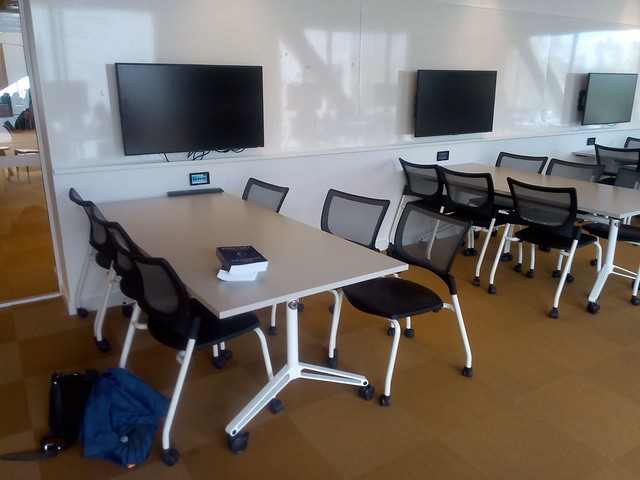
This is flipped, blended learning. It helps to have a purpose designed building, like the  ANU Marie Reay Teaching Centre opened March 2019, by Architects BVN. The Centre has only flat floor classrooms, for 30, 60, or 120 students. The flexibility here is provided by retractable walls, furniture on wheels, and electronic screens on multiple walls.

Learning to Reflect

Flipped module for teaching international masters students to write a job application:


Wall mounted LCD screens and desks on wheels at ANU Marie Reay Teaching Centre
Wall mounted LCD screens
& desks on wheels at
ANU Marie Reay Teaching Centre

  1. Online notes
  2. Videos
  3. Quizzes
  4. Peer assessed online forums
  5. Peer assessed assignments
  6. Classroom discussion in flat floor room


The module is designed to help students to develop capabilities expected of working professionals to identify their development needs, how they will acquire these and to reflect on what they have learned.

An overview of the development of the module, and an open access version of the notes are available.


2. Micro-credentials delivered off-shore

NZQA micro-credentials: 1 to 8 weeks study
AQF Review: considering micro-credentials
Attractive for international and STEM students.
3 x 1 week study modules = 1 semester course?


M-learning can be over shorter periods and targeted at specific skills. The New Zealand government is recognizing micro-credentials from tertiary education organizations as of 22 August 2018. The NZ credentials can be the equivalent of 1 to 8 weeks study. The shortest qualification typically issued by Australian universities is a 12 week graduate certificate.

An AQF Review: considering micro-credentials. This could allow much shorter, and more flexible, credentials. These would particularly appeal to international students, and those in STEM areas.

Even in advance of any official recognition of micro-credentials, institutions can create smaller units of instruction, for example, dividing a semester course which is notionally three weeks full time study into three one week units. Students could undertake the three units separately, or as part of a qualification.

3. Blockchain for degree credit onshore

Lifelong learning and micro-credentials will result in worker having several hundred qualifications. This would be unmanageable with paper certificates and even with web based e-certificates, such as those issued by "My eQuals" in Australia (the image shows my Graduate Certificate in Higher Education, issued by ANU). Employers will want to be able to automatically check qualifications against job requirements, to ensure they are genuine (the other image shows one of the many web advertisements for fake qualifications). One technology which may be used is block-chain. There is an ACS Blockchain technical committee looking at this, as one use for the technology.


Why worry about this?


China's Belt & Road Education Plan


  1. Two-Way Student Exchange
  2. Co-Operation in Running Educational Institutions
  3. Teacher Training
  4. Joint Education and Training
China Ministry of Education. Education Action Plan for the Belt and Road Initiative, 2016. URL https://eng.yidaiyilu.gov.cn/zchj/qwfb/30277.htm


China's Belt and Road Education Plan envisages students from the Indo-Pacific region studying at campuses in China, and also on regional joint venture campuses. Australian institutions will have difficulty competing for international students with these campuses. However, the plan appears to cover only on-campus face-to-face education. This provides the opportunity for Australian institutions to offer online learning using mobile devices, supplemented with on-campus education. This could complement, rather than seek to directly compete with, China's Initiative.

See also: Australian Department of Education. China's Belt and Road Initiative – Education, 2017.


More Information

Monday, June 11, 2018

International Students Appreciate Active Learning

Marrone,  Taylor and Hammerle (2018) found that active learning techniques work for large lectures, particularly for international students. This is a significant finding, as it has been assumed by some that international students just want to passively be told what to learn. The authors also suggest better results could be obtained with small group activities, where international students feel more comfortable. The research was conducted with 413 accounting students at an Australian university.

Reference


Marrone, M., Taylor, M., & Hammerle, M. (2018). Do International Students Appreciate Active Learning in Lectures?. Australasian Journal of Information Systems, 22. doi:http://dx.doi.org/10.3127/ajis.v22i0.1334

Monday, February 26, 2018

Internationalism and Australian Higher Education

Landscape Architecture Australia has devoted its February 2018 edition to :"Embracing the Asian Century". Other disciplines may want to follow this example and look at the education of international students in Australia and how Australian practitioners do overseas. While focused on education of landscape architects, some of the articles are about universities and students in general.

In "The Changing Demographics of Australian University" (p. 22-23), Tom Harper and Brock Hogan, provide a chart of the number of domestic and international student enrollments, from the 1950s to today, with the federal governments color coded by party. This shows a gentle steady increase for the Menzies to Gordon Coalition era, then a small jump for Whitlam Labor, smoothing off during Fraser. Curiously, the most significant jump in enrollments appears to be one third through the Howard government in 2000. In contrast the Rudd/Gillard Labor deregulation is a small bump. International enrollments appear to show the same pattern. Below this on the same time scale the major landscape programs at Australian universities are shown. This is color coded as to type of degree (Bachelor or Master and the various later models: Melbourne, Bologna and 3+2). It would be interesting to see a similar chart for other disciplines.

In "Reflections on an Australian Education" Jill Walliss and Heike Rahmann provide insightful, mostly positive, quotes from international students about the Australian education experience. This is accompanied by more excellent charts by Tom Harper and Brock Hogan. One chart tracks nine international students and where in the world they study between 1990 and 2017. The point here is that students may spend multiple periods in different countries.

I was curious that there was not mention of Canada in the articles I read, as it rivals Australia for international students. There was a brief mention that in 2014 86,000 of the 580,000 international students (15%) were at offshore campuses. However, there was no discussion as to the quality of this experience versus onshore. Also there was nothing on if this was likely to increase, or if this will result in increased completion, as local partners learn to set up their own campuses. Also there is no mention what role on-line learning may have in the future. I was an international graduate student and expect this will be the normal form of graduate education in the next decade.

Monday, September 25, 2017

International Students Not a Problem for Australian Universities But Numbers Will Drop

Bates Gill and Linda Jakobson from the China Matters think tank ask "Is there a problem with Chinese International Students?". They apparently think there is a problem, but I am not so sure. Australian universities are overly dependent on fees from international students, but that market will shrink to about one-tenth the current size over the next five to ten years, with competition from domestic Chinese universities and e-learning. The problem of other nations seeking to monitor and control the actions of their students in Australia is something our universities and government learned to deal with decades ago, as part of the Colombo Plan.

Gill and Jakobson point out that students from the People's Republic of China (PRC) make up about 27.5% of international enrollments in Australian higher education and more than 60% in Canberra's institutions. There are concerns that these students do not have adequate English, resulting in poorer educational outcomes and they may have less contact with Australians. Also, there is the concern the PRC government seeks to "influence academic discourse" and discourage its students from "speaking critically about the PRC".

The large numbers of international students, I suggest, is a temporary phenomenon, which will correct itself over the next five to ten years. China and India will continue to build up their own higher education institutions, so they can supply domestic demand and offer low-cost education to developing nations. Australian institutions will still have a demand for high-quality specialist programs, but the bulk demand for business and computing courses will cease. A reasonable expectation would be for international student numbers in Australia to be one-tenth the current level within ten years. That will present a problem for those undertaking the bulk of the teaching on short term and casual contracts, but not for the universities themselves. Some universities will have a problem having over-invested in accommodation for international students, but this can be re-purposed as affordable housing.

Australian campus based courses will also face competition from their own and others e-learning programs. Australian Universities are in the last phase of moving from lecture-based to blended education. Students no longer sit and listen to a professor speaking in a lecture hall, but instead watch a video and then attend a face-to-face interactive class, working with other students. As the demand for vocationally relevant education continues, there will be less need for the face-to-face part of the blended course to be on campus, or in Australia. This will present a problem for educators used to delivering face-to-face education. However, there is time to train the next generation of academics in e-learning techniques.

While the number of international students on Australian campuses will drop by 90%, the number of International students enrolled and the revenue from then will not necessarily diminish. Provided they can maintain high standards, Australian institutions will be able to continue to charge a premium for on-campus and on-line international programs.

International students previously saw study in Australia as a way into a western workplace. However, with the rise in the Chinese and Indian economies, it will be more attractive to serve an apprenticeship in those environments. Even if formally enrolled in an Australian university it will not be so desirable, nor necessary, for the student to visit Australia. As an example of this, I spent three years as a student at Athabasca University in Canada, without ever visiting the campus in Canada. Studies were on-line with practical assignments based on my local workplace.

The issue of international students relating to the Australian community and of monitoring by their governments is one which was faced by universities with the Colombo Plan from the 1950s. Daniel Oakman discusses these issues in his book "Facing Asia:A History of the Colombo Plan", particularly Chapter 6 "Face to Face with Asia". The Australian Government and the universities managed to deal with these issues decades ago, using approaches similar to those now suggested by Gill and Jakobson. These issues were normally dealt with quietly, without publicity, but are documented in the academic literature and it is surprising this was not referenced by Gill and Jakobson.

Gill and Jakobson recommend specifying a "minimum scope of engagement between Australian and international students in after-class activities and the local community". However, my experience of being an International student suggests that something more focused will be needed. As a student, I tended to only engage with other students when I was required to do so as a part of the course assessment and then only with students who were most like me. The ability to engage with other cultures, I suggest, should be made an explicit part of the student's training, with specified skills and assessment.

As well as for international students, skills in working with those from other cultures could be useful for domestic Australian students, who increasingly will be working internationally. This could be useful in changing the domestic student's (and some staff) perception of international students from an encumbrance to a valuable source of learning.

Monday, January 4, 2016

Repayment of Student Loans by Australians Overseas

From 1 January 2016, Australians with student loans  are required to make repayments while living overseas. The Australian Taxation Office will collect the payments. Previously students did not need to make repayments unless they lived in Australia. This is expected to recover a modest $150M over ten years.