Showing posts sorted by date for query nested. Sort by relevance Show all posts

Wednesday, May 6, 2026

Ideating Australian Higher Education

Professor Quigley at ANU.
Photo by Tom Worthington CCBY, 6 May 2026 
Greetings from the Australian National University where Professor Aaron Quigley as the new Dean of the ANU College of Systems and Society, welcomed entrepreneurs. ANU is hosting Canberra Innovation Network's First Wednesday pitch night. Before the one minute pitches, Professor Quigley invited everyone to comment on the university's draft strategy

Here are the comments I have submitted: 

Comments on ANU Draft Strategy

As requested, here are some comments on the "Draft Strategy v1.0, University Strategy", 21 April 2026:  

Answering the questions asked in the document:

* How can we best capture and articulate the distinctive, and complex, contribution that ANU makes to the nation?

I suggest starting from the functions of the ANU, as set by Parliament in legislation. In particular "... in relation to subjects of national importance to Australia ... its national and international roles and to the needs of the Australian Capital Territory and the surrounding region ...".

* How do we attract and support the talent that we need – in students and staff – to maximize the impact that we have through our research and education?

ANU can continue to use the marketing approach of promoting itself as a research intensive university with a national mandate. This sets ANU apart from other Australian universities and most around the world.

However, whatever the marketing says, being good at research doesn't make you good at education (the opposite in fact), so the university needs to ensure it has staff who are trained and formally qualified to teach. We could expand ANU's science communication area to provide training and qualifications in education, so staff and students don't have to obtain this elsewhere. To maximize impact we should expand collaboration with the Canberra Innovation Network, encouraging researchers to train in innovation and offering this as a formal part of degree programs.

* What do we need – in the ways we work, where we focus, or what we do – to be resilient to change from external forces like AI, demographic shifts and climate change?

The ANU should implement nested qualifications, work integrated learning and blended/online options. This will require staff to be trained in new ways of teaching and assessment.

AI is easily addressed, as has been discussed at numerous ANU symposiums. Staff need to be trained in how to use AI and how to teach this to students. Assessment needs to be changed from examination, to project based, with students presenting evidence of consistent long term work, then being questioned on what they have achieved.

Climate change can be addressed in part by ANU offering courses to combat it, such as ICT Sustainability, COMP7310 (Worthington, 2012). One of the techniques outlined in that course can be applied at ANU to reduce its carbon footprint: intensive use of facilities. ANU can increase the use of classrooms and other facilities, by doubling the number of students. This will reduce the carbon emissions, per student.

* What should we fix for our University to work better?

Opening University House should be a priority. The lack of opportunities for senior staff to mix informally at events may have hindered good governance over the last few years. One of the features of a great university, which I noticed when visiting Oxbridge, was the way wide consultation could be informally done. Senior university people need to hear unwelcome messages and it is best to do that is informally (Worthington, 1999).

ANU should call on its in house experts for advice on how to run the university. There should not be a need to call on external consultants, given that ANU staff, including myself, are called on for expert advice by industry and government.

* What’s missing?

The ANU should start from the functions set by the Parliament and devise strategies to achieve those. ANU should not try to find "new ideas" for the future of the university. As the experts at CBRIN point out, innovation is not about new ideas, it is about identifying who the client is, what they need, and providing that. There are many well tested approaches used by universities around the world, which ANU could adopt.

ANU can enhance its reputation by being seen to be addressing current national priorities. These include climate, economics, social and defence issues. ANU plays a significant role in these, but this rarely receives the attention it deserves.

As a postgraduate student of education, I looked at how to provide better learning at a research intensive university (ie: ANU). In studying the history of Australian universities, I found that, from the first, they had two main missions: firstly to provide trained professionals and secondly research for the benefit of society. An act of parliament directs ANU to those same two functions.

References

Worthington, T. (1999). "Cambridge live from a Double Decker Bus" in Net Traveler: Exploring the networked nation (2nd ed.). Australian Computer Society.

Worthington, T. (2012, July). A Green computing professional education course online: Designing and delivering a course in ICT sustainability using Internet and eBooks. In 2012 7th International Conference on Computer Science & Education (ICCSE) (pp. 263-266). IEEE. Presentation: https://www.tomw.net.au/technology/it/green_computing_professional/

ps: A previous version of this post was titled "Hacking Australian Higher Education". This was in the sense of hacking being about quick innovation. But then there was a hacking attack on Australian universites, so I changed the title to "innovating".

Thursday, April 2, 2026

Parliamentary Inquiry into the rise in the number of Australian university graduates who struggle to find work after graduating

The Australian Senate is inquiring into "The rise in the number of Australian university graduates who struggle to find work after graduating". Normally I would have to compose a short pithy summary into what an inquiry is about. But in this case that is a direct quote from the very short terms of reference. The Senate Education and Employment References Committee has called for submissions by 5 June 2026, aiming to report by 20 November 2026.

The full terms of reference is: 

"The rise in the number of Australian university graduates who struggle to find work after graduating, with particular reference to:

  1. the state of the entry-level job market for graduates;
  2. the quality of university education in Australia;
  3. whether graduates of Australian universities are being taught the skills that employers are looking for;
  4. the state of affairs in comparable jurisdictions;
  5. the economic, social and psychological effect that this experience has on graduates; and
  6. any other related matters" 

Some have taken this as an attack on universities, that they are not teaching the right things. But these seem reasonable questions. The Australian community spend a lot  on universities and need to be sure they are getting their moneys worth. 

As one of those teaching work integrate learning and "soft" skills to students, in accordance with professional accreditation requirements, we have a good story to tell. However, in my submission to a previous inquiry, I suggested universities could offer nested online programs with more work integration. My academic colleagues may not like the idea, but I suggest applying more of the techniques from the Vocational Education sector. This would also improve the economic, social and psychological impact of study, as students could undertake it in smaller, cheaper chunks, mostly while employed.

Improved assessment design can also help reduce the stress of study. I am one of those students who suffers stress in formal paper based examinations. As a result I spent my early university years failing, until I realized I could select courses and programs which did not have exams. This limited my choice, buy I was able to help expand the options in my own designing of courses and setting policies for accreditation for my profession.


Thursday, December 11, 2025

Undergraduate Certificates are not qualifications for dropouts

The media is portraying Swinburne University of Technology's announcement of an Undergraduate Certificate of Higher Education Studies, as a qualifications for dropouts. But this is a positive move, which is an extension of current practice by universities. When a student is unable to complete their program of study it has been usual to offer them a lesser qualification. With postgraduates this could be a graduate certificate. But until recently there was no equivalent for undergraduates, the shortest qualification being a diploma (one year of study). With the advent of undergraduate certificates, students can be offered recognition for their effort. 

My preference would be for universities to go further and offer nested qualifications. That is, rather than receiving a generic certificate, they would get a qualification in their specific field. This would be done by designing their program as a certificate, followed by diploma, advanced diploma and then degree. The student would be awarded each without having to withdraw. I have had the wrenching experience of having to decide should I take the qualification now, or go on to further study. I chose to take what I could get, as I suspect many from low SES backgrounds would. 

Thursday, October 30, 2025

Impact Evaluation for Equity workshop

This morning I attended the Impact Evaluation for Equity workshop for Canberra universities, hosted at the Australian National University. This was organized by the Australian Centre for Student Equity and Success (ACSES). Dr Patricia Vermillion Peirce (ACSES Trials Lead) provided enthusiastic and knowledgeable will facilitation. The idea is to help with evaluation of equity practices at universities. Governments and universities spend a lot of time and money providing programs to disadvantaged groups of students, but do these programs actually work and could they be done better? This is the aim of evaluation. 

As a student of education, I was required to study evaluation techniques, but Patricia covered many more approaches I was not familiar with. One aspect which troubles me with equity issues is where universities are not implementing good teaching practices and need to make up for this with programs for students who are discriminated against as a result. If universites used the type of online, competency based, flexible, nested, RPLed and other techniques which are routine in vocational institutions, then much of the equity programs would not be required. 

In some cases universities simply need to implement what is required by law. As an example it if very simple for universities to provided closed captions on video material. As a result the law requires universities to do this. However, so cliam (falsely) that students have to request this.

Sunday, September 21, 2025

Bill Shorten doesn't need to re-imagines universities

In "Bill Shorten ‘re-imagines universities’, with specialist institutions and bespoke degrees", Michelle Grattan, Professorial Fellow, University of Canberra, reports on a speech by their new Vice Chancellor (VC). In this the VC is reported as  calling for a “fundamental re-imagining” of Australia’s universities. But much of what the Canberra VC is describing is routine in the Vocational Education and Training (VET) sector. Students from the Canberra Institute of Technology already undertake their initial training there, before transitioning to University of Canberra. However, there would be value in universities adopting some of the VET approach themselves. The 3 year degree model can be modified to make it more flexible, rather than "broken". 

Australian law already allows for specialist higher education institutions, both universities and vocational education, offering degrees, and run by not-for-profit government and non government bodies, as well as for-profit companies. However, most universities have chosen to expand by offering a broad range of programs and government have allowed them to duplicate what is already available from nearby institutions. At present some specialisation appears to be taking place, with universities shutting down unprofitable programs. However, this might result in them all offering the same limited range of business and STEM.

A more diverse education sector would, as the VC suggests, help with economic resilience and national security. However, our universities need to look to their own resilience first. COVID-19 might just be a small taste of the shocks to come. Our universities need to be ready with online teaching techniques and financial reserves, in case most of the international students leave Australia suddenly due to geopolitical tensions.

Australia's higher education sector already has considerable flexibility. in 2012 I was studying how to teach at the ANU. As part of this I wanted to learn how to teach online, which was uncommon at Canberra's university. With the approval of my ANU supervisor I enrolled for two terms at the University of Southern Queensland, a leading provider of online education. To learn about vocational education techniques, I later enrolled at the Canberra Institute of technology. To learn how to teach international students online, I enrolled as an international student in North America

As well as bolstering the economy with well trained workers, our universities can provide technology for defence. One team of students I was tutoring were testing the advanced phased array radars for Australian warships, and this technology will form the core of Australia's anti-ballistic missile shield. 

Higher education can strengthen the economy by being ready with the research inventions and trained staff needed to respond to threats and exploit opportunities. 

The VC suggested a "new architecture for learning was needed in today’s world". However, I suggest this is one of those areas where our academics have anticipated the need and already have what is needed developed and ready to implement. Some Australian educational institutions already have fast and flexible programs. These are mostly in the vocational education sector, but universities can quickly be brought up to speed. 

The monopoly of the 2 year degree was broken early this year, when the "vocational degree" was introduced. This allows government, private and for-profit vocational institutions to issue job-ready degrees. Those institutions can apply their nested, competency based and  work integrated learning techniques. In this way someone can enroll in a short program to get just enough of a qualification to get their first job. They can then build on that, getting course credit for skills gained at work, progressing through more advanced qualifications to a degree. The worker can then consider postgraduate studies at university.

The VC gave the example of quantum mechanics for defence applications. Australian universities have research programs in this area. The Australian National University spun off a company to provide quantium products for industry and defence.

The Graduate Certificate in Strategic Technologies proposed by the VC is an interesting idea. Canberra already has several institutions with experience in this area. As a defence employee, I attended short training courses at Australian Defence Staff College, and later helped teach at ADFA, through the use of hackathons

As the VC points out there is scope for using AI for Recognition of Prior Learning (RPL). At CIT I learned techniques for evaluating what students already know. I apply these skills at ANU processing applications for course exemptions and credit. This is a very complex process, already computer supported, and requiring teamwork from professional and academic staff. Some AI support would assist. 

In the past I have suggested a portfolio based program, where the student is given a table showing all the skills and knowledge they are required to demonstrate top graduate and all the ways they could do this, including RPL and work integrated learning. But this would be overwhelming if presented as a large spreadsheet and careful step by step help would be needed. There would still be the need for specialist advice to students. I vividly remember using USQ's pre-enrollment system to work through options. I scratched my head and though "what now?". At that point the phone on the desk beside me rang and it was USQ's staff offering help. This was a little spook, but they said they had saw I was having difficulty.

The VC's proposed re-imagining of university I suggest need to look further. The VC suggests areas of teaching STEM, artificial intelligence, & trauma-informed health care. However, these are already areas investigated, researched, planned and being implemented.

Government already subsidies higher education and this model can be applied to micro and shorter credentials. Where there is a shortage government can offer direct subsidies and incentives for industry. However, there is a risk of government and industry micromanaging skills and pushing students into programs which will be obsolete by the time they graduate.

All Australian universities are required to be a bit general. They can't specialise in just one discipline. But they are not required, as the VC suggests, to do everything. Recent criticism of several institutions has been because they are making painful cutbacks, dropping some discipline areas to focus on fewer. 

It is true that Australian universities use prestige in research to market education which has very little to do with that research. However, they do this because it is a very successful marketing strategy. Regional and education focused universities have difficulty coming up with an alternative approach. As a mature-age student from a first-in-family, low SES background I experienced some of these contradictions first hand. 

The VC's proposal for specialist universities, would be part of a Dedawkinsation, which is perhaps already underway. However, Australian governments have a poor track record at picking winners. It might be better to have policy and funding settings which encourage institutions to further specialise.

The VC also suggested creating a pre-Dawkins two-tiered system, with some institutions focused on teaching. I suggest instead policy and funding to promote teaching skills for academics, wherever they teach. It is one of the dirty little secrets of universities that their teach staff are less qualified to teach than those in vocational education, or schools. As a university academic I am one of the exceptions having a MEd. During COVID-19 I was able to quickly pivot to online teaching and assessment. When I colleagues asked me how I could do this with little apparent effort I said "I have a degree in this".

Higher education is important to national security. However, I suggest caution in the VC's suggestion of focusing exclusively on sovereign capability. Australia does have a lead in some areas, such as phased array radars and high speed multi-hull vessels. However, our two most successful current defence projects are partnerships with US companies: the Ghost Bat robot fighter jet and Ghost Shark robot submarine. However, there is no corresponding Ghost Geco robot tank project, and that might be an area for exclusively sovereign capability.


Wednesday, September 10, 2025

VET Option Can Lower Student Stress

Ben Edwards & Jessica Arnup have detailed the stresses Year 12 students face in choosing a career in"New research shows Year 12 students face many pressures – far beyond study and exams (The Conversation, September 8, 2025). However, the situation is not as bleak as the researchers depict. The key to this optimism is the the last part of the article, where the authors note more interest in Vocational Education and Training (VET). This aligns with the government's target for study, which is not for 80% completing university by 2050, but "... 80 per cent of the workforce will have a TAFE qualification or a university degree" (Jason Clare, 18 December 2024). 

More young people want to, and can, go to VET, instead of, or as a preparation, for university. Having a VET option reduces the stress for young people, providing a lower cost option, without high stakes exams, with nested, nationally standardised programs. 

VET students can take a low cost, or free, short course to get an entry level job. They know study & what they do at work, will count towards further qualifications. VET competency based assessment removes the pressure to excel, which exams induce.

There is still an important role for universities. But they should learn from the VET approach

Wednesday, August 28, 2024

Untangling Australian Higher Education from Migration Policy

Professor Andrew Norton (Australian National University) makes a well reasoned case for Australia not needing caps on international student numbers. He suggests recent changes to regulations will be sufficient to correct problems with the system. However, I suggest some of these problems are political, rather than administrative, but the government's proposed close regulation will make things harder for them, rather than easier. Universities should be ready with alternative policy proposals, for when this government, or a future one, realises they need another solution.

As Professor Norton points out the pent up demand for international education caused by COVID coincided with a a shortage of housing in Australia. But as other commentators have pointed out, these are not necessarily connected: students have different housing needs. Reducing the number of students competing for inner-city share houses and on-campus dorms, will not provide suburban houses for Australian families.

The Australia government proposes to set quotas for the number of students in each course at each university. A political calculation has been made to set the quotas higher at regional universities in sensitive electorates, and lower for capital city universities. The elite capital city universities are perceived to be well off and it is assumed will not elicit sympathy from voters. It is likely a flawed calculation.

Apart from the politics, Australia needs universities to provide a trained workforce to service the community and support the economy. International student revenue has been used to supplement decreasing funding from government. 

In my submission to the accord panel, I suggested Australian universities need to design an education product which appeals to both domestic and international students. These should not be reliant on a work visa to be attractive to international students. They should not be dependent on students, international or domestic, being at a particular location, country, or on a campus. The universities should end the arms race of offering more and more advanced degree programs to each student. Vocational and university offerings should be combined to meet current real world work needs. Education should be offered online wherever the student is, in small nested packages, which can build into degrees.


Wednesday, August 7, 2024

Stackable Micro Credentials from UNSW Canberra

  Professor Blackburn, UNSW.
Photo by Tom Worthington CC-BY 2024.
Greetings from First Wednesday Connect at Canberra Innovation Network. The pitch from Professor Deborah Blackman hooked me with on Stackable Micro Credentials UNSW Canberra. UNSW offers very short training modules (called microcredentials). These can be used for credit towards a larger qualification, usually a graduate certificate. The idea is to supplement, rather than replace, conventional courses and qualifications, to top-up skills and knowledge quickly where needed. 

UNSW Canberra were hosting the event and this was a good opportunity to learn more about the business model behind their new Canberra CBD campus. What I couldn't understand was where UNSW was going to get all the students to fill the new classrooms: where they expecting to attract undergraduates to canberra from around Australia, or the world? The answer which became clear from a series of pitches from UNSW staff was that the new campus would focus on postgraduates, work shills and the needs of the Australian Public Service, the defence community and industry.

Australian industry, the public service and defence needs workers with new skills. Outbidding other employers for experienced staff is expensive, as is headhunting abroad. The better way to acquire stared staff is to take the staff you have and train them further. In 19 years with the Australian Public Service I was regularly sent on training courses run by top people in their field*. One problem in that system was the training was not formally recognised. Systems of nested microcredentials allow for recognition. I suggest this is the core of the future of Australian higher education. Unfortunately Australian universities are well behind their international competition, especially Singapore, with this.

ps: * Sometimes the training could be excessive. I was sent on two project management courses back to back. After a few days of intensive training I was ready to knot the sheets together and escape from my monk-like room in the Melbourne Business schools, but the windows did not open. ;-)

Sunday, February 25, 2024

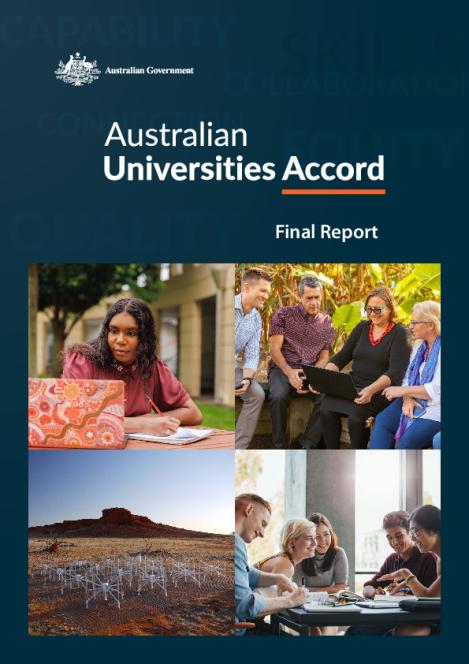
Australian Universities Accord Final Report: Mostly Good

Australian Universities Accord
Final Report
, 25 February 2024
The Australian Universities Accord Panel, chaired by Professor Mary O’Kane, has released a 408 page final report (25 February 2024). Some of the suggestions I made in my submission (and no doubt many others made), found their way into the report).

There is also a Summary Report by the Department of Education, which at 34 pages is longer than the executive summary in the actual report, so seems a bit pointless (unless the department just wanted to put its own spin on things).

The report, while mentioning democracy and civic values, emphasizes the economic benefits of research and higher education. It raises issues of low demand from students, casualisation of the university workforce, and financial pressures. Equity also features prominently. The report makes 47 recommendations to address these, and other, issues.

Targets and VET

The recommendations under broad headings, the first of which is the "National Tertiary Education Objective". Interestingly this is proposed for both higher and vocational education, to:

a. "underpin a strong, equitable and resilient democracy
b. drive national economic and social development and environmental sustainability."

Vocational education is mentioned further in the Attainment targets:

a. "a skilled workforce to meet the changing needs of the economy through a tertiary education attainment target of at least 80% of the working age population with at least one tertiary qualification (Certificate III and above) by 2050 compared with 60% in 2023

b. growth in Commonwealth supported places in higher education to achieve this target, more than doubling the number of students in Commonwealth supported places from around 860,000 in 2022 to 1.8 million in 2050 across all age groups

c. growing numbers of younger Australians with a university education, through an attainment target of 55% of 25 to 34-year-olds with a bachelor degree qualification or above by 2050 compared with 45% in 2023, noting that many will also have a VET qualification

d. a strong and growing contribution to tertiary attainment driven by TAFE and the vocational system, with a planning assumption that 40% of 25 to 34-year-olds will have a tertiary level vocational or technical qualification in 2050, noting that some people have both a VET and higher education qualification ..."

As it happens, in my submission to the accord panel, I suggested an 80% vocational target but at a more ambitions Certificate IV level, rather than Certificate III. The panel's proposed target of 55% of young people with a bachelor degree may seem modest, given this is already at 45%. However, we may have already past peak degree, with enrollments dropping, as young people decide a degree is not their best investment. Government would do well to agree with this assessment, and decide to fund more flexible forms of education, rather than traditional bachelors degrees.

Flexible Courses and RPL

Under "A more flexible and responsive skills system" the panel recommends "working with tertiary education providers, industry and business to adopt a consistent, published, national approach to recognition of prior learning (RPL) and credit recognition":

i."address historical, cultural and institutional barriers to RPL and credit recognition

ii.make it easier for students to gain maximum credit for previous study and minimise

the time taken and cost to get a new qualification

iii.include recognising appropriate work experience

iv.improve student mobility to enter, exit and return to tertiary education"

While RPL is routine in VET, the difficulty will be in persuading and educating the university sector in how to do it. While universities could learn much from the VET sector, it will be difficult for the upper end of the university sector to accept this. Part of my day job for several years has been processing applications for credit for prior study, & RPL. This is something I have been formally trained to do in TAFE, & university programs, and though being on the accreditation standards board of my profession, but is not a skill many of my colleagues share, or value. Many universities in Australia share course designs across institutions, and international, where external professional recognition imposes standardization. However, this is not formally recognized, so a time consuming process is required to process every application for every course credit. This could be improved by giving incentives to universities to work together, and train staff.

The panel recognize the need for more flexible qualifications, with a recommendation for modular, stackable qualifications:

"5. That to help Australians quickly get the skills they need to fill jobs that are in shortage, the Australian Government establish a comprehensive system of modular, stackable and transferable qualifications, including microcredentials, consistent with a reformed Australian Qualifications Framework." (Page 19)

This one recommendation is worth a whole report in itself. In my submission, I recommended nested programs, rather than the more ambitious stackable. There is a subtle difference here. A university can create a set of qualifications which a student can undertake in sequence (nested). It is much harder to allow the student to assemble a larger qualification from an assortment of smaller ones (stackable). Even the much easier task of providing standalone micro-credentials is one that universities have been slow to achieve. The level of educational design skills would need to be considerably increased at Australian universities to achieve this aim.

Work Integrated Learning

The panel proposes to have studnts "earn and learn while studying" with a "Jobs Broker" for relevant part-time work, paid by employers.

"7. That to ensure students develop work relevant skills for employment after their study, the Australian Government increase opportunities for students to both earn and learn while studying by:

a. establishing a national brokerage system (‘Jobs Broker’) to support tertiary education students find part-time work and placements relevant to their fields of study. Delivery should be through a provider that charges paid subscriptions by employers. The service should be free for students, and allow them to earn income while studying and reduce cost of living pressures

b. promoting work-integrated learning (WIL) by working with peak bodies for employers, industry, business and tertiary education providers to deliver more WIL opportunities in curricula across all disciplines, and provide training to industry supervisors

c. improving measures of graduate generic skills as part of the Graduate Outcomes Survey and Employer Satisfaction Survey. The Australian Tertiary Education Commission should showcase best practice as part of its ‘State of the Tertiary Education System’ annual report

d. using models like degree apprenticeships that encourage an employment relationship as part of course design." (Page 19)

Again this is a recommendation which deserves a whole report itself, with implications for how higher education is provided. For students to be engaged in significant part time work requires them to be part time students. Flipping the Australian university system from a focus on full time study, to part time would seem radical, but is just a recognition of what has already happened. Much of the stress for students and staff comes from students who are holding down a job while studying full time.

For the last eight years I have been helping teach students undertaking Work Integrated Learning, mostly in groups, but also individual interns. Even in the vocationally orientated filed of computing, during a boom in demand for skills in areas such as cyber security, analytics, and AI, this is not easy. Outside vocationally orientated disciplines, such as computing, engineering, and business, this is going to be especially difficult. There is then the problem of training academic staff to design, teach and assess WIL.

Professional Accreditation

The Panel's recommendations on "Professional accreditation bodies", were slightly jarring for someone who has served on accreditation setting committees. As a member of my profession, I am used to telling universities, and governments, what they have to do, not the other way around.

"9. That to ensure professional accreditation including placement requirements are appropriate for industry and business skill needs, tertiary education providers and the Australian Government, through the Australian Tertiary Education Commission, work with professional accreditation bodies, to agree a code of conduct for these bodies. The code should ensure that any accreditation requirements are evidence-based and proportionate to the gain they provide and that placement requirements ensure that students gain industry relevant skills and experience without imposing onerous placement length and conditions." Page 20

That accreditation requirements should be evidence based is reasonable, and work placements not onerous. However this should be a mutual obligation, with the universities required to show they are teaching & assessing work relevant skills.

One example of where WIL assessment can go wrong is with e-portfolios. Students are told to reflect on what they learned on their placement, without training in how to write reflectively. The approach I have been using for the last few years is to frame the reflective e-portfolio in the form of an application for a job, so it is relevant to the student, and have the careers staff teach this.

Participation targets for First Nations, Low SES, Regional, Rural, Remote and Students with a Disability

In recommendation 10, the panel proposes participation targets for undergraduate university students by 2035: 3.3% First Nations, 20.2% low SES, 24.0% regional, rural, and remote, and current rate for students with disability. These are very modest targets, but even so no penalties for non-achievements, or incentives are proposed. Also by emphasizing university this may not be be in the best interests of studnts woH might benifit from attending VET first.

Building aspiration including through increasing readiness for tertiary education and providing career advice

In Recommendation 11, the panel proposes work by federal, and state governments on "... outreach programs designed to develop familiarity with tertiary education". Harder is to "... ensure post-school pathways are visible and integrated into secondary schooling ...".

Fee-free preparatory courses

The Panel calls for free university preparatory courses. One way to fit this in the current system, I suggest, would be to have the preparatory courses run by the VET sector.

Support to participate and succeed in learning

In recommendation 13 the Panel proposes funding for under-represented groups, to meet the targets set in Recommendation 10. It would have been a bit easier to follow the recommendations, if these had been together. No specific amounts are mentioned, or if this additional funding is to come out out of that already provided to universities. Also there is no mention of developing curricular, materials, delivery techniques to suit these students. As an example, it is likely many of the studnts would benifit from blended programs, delivered in part remotely at home, and on country. Also the content of courses may need to be different. Such course content and delivery techniques would also greatly enrich the leanring experience of other students.

Financial support for placements

The panel proposes in recommendation 14 government funding for work placements in nursing, care and teaching professions. The argument presented, that this would reduce financial hardship, makes no sense, unless the government support is extended to all disciplines.

Student income support

In recommendation 15 the panel asks the federal government increasing allowances and loosening rules. Hard to argue with that, except perhaps to suggest abolishing some of the rules.

Reducing student contributions and reforming HELP repayment arrangements

Of most interest to students will be the panels recommendation 16, to reduce the burden of HELP loans, and in particular the effect of the Job-ready Graduates (JRG) package. At the time it was introduced, many warned charging humanities students as a way to direct them to what the then government saw as more vocationally relevant programs would not work. It did not work, and the studnts should not be further punished for past bad government policy.

While previous recommendations were not specific about money, recommendation 17 proposes universities charging "high fees" (over $40,000) for graduate coursework (I assume a Masters), "be required to re-invest a proportion of income earned back into scholarships and bursaries to support students from under-represented backgrounds to access these courses". This Robinhood approach doesn't appear to be proposed for undergraduate courses, or for international student fees. Also it is a relatively mild levy, being retained within the institution.

Ensuring student safety and experience

The Panel calls for a National Student Ombudsman to handle complaints in recommendation 18. The Australian Government recently announced such an office would be established. It is usual for an industry ombudsman to be funded by the industry members, but there is no mention of funding in the announcement.

More controversial is recommendation 19, calling for student unions funded from student fees. This would go counter to the previous government's approach of cutting off funding to student unions. As an online student for seven years, I was slightly annoyed by services and amenities charges, when they went to the upgrading of facilities I had never seen, and would never use, because they were a thousand kilometers away.

Early at-school offers

Recommendation 20 reads like a cartel wanting to maintain the market share of its members. The panel recommends "early at-school offers for 2025 and 2026 should not be issued before September" to "maintain the integrity of senior secondary certificates". However, if universities are able to determine which students are likely to succeed at studies without certificates, they do not have integrity. If the certificates are no longer of value to universities, they should be modified to suit other users, such as employers, and VET. This would also certificates to emphasize work relevant skills.

Quality learning and teaching

Recommendation 21 shows the Panel placing hope over available evidence, by suggesting measures to "prepare the higher education sector for growth in student numbers". I suggest a further decrease in domestic student numbers is more likely, and would be a better outcome in terms of public policy. However, in any case I agree with the panel about "using proven innovative learning approaches which embrace online and hybrid teaching modalities". However, what is lacking is any proposal for university teachers being required to be qualified to teach. Paradoxically, while universities teach the highest level teachers they have the lowest requirements for teaching qualifications. The panel is not proposing to change that.

International education

At this point, it is time for a break ...


Tuesday, January 16, 2024

Design Education for Disadvantaged Students

Dr Neil Raven
Dr Neil Raven, a UK educational consultant has provided a useful analysis on the effect of the COVID-19 pandemic on the educational ambitions of young people from disadvantaged backgrounds (Raven, 2023). They talked to 14 teaching professionals from schools and colleges in the English disadvantaged areas. Raven concluded that the participation gap for higher education widened due to the pandemic. However, I suggest a problem with the analysis is that it focuses on how to get more students to attend existing forms of higher education not designed form them, not what is best for the students. 

Universities were unable to send staff to schools during the pandemic to recruit students. What Raven doesn't point out is that universities could, and should, have had alternative ways to interact with students. Just as universities could have had an online teaching option available before the pandemic, but most chose not to, they could have provided ways to reach out to school students online. That lack of care for students, I suggest, could be a useful indicator for future students. Those institutions having inflexible practices, may not be the best for students from disadvantaged backgrounds. These students will be more likely to need part time jobs, and have family care duties to attend to, so need flexible ways of learning. They therefore should choose a university, or VET institution, which provides flexibility, and does not require in-person attendance.

Raven also mentioned students’ concerns about moving away from home to study were made worse by the pandemic. This is a reasonable and rational concern of students. Rather than dismissing it, as an inconvenience for universities which have a campus based business model, I suggest it can be addressed by bringing the institution to the student. In addition Raven mentions the cost of higher education being a greater concern due to the pandemic making jobs less secure. Here again, the solution should not be trying to convince students that the cost is not a problem, but lower the debt burden on students, through lower fees, and options for part time work, with nested qualifications. 

Ironically Raven's research is published by the UK Open University, but the paper doesn't discuss the option of studnts from disadvantaged backgrounds studying at such institutions, which were specifically designed to overcome such disadvantage.

References

Raven, N. (2023). The impact of the pandemic on widening participation students: the teaching professionals’ perspective. Widening Participation and Lifelong Learning25(1), 99-124. DOI https://doi.org/10.5456/WPLL.25.1.99 

Wednesday, November 29, 2023

Broad Skills Needed for AUKUS

The Australian government has announced $128M for 4,001 STEM students with skills needed for the AUKUS nuclear-powered submarine project. It should be noted most of the training, and jobs, will not be related to nuclear technology. The initial submarines will be purchased built from the USA and largely supported by US personnel. In my opinion, it is unlikely the followup AUKUS submarines will ever be built. By that time conventionally armed crewed submarines will have been rendered obsolete by drones. However the STEM skills the graduates learn in these courses will be critical to designing and building drone submarines as part of the evolved and expanded AUKUSJSK.

Professor Andrew Norton has criticized the level of funding, as it assumes a 25% attrition rate per year. He points out this is higher than is typical. This may reflect the demand for skills in industry. Universities may have difficulty keeping students in the program, when they could be earning in industry after only completing part of the program, especially those in the AUKUS courses who will be required to meet security vetting requirements. One approach would be to have nested work integrated programs, where students study while working on AUKUS, with their work being submitted for assessment. Students could complete the first part of the program, and be awarded a qualification to get them an entry level job. They would be then study while working for a promotion.

Wednesday, February 22, 2023

Discussion Paper on The Future of Australian Universites

The Australian Universities Accord Panel, chaired by Professor Mary O’Kane, has released a 44 page Discussion Paper. I submitted Some Thoughts on the Future of Australian Higher Education in December.

There are a series of questions in the paper. Here is my attempt to answer some. An underlying these in these, I realised later, was to make Uni more like TAFE, with shorter, nested, competency based, work integrated courses, delivered by people trained to teach:

Role of higher education:

  1. "How should an Accord be structured and focused to meet the challenges facing Australia’s higher education system? What is needed to overcome limitations in the current approach to Australian higher education?
  2. How can the diverse missions of Australian higher education providers be supported, taking into account their different operating contexts and communities they serve (for example regional universities)?
  3. What should the long-term target/s be for Australia’s higher education attainment by 2030 and 2040, and how should these be set and adjusted over time?"

There is enough in just these three questions to keep academia busy for decades. I suggest the diverse mission of Australian higher education can be supported by allowing for a diversity of institutions. In particular vocational education needs to be strengthened, to become the first option for post-school education, not just something you do if you can't get into a  university. A reasonable aim would be to have 80% of the 25-34 year old population with at least an AQF Level 4 Qualification (Certificate IV). This would be more useful goal than aiming for a bachelor's degree for the majority of the population.

Challenges and opportunities for the higher education system

4. "Looking from now to 2030 and 2040, what major national challenges and opportunities should Australian higher education be focused on meeting?

5 How do the current structures of institutions, regulation and funding in higher education help or hinder Australia’s ability to meet these challenges? What needs to change?

6 What are the best ways to achieve and sustain future growth in Australian higher education, given the changing needs of the population and the current pressures on public funding?

7 How should the mix of providers evolve, considering the size and location of existing institutions and the future needs of communities?"

The challenge I suggested Australian universities face in 2016 was how to provide quality education online. I warned that international students could be prevented from getting to Australian campuses, due to a regional crisis. Unfortunately universities failed to heed this warning, and were largely unprepared when COVID-19 struck.

However, I also warned of a longer term challenge with competition for international and domestic students from offshore, and online universities. Australian universities are also failing to meet this challenge, assuming that with COVID-19 receding, they can scale back ad-hoc online learning. As a result, international and domestic studnts will choose to study elsewhere.

Challenges and opportunities for the higher education system

9 "How should Australia ensure enough students are studying courses that align with the changing needs of the economy and society?

10 What role should higher education play in helping to develop high quality general learning capabilities across all age groups and industries? 

11 How should Australia boost demand from people to study in the higher education system? 

12 How should an adequate supply of CSPs be sustained and funded, as population and demand increase?"

Australian governments can fund vocational education programs in areas of demand. Some of those students can then go on to university study. This will ensure that there are incentives for study in particular fields, without burdening the taxpayer with the entire cost.

Universities can provide work integrated, competency based, nested programs, which allow new and mature students to gain the skills they need quickly. A student should be able to undertake a microcredential which takes only a few weeks study, and have that count towards a certificate, diploma, and degree.

Collaboration with industry

13 "How could an Accord support cooperation between providers, accreditation bodies, government and industry to ensure graduates have relevant skills for the workforce?

14 How should placement arrangements and work-integrated learning (WIL) in higher education change in the decades ahead?"

Professional associations have a key role in setting the standards for the professions. 

Unpaid internships should be outlawed through state and federal legislation. Those industries willing to pay for trainees will get staff. Those companies unwilling to invest in their future will not have a future.

Lifelong Learning

15 "What changes are needed to grow a culture of lifelong learning in Australia?

16 What practical barriers are inhibiting lifelong learning, and how can they be fixed?"

A major impediment to life long learning is the assumption that school leavers attend a campus full time for three years to obtain a degree for a first job. Shorter qualifications, part time, and mature students are therefore seen as an afterthought by universities. This can be changed by requiring universities to offer online, nested, qualifications which suit mature working students. 

Connection between the vocational education and training and higher education systems

17 "How should better alignment and connection across Australia’s tertiary education system be achieved?

18 What role should reform of the AQF play in creating this alignment?

19 What would a more effective and collaborative national governance approach to tertiary education look like?

20 How can pathways between VET and higher education be improved, and how can students be helped to navigate these pathways? 

21 How can current examples of successful linkages between VET and higher education be integrated across the tertiary education system? 

22 What role do tertiary entrance and admissions systems play in matching learners to pathways and supporting a sustained increase in participation and tertiary success?"

Better alignment can be achieved by directing more of the funding to the vocational sector, so it becomes the first choice for students leaving school. That will then give the vocational sector the power to negotiate alignment with universities, as most university entrants will be coming from the vocational sector, and that sector will be able to influence which university they select.

The tertiary entrance and admissions systems are poor at matching learners to pathways, and should be scrapped.

Solving Big Challenges

23 "How should an Accord help Australia increase collaboration between industry, government and universities to solve big challenges?

24 What reforms will enable Australian research institutions to achieve excellence, scale and impact in particular fields?

25 How should Australia leverage its research capacity overall and use it more effectively to develop new capabilities and solve wicked problems?

26 How can Australia stimulate greater industry investment in research and more effective collaboration?"

Australian government can consult the education sector, as well as others, when setting national priorities.  They can then allocate funding for universities in accordance with those priorities.

Compulsory industry training for research students will help increase impact. There is little point in having excellent research if the researchers do not see it as part of their job, and do not have the skills, to put that research into practice.

Research Workforce

27 "How can we improve research training in Australia including improving pathways for researchers to gain experience and develop high-impact careers in government and industry?"

The Australian Government can improve pathways by transferring funding from research doctorates to professional doctorates. Professional doctorates provide more rounded, useful graduates for government and industry.

Academic Preparadness

28 "What is needed to increase the number of people from under-represented groups applying to and prepared for higher education, both from school and from other pathways?

29 What changes in provider practices and offerings are necessary to ensure all potential students can succeed in their chosen area of study?"

Open universities have for decades shown how to provide for under-represented groups, by offering part time, online studies, recognising prior experience as being as valuable as formal study.

Addressing barriers to access

30 "How can governments, institutions and employers assist students, widen opportunities and remove barriers to higher education?

31 How can the costs of participation, including living expenses, be most effectively alleviated?"

Governments can increase funding for vocational education, to make it the default pathway to university. Government can require universities to make online, part time, work integrated learning the default option.

Training can be provided to university program and course designers to show them how to design out the privileged assumptions built into current university programs. Government can require universities to built in study skills courses to programs, rather than have these an optional extra for disadvantaged students.

System-wide approaches to increasing access and equity

32 "How can best practice learning and teaching for students from under-represented groups be embedded across the higher education system, including the use of remote learning?

33 What changes to funding and regulatory settings would enable providers to better support students from under-represented groups in higher education?"

Governments, and professional accreditation bodies, can make teaching qualifications for university teaching staff mandatory. Staff will then have the skills needed to design out the discrimination currently built into courses, due to lack of competence.

Communities

34 "How should the contribution of higher education providers to community engagement be encouraged and promoted?

35 Where providers make a distinctive contribution to national objectives through community, location-based or specialised economic development, how should this contribution be identified and invested in?"

Community engagement can be fostered by building on social enterprise programs run through organisations such as the Canberra Innovation Network. Academics and their students, need specific training in how to identify community needs, and how to talk to the community. This can be built into professional curricular, as is done in the ANU School of Computing's Techlauncher Program.

Regulation and governance

36 "What regulatory and governance reforms would enable the higher education sector to better meet contemporary demands?

37 How could a more coherent and dynamic national governance system for higher education be achieved?"

One of the strengths of the Australian education system is the mix of federal state and non-government. The temptation to simplify, and centralise, should be resisted.

Academic workforce

38 "How can the Accord support higher education providers to adopt sector-leading employment practices?"

The Accord can recommend legislation making wage theft a crime, with jail terms for the Vice Chancellors where institutions deliberately, and systematically, steal money from their staff.

The problem of insecure employment can be addressed by ensuring that doctoral students are trained for jobs which exist in government, or industry, and not given the false impression they have a well paid secure future in academia. With the ability to get a job elsewhere, academic staff will be much harder for universities systematically to exploit.

Quality experience for students

39 "What reforms are needed to ensure that all students have a quality student experience?

40 What changes are needed to ensure all students are physically and culturally safe while studying?"

Having students first undertake vocational education, and paid employment, will ensure more maturity on entry to university. Compulsory courses on study skills can incorporate familiarly with what students can expect, and how to complain when they don't get it. Compulsory group work for new students can incorporate cultural sensitivity training.

Compulsory training for teachers in how to teach can incorporate cultural sensitivity training.

Research quality

41 "How should research quality be prioritised and supported most effectively over the next decade?"

The Australian Government can fund the development of an international university ranking scheme which prioritises education quality over research quantity. This will correct the current imbalance where universities strive to maximise the production of research papers, at the expense of quality, to achieve a high ranking, and thus attract students. 

Academic integrity

42 "What settings are needed to ensure academic integrity, and how can new technologies and innovative assessment practices be leveraged to improve academic integrity?"

Academics can be trained in how to design courses which incorporate authentic work integrated assessment, rather than essays and exams. This will be more effective than continuing the arms race between AI to create essays, and AI to detect them.

International Education

43 "How should the current recovery in international education be managed to increase the resilience and sustainability of Australia’s higher education system, including through diversification of student enrolments from source countries?

44 How can the benefits of international education be shared broadly across the system, including in regional areas, and what level of reporting should there be?"

The resilience of Australian Higher education can be increased by providing a quality online option. A condition of funding of Australian universities should be cooperation, not competition, with international marketing. Existing cultural contacts with Vietnam, Indonesia, and the region, should be exploited.

The Australian Government should scrap the New Colombo Plan, and instead fund a virtual Colombo program, which subsidises students from developing nations to study online alongside Australian students.  

Investment and affordability

45 "How should the contribution of different institutions and providers to key national objectives specific to their location, specialist expertise or community focus be appropriately financed?

Q46 How can infrastructure development for higher education be financed, especially in regional and outer urban locations?"

Government funding of regional campuses should be conditional on those campuses being shared, between institutions, and with the local community.

Commonwealth funding for higher education research and teaching and learning

47 "What structure of Commonwealth funding is needed for the higher education sector for the system to be sustainable over the next two decades?"

Funding for teaching and learning should continue to be limited to accredited institutions, public and private. Rather than open degree awarding to a larger range of institutions, students should be encouraged to obtain more vocationally relevant sub-degree qualifications. The current degree awarding institutions can then be incentivised to grant credit to a degree for these.

Student contributions and the Higher Education Loan Program

48 "What principles should underpin the setting of student contributions and Higher Education Loan Program arrangements?

Government should fully fund the equivalent of one Certificate IV for each Australian citizen, with subsidies reducing as the student completes each higher level of study.

Job-ready Graduates (JRG) package

49 "Which aspects of the JRG package should be altered, and which should be retained?"

Undergraduate Certificates should be retained as part of nested degree programs. However, the option of the student undertaking this in the vocational sector should be encouraged.

Tuesday, December 13, 2022

Some Thoughts on the Future of Australian Higher Education

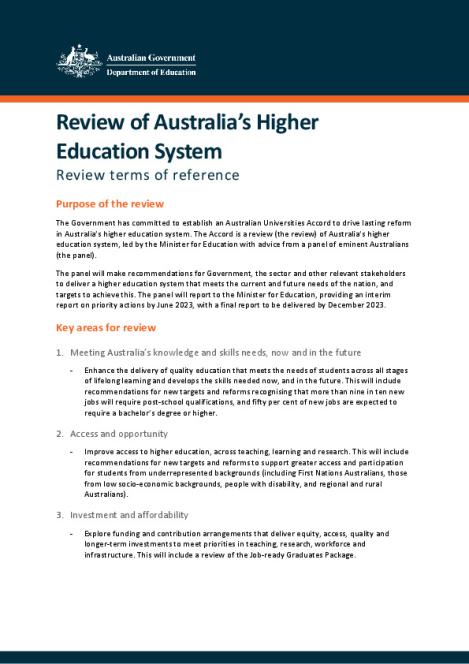
The Higher Education Review Terms of Reference, lists seven key areas for consideration (Department of Education, 2022). Here are some thoughts on the topic. Please note that while I am an Honorary Lecturer in Computing at the Australian National University, and a member of the Professional Standards Board of the Australian Computer Society, these recommendations are my own, and may not represent the views of any organisation I am associated with. 

The Review has asked for priorities. I suggest no radical change is needed. Universities should continue to provide educated professionals for the workplace, and applied research for industry, supported by fundamental research. Better funding of, and linkage with the VET sector is needed. This can be facilitated by training university academics in how to teach, using the work integrated techniques used in VET. Australia should double down on the use of online blended, and mobile learning, and promote this for international students. Government should target strategic areas for HE/industry cooperation, starting with a $20B defence drone program.

Recommendations on the Review Topics

1. Meeting Australia’s knowledge and skills needs, now and in the future

Recommendation 1: Australian universities should continue to be funded to focus on educating professionals, conducting applied research for industry, supported by fundamental research. The funding for the Vocational Education and Training (VET) sector in preparing professionals, both before and after university, should be expanded. 

Discussion: Universities should continue to provide first, and advanced degrees, with some vocational institutions offering first degrees, and other shorter qualifications. All should offer options for competency based, stacked short qualifications, with work integrated learning, and project capstones, as recently announced by Singapore Institute of Technology.

From the establishment of the first university, the top priority for Australian higher education has been to educate professionals for the workforce. The second priority has been applied research, in support of industry. Both education and applied research have been supported by fundamental research. There is no need to change these priorities. 

Alongside universities, have been vocational institutions, providing more focused courses, and providing  specific skills needed immediately. Schools have also been able to provide vocational qualifications, as well as preparation for university. A minority of jobs will require a bachelor's degree, or higher, as the specific skills required will be specified using small skills units, which can be obtained via industry certification, VET, or university.

2. Access and opportunity

Recommendation 2: Government funding should be contingent on universities continuing to offer online, blended, and mobile learning, as a way to enhance access for those who can't get to a campus regularly. Qualifications be required to be  stacked, so that students will receive a worthwhile outcome from months of study, while still being able to go on to a multi-year one.

Discussion:  hose from First Nations, low socioeconomic backgrounds, disability, regional and rural areas, have been underrepresented at Australian universities, both as students and staff, in part because they simply could not get to a campus. Online access can help correct this form of discrimination, further enhanced with a mobile option (Cochrane, Et. al, 2020). Allowing for online and hybrid access also forces better design of courses and work, lowering other more subtle barriers to access. The Australian government should make online access for staff and students a condition of funding. 

COVID-19 caused Australian higher education, & much of the research effort, to move online. For those trained to teach and work online in a pandemic emergency, this was less challenging (Worthington, 2020, & 2006). 

However, most students were already undertaking most of their studies online pre-COVID, even when officially enrolled on-campus. Researchers also collaborated online, across campus, the continent, and the world. The pandemic made these practices official. Australian institutions should build on the work done during COVID-19, with training provided for staff in how to teach, and work in teams online.

Having shown it is possible to provide an online option for staff and students, universities have a legal obligation to continue to do so. Remove the online option would unlawfully discriminate against those who cannot be there in person, for reasons of economic circumstance, disability, family care, community, or cultural obligations.

3. Investment and affordability

Recommendation 3: Governments fund VET programs for new students, nested with intermediate programs at university. All programs would have the option of competency based assessment, and recognition of prior learning. Funding be provided for university academics to be trained in how to design and teach using these techniques. 

Discussion: The lowest cost course is one the student doesn't have to do. If the student already has the required skills and knowledge, there is no need for them to do a course, and they can move on to something more advanced. This approach is well established in the Vocational Education Sector, but not higher education. It requires staff trained in how to carry out experience based assessment, and to accept qualifications of other institutions. It also requires embracing competency based assessment, which university academics are reluctant to do. These staff need training in how to perform such assessment, and be familiar enough with it that they are willing to accept it.

4. Governance, accountability and community

Anduril Dive-LD Ghost Shark XL-AUV, 
made in Sydney
Recommendation 4: The Australian Government fund  coordinated industry/education programs, starting with a $20B drone defence program. This would research, develop, build and deploy autonomous sub-sea, sea, land, air and space systems. This would include developing  automated systems for additive manufacture, train military personnel in tactics, and set up for mass production.

Boeing MQ-28 Ghost Bat UAV
made in Queensland.
Discussion: Past education/industry programs have been short term and piecemeal. The Australian Government is expected to spend $171B on nuclear submarines, to be partly built in Australia. However, remote sensing, and drone technology, may have rendered the submarines obsolete, before the first can be completed. The Australian government is already investing in joint air and subsurface drone development with US companies, with prototypes already being tested.

The Boeing MQ-28 Ghost Bat stealth unmanned aerial vehicle (UAV) which is made in Queensland, and Anduril Dive-LD Ghost Shark extra-large autonomous undersea vehicle (XL-AUV) recently completed in Sydney, show potential. The Australian Higher education sector has already assisted through activities such as the Navy Warfare Innovation Workshop 2020, which featured drones. Funds diverted from the nuclear program could make Australia a world leader in drones.

5. The connection between the vocational education and training and higher education systems

Recommendation 5: Governments fund university academics in the teaching techniques and course design approaches, including online, blended, work integrated, and other techniques used in VET.

Discussion: A striking feature of the Australian education system is how the higher the level, the less teaching qualifications are required. School teachers are required to have at least a first degree, and increasingly an advanced degree in teaching. VET teachers need at least a Certificate IV in Training & Assessment. However, university academics are expected to teach, and design learning, without any AQF qualification. 

Connecting VET and universities would be much easier if universities had staff qualified to teach. It would help if the teaching include the techniques used in the VET sector, both to improve the quality of university teaching, and allow better integration with the VET sector. This doesn't require university academics sitting in lecture halls listing to lectures on teaching. In fact they should not be doing that, and instead learning online, while teaching. 

6. Quality and sustainability

Recommendation 6: Discontinue the New Colombo Plan program, and instead fund university programs which allow domestic and international students to learn together collaboratively online.

Discussion: After a virus closed campuses in 2003, the National University of Singapore conducted an annual "E-learning Week", to practice teaching online in an emergency (Chandran, 2010). The Australian Government, and universities therefore had plenty of warning of the possibility of a pandemic, and prudent precautions to take.  Unfortunately Government, and most universities, failed to prepare for this known risk. As a result universities had to put in place ad-hoc online learning, using staff untrained for the challenge.

International students could again be kept offshore by a regional security crisis (Worthington, 2017). Also Australian universities face increasing international competition. Rather than just retreat into serving a shrinking premium market for onshore courses, Australian institutions can also offer premium online and blended programs. This can be done by training staff in how to teach online, and challenge the myth that online learning is inferior in quality. This learning can be engaging, and offer international students the chance to study with Australians (Worthington, 2014).

7. Delivering new knowledge, innovation and capability

Recommendation 7: Governments fund training for undergraduate, and graduate students to learn commercialisation techniques, at centres such as the Canberra Innovation Network, while receiving course credit, as exemplified by the ANU Techlauncher program (Worthington, 2019).

Discussion: For university research to deliver practical outcomes, researchers need to learn commercialisation skills. It is not sufficient for a researcher to pass on their discoveries for others to commercialise, they need to be actively involved. This training is best done at the innovation centres located near universities, in partnership with local, state government, and industry. This training should be integrated with formal programs of study, not as an optional extracurricular activity.

References

Terms of Reference, Review of Australia’s Higher Education, Department of Education, Australian Government, 10 November 2022. URL https://www.education.gov.au/australian-universities-accord/resources/terms-reference

Responding to the Coronavirus Emergency with e-Learning, Worthington, Tom, Athabasca University, April 17, 2020.  URL https://news.athabascau.ca/beyond-50/responding-to-the-coronavirus-emergency-with-e-learning/

Wireless Web System for an Avian Influenza Pandemic, Worthington, Tom, Australian National University, March, 2007. URL https://www.tomw.net.au/2005/wd/sahana3.shtml

Digital Teaching In Higher Education: Designing E-learning for International Students of Technology, Innovation and the Environment, Worthington, Tom., 2017. URL http://www.tomw.net.au/digital_teaching/introduction.shtml

Chinese and Australian students learning to work together: online proposal to expand the New Colombo Plan to the online environment. Worthington, T. (2014, August). In 2014 9th International Conference on Computer Science & Education (pp. 164-168). IEEE. URL https://doi.org/10.1109/ICCSE.2014.6926448

National University of Singapore's Campus-Wide ELearning Week. Chandran, R. (2010, May). In Global Learn (pp. 2062-3302). Association for the Advancement of Computing in Education (AACE). URL https://cpb-us-w2.wpmucdn.com/blog.nus.edu.sg/dist/0/119/files/2011/03/national-university-of-singapores-campus-wide-elearning-week.pdf

Blend and flip for teaching communication skills to final year international computer science students. Worthington, T. (2019, December).  In 2019 IEEE International Conference on Engineering, Technology and Education (TALE) (pp. 1-5). IEEE. URL https://doi.org/10.1109/TALE48000.2019.9225921

A collaborative design model to support hybrid learning environments during COVID-19. Cochrane, T., Birt, J., Cowie, N., Deneen, C., Goldacre, P., Narayan, V., Ransom, L., Sinfield, D., & Worthington, T. (2020, December). In Proceedings of the ASCILITE 37th International Conference on Innovation, Practice and Research in the Use of Educational Technologies in Tertiary Education, Armidale, Australia (Vol. 30). URL https://2020conference.ascilite.org/wp-content/uploads/2021/04/ASCILITE-2020-Proceedings-Cochrane-T-et-al.pdf