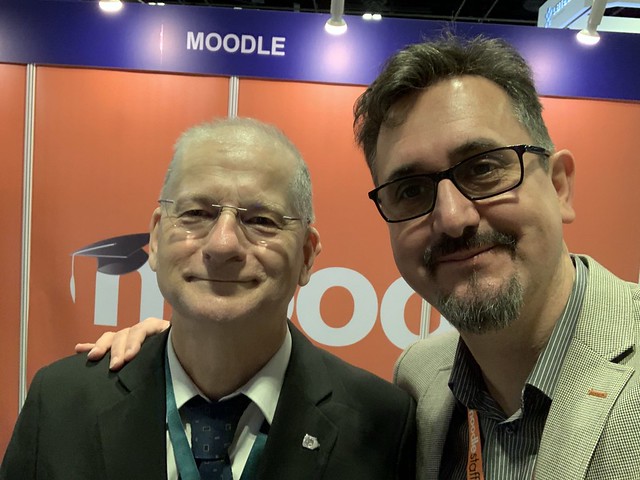
It was a delight to bump into Martin Dougiamas, founder and CEO of Moodle Pty Ltd, at EduTech Asia 2018 in Singapore this week. Martin gave a presentation "Moodle the world’s most widely used LMS". This is also a product I have used day in and day out since 2009, as a graduate course designer, on-line instructor at two tertiary institutions and as student at four.
I will be demonstrating some of my use of Moodle at Edtechposium, 29 October, and Telfest, 5 November, in Canberra.

Showing posts with label EduBuild 2018. Show all posts
Friday, October 12, 2018
Tuesday, October 9, 2018
Stopping Climate Change One Classroom at a Time
As a child I enjoyed watching black and white science fiction disaster films. Scientists in white coats would warn of impending doom, but be ignored until it was almost too late.
I don't have a white coat, but I am a member of the Australian
National University Climate Change and Energy Change institutes. Some of my
colleagues helped write the "Special Report on Global Warming of 1.5°C" for the Intergovernmental Panel on Climate Change (IPCC), issued 8
October. The report warns of more extreme weather and rising sea levels
if carbon emissions are not reduced. The report says limiting global
warming to 1.5°C requires "rapid and far-reaching" transitions in land,
energy, industry, buildings, transport, and cities."
Unfortunately, like those old science fiction films, such unwelcome news is not well received. But some changes can be made which enhance human well being while also reducing emissions.
At the EduBuild Asia 2018 conference in Singapore today I am suggesting the increased use of blended, online and mobile learning. Older students can spend more time learning via their mobile devices, away from campus. Classrooms can be reconfigured and teaching techniques changed, so when on campus students learn much more intensively. As well as improving student's education, this will reduce the carbon footprint of the campus.
Unfortunately, like those old science fiction films, such unwelcome news is not well received. But some changes can be made which enhance human well being while also reducing emissions.
At the EduBuild Asia 2018 conference in Singapore today I am suggesting the increased use of blended, online and mobile learning. Older students can spend more time learning via their mobile devices, away from campus. Classrooms can be reconfigured and teaching techniques changed, so when on campus students learn much more intensively. As well as improving student's education, this will reduce the carbon footprint of the campus.
Saturday, October 6, 2018
Learning to Use Tech-teaching Spaces in Singapore
Just on my way to Singapore to speak on energy use and flexible classrooms at EduBuild Asia 2018. My talk on energy use and learning was planned months in advance. But the talk on flexible classrooms only came about yesterday, when a gap opened up in the EduTech Asia program. I had prepared notes for a Roundtable Discussion on 10 October, but will now be presenting this the day before as TechTalk as well.
Friday, August 31, 2018
Decreasing Campus Energy Use With Flexible Classrooms and e-Learning
I will be speaking on "Decreasing Campus Energy Use With Flexible Classrooms and e-Learning" at EduBuild 2018 in Singapore, 9 October, 5:20pm. This is a new part of the annual EduTech conference, focusing on classroom design and use.
- Energy use and Carbon Emissions
- New Flexible Classrooms
- E-learning
Wednesday, August 8, 2018
Learning to use new tech-infused teaching spaces
![]() |
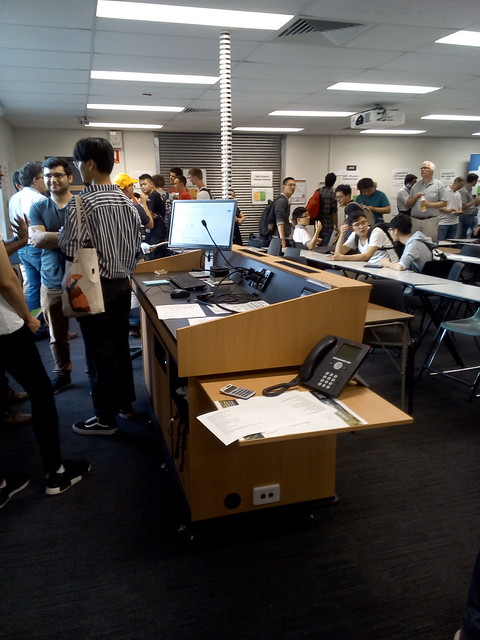
| ANU "TechLauncher" in flat floor classroom. |
"Teachers and students will need to learn to use new flexible classrooms.ps: The day before at EduBuild I will be speaking on "Decreasing Campus Energy Use With Flexible Classrooms and e-Learning".
This will require blending the physical spaces with online tools and techniques. Both staff and students will need to work together, with team teaching and group learning.
- How do we get teachers to use these new spaces for more than old fashioned "chalk and talk"
- How can physical spaces be integrated with flipped, blended and online courses?
- How can these spaces fostering student engagement?
- How do these spaces promote collaborative and peer learning?
- What curriculum changes are needed to promote effective use of new teaching spaces?
- Can the new teaching spaces also be innovation centers?
- Do teachers, and university academics, need new formal qualifications to teach in these spaces?"
Subscribe to:
Posts (Atom)