Showing posts with label blended learning. Show all posts

Tuesday, December 13, 2022

Designing for online, blended and synchronous learning for computing students

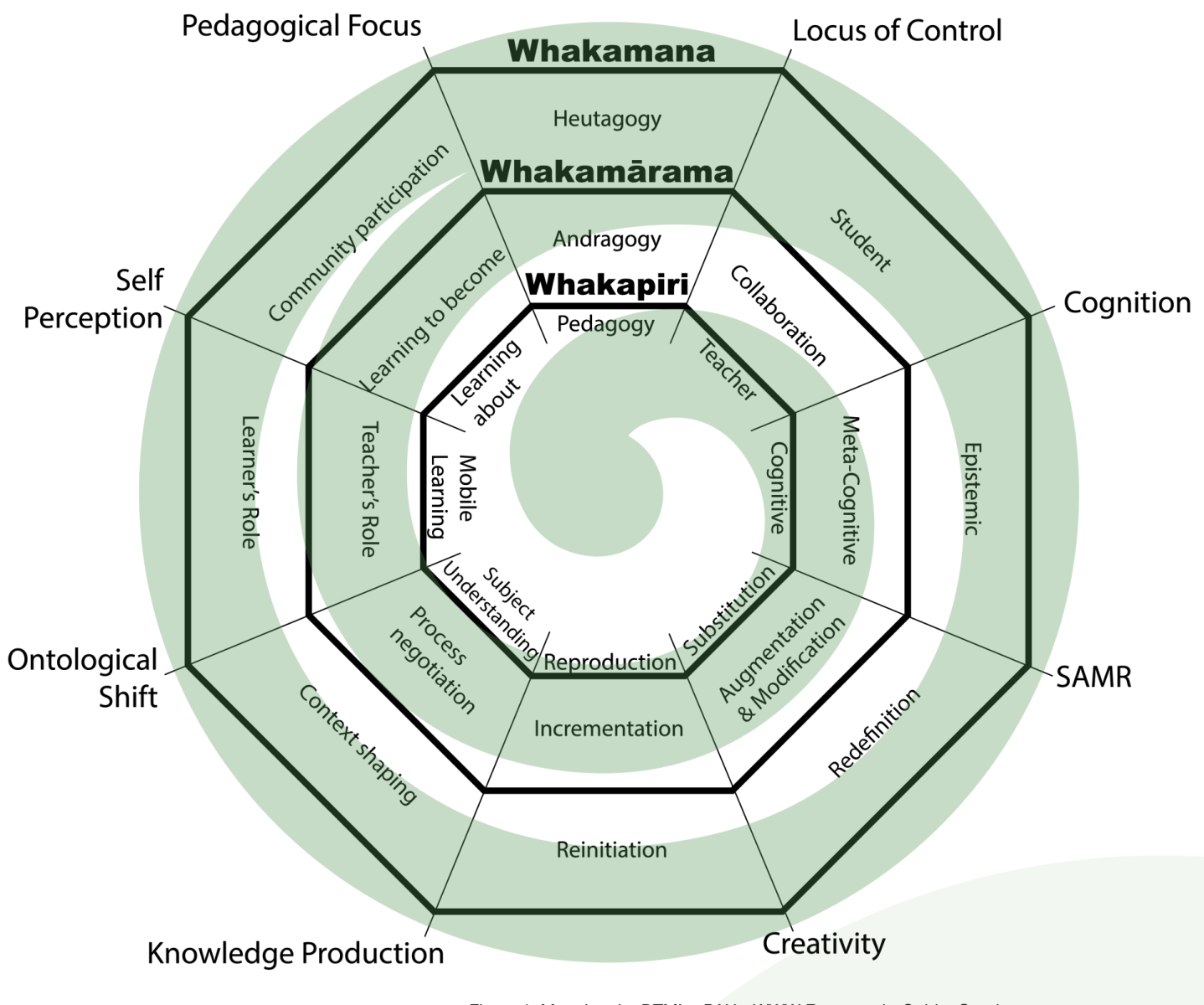
Today I talked to the participants of Thomas Cochrane's "Design for Transformative Mobile Learning Design BootCamp", along with other authors of the paper, "Analysing mobile learning designs: A framework for transforming learning post-COVID" (2022). 
The talk gave me a needed confidence boost, as I was writing Some Thoughts on the Future of Australian Higher Education, and thinking: "What do I know about higher education?". After the talk, I realised "I know something about it", as Dr McCoy would say. ;-)

Reference

Cochrane, T. D., Narayan, V., Aiello, S., Alizadeh, M., Birt, J., Bone, E., Cowie, N., Cowling, M., Deneen, C., Goldacre, P., Sinfield, D., Stretton, T., & Worthington, T. (2022). Analysing mobile learning designs: A framework for transforming learning post-COVID. Australasian Journal of Educational Technology38(4), 1–21. https://doi.org/10.14742/ajet.7997

Tuesday, June 7, 2022

Developing a Learning and Teaching Strategy

Along with many university staff, I have been invited to be part of developing a Learning and Teaching Strategy. This is an issue exercising the minds of people at many universities at present (or should be), as we recover from the COVID-19 pandemic. I have spent some of the last ten years studying, researching and presenting on these issues, so note that these are my views, not necessarily those of any particular institution.

An Approach

The approach I suggest is that universities design for a student who is remote, part time, and focused on practical vocational outcomes. Then add optional on-campus, and more academic activities. In terms of teacher development, require formal qualifications, but with training based on workplace experience.

It is much easier to start with a course designed for remote students, and add on-campus activities, than the reverse. Also, when another emergency forces some, or all, students online, this can be accomplished with no change in course design or delivery, the on campus components can be simply cancelled, leaving the remote component to continue. This approach was found to be effective in response to COVID-19 (Narayan, et al., p. 168, 2021).

Some issues:

1. Learning

Use of digital learning environments, on-campus learning, blended, flipped and flexible. As a result of the need to switch to online learning during the Pandemic, universities have well developed technical support for modern teaching approaches. The students are expecting these. The problem, up until 2020, was in convincing staff to do more than give the usual lectures. COVID-19 forced a crash program of online delivery. The problem is now how to make this more than just recorded lectures.

In part, the problem with learning is one of the self image of academics. When I joined the staff of a university decades ago, I assumed I would be researching, and teaching by giving an occasional lecture. As a computer professional, who had an award for helping getting the nation on the Internet, I assumed I could easily translate classroom teaching online. It took about ten years to realise I needed to swallow my pride and learn how to teach online without lectures. This is a process we need to take academic staff through, using dogfooding: teach them to teach by having them a student.

2 . Assessment

Also as a result of the pandemic, universities have technical support for flexible and advanced authentic forms of assessment (even if they don't use these). The ideal form of assessment is where the student does what they will need to do after graduation, in the workplace, and how they do it is checked. This can be in a real workplace, with an internship, or other Work Integrated Learning (WIL), or some form of simulation. Ideally the assessment is progressive, throughout the students courses, and accompanied by timely relevant feedback, so they pay attention. However, good assessment is much harder than end of semester examinations (which are bad assessment). This requires academics to be trained in how to assess, and time to set up. Once set up using the digital tools, the assessment takes more work. But academics will require the training and support to get to this point. 

As a student of assessment I did not believe much of what I was being told, until I had to experience it first hand (more dogfooding). As an example, I did not believe students did not read detailed feedback on assignments, until I got back my assignment on assessment and did not read the feedback. Only after this did I set about delivering feedback in smaller, more frequent chunks. Only after having to do group-work online, and reflective portfolio,  did I understand what these were about.

3. Teaching

How to ensure quality teaching is a dilemma for all university, but especially for research intensive ones. Whatever the marketing slogans might say, research is the priority, and researchers generally do not make good teachers. While vocationally focused, and not an elite researcher, I still did not volunteer to undertake teacher training, and had to be forced to do it. 

Universities will need to require staff to undergo teacher training, making recruitment and promotion conditional on achieving the required standard. I suggest this be done with formal courses, and AQF aligned qualifications. Voluntary schemes and ad hoc training courses are not sufficient. Universities have the opportunity to set up nested programs which can be a showcase for future offerings across the institution. As an example, micro-credentials which nest into a graduate certificate, diploma, and masters degree in university education, with WIL, & recognition of prior learning (RPL). Components of these programs can be offered to students, who are plan to be trainers in their discipline, as well as to staff. 

4. Job Ready Graduates

Internships, WIL, and career skills, as typically provided in computing, engineering and other closely vocationally linked disciplines, can be expanded to other fields. As an example, the ANU Computing School offers internships to individual students, and group projects for real clients (Awasthy, Flint, & Sankaranarayana, 2017). ANU Careers guides the group project students through the process of documenting the skills gained, considering careers, and applying for a job. Rather than this being extra-curricular, it is integrated into a course, with assessment (Worthington, 2019). Further digital support for these resource intensive programs can be developed. As with other forms of education and assessment, it would be valuable for teaching staff to have undergone such a program as a student.

References

Awasthy, R., Flint, S., & Sankaranarayana, R. (2017, April). Lifting the constraints—closing the skills gap with authentic student projects. In 2017 IEEE Global Engineering Education Conference (EDUCON) (pp. 955-960). IEEE. https://doi.org/10.1109/EDUCON.2017.7942964

Narayan, V., Cochrane, T., Aiello, S., Birt, J. R., Alizadeh, M., Cowie, N., Goldacre, P., Sinfield, D., Stretton, T., Worthington, T., Deneen, C., & Cowling, M. A. (2021). Mobile learning and socially constructed blended learning through the lens of Activity Theory. In S. Gregory, S. Warburton, & M. Schier (Eds.), Back to the Future – ASCILITE ‘21. Proceedings of the 38th International Conference of Innovation, Practice and Research in the Use of Educational Technologies in Tertiary Education (pp. 166-171). Australasian Society for Computers in Learning in Tertiary Education. https://2021conference.ascilite.org/wp-content/uploads/2021/11/ASCILITE-2021-Proceedings-Narayan-Cochrane-Cowie-Goldacre-Birt-Sinfield-Mehrasa-Worthington-Aiello.pdf

Worthington, T. (2019, December). Blend and flip for teaching communication skills to final year international computer science students. In 2019 IEEE International Conference on Engineering, Technology and Education (TALE) (pp. 1-5). IEEE. https://doi.org/10.1109/TALE48000.2019.9225921
Wednesday, September 9, 2020

Replace Old Lecture Theatres with Energy Efficient Flexible Teaching Spaces

The Australian National University is conducting a public consultation on "How can we reduce ANU contributions to climate change?". I submitted a suggestion to Shift 80% of ANU Learning Online to Reduce CO2 Emissions, under the Behavioral change theme. But I was also asked to contribute suggestions to the Energy and buildings theme, so have proposed to replace lecture theaters with flexible spaces. 

Replace Old Lecture Theatres with Energy Efficient Flexible Teaching Spaces

ANU's older lecture theatres have tiered floors with fixed seats. These can be replaced with flexible classrooms suiting modern education techniques, and which are more energy efficient. Modern teaching techniques emphasise student discussion and teamwork, which is difficult to do when all the seats are fixed facing forward. The Marie Reay Teaching Centre in ANU's Kambri precinct, has flat floors made of engineered sustainable plantation timber, with furniture on wheels. This has been used for flipped blended learning (Worthington, 2020). As students undertake more study outside the classroom with this approach, less teaching space will be required, reducing energy use further.

Reference

Worthington, T. (2020, June). Blend and Flip for Teaching Communication Skills to Final Year International Computer Science Students. Paper accepted for the IEEE International Conference on Teaching, Assessment and Learning for Engineering (TALE), 10-13 December 2019, Yogyakarta, Indonesia. URL https://openresearch-repository.anu.edu.au/handle/1885/204833

Thursday, April 9, 2020

Blended Learning Challenge for the ACS Flatten the Curve Hackathon

The Australian Computer Society is running a Flatten the Curve hackathon, to develop prototypes in 48 hours to counter the  COVID-19 Coronavirus. Registration closes 3:30 pm 9 April, and the event starts at 9pm. The challenge I have submitted is Blended Learning for a gradual return to campus, and so if there is a further outbreak of disease online learning can be quickly implemented. This will require tools, teacher training, and changes to government policy.

Saturday, April 4, 2020

Plan a Gradual Return to the Classroom with Blended Learning

Most educational institutions had to scramble to convert courses for online delivery due to the  COVID-19 Coronavirus. Those educational institutions which were already providing large scale e-learning, and those who took my advice in 2017 to be ready with online learning in case of a crisis, have had less difficulty. A more orderly move back to the classroom can be planned, when the virus is under control in the next few months. This could use blended learning, with on-campus components gradually added to the blend. However, the online components should be retained for all programs, in case of future emergencies, and to cater for individual student needs.

It is not feasible to set a deadline when all classes return to "normal" campus-based teaching. Rather than having all students stop online learning at once and return to campus on the same day, stagger it over weeks, or months. Students would be on campus initially for only a few classes. Some students will be unable to return for medical and other reasons. 
 
With a gradual return there would be fewer students on campus, allowing for easier social distancing. Further COVID-19 outbreaks are possible, until a vaccine is widely administered. If there is a further outbreak, the decision to move back to online learning would be much easier. There would be no difficult decision to declare a campus "closed". Instead the on-campus options would be swapped out and the online equivalents used, for as long as is required. This could be done just for a particular group of students who may have had contact with a person found to be infected, rather than closing the whole campus.


Australian institutions should include online learning, as part of permanent contingency planning, as was done by some institutions in our region years before the current emergency.

Blended learning will also better suit student needs and the reality of how they now study. The idea that most university students were "full time" and  "on-campus" was a fiction. Even before COVID-16, most students did not attend most lectures, in the typical Australian university program. Many students have families, or jobs, or both, competing for their time, making them effectively part-time students, studying mostly online. The opportunity can be taken to redesign programs, to provide blended learning. 

The distinction between on-campus and online students can be removed, along with full and part-time, domestic and international. The typical student will likely study 20% on campus and 80% online. But students should be allowed to choose the blend which suits them. Courses and programs can be flipped, with a design for online delivery, plus some campus-based elements added were appropriate. If Australian universities do not offer these options, domestic and international students seeking them will be required to enroll at overseas institutions.

Professor Marginson of Oxford University, has suggested treating online learning as a different product with a "separate pricing structure” (Coronavirus: global student flows to suffer ‘massive hit’ for years, Ellie Bothwell, Times Higher Education, 26 March 2020). However, offering cut-price online degrees could risk the reputations of institutions, and countries, for quality education. Blended learning, could incorporate some online learning, but be seen to be a quality product worthy of the full fee.

Australian higher education policy should be changed to accept blended learning as the default, for both domestic and international students. Australia should focus on quality education for all students, wherever they are. This will reduce the burden from unworkable regulations, which have been waved during the current emergency. It will also provide a competitive advantage for Australia in a more competitive international education market.

Tuesday, January 28, 2020

Keeping in touch with students online in difficult times

Previously, I suggested  Australian educational institutions should be prepared to implement blended/e-learning, if some, or all, students are not able to attend campus, due to the Novel Coronavirus, bush-fires, or other emergency. Some institution plan to switch to online learning, but teachers need to know what to do. The Australian National University provide a series of free online short "Coffee Courses". The course "Engaging students online", points out that online students can feel isolated, but this can be countered by the teacher creating a sense of social presence.The teacher can take a few easy steps to make themselves disable to the student (including literally providing a picture of themselves), and having activities to promote engagement between students.

The ANU's setting expectations and creating space for engagement. Students need to be encouraged to participate, but given some idea of how much, what and where to.

So it is a good idea to provide text, supplemented with small images, as an alternative for those who can't access videos. A student may be relying on their smart phone, rather than a desktop, or laptop, computer, so the content should be formatted to suit a small device.

Students may be in temporary accommodation surrounded by distractions, so any exercises need to be short, and clear.

Monday, January 27, 2020

Educational Institutions Could Offer Blended Learning in Response to Novel Coronavirus

NUS  eLearning Week Video, 2014
NUS eLearning Week Video, 2014
This is to suggest that Australian educational institutions be prepared to implement blended/e-learning, if some, or all, students are not able to attend campus, due to the Novel Coronavirus, bush-fires, or other natural disasters. In addition to allowing students to continue their study, this would have positive mental health benefits, allowing the students to keep in touch, and have something to keep them occupied. There is a precedent for this in Singapore's "e-Learning Week" (Chandran, 2010).

Australian universities, vocational educational institutions, colleges, and many secondary schools, already have e-learning tools used to supplement classroom teaching. However, teachers may need extra support for this, some administrative procedures may need to be changed, and institutions may need wavers for some legal requirements. In particular visa regulations limit the amount of e-learning international students can undertake, and the regulations assume students are in Australia.

Singapore e-­Learning Week


One public health measure for the 2003 SARS outbreak was the closure of educational institutions. In response, Singapore  Polytechnic, and the National University of Singapore (NUS) implemented an “e-­Learning  Week” (Chandran, 2010). This was designed to prepare the institutions for possible future closure due to quarantine, or other public health conditions. NUS mentions "severe haze" as one reason for closing a campus, which has occurred in Australia. NUS provided a short video, explaining the 2014 e-learning week.

Since the first e-learning week in 2006, the availability of tools, and the understanding of their use has increased. Teaching formats, such as the "flipped classroom" lend themselves to the provision of a blended mode of teaching which can become pure online delivery, if required. With this approach, there is no need for an abrupt change in teaching mode: those students who can get to class can have a class, those who can't use the online option.

eBook with Videos


Many teachers are reluctant to adopt e-learning due to the time it takes to prepare materials. However, research shows that slick broadcast-quality videos are not required. Students learn just as well with a video recorded by their teacher sitting at their desk on a $50 web camera, or no camera at all (as NUS points out). An approach I have used is to prepare an e-book of notes, and then produce videos from that using synthetic speech and slides. What is most important, as with a face-to-face classroom, is to have activities for the students, working together, and to provide them with feedback on how they are doing.

Victorian Educaiton Pandemic Plan


Victoria's Department of Education and Training has a Pandemic Influenza Incident Response Plan (2016), which includes in the containment strategy:
"If required, schools may be closed on advice of the Chief Health Officer, DHHS. In these circumstances:
  • inform teachers of their obligations during school closures 
  • for students at home, provide access to educational materials including online learning." (page 28)

However, the plan does not appear to have been tested.


 References


Chandran, R. (2010, May). National University of Singapore'sCampus-Wide ELearning Week. In Global Learn (pp. 2062-3302). Association for the Advancement of Computing in Education (AACE). URL https://cpb-us-w2.wpmucdn.com/blog.nus.edu.sg/dist/0/119/files/2011/03/national-university-of-singapores-campus-wide-elearning-week.pdf

Sunday, February 17, 2019

Blend, Flip, and Back to the Classroom

ANU Marie Reay
Teaching Centre
I will be speaking on "Blend, Flip, and Back to the Classroom", at ANU in Canberra, 1pm, 15 March 2019.

Each year I find a theme to talk about at conferences and events. This evolves during the year (sometimes I don't know what the theme is until later). But it looks like it will be:

Blend, Flip, and Back to the Classroom

Tom Worthington, Marie Reay  Teaching Centre, Room 2.02, ANU, 1pm to 2pm, Friday 15 March 2019.
"In 2008 Tom Worthington ended his last lecture for the year at ANU by announcing it would be his last lecture, ever (1). Having become disillusioned with the lecture format, he has been teaching online for the last ten years, with his award winning course offered by three institutions, in Australia and North America (2). During that time Tom looked at alternative classroom designs in Australia and around the world. In February 2019 the Australian National University unveiled the Marie Reay Teaching Centre, a flexible teaching building (3). So this year Tom is going back to the classroom to apply what he has learned, with a blend of online and classroom teaching in the new building (4). This is intended to be a model for how academics can easily convert conventional courses to new interactive ways of learning, and allow each student to choose the blend of online and classroom learning to suit their needs."
References
  1. Worthington, T. My Last Lecture, Net Traveller (Blog), August 20, 2008. URL https://blog.tomw.net.au/2008/08/my-last-lecture.html 
  2. Worthington, T., "A Green computing professional education course online: Designing and delivering a course in ICT sustainability using Internet and eBooks," Computer Science & Education (ICCSE), 2012 7th International Conference on , vol., no., pp.263,266, 14-17 July 2012 URL: http://dx.doi.org/10.1109/ICCSE.2012.6295070 Preprint available at: http://hdl.handle.net/1885/9013
  3. Worthington, T. Learning to Teach in the New ANU Teaching Building, Higher Education Whisperer (Blog), February 11, 2019. URL https://blog.highereducationwhisperer.com/2019/02/learning-to-teach-in-new-anu-teaching.html
  4. Worthington, T. Helping Computing Students Prepare a Reflective Portfolio: Parts 1 to 7, Higher Education Whisperer (Blog), November 28, 2018 to February 13, 2019. URL https://blog.highereducationwhisperer.com/search/label/Reflective%20Portfolio%20Course
ps: Last year the theme ended up "Blended Learning for the Indo-Pacific", presented as a short paper at the IEEE International Conference on Teaching, Assessment and Learning for Engineering (TALE 2018) in December. This started out at the beginning of the year with an invitation from Sri Lanka's computer society to speak at their national conference. But before this the Australian Computer Society had a gap in their Canberra conference, so I first spoke on this, with 24 hours notice, in September under the title  "Mobile Learning from Canberra with Microcredentials and Blockchain for the Indo-Pacific: Colombo Plan 2.0".  Also I prepared a version for the Senate Inquiry into UN Sustainable Development Goals, and did a repeat performance for the ACEN WIL Snapshots Second Chance Conference. There may have been a few guest lecture versions as well.

Tuesday, October 9, 2018

Stopping Climate Change One Classroom at a Time


As a child I enjoyed watching black and white science fiction disaster films. Scientists in white coats would warn of impending doom, but be ignored until it was almost too late.
I don't have a white coat, but I am a member of the Australian National University Climate Change and Energy Change institutes. Some of my colleagues helped write the "Special Report on Global Warming of 1.5°C" for the Intergovernmental Panel on Climate Change (IPCC), issued 8 October. The report warns of more extreme weather and rising sea levels if carbon emissions are not reduced. The report says limiting global warming to 1.5°C requires "rapid and far-reaching" transitions in land, energy, industry, buildings, transport, and cities."

Unfortunately, like those old science fiction films, such unwelcome news is not well received. But some changes can be made which enhance human well being while also reducing emissions.

At the EduBuild Asia 2018 conference in Singapore today I am suggesting the increased use of blended, online and mobile learning. Older students can spend more time learning via their mobile devices, away from campus. Classrooms can be reconfigured and teaching techniques changed, so when on campus students learn much more intensively. As well as improving student's education, this will reduce the carbon footprint of the campus.

Tuesday, July 24, 2018

Canberra Plan 2029: Blended Learning for the Indo-Pacific

This is to propose that over the next ten years Australia develop accessible, low cost post-secondary education for the Indo-Pacific region, using blended techniques. Students would study online using their mobile device at home and then come to Australia for more advanced classes. This would complement, rather than compete with, China's Belt and Road Education Plan (China Ministry of Education, 2016).

I am scheduled to speak at the National IT Conference in Sri Lanka (NITC 2018), in Colombo 2 to 4 October 2018, organized by the Computer Society of Sri Lanka (CSSL) and at EduTech Asia 2018 in Singapore 8 to 11 October 2018. So need something to talk about. So I thought I would develop ideas I explored in previous conferences.

Chinese universities are forming join ventures with institutions in the region and providing scholarships for citizens of the region to study in China (Australian Department of Education. (2017). However, these are based on the use of conventional campus based education. Australia could complement these initiatives using new forms of blended learning, which merge campus with online learning (Worthington & Wu, 2015). This would allow students of the region to work together online (Worthington, 2014).

References


Australian Department of Education. (2017, 27 November). China's Belt and Road Initiative - Education, Department of Education, Australian Government. URL https://internationaleducation.gov.au/International-network/china/PolicyUpdates-China/Pages/Chinas-Belt-and-Road-Initiative-.aspx

China Ministry of Education. (2016, July). Education Action Plan for the Belt and Road Initiative, Ministry of Education, People’s Republic of China. URL https://eng.yidaiyilu.gov.cn/zchj/qwfb/30277.htm

Worthington, T. (2014, August). Chinese and Australian students learning to work together online proposal to expand the New Colombo Plan to the online environment. In Computer Science & Education (ICCSE), 2014 9th International Conference on (pp. 164-168). IEEE. URL https://doi.org/10.1109/ICCSE.2014.6926448

Worthington, T., & Wu, H. (2015, July). Time-shifted learning: Merging synchronous and asynchronous techniques for e-learning. In Computer Science & Education (ICCSE), 2015 10th International Conference on (pp. 434-437). IEEE. URL https://doi.org/10.1109/ICCSE.2015.7250285

Monday, February 19, 2018

Async-Sync Learning System

A project proposal prepared for students, which may be of interest:

Async-Sync Learning System


Modify existing free open source educational software to combine the features of Asynchronous and Synchronous learning delivery.

Current learning management software provides delivery in one of two modes: Asynchronous, where the student can use the materials in their own time (example: Moodle), or Synchronous, where the students and instructor are online at the same time (example: Big Blue Button).

An approach has been proposed combining the features of both Asynchronous and Synchronous in the one package: "... synchronization of the asynchronous learning process ..." (Worthington, p. 619, 2013). This has been investigated with a small proof-of-concept (Worthington & Wu, 2015). An attempt was made in a previous ANU group project to expand this, but difficulties were experienced integrating Moodle and Big Blue Button.
Tools have matured since 2015 and it is proposed to make another attempt to build an Async-Sync Learning System (ASLS), beginning with a simple use case:
"A teacher in the new ANU Collaborative Learning (CLE) Building gives their class a set time to complete a quiz and then discuss it. Students participating remotely via the ASLS complete the quiz at the same time and take part in the discussion with the students in the room (synchronous mode). After the class, the teacher presses "Publish" and the lesson recording is made available to students who could not take part live. A student watching the recording later (asynchronous mode) has the same amount of time to complete the quiz as one in the live class. They can't fast forward past the quiz to the discussion, until they completed the quiz (due to the synchronization feature of the software). After they complete the quiz, the student can contribute to the discussion, and access what the other students who were in the room and participating remotely live, or later, said."
Any materials produced by the project will be under an open source license available for free use. Students will have the option to enter the project in the Innovation ACT competition and set up a company to support the product.

References:

  • Worthington, T. (2013, April). Synchronizing asynchronous learning-Combining synchronous and asynchronous techniques. In Computer Science & Education (ICCSE), 2013 8th International Conference on (pp. 618-621). IEEE. URL https://doi.org/10.1109/ICCSE.2013.6553983
  • Worthington, T., & Wu, H. (2015, July). Time-shifted learning: Merging synchronous and asynchronous techniques for e-learning. In Computer Science & Education (ICCSE), 2015 10th International Conference on (pp. 434-437). IEEE. URL https://doi.org/10.1109/ICCSE.2015.7250285

Aims

  1. Investigate forms of learning delivery
  2. Modify existing open source software to provide Asynchronous and Synchronous functions in the one package

Requirements

Experience with, or interest in, education would be an advantage.

e


Worthington, T. (2017). Digital Teaching in Higher Education: Designing E-learning for International Students of Technology, Innovation and the Environment. Lulu. com. URL http://www.tomw.net.au/digital_teaching/

Monday, June 13, 2016

Adaptive Courseware Doesn't Work But Blended Instruction Does

Yarnall, Means, and Wetzel (2016) analyzed the results of trials of adaptive courseware, funded by the Bill & Melinda Gates Foundation. Adaptive courseware uses data on student progress and provides feedback to the students and instructors to improve learning. However, this report found that the majority of trials of adaptive courseware had no discernible impact on grades and did not improve student completions. Curiously the report suggests pressing on with adaptive courseware, even though it does not seem to have much positive effect.

The most interesting point for me was that switching from lectures to adaptive blended instruction improved student learning. But the authors did not draw the obvious conclusion: it was likely the switch from lectures which made the difference, not the adaptive courseware. There is no mention of "flipped classroom" in the report. The evaluators were out to see if adaptive courseware worked (impact evaluation) but perhaps forgot the overall goal, which is to improve student learning.

References

Yarnall, L., Means, B., Wetzel, T. (2016) Lessons Learned From Early Implementations of Adaptive Courseware. Menlo Park, CA: SRI International. Retrieved from https://www.sri.com/sites/default/files/brochures/almap_final_report.pdf

Thursday, May 12, 2016

Future of Tertiary Education in Australia

I am speaking on "How CIOs are vital to the Future of Tertiary Education in Australia" day one of the "Tertiary Education IT Leaders" stream of EduTECH 2016 (also chairing day two). I would welcome comments, corrections and suggestions for the presentation:

How CIOs are vital to the Future of Tertiary Education in Australia

Education is Australia’s fourth largest export industry. However, higher education needs on-line to remain competitive. Meantime campuses are evolving into networked places to live and be entertained, with learning spaces more like an airport business lounge than a classroom.
  • Blended Learning: E-learning by stealth has taken over,
  • Wireless Campus: Lecture theaters replaced by wifi learning spaces,
  • Education as Entertainment: Students demand a full bandwidth experience,
  • Education as a business: Move on-line or go under. 
Draft slides for the talk are available. I would welcome comments, corrections and suggestions.

ps: The event is 30 to 31 May in Brisbane and there also streams on K-12, workplace and VET education and libraries. Registrations are open.

Saturday, August 1, 2015

Report on Distance, Blended, and Online Learning

Siemens and Dawson (2015) has produced a magnum opus meta-study on the history and future of Distance, Blended, and Online Learning. This 234 page PDF document "Preparing for the Digital University" (plus 41 slide presentation), takes us back to the origins of paper based distance education, through the transition to e-learning and onto the MOOC:

Contents

  1. Introduction  6
  2. The History and State of Distance Education  9
  3. The History and State of Blended Learning  55
  4. The History and State of Online Learning  93
  5. The History and State of Credentialing and Assessment   133
  6. Where is Research on Massive Open Online Courses Headed?   161
  7. Future Technology Infrastructures for Learning  199
Some important, but overlooked points the report covers are that the assumption that classroom teaching is superior is most likely incorrect:
"It is equally important to understand what role different modes of course delivery (i.e., asynchronous, synchronous, or classroom) have on overall student performance. The results are still not conclusive, although it seems likely that asynchronous delivery is superior to traditional classroom delivery, which in turn is more effective than synchronous distance education delivery." Emphasis added from (Kovanović., Joksimović., Skrypnyk, Gašević, Dawson & Siemens, p. 38, 2015).
Kovanović., Joksimović., Skrypnyk, Gašević, Dawson & Siemens also chart the different terms used in the literature to describe for e-learning from 1990 to the present (p. 100, 2015): The two most popular term from 2006 to 2014, were "e-learning" and "online learning", well ahead of the others:
  1. e-learning
  2. online learning
  3. computer aided learning
  4. distance learning
  5. distance education
  6. computer assisted learning
  7. distributed learning
  8. web-based learning
  9. computer-mediated learning
  10. internet-based learning
The study is cited by Ossiannilsson,  Williams, Camilleri & Brown (2015) in their review of quality models for online and open education. One point that both reports do not seem to address is that, if these forms of education have existed for so long, why do we need special quality models and studies of them: why isn't this just treated as part of normal education? One problem may be that proponents of on-line and open education want to keep treating their subject as special. Ossiannilsson,  Williams, Camilleri & Brown (p. 18, 2015) write "... in all systems face-to-face delivery of teaching remains the predominant mode ...". But is this the case?

In Australian universities, lectures are now routinely recorded for on-line use by the students and it is not unusual for course notes to be distributed via the web and assignments submitted on-line. My experience is that where lectures are recorded between one quarter and a third of the students will turn up for lectures. If it is the case that two third to three quarters of students are not attending class, then it could be argued that face-to-face delivery is not predominant mode of teaching in  the Australian university system.

This study was of interest to me in several respects. One is that one of the authors (Siemens) has been teaching me distance education in an on-line course. Another is that I have just returned from two international e-learning conferences (ICOFE 2015 and ICCSE 2015). Last night I talked at a Linux user group meeting at the Google Sydney offices on "Open Mobile Learning". What struck me was the contrast between the last experience and the two conferences.

The eduction conferences were attended by professional educators, coming from an environment where education is provided by institutions and students normally pay and enroll, where the objective is to make education more open and affordable. In this respect the perspective is similar to that of the authors of "Preparing for the Digital University". These educators feel they have to make the case for on-line learning. In contrast the Linux users come from a perspective where norm is educational materials freely and openly available on-line. Courses are open and accessible, perhaps with the option of a small charge form some form of credential. Trying to explain the difficulties of implementing open education to these people is difficult, as they just see it as normal and natural.

References


Kovanović V., Joksimović S., Skrypnyk O., Gašević D., Dawson S. and Siemens G. (2015). The History and State of Distance Education. in G. Siemens & S. Dawson (Eds.), Preparing for the Digital University (pp. 9-54). http://linkresearchlab.org/PreparingDigitalUniversity.pdf#page=9
Ossiannilsson, E., Williams, K., Camilleri, A. F., & Brown, M. (2015). Quality models in online and open education around the globe. State of the art and recommendations. Retrieved from http://www.pedocs.de/volltexte/2015/10879/pdf/Ossiannilsson_et_al_2015_Qualitymodels.pdf
Siemens, G., & Dawson, S. (2015). Preparing for the Digital University: a Review of the History and Current State of Distance, Blended, and Online Learning. Retrieved from http://linkresearchlab.org/PreparingDigitalUniversity.pdf