Showing posts sorted by date for query engagement. Sort by relevance Show all posts

Thursday, May 14, 2026

AI for Higher Education Faculty: Course by the Digital Education Council

After congratulating myself for completing the short course "AI Literacy for All", by the Digital Education Council, I discovered there was another one "Certificate in AI for Higher Education - AI for Faculty", which perhaps I should have done instead. The "All" course was very short and simple, with content I already knew. The Faculty course is much longer (perhaps too long), with more depth (perhaps too much, with much I already knew). 

While providing a good introduction to AI for teaching staff, the course goes into too much detail on pedagogy, policy and projects. Much of this detail is material trained educators, administrators and project managers should already know. If they don't, they are only going to learn enough from a short course like this to get themselves, and their institution, into trouble. 

I suggest flipping the design: present the last section, from Singapore Management University (SMU), first. SMU provide practical techniques which educators could use to improve their teaching and reduce workload. The other material on policy and theory could be built on the back of that (or skipped for those of us already trained in it). As it is, the SMU material appears to be tacked on the end as an afterthought. Also I am still not sure exactly who, or what, the Digital Education Council is: how long has it been around, where is it based?

Synthetic Video Presentations

I had one "Wow!" moment in the course, with one video by Tamas Makany at SMU, about how to use an avatar for a training video. They explained how they used HeyGen software to create a video presentation featuring a synthetic version of themselves. It took a minute to realize that what I was looking at on the video was a an example of what was being discussed: it looked like a video of a real person. 

For several years I have been using text to speech software to create short video slide shows. These have a voice with an Australian male accent, which sounds remarkably like me. This use sa much simpler process than Dr Makany describes. I create a power-point presentation, with the narration for each slide in the notes. An online tool then turns that into a video. Being able to add a synthetic talking head would be useful. Dr. Chris Poskitt, also from SMU, described his use of a tool for adding questions to a presentation, unfortunately I couldn't work out what the tool was. The closed captions on the video were not available in English, which made it difficult. Also course system kept switching to high resolution video, which I kept switching back to low resolution, so my slow home wireless Internet modem could cope better. 

Course No Substitute for Teacher, Policy, or Project Training

The course gives a potted overview of teaching, but anyone teaching should know this stuff. There is an overview of how to do policy. There was a potted introduction on how to run an AI policy. However, as trained educator, I know about teaching and just need to know how to apply AI to this. As an experienced bureaucrat I know how to run policy processes, and don't need to be spoon fed this in an AI course. Similarly, as a certified computer professional I know how to run a project. The overviews of these areas in the course might be enough to give an untrained person the false impression they could do teaching, policy making or IT project management.

This course starts with a potted history of online learning and the application of AI to it. This history is somewhat short sighted, in that it claims online learning starts around the 1980s. I guess there isn't time for anything more detailed, but I am not sure why online learning need to be mentioned at all, as it is a separate topic from AI. You can do online learning without AI, and you can use AI for learning in a classroom. Is the Digital Education Council pushing a specific agenda? 

For me, the most significant insight from the course was the use of exiting learning tools enhanced with AI.  Tools such as drill and practice quizzes (Quizlet), lab simulations and chatbots can be created using AI. This can be done by the students themselves, with teacher guidance. This is an appealing approach, as it takes away some of the tedium creating the content for the tools, while retaining the teacher's oversight. It also involves students actively in their learning. 

More usefully Digital Education Council point to research they have done showing students across the world say they are already using AI. This is a useful wake-up call for educators who just wish AI would go away. But then some claims made I am not so sure about, for example that AI gives students instant feedback and that is a good thing. I am not so sure instant feedback is a good thing. We need to entourage students to think about the topic and the work they have done. If they get instant feedback from an apparently authoritative source, that cuts out reflection. However some of the pedagogy theory in the course is a bit dated, such as use of Bloom's Taxonomy.

The "AI Literacy for All" had videos with transcripts in multiple languages. However, this course appears to only have closed captions in English. This is a problem as I like to speed read through the transcript. Also some of the videos have no accompanying text. 

The course covers more than just Generative AI, including chatbots, which are applicable in education. In 2018 I took part in a workshop at University of Wollongong as part of the IEEE International Conference on Teaching, Assessment, and Learning for Engineering (TALE). Chi-Un Lei, Yuqian Chai, Xiangyu Hou, and Vincent Tam from University of Hong Kong, took us through using IBM Watson Assistant chatbot engine. My chatbot answered questions about an assignment deadline. It parsed the student's request for an extension and said "No". ;-) 

Some of the uses of AI proposed have ethical difficulties, such as an analysis of the student's performance across all courses and on phone calls. Other proposed uses are not new, such as analysis of the student's performance & personalization of lessons. Claims for these have been overstated. In a well design course it is possible to monitor student's performance & provide feedback via the regular assessment. 

Offering students ways to summarize their notes miss the point that the ability to summarize is one of the key ways students learn & is a skill valued by employers. 

No Dogfooding

Something which struck me a little way into my second Digital Education Council course on AI was the lack of dogfooding: that is doing what you advocate others do. That is, these are courses on how AI could be used in education, so where is the use of AI in these courses? 

Despite talking about how AI could be applied, these are very conventional online courses. There is a fixed linear structure: for each module you watch a video, read some readings, write some reflections, do a multiple choice quiz, then move to the next module. The only apparent use of AI is in some of the reflections, where the student is asked to make use of AI for an exercise ,then discuss the results. This is not necessarily a bad thing, this is a proven format for online educaion, which I am comfortable with. But where is the AI powered education DEC talks about, but doesn't do?

Something which adds to the difficulty of using AI, in association with the DEC AI courses, is that copying and pasting has been turned off in some modules. This also makes normal, non-AI study hard. Normally I would copy a question I am asked, then edit that to produce the answer, then paste it back. I would also write the answer in an editor which has spell checking. The AI courses, on my web browser, allow spell checking, but not correction. So I know I have words spelled wrong, but not what the right word is. I have a couple of goes at guessing what the correct spelling is, then give up and leave the misspelled word in. This is demoralizing and insulting for me. 

Western Blokes in Suits Bias

The early videos mostly feature a western males, in dark business suits or dark Silicon Valley expensive casual clothes. The dress standard gets more casual as the course progresses and the range of presenters increases, but there is, only one female presenter. The voices change between videos and I started to wonder if this was all AI generated, until the last more friendly and scruffy professor appeared, surprisingly from Singapore Management University. It would help if there was a more diverse range of presenters, although I must confess I am sitting here in my tweed coat, with tortoise shell glasses on. ;-)

Too Much Stuff

While talking about good education design, the course suffers from a problem common to such modules: too much stuff. The course took me weeks to do, even without the absurdly large number of optional readings. What is the point of offering a short course and then filling it with enough readings for a semester long program? 

While an experienced online student of education (seven years, three qualifications, in two countries), I struggled to keep on at this course, hour after hour, day after day, week after week. Around about the end of module 2, I started to loose the will to live. ;-)

Benefit from More Systematic Approach to Learning Design

Many of the steps recommended for use of AI in education also apply generally. To use the AI you need to know what you are teaching and how you want to assess it. Those steps also are important in education using pencil and paper.

Advertorial?

Some sections of the course described the benefits of particular products in such detail, that this started to sound like a paid advertisement for the product. 

Too Busy

While most of the course videos are slides with talking heads, a few are very busy animated product demonstrations. Text appears, a pointer moves around, windows pop up and disappear. This can be a bit overwhelming.

Weak on Privacy 

While the course repeatedly warns about privacy it demonstrates many tools which are hosted in the cloud in the USA. For institutions in Australia, Europe, and other parts of the world with privacy legislation, this makes them unusable.

Questions Require Knowledge Not in the Course

Several times the multiple choice questions ask about topics I don't remember being in the course. Perhaps I am just not a very attentive student, but perhaps the course was revised, material deleted and the questions not updated. As a student this was disconcerting, but generally I could guess the correct answer, by eliminating all the implausible options.

AI for Transfer Credit

One example which got my attention was AI course transfer credit.  I volunteered to help assess students applications for course credit. Eight long years later, I am still "temporarily" doing this thankless task. ;-)

If AI could be used to help assess course credit that would reduce the drudgery of the task, and as the course points out, improve equity.

Students not concerned about value for money

There are some interesting results from the Digital Education Council's survey of students internationally, although it was a relatively small number of students. What I found surprising was the concern about the value and value for money of their degree was the least of their worries, when it came to AI. Privacy was the top concern, which is not what I expected. A survey of staff had even fewer participants and while views of AI were more for than against, it is likely there is respondent bias in this survey (those keen on AI would be more likely to complete it).

Integrity?

The section of the course on integrity goes far beyond just AI and could be omitted. As an example, fake certificates used for enrollment predates AI by thousands of years. AI didn't cause this problem, even if it makes the problem worse. Solving the problem is not for educators to do.

No document presented by the student can be trusted. In every case you have to check with the institution it clams to be from if they really got those results. Some institutions have difficulty with this. When enrolling in Canada, I proudly presented my digital certificate from ANU. But I was asked for a certified paper copy. I had to pay to have this printed, signed, placed in an envelope, seals placed over the envelope seams, the seals each signed, placed in another envelope and couriered to Canada. This was accepted happily, but was all nonsense, as I could have easily faked it. 

One section of the course cited multiple universities who have decided Turnitin can't detect AI use. This is hardly a revelation, as anyone who has spent a few minutes trying it will see. ANU turned off Turnitin's AI detector on 1 January 2024.

Building AI

The section on building AI was unnecessary, and wrong, in parts. AI is a specialized form of IT and so IT professionals are needed for this. But the course suggests academics can build an AI system themselves, without mentioning of needing competent professionals. This is dangerous advice.

The second option for was for academics to do an AI startup, that is inventing the AI yourself, which is just silly. This is the equivalent of a catering company needing a computer, so soldering one together. While one company once did that 75 years ago, it is not an approach needed today. ;-)

The third option presented was to cooperate with corporations and startups, but without mentioning this is a high risk strategy (about 75% of computer projects fail). The most obvious, low risk, sensible option is not mentioned, which is to simply buy an AI service. There is no need to built it, invent it, collaborate, just buy an already built product. 

As an computer professional, I am often asked for recommendations on software and hardware. My advice is to buy what your friends and colleagues use. What you buy will be more likely to work and when you have problems you can ask people you know for help. The mistake many individuals and organisations make is to buy something new, on the assumption it must be better.

Decentralization

The course warns of the problems of decentralization, with different parts of the university having different approaches to AI, thus confusing the students. In a way this is understating the problem, with different instructors having different approaches: the decentralization goes all the way down to the individual. 

On the other hand decentralization doesn't matter so much to the student, as the university is just one organisation they have to deal with. At one point I was enrolled in two universities and a vocational education college at the same time, each with its own rules and timetables. Students will almost all be working so exposed to at least two sets of AI rules, one of their employer and the other where they are studying.

Guidelines

The section of the course on university guidelines was useful, as it included many examples, including an Australian one. 

Communication

The course got a little silly when it suggested communicating AI policy by email, intranet and web pages. What next, suggest what grade of paper is best for AI posters? ;-)

More seriously, communication of AI policy is important, but is no different than many other polices which need to be communicated. Just as no special strategy is needed for AI project management, none is needed for communications.

Fantasy Future

The last section of the course did not start well, presenting a future, where robotics & AI proves leisure time for the population & more time for students to explore their interests. This future has been predicted for other technological developments applied to learning, from correspondence courses to the Internet. However, they did not take into account the unchanged human nature. Traditional educational institutions have been able to accommodate each technological development, with the students & the community rejecting radical changes to educational delivery.

Despite this, I was most impressed with the last section of the course provided by SMU. Perhaps DEC should have left it to SMU to provide the entire course. But still, much of this was about the processes of education, which anyone teaching at a university should have learning in their basic teacher training (I did). One part I did not like was a 55 minute video. This was an interesting conversation between two experts, but 55 minutes is far, far too long. This should have been broken into smaller chunks.

One curious metaphor used was "hands on the wheel" of AI. My new car is controlled with voice and buttons. There is a steering wheel, but most of the time the car steers itself. That might be a better metaphor for AI in education: I select the destination, the car proposes a route, which I amend as needed then confirm. I then monitor the car's systems, while it dives itself. 

Singapore Education Leadership

Singapore's universities previously provided me with career, and life, changing inspiration. In 2013 I was giving a talk in Singapore on e-learning. One of the audience mentioned Singapore had an e-learning week, after a SARS outbreak, to prepare for future pandemics. As a result I was mentally and technically prepared for the COVID-19 outbreak a decade later. The SMU section of this course may well prove to be a similar pivotal moment in my teaching.

ACRONYMS

The educational acronyms used in the course were getting a bit silly, particularly the ABCDEF framework. What next an alphabet framework? Copilot wrote me one. ;-) 

A–Z Educational Acronym (All Letters in Order)

  1. Active
  2. Building
  3. Curiosity
  4. Drives
  5. Engaged
  6. Focused
  7. Growth,
  8. Helping
  9. Innovative
  10. Judgement
  11. Kindle
  12. Lifelong
  13. Mastery.
  14. Nurturing
  15. Open
  16. Problem‑solving
  17. Questions
  18. Reinforces
  19. Skilled
  20. Thinking,
  21. Uplifting
  22. Valuable
  23. Wisdom
  24. Xpanding
  25. Youthful
  26. Zeal.

Output

Here is one of the exercises I completed as part of the course. I am still not sure what I was supposed to do with it, as there was nowhere to submit it. This was done with the aid of MS Copiliot:

Learning Activity Brief: Exploring Project Reports with Microsoft Copilot

Learning Goal

Students will develop a clear understanding of the structure, purpose, and quality expectations of professional project reports in computing. By the end of the activity, students should be able to:

  • Identify the essential components of a high‑quality computing project report

  • Distinguish between technical detail, justification, and reflective analysis

  • Evaluate the clarity, coherence, and professionalism of report writing

  • Apply these insights to improve their own project reporting practices

Role of AI (Microsoft Copilot)

Students will use Microsoft Copilot as an exploratory and analytical tool. Copilot will support:

  • Information gathering — e.g., asking Copilot to explain typical report structures, compare academic vs industry reports, or summarise best‑practice guidelines

  • Critical evaluation — e.g., prompting Copilot to critique sample report excerpts or identify weaknesses in clarity, structure, or justification

  • Reflection — e.g., asking Copilot how a reader might interpret a section, or what improvements would strengthen a report’s argument

Copilot is not used to generate a full project report. Instead, it acts as a catalyst for discussion, critique, and deeper understanding.

Activity Workflow (1 hour, small groups)

  1. Initial Prompting (10 min) Groups ask Copilot to outline what makes an effective computing project report.

  2. Deep Dive (20 min) Each group selects one component (e.g., requirements, design rationale, testing, evaluation) and uses Copilot to explore expectations, common pitfalls, and examples.

  3. Critical Challenge (15 min) Groups provide Copilot with a short, deliberately flawed excerpt (provided by the instructor) and ask it to critique and suggest improvements.

  4. Synthesis (15 min) Groups consolidate their findings into a concise artefact.

Student Product

Each group produces a one‑page “Project Report Quality Guide” that includes:

  • A definition of the chosen report component

  • Key quality criteria

  • Common mistakes students make

  • A short example of improved writing based on Copilot’s critique

  • A brief reflection on how AI supported (and sometimes limited) their understanding

This product must be written in the students’ own words, with AI‑generated text clearly identified or paraphrased.

Assessment

This activity contributes to formative assessment and may be graded on participation or as a low‑stakes submission. Assessment focuses on:

  • Accuracy and clarity of the group’s explanation of their report component

  • Depth of analysis in identifying quality criteria and pitfalls

  • Critical engagement with AI — evidence that students questioned, validated, or refined Copilot’s output

  • Quality of the improved example — demonstrating understanding, not AI‑dependence

  • Reflection on the role of AI in academic and professional writing

Rubric criteria can be aligned with:

  • Understanding of report conventions

  • Critical thinking

  • Communication quality

  • Responsible AI use 


Thursday, July 24, 2025

How can Local Government use AI to improve services?

Dr Tim Turner, Chairing the meeting
Greetings from the Canberra Innovation Network (CBRIN) where I am attending a meeting on "How can the ACT Government use AI to improve government services?" organised by the Pearcey Foundation. There are about 20 people in the room from government, industry and academia, with Dr Tim Turner chairing. I am not exactly sure why I am here, but when we went around the room I said I would teach this stuff, to students.

Each year, as well as sponsoring awards for Canberra entrepreneurs, the ACT Government sets a challenge for the Pearcey Foundation to address, with experts in Canberra. This year it is improving government services through AI. Apparently we are going to be doing brainstorming. 

Priority 1 is planning and development.

As it happens I know a little about ACT planning processes, as I chaired a local committee for redevelopment of the shopping center at Dickson. My suggestion was to train the staff to use AI, so they did not go off and use tools they should not, and put sensitive data into them. Also I suggested a tool to point citizens to other levels of government which provide relevant services. I am off to Singapore for Education and FinTech conferences in November, so did a quick search. I found the Singapore Government have had an AI for government plan since 2001, and have updated it since. So it would be worth looking at there experience (especially as Canberra is similar in some ways being a city state). One thing I put to the meeting was if AI could be used to improve social housing. As I was commenting on something another participant said, I commented "Like a smart patter book?". It turned out that wasn't what they meant, but perhaps this would be a good idea. NSW has a pattern book for cluster housing. If you use one of the designs it is pre-approved. The smart version would allow you to customise designs for different sizes and locations, but still meet planning requirements and get approved quickly. I then asked the meeting if there was an opportunity for small startup companies to provide AI products. It then dawned on me, this was why we were meeting at CBRIN. This raises the issue as to what is the role for government: do they need to build the software to do this, train the AI models, or can they just buy the service? Obviously Canberra's universities have teams of students who can build prototypes. 


I did the obvious, and asked Microsoft Copilot:

"The ACT Government can leverage artificial intelligence (AI) to improve public services by drawing on best practices and emerging trends from other jurisdictions. Here's a breakdown of how AI is being used and could be applied in the ACT:


---


### **1. Enhancing Service Delivery**

AI can streamline and personalize interactions between citizens and government services:

- **Customer Service**: AI-powered chatbots and virtual assistants can provide 24/7 support, answer FAQs, and guide users through complex processes like applying for permits or accessing health services[1](https://www.ncsl.org/technology-and-communication/artificial-intelligence-2025-legislation).

- **Healthcare Inspections**: AI can assist in analyzing inspection data to identify patterns and prioritize high-risk facilities for review[1](https://www.ncsl.org/technology-and-communication/artificial-intelligence-2025-legislation).

- **Road Safety**: AI can analyze traffic data to optimize road maintenance schedules and identify accident-prone areas[1](https://www.ncsl.org/technology-and-communication/artificial-intelligence-2025-legislation).


---


### **2. Responsible AI Governance**

Governments are increasingly adopting frameworks to ensure ethical and safe AI use:

- **Pilot Projects**: Many states start with pilot programs to test AI applications in public services before full-scale deployment[2](https://cdt.org/insights/state-government-use-of-ai-the-opportunities-of-executive-action-in-2025/).

- **AI Task Forces**: Creating cross-agency task forces helps coordinate AI strategy, assess risks, and ensure alignment with public values[2](https://cdt.org/insights/state-government-use-of-ai-the-opportunities-of-executive-action-in-2025/).

- **Impact Assessments**: Agencies are encouraged to conduct assessments to evaluate the societal, privacy, and equity impacts of AI systems[3](https://www.dlapiper.com/en-us/insights/publications/2025/04/white-house-releases-guidance-for-ai-acquisition-and-use-in-government).


---


### **3. Equity and Civil Rights Protections**

AI systems must be designed to avoid bias and protect vulnerable communities:

- **Bias Mitigation**: Guidelines can require agencies to evaluate AI tools for potential discriminatory outcomes, especially in high-impact areas like housing, employment, and education[2](https://cdt.org/insights/state-government-use-of-ai-the-opportunities-of-executive-action-in-2025/).

- **Transparency**: Publishing inventories of AI tools and their use cases helps build public trust and accountability[2](https://cdt.org/insights/state-government-use-of-ai-the-opportunities-of-executive-action-in-2025/).


---


### **4. Workforce and Procurement Strategy**

AI adoption should support—not replace—public sector workers:

- **Workforce Impact**: Agencies should assess how AI affects staff roles and ensure it enhances rather than displaces human work[2](https://cdt.org/insights/state-government-use-of-ai-the-opportunities-of-executive-action-in-2025/).

- **Smart Procurement**: Governments are updating procurement policies to ensure ethical sourcing of AI tools, protect data rights, and avoid vendor lock-in[3](https://www.dlapiper.com/en-us/insights/publications/2025/04/white-house-releases-guidance-for-ai-acquisition-and-use-in-government).


---


### **5. Legislative and Regulatory Frameworks**

The ACT can learn from other states that have enacted AI-specific laws:

- **Transparency Laws**: Requiring agencies to disclose their use of automated decision-making tools publicly[1](https://www.ncsl.org/technology-and-communication/artificial-intelligence-2025-legislation).

- **Worker Protections**: Ensuring AI does not undermine existing labor rights or collective bargaining agreements[1](https://www.ncsl.org/technology-and-communication/artificial-intelligence-2025-legislation).


Here’s a tailored proposal for how the ACT Government could implement AI to improve services across health, transport, and education:


1. Health

AI Applications

Predictive Analytics for Hospital Demand: Use AI to forecast patient admissions and optimize resource allocation.

Virtual Health Assistants: Provide 24/7 support for mental health and chronic disease management via chatbots.

Medical Imaging Analysis: Deploy AI to assist radiologists in detecting anomalies in scans faster and more accurately.

Implementation Steps

Partner with Canberra Health Services to pilot AI triage tools in emergency departments.

Collaborate with universities for ethical AI research in diagnostics.

Ensure compliance with privacy laws and conduct regular audits for bias.

2. Transport

AI Applications

Smart Traffic Management: Use AI to analyze traffic flow and adjust signals dynamically to reduce congestion.

Predictive Maintenance: Monitor infrastructure (roads, bridges, buses) to predict failures and schedule maintenance.

Public Transport Optimization: Analyze commuter patterns to adjust bus routes and schedules.

Implementation Steps

Integrate AI with existing Transport Canberra systems for real-time traffic updates.

Launch a pilot with AI-powered predictive maintenance for ACTION buses.

Use anonymized MyWay card data to train models for route optimization.

3. Education

AI Applications

Personalized Learning: AI tutors can adapt content to individual student needs and learning styles.

Administrative Automation: Streamline tasks like enrollment, grading, and feedback.

Early Intervention: Identify students at risk of disengagement or poor performance using predictive models.

Implementation Steps

Partner with ACT public schools to trial AI learning platforms in STEM subjects.

Train educators on ethical AI use and data literacy.

Establish a student data governance framework to protect privacy.

Cross-Cutting Recommendations

Create an ACT AI Taskforce: Include representatives from government, academia, industry, and civil society.

Develop an AI Ethics Framework: Ensure transparency, accountability, and fairness in all deployments.

Public Engagement: Host forums and consultations to build trust and gather feedback."


Wednesday, June 18, 2025

Hacking AI for Assessment or Hacking Assessment for AI?

Greetings from the Australian National University science teaching building, where Bert Verhoeven from University of Newcastle, is running us through an AI Assessment Hack-a-thon. The follows seamlessly from the EduTech Australia HE stream I chaired last week in Sydney and ACS TechUplift25 next month in Canberra. He suggests we need to learn about AI and use it in teaching. AI has limitations and Bert argues we need to teach students to use the tools critically.  

For the last few years I have been attending conferences, workshops and symposia on AI and education. Assuming I am convinced of the importance of this, where do I learn to use it for teaching? Can I sign up for a formal postgraduate university program in this, as I did to learn teaching and assessment? I did a quick search and neither of the institutions I got my most recent two qualifications in education were offering courses in AI for teaching (they did offer AI courses for computing students). There are some vocational education, but mostly for computer game development, some for business, none for education. I tried searching my friendly local TAFE, but "artificial intelligence" only comes up in the academic misconduct policy. 

There seems to be the opportunity to create courses on AI or education, perhaps also to educate academics about education. Many of the approaches to using AI in teaching and assessment are based on well known educational techniques. In effect AI is exposing poor teaching and assessment techniques. The solution is to use better techniques, which can incorporate AI.


Along the way there was discussion of program assessment structures where the student is given formative feedback in individual courses, then assessed at the end of their program. Such an approach makes sense in terms of education, but I suggest is not a viable product. As a student I am studying part time while working, so a bachelor's degree will take me six, or more, years. The risk of investing many tens of thousands of dollars for potentially no return (if I fail the final assessment) is unacceptable,. I want a return on my investment much quicker, at least within a year. As a result I will sign up where there are stacked credentials offered, even while grumbling about all the assessment. ;-)

ps: The environmental effects of AI came up. This amplifies the concern over data centers generally, in terms of energy and water use. It is not difficult to do back of the envelope calculations and I previously showed computer students how to do this. 

pps: I commented to Bert that I could not find any AI for teching courses and he suggested I ask Chat GPT to design one with the prompt "Write a course outline for a graduate course in Artificial Intelligence for Education to teach university academics in Australia.". Here is what it came up with:

Course Title:

Artificial Intelligence for Education

Course Level:

Graduate (Professional Development / Postgraduate Coursework)

Target Audience:

University academics, educational technologists, learning designers, and administrators in Australian higher education institutions.

Course Duration:

12 weeks (can be adapted to 6-week intensive format)

Delivery Mode:

Blended (Online + Optional In-Person Workshops)


Course Description:

This course equips university academics with a deep understanding of artificial intelligence (AI) and its transformative role in higher education. Participants will explore current and emerging AI technologies, pedagogical opportunities and risks, ethical considerations, policy implications, and practical strategies for integrating AI tools into learning, teaching, and assessment. Special emphasis is placed on the Australian higher education context, including alignment with TEQSA and national education policy frameworks.


Learning Outcomes:

By the end of the course, participants will be able to:

  1. Explain foundational concepts and types of AI relevant to education.

  2. Evaluate current AI applications in teaching, learning, and assessment.

  3. Design AI-enhanced learning activities and assessments.

  4. Critically assess ethical, legal, and social implications of AI use in education.

  5. Interpret Australian higher education policy in relation to AI implementation.

  6. Demonstrate leadership in responsible and innovative AI adoption at the institutional level.


Weekly Topics Overview:

Module 1: Foundations of AI in Education (Week 1–2)

  • Introduction to AI, machine learning, natural language processing, generative AI.

  • History and evolution of AI in education.

  • Overview of current tools (e.g. ChatGPT, Copilot, AI tutors, predictive analytics).

  • Case studies from Australian and global universities.

Module 2: AI in Learning and Teaching (Week 3–4)

  • AI-supported personalised learning and adaptive systems.

  • Intelligent tutoring systems and learning analytics.

  • AI in online, blended, and face-to-face modalities.

  • Impacts on curriculum design and academic roles.

Module 3: AI in Assessment and Academic Integrity (Week 5–6)

  • Automated grading, feedback generation, and formative assessment.

  • Designing AI-resilient and AI-enhanced assessments.

  • Addressing academic integrity, contract cheating, and detection tools (e.g. Turnitin AI detectors).

  • TEQSA guidance and institutional policies.

Module 4: Ethical and Societal Considerations (Week 7–8)

  • AI bias, transparency, explainability, and fairness.

  • Privacy, surveillance, and data protection (incl. Australian privacy laws).

  • Inclusion, accessibility, and equity in AI adoption.

  • Frameworks (e.g. UNESCO AI ethics, Australian AI Ethics Principles).

Module 5: Policy, Governance, and Strategic Leadership (Week 9–10)

  • Institutional AI strategies in higher education.

  • TEQSA, AQF, and other regulatory frameworks.

  • Developing policies for AI governance in teaching and learning.

  • Risk management and future-proofing universities.

Module 6: Capstone Project and Futures Thinking (Week 11–12)

  • Scenario planning: the future of AI in higher education.

  • Capstone: Propose a strategy, curriculum redesign, or policy for AI integration in your institution.

  • Peer review and reflection.

  • Pathways for ongoing development and institutional leadership.


Assessment Tasks:

  1. AI Tool Evaluation Report (20%)
    Review and critically evaluate an AI tool relevant to teaching or assessment.

  2. Discussion Journal (20%)
    Weekly reflections and engagement with peers on ethical, pedagogical, and technical issues.

  3. Case Study Analysis (20%)
    Analyse a real-world use of AI in higher education, including risks, benefits, and improvements.

  4. Capstone Project (40%)
    Develop a detailed proposal for implementing or evaluating AI in your teaching or institutional context, aligned with regulatory and ethical frameworks.


Learning Methods:

  • Weekly asynchronous modules (videos, readings, quizzes)

  • Interactive webinars with AI and education experts

  • Collaborative projects and case-based learning

  • Hands-on experimentation with AI tools (e.g. ChatGPT, Copilot, Perplexity, LMS-integrated AI)

  • Online community of practice


Recommended Readings & Resources:

  • Luckin, R. (2018). Machine Learning and Human Intelligence.

  • Selwyn, N. (2021). Should Robots Replace Teachers?

  • TEQSA & DET Reports on AI in Higher Education (Australia)

  • UNESCO and OECD Guidelines on AI and Education

  • OpenAI and Microsoft Copilot documentation


Optional Workshops (In-person or Online):

  • “Designing Assessments in the Age of AI”

  • “AI for Learning Designers and Educational Developers”

  • “Ethics and Policy Roundtables: Creating AI Governance Models”

Tuesday, November 19, 2024

Best of ASCILITE 2024


I have booked to attend the ASCILITE 2024 computers and education conference at the University of Melbourne, 1 to 4 December (being a joint author on one paper). But conferences with multiple streams can be a bewildering experience, so I like to do a best of, in advance. Here are my picks:

Sunday December 1, 2024 09:00

Third Space Symposium: Working well in tertiary education

Dark Green Room B101 (512 capacity) - 2.12.24 December 2, 2024 15:30

David Parsons et al - What does the Ideal Postgraduate Micro-Credential Look Like? A Student Perspective

Pink Room 153 (150 capacity) - 2.12.24 December 2, 2024 11:00

Ekaterina Pechenkina - Navigating the complex terrain of online professional learning

December 2, 2024 12:00

Taneile Kitchingman et al - Implementing an interactive oral task to assess undergraduate psychology students’ attainment of pre-professional competencies

December 2, 2024 15:30

Amanda Samson et al - From Campus to Career: Leveraging Technology to Improve Work Readiness and Industry Engagement

White Room 453 (60 capacity) - 2.12.24 December 2, 2024 14:10

Mehrasa Alizadeh et al - Investigating the impact of online learning platforms on student engagement and learning outcomes: Comparing Zoom with VR

Light Blue Room 253 Tuesday 3rd December

11:00 - 12:00 Scaling-up technology-enhanced authentic learning across a university-wide curriculum innovation program Presented by Elisa Bone

Dark Blue Room 456

14:10 - 14:30 Navigating the terrain of academic publishing in educational technology Presented by Linda Corrin et al

Wednesday 4th December Light Blue Room 253

11:00 - 12:00 Navigating the Generative AI Response: Reflections from Four Universities Presented by Tania Broadley

Wednesday, June 26, 2024

What is on in Adelaide in late August?

iAward to ANU Techlauncher
What is on in Adelaide, 28 to 30 August 2024? I will be attending the 2024 National iAwards on 29 August, as on of the teaching team fior the Australian National University's Techlauncher Project which is in the running. Are there any computer or education events on, while I am in town? I would be happy to give a talk, if someone has a venue. My next scheduled speaking engagement is on academic integrity in assessment.

Monday, April 8, 2024

What have you done to improve online student engagement?

I will be speaking on "Teaching Green Computing Online: 15 Years of Student Engagement via Nudging" at the free Online Engagement in Higher Education Special Interest Group Webinar, of HERDSA, 1pm, this Wednesday, 10 April 2024. HERDSA didn't want this to be just me talking, so as well as ten slides, I prepared four questions for the participants to answer, & discuss live:
"1. What have you done to improve online student engagement?
2. What level of granularity is best for feedback to students: hourly, daily, weekly, monthly?
3. Do students get tired of boilerplate replies?
4. Will they get annoyed by AI generated feedback?"

"In 2008 the Australian Computer Society commissioned Tom Worthington to design an online course in green computing. This course formed part of the Australian Computer Society’s professional development program. This was later run at the Australian National University as a masters course, and is still offered fifteen years later through Athabasca University (Canada).

The course uses a conventional text-based distance education format, with no video, and no webinars. Why? What was the rationale? This presentation shares key design principles of this unique format that has positively impacted student engagement. As a means of facilitating student engagement nudging techniques have been employed.

This HERDSA Special Interest Group, Online Engagement in Higher Education, will discuss the factors that have improved online student engagement and consider implications and applications of their own online courses, including a coordinated nudging process. This event will provide insights for those looking to adopt a nudging approach to better facilitate student engagement and learning.

Join this to see how this works, and can be applied at your institution."

Wednesday, March 27, 2024

Good Online Learning Design is Good Learning Design

Associate Professor Elaine Huber,
University of Sydney
It is good to have a study which confirms, with scholarly rigor, what educators already knew: engagement is most important, with a focus on the student experience, and a supportive environment (McEwen & Huber, 2024).

What makes good teaching applies equally in a classroom, & online. It is just easier to hide bad teaching in a classroom. As an educator I have found that students are just as happy with well designed online courses as classroom based. There is plenty of research over decades to say the learning outcomes are much the same. 

Educators need to stop treating learning online as something new and novel. This is the normal way students have been learning for at least the last decade. It is just taking a long time for educators to admit this.

I first tried to teach online in 1999, shortly after joining a university faculty. Being a computer professional, I had no problem with the technology. The problem was my fixed idea as to what university teaching was: I was trying to emulate the lecture online, & failing to engage students. What I had to do was give up the idea that I was central to the student learning, and instead the student was. I then had an Epiphany, when I found myself announcing, at the end of a lecture series, it would be my last. I stopped giving lectures, & accepted a commission to prepare an online course, after being trained in vocational education techniques. After teaching vocational students, I discovered the same course content, & techniques, worked fine for university students.

Later as an online student myself, I experienced what it was like at two Australian universities, a vocational college, & a North American university. What was surprising was how achingly lonely & frustrating the experience was, how it was much the same on both sides of the Pacific, & how despite the problems, online 14,000 km from home was a better experience than being on campus at an Australian university.

Reference

McEwen, C., & Huber, E. (2024). Developing an Analytical Framework to Compare Students’ Experiences of Online Learning with Indicators of Good Online Learning Site Design. Advancing Scholarship and Research in Higher Education, 5(1). https://doi.org/10.59197/asrhe.v5i1.8317

Friday, March 1, 2024

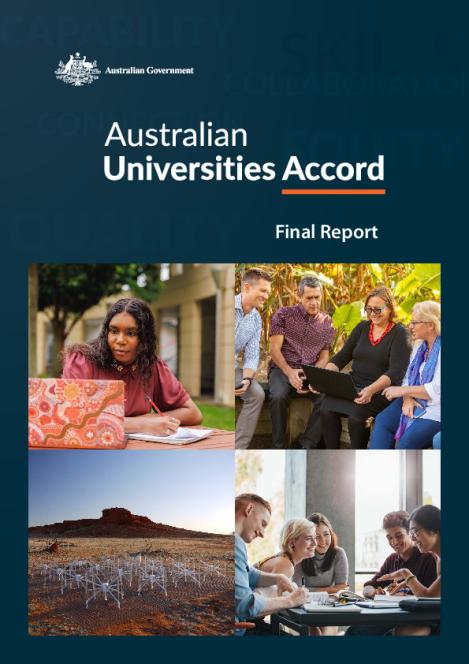
Australian Universities Accord Final Report: According to Generative AI

For the fun of it I asked Microsoft Copilot to summarize and critique the Australian Universities Accord Final Report. Here is what it came up with. ;-)

Summary:

The Australian Universities Accord Final Report, released by the Hon Jason Clare MP, Minister for Education, contains 47 recommendations aimed at reforming higher education to meet Australia’s future skills needs. Here are the key points:

  1. Reform Goals: The report sets a vision for the next decade and beyond. It aims to enhance the higher education sector’s effectiveness and responsiveness.

  2. Workforce Qualifications: The report recommends that at least 80% of the workforce should have either a vocational education and training (VET) or university qualification by 2050. Currently, this figure stands at 60%1.

  3. Long-Term Plan: The Accord Final Report provides a long-term reform plan to address the evolving demands of Australia’s workforce and economy.

For more detailed insights, you can refer to the Summary Report prepared by the Department of Education2. It outlines the themes and issues identified in the full report.

Remember, this is just a concise overview, and I recommend exploring the full report for comprehensive information.

Critique:

Let’s delve into a concise critique of the Australian Universities Accord Final Report. Here are some key points to consider:

  1. Ambitious Goals: The report sets ambitious targets, such as aiming for 80% of the workforce to have either a vocational education and training (VET) or university qualification by 2050. While this goal is commendable, achieving it will require substantial effort and investment.

  2. Implementation Challenges: The report outlines several recommendations, but translating them into effective policies and practices may face challenges. Implementation across diverse universities and regions could be complex.

  3. Equity and Access: While the report emphasizes workforce qualifications, it’s essential to ensure equitable access to higher education. Addressing barriers faced by disadvantaged groups, including Indigenous students and those from low socioeconomic backgrounds, is crucial.

  4. Funding and Resources: The report doesn’t delve deeply into funding mechanisms. Sustainable funding models are essential to support quality education, research, and infrastructure.

  5. Industry Collaboration: The report highlights the need for stronger collaboration between universities and industries. However, striking the right balance without compromising academic autonomy is critical.

  6. Digital Transformation: The report acknowledges the importance of digital skills. Universities must adapt swiftly to technological advancements and prepare graduates for a rapidly changing job market.

  7. Research and Innovation: While workforce qualifications are vital, universities’ role in research, innovation, and knowledge creation should not be overshadowed. Balancing practical skills with intellectual growth is essential.

In summary, the Accord Final Report provides a roadmap, but its success hinges on effective execution, stakeholder engagement, and ongoing evaluation. Policymakers, educators, and industry leaders must collaborate to turn these recommendations into meaningful outcomes for Australia’s higher education sector.


Thursday, February 29, 2024

Universities Accord Report: International and Regional Education Needs Credible Online Offerings

Australian Universities Accord
Final Report
, 25 February 2024
Despite the export revenue from, and controversy over, international education, the Australian Universities Accord final report (25 February 2024), waited until recommendation 22 before addressing the topic. The focus of the recommendations is aligment between what Australian tertiary instutions, both universities and vocational education and training (VET) institutions teach, and Australian economic needs. This assumes that the international student's aim is to migrate to Australia (I was an international student but did not move to Canada). The Panel also proposes growing international education in regional and remote areas. Unless there are specific jobs for the students, such as in mining, this seems unrealistic.

Why would a student, particularly a young student, prefer to student in a remote area, which they could study in one of Australia's exciting cities? The mining industry has to provide very high salaries to attract workers. Will regional universities be prepared to offer cut price courses, or a guarantied high salary part time job to students?

More realistic are proposals from the panel to streamline visa processes. Australian universities are dependent two markets: China, and India. As I warned in 2016, a regional crisis could result in the loss of most on-campus international students. Universities need to diversify markets, and delivery methods.

The panel suggests improving alumni engagement in the region. This is certainly one way to boost links, but other more direct forms of marketing should also be used.

The recommendations on international students from the panel are excessively timid. Rather than see international students as a source of funds, and workers, it can be a way to provide a more vibrant environment for domestic students, who are preparing to be part of a global workforce. I presenting a proposal in 2018 to have students of the region working together online.

Producing new knowledge and using research capability


The panel rightly chose to put learning issues before research. With recommendation 24 the panel proposes a an examination of
national research funding. However Australian universities should have already being doping that, routinely, as part of their normal planning.

Professor Lachlan Blackhall,
ANU
Deputy Vice-Chancellor
(Research and Innovation).
Panel recommends Australian governments use university research output. However, that presupposes that universities have staff with consulting skills, which are different from research skills. If universities want the results of their research to be used, then academics have to learn new skills. Many universities have made a start with this, by establishing innovation centers to teach entrepreneurial skills. Some of promoted academics with exceptional entrepreneurial knowledge, such as Professor Lachlan Blackhall, the new ANU
Deputy Vice-Chancellor (Research and Innovation).

Unfortunately the most important recommendation for using research capability is buried down in 26:
"e. ensuring that training in entrepreneurial, business, teaching and leadership skills is offered through additional qualifications in parallel with research training in preparation for careers beyond academia"
However, it is not clear that professional skills should be optional for doctoral graduates, and not a core part of their training. The government could take an alternative approach, and require this training, or transfer some of the funding to support professional doctorates, which have as their primary purpose the application of knowledge.

Establish an Australian Tertiary Education Commission

The panel recommends an "Australian Tertiary Education Commission", as an umbrella agency over existing federal higher education bodies. The idea has some merit. However, I spent some time working for the Commonwealth Schools Commission (more on this later), which lacked the powers to be truly effective. Whatever the administrative structure, education will remain a highly political issue.

Improving workforce capability and capacity

Recommendation 31 "b. encourage minimum teaching qualifications for higher education teaching roles" would not be acceptable for schools, or VET, and I suggest should not be for universities. There should be mandatory minimum teaching qualifications for universities. A simple approach would be to set these at the same level as VET, with a Certificate IV, although universities might find it easier to offer undergraduate and graduate certificates (although I found my Cert IV in T&A of more practical use than my Grad Cert in HE).

Centre of Excellence in Higher Education and Research

Recommendations 32 to 36 I suggest could be addressed together. The first is for a "Centre of Excellence in Higher Education and Research". That could then work on the others: 33 Tertiary Education Racism Study, 34 A First Nations-led review, 35 First Nations governance, supported by the last: 36 Data, measurement, and reporting.

Planning the tertiary education system of the future

Recommendation 37 is for the Australian Tertiary Education Commission to look at what tertiary education providers are needed and where. However, there are more fundamental questions to be addressed, in terms of the mix of VET and university, the mix of online and on-campus, and the mix of not and for-profit universities. One major question the Panel did ask is if specialist university should be permitted, which address one area of research. A question the Panel did not ask is if non-research institutions should called universities.

Regional tertiary education and communities

Curiously, than recommendations appear to be listed in order of importance, with the lost important last. Recommendation 39 addresses higher education delivery in regional and remote Australia. Unfortunately the Panel had confused delivery to regional, rural and remote areas, with the location of campuses in those areas. Australia was a pioneer in paper based distance education, 50 years ago. That was enhanced with the Internet and made mainstream by the COVID-19 pandemic. The idea that a student's first consideration of where a campus is belongs in the past. The Panel have some useful recommendations, such as renaming and expanding Regional Study Hubs. However, Australian Government need to seek advice on how to structure higher education more widely, or risk building a system for last century.

In 2013, when considering further study, I first looked at universities in the city where I lived. I then looked at universities within commuting distance. But I quickly dismissed these options, and enrolled at a campus 1,700 km away. For follow on studies I enrolled 17,000 km away, in another country. This was much simpler to do, and cheaper, than enrolling at an Australian university. It is this world Australian universities need to be able to compete in. Campuses are still useful to supplement learning, and research, but are no longer the main game.


Wednesday, February 28, 2024

Teaching Green Computing Online: 15 Years of Student Engagement via Nudging

I will be speaking on "Teaching Green Computing Online: 15 Years of Student Engagement via Nudging" at the HERDSA Online Engagement in Higher Education Special Interest Group, 1pm, 10 April 2024.

"In 2008 the Australian Computer Society commissioned Tom Worthington to design an online course in green computing. This course formed part of the Australian Computer Society’s professional development program. This was later run at the Australian National University as a masters course, and is still offered fifteen years later through Athabasca University (Canada).

The course uses a conventional text-based distance education format, with no video, and no webinars. Why? What was the rationale? This presentation shares key design principles of this unique format that has positively impacted student engagement. As a means of facilitating student engagement nudging techniques have been employed.

This HERDSA Special Interest Group, Online Engagement in Higher Education, will discuss the factors that have improved online student engagement and consider implications and applications of their own online courses, including a coordinated nudging process. This event will provide insights for those looking to adopt a nudging approach to better facilitate student engagement and learning.

Join this to see how this works, and can be applied at your institution."

Presentation available.


Tuesday, February 6, 2024

Learning & Teaching This Year

Professor Abby Cathcart
Greetings from the ANU Learning & Teaching Day: Connect & Inspire. Professor Abby Cathcart, QUT Director Student Success & Teaching Advancement, addressed putting joy back into university study. She pointed out the difficulties with online learning during the pandemic. As she pointed out this was made worse by it being used as an emergency measure, and provided a vision for a path out of this conundrum. One off the wall idea was to shut down the learning management system for six months, but a more practical one was to require senior academics to teach. 

What resonated with me in Professor  Cathcart's presentation was communicating to new academics that teaching is a scholarly endeavor. This doesn't require every academic to become an educational specialist, but they need to learn a little. Another point I liked was that we need to do less as teachers. Teachers, and students can become overwhelmed by the online engagement required. When learning course design one of the approaches I took was to estimate the time required by the teacher, and the student, for each activity, and ensuring this fitted in a time budget for the course.

However, I was not convinced by Professor Cathcart call for joy in teaching. Rather I suggest academics should act professionally. They need to ensure they are competent to teach, and in doing so be able to do it efficiently, without overwhelming themselves, or their students. The average academic should not innovate in their teaching, instead they should learn researched, proven methods. I was bemused and frustrated during COVID-19 by academics proudly reporting how they were inventing ways to teach online, which actually had been known and used for at least a decade.

Professor Cathcart then addressed the issue of unngaged studnts. She [pointed out that just under half of studnts said they preferred blended learning, but most did not collaborate online. As an international online student for three years I experienced a deep sense of loneliness. What helped were group projects, where I was required to collaborate with other students. 

Professor Cathcart mentioned clubs and societies at university which help with engagement. However, a student has only a limited amount of time for study, squeezed in between work, family, and other responsibilities. Any time spent in extra curricular actives will therefore come from study time. As a graduate student I did not participate in any social activities, as I was there to get through the program as quickly as possible. My view was that social activity risked distraction from study, and failure. This is a reasonable, and ration approach for students. As a result, I suggest collaborative activities have to be built into the formal compulsory, assessed program. 

Professor Cathcart cited Taylor et al 2022 relating emergency online teaching to the stages of grieving. She pointed out that learning how to teach online can make the teacher's view of teaching online more positive. As someone how spent seven years being trained to teach, and particularly online, I can understand this point of view. However, for those for whom research is the priority, it is very difficult to convince them to do a whole lot of study and await enlightenment. 

A lighted point came in the presentation when Professor Cathcart discussed how teaching could bring joy for the teacher. She quipped that discussion of joy was always illustrated with a middle aged woman doing yoga, but that was not her. 

In her introduction, Grady Venviolle mentioned hat it was great to see parents with the new students on campus. I found this a little odd, as I was escorted to primary school for the first day, but the idea a parent would accompany me to university seems weird. Also I did not set foot on the campus of the last two universities I studied at. One was more than 1,000 km away, the on the other side of the planet. Having a campus is useful for a university, but not something every student can access. The challenge is how do we provide students with options, wherever they are.