Showing posts with label Pacific Security Cooperation Workshop. Show all posts

Thursday, November 24, 2022

China’s proposed economic and security pact and Pacific responses

At the the Pacific Security Cooperation Workshop hosted at ANU in Canberra, the issue of China looking for military bases on Pacific islands is being discussed on day two of the program. One point was that these can be dual use facilities, which have an overtly civilian role. Examples are docks and airfields for civilian use, but which also can have a military role. There was also mention of China's Belt and Road Initiative. One more lighthearted was speculation that Chinese police were training Solomon Islands people in Kung Fu as a form of soft power, because Bruce Lee is better known than anything else about China.

"China’s proposed economic and security pact and Pacific responses

(Moderator: Professor Hidekazu Sakai)

Speakers

Dr Henry Ivarature, Australia Pacific Security College
Pete Connolly, Australian National University
Dr Anna Powles, Massey University
Dr Joseph Foukona, University of Hawai’i – Mānoa

  • What are the implications of the Solomon Islands-China security agreement for security cooperation in Solomon Islands?
  • What issues arise from China’s efforts to secure a regional economic and security pact?
  • What do the responses of Pacific Island countries to China’s overtures tell us about the future of regional security cooperation?
  • What are the implications of geopolitical discussions about China at the local level?"

Wednesday, November 23, 2022

Tonga Tsunami Relief Coordinated from Bungendore, NSW

At the the Pacific Security Cooperation Workshop hosted at ANU in Canberra, Air Commodore David Hombsch, HQ JOC ADF, is describing how the headquarters in Bungendore NSDW was able to take workload off personnel on the ground in Tonga during relief operations after the January 2022 tsunami. The personnel in Australia were able to coordinate with their counterparts around the Pacific, using high quality communications available. They could also take advice from experts in Canberra. This in a way goes against the usual model of military and relief operations which see a tent city built, usually at an airfield, full of staff, or on a ship offshore.

One point Mr Sione Taumoefolau, of the Tonga Red Cross made was the need for somewhere to store the materials provided by international donors. One way I suggest might be for lightweight structures built on shipping containers to be used. There is likely to be a surplus of shipping containers, and these can be used to build warehouses, by the addition of a fabric roof between two rows of containers. 

Australian Stripping Small Pacific Countries of Skilled Workers

An issue raised at the the Pacific Security Cooperation Workshop hosted at ANU in Canberra just now was Australia attracting highly trained staff from small pacific nations. The ABC reported "Pacific hospitals suffer nursing shortage as workers leave for Australia's labour scheme" (ABC Radio, 22 November 2022). This issue was taken up by other delegates at the workshop. 

Perhaps an ethical approach would be for the Australian government to compensate the countries the workers come from, for the cost of their upbringing, education and training (around $1M per worker). This would make for a more rational migration policy, rather than just using it for quick cheap labor. 

Pacific Security Cooperation Workshop at ANU

Pacific Security Cooperation Workshop
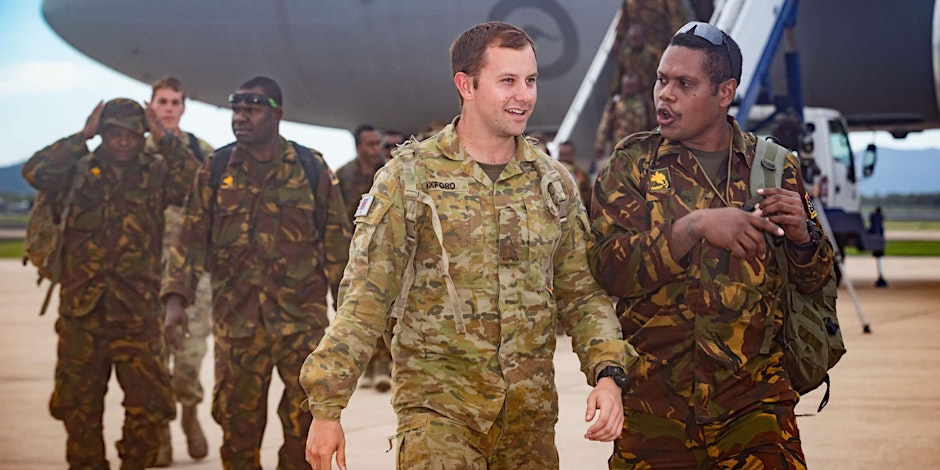
Greetings from the Pacific Security Cooperation Workshop hosted at the Australian National University in Canberra. On the agenda are response to COVID-19 and disasters, and, of course, China. This is core business for the university, which was set up, in part, to advance Australia's interests in the region. While the Pacific has not been at the forefront of strategic thinking, ANU, and other institutions, have been quietly studying it for decades. There is a report from last years workshop.

In opening remarks, Professor Alan Tidwell, Georgetown University, made the point that the US military has difficulty in cooperation with Pacific island states as most don't have a conventional military forces. This, I suggest, is a serious limitation in dealing with security issues in the region. In responding to grey zone operations, conventional military force may be counterproductive.