Showing posts with label indo-pacific. Show all posts

Thursday, November 24, 2022

China’s proposed economic and security pact and Pacific responses

At the the Pacific Security Cooperation Workshop hosted at ANU in Canberra, the issue of China looking for military bases on Pacific islands is being discussed on day two of the program. One point was that these can be dual use facilities, which have an overtly civilian role. Examples are docks and airfields for civilian use, but which also can have a military role. There was also mention of China's Belt and Road Initiative. One more lighthearted was speculation that Chinese police were training Solomon Islands people in Kung Fu as a form of soft power, because Bruce Lee is better known than anything else about China.

"China’s proposed economic and security pact and Pacific responses

(Moderator: Professor Hidekazu Sakai)

Speakers

Dr Henry Ivarature, Australia Pacific Security College
Pete Connolly, Australian National University
Dr Anna Powles, Massey University
Dr Joseph Foukona, University of Hawai’i – Mānoa

  • What are the implications of the Solomon Islands-China security agreement for security cooperation in Solomon Islands?
  • What issues arise from China’s efforts to secure a regional economic and security pact?
  • What do the responses of Pacific Island countries to China’s overtures tell us about the future of regional security cooperation?
  • What are the implications of geopolitical discussions about China at the local level?"

Wednesday, November 23, 2022

Tonga Tsunami Relief Coordinated from Bungendore, NSW

At the the Pacific Security Cooperation Workshop hosted at ANU in Canberra, Air Commodore David Hombsch, HQ JOC ADF, is describing how the headquarters in Bungendore NSDW was able to take workload off personnel on the ground in Tonga during relief operations after the January 2022 tsunami. The personnel in Australia were able to coordinate with their counterparts around the Pacific, using high quality communications available. They could also take advice from experts in Canberra. This in a way goes against the usual model of military and relief operations which see a tent city built, usually at an airfield, full of staff, or on a ship offshore.

One point Mr Sione Taumoefolau, of the Tonga Red Cross made was the need for somewhere to store the materials provided by international donors. One way I suggest might be for lightweight structures built on shipping containers to be used. There is likely to be a surplus of shipping containers, and these can be used to build warehouses, by the addition of a fabric roof between two rows of containers. 

Australian Stripping Small Pacific Countries of Skilled Workers

An issue raised at the the Pacific Security Cooperation Workshop hosted at ANU in Canberra just now was Australia attracting highly trained staff from small pacific nations. The ABC reported "Pacific hospitals suffer nursing shortage as workers leave for Australia's labour scheme" (ABC Radio, 22 November 2022). This issue was taken up by other delegates at the workshop. 

Perhaps an ethical approach would be for the Australian government to compensate the countries the workers come from, for the cost of their upbringing, education and training (around $1M per worker). This would make for a more rational migration policy, rather than just using it for quick cheap labor. 

Pacific Security Cooperation Workshop at ANU

Pacific Security Cooperation Workshop
Greetings from the Pacific Security Cooperation Workshop hosted at the Australian National University in Canberra. On the agenda are response to COVID-19 and disasters, and, of course, China. This is core business for the university, which was set up, in part, to advance Australia's interests in the region. While the Pacific has not been at the forefront of strategic thinking, ANU, and other institutions, have been quietly studying it for decades. There is a report from last years workshop.

In opening remarks, Professor Alan Tidwell, Georgetown University, made the point that the US military has difficulty in cooperation with Pacific island states as most don't have a conventional military forces. This, I suggest, is a serious limitation in dealing with security issues in the region. In responding to grey zone operations, conventional military force may be counterproductive. 

Sunday, June 13, 2021

Education for a Better World


Yesterday, President Biden announced that "The United States is rallying the world’s democracies to deliver for our people, meet the world’s biggest challenges, and demonstrate our shared values". I suggest part of this could be an online education program, to complement, rather than confront, China's Belt and Road Education Plan (Worthington, 2014 & 2018).

Expanding infrastructure in low and middle-income countries will required trained workers. The Build Back Better World  (B3W) program aims to invest trillions of dollars in developing countries infrastructure. That will require millions of trained professionals, in the fields of energy, health, digital technology, and education. 

I propose Australia be the lead partner for B3W Education, in the indo-pacific, but world wide. We can mobilize our decades of expertise in higher education. In doing so, we can create new opportunities around the world, as well as jobs at home.

References

Worthington, T. (2014, August). Chinese and Australian students learning to work together online proposal to expand the New Colombo Plan to the online environment. In 2014 9th International Conference on Computer Science & Education (pp. 164-168). IEEE. URL https://doi.org/10.1109/ICCSE.2014.6926448

Worthington, T. (2018, December). Blended Learning for the Indo-Pacific. In 2018 IEEE International Conference on Teaching, Assessment, and Learning for Engineering (TALE) (pp. 861-865). IEEE. URL https://doi.org/10.1109/TALE.2018.8615183

Thursday, May 13, 2021

Protecting Australian Education Exports

Van der Kley and Herscovitch, have produced a four page policy paper, for the ANU National Security College, on the risks to international student enrollments from China, due to tensions with Australia. Unfortunately, the provocative title of the paper may make the situation situation worse. I suggest policy proposals for protecting Australia's interests can be worded in a way which avoids giving offence.

As the paper points out, education is a $10B export industry which employs many Australians, and one of the few major ones not effected by Chinese restrictions. The industry is fragmented, with Australian public and private institutions both  competing for international students. The authors propose an Office for Education Trade, but Austrade, I suggest, is particularly unsuited to this role and may well do more harm than good. It is perhaps the lack of government intervention, which has been behind the success of this export sector. Australia has excellent, independent institutions, which international students value highly and government branding may damage this. 

Tom Worthington Speaking at NICT 2018 in Colombo
Tom Worthington, proposing Indo-Pacific
joint education initiative
, in Colombo, 2018

Australia should, obviously diversify its education market to new countries. That can take years, but Australia academics connections with the region can help with this (obvious markets are India, Sri Lanka and Indonesia).

As the authors suggest, Australia should prepare for Chinese students being discouraged from studying in Australia. In 2017 I warned of this possibility and suggested online learning should be prepared as an option. In this I avoided explicitly mentioning China, to avoid giving offence. The crash programs to implement e-learning in 2020 for COVID-19 have now made this possible. However, while providing some flexibility, a reliance on e-learning also creates a risk, as technical means could be used to cut off Australian institutions access to their students in China. 

The paper recommends increasing Australia’s education diplomacy. However, there is no mention of , its implications for Australian education exports, or the geopolitical and geoeconomic situation of the region. Rather attempting to directly challenge China, I have suggested offering alternative forms of education to the region (Worthington, 2014 & 2018). While the loss of Chinese international students is of concern, in the longer term there are far graver implications for Australian education, and the nation's strategic situation.

References

Protecting Education Exports: Minimising the damage of China’s future economic coercion, Policy Options Paper No 18, Dirk van der Kley and Benjamin Herscovitch, National Security College, May 2021. Url https://nsc.crawford.anu.edu.au/sites/default/files/publication/nsc_crawford_anu_edu_au/2021-05/digital_nsc_policy_options_paper_no18.pdf

Worthington, T. (2014, August). Chinese and Australian students learning to work together online proposal to expand the New Colombo Plan to the online environment. In 2014 9th International Conference on Computer Science & Education (pp. 164-168). IEEE. URL https://doi.org/10.1109/ICCSE.2014.6926448

Worthington, T. (2018, December). Blended Learning for the Indo-Pacific. In 2018 IEEE International Conference on Teaching, Assessment, and Learning for Engineering (TALE) (pp. 861-865). IEEE. URL https://doi.org/10.1109/TALE.2018.8615183

Monday, January 21, 2019

Education for the Indo-Pacific Does Not Need 5G Mobile Communications


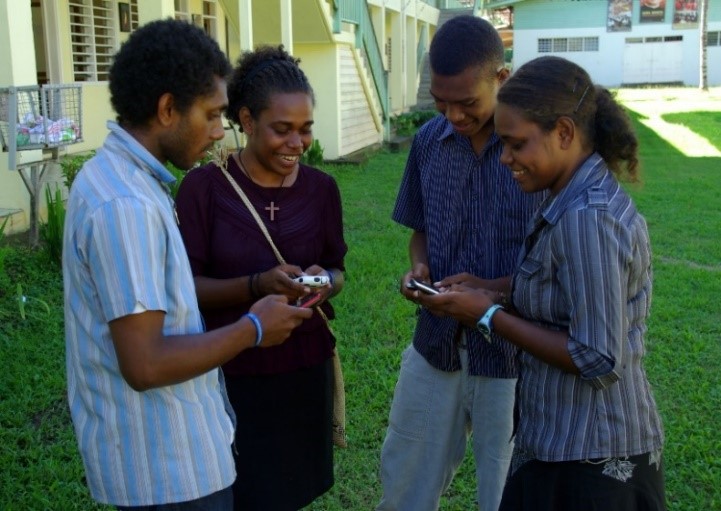
Exploring the mobile internet,
Solomon Islands,
Photo: Irene Scott/DFAT.
The short paper I presented on "Blended Learning for the Indo-Pacific" at the International Conference on Teaching, Assessment, and Learning for Engineering (TALE) in Wollongong last December, has been published by IEEE. One curious addition to the paper is the keyword "5G mobile communication". The paper discusses using smarphones for education, but I never mention fifth generation mobile networks, nor do I think these are really necessary.

A 3G or 4G network connection is more than enough for a student. A 3G network provides tens of megabits per second and 4G hundreds. This is sufficient for a student to watch videos, and upload their own, as well as take part in live video conferences. In practice students may have much more limited access, due to cost and logistics, so I design online courses where the student can download large materials infrequently, and then use a much slower connection for interaction.

An example of where this may be an issue is the Solomon Islands. The Australian Government is funding a fibre optic cable to the Solomon Islands and the Department of Foreign Affairs and Trade has asked for ideas how this could help young people with skills and education. I have submitted a proposal "Micro-credentials by Mobile Phone for the Solomon Islands", which is based on my TALE paper.

The problem in the Solomon Islands will be getting the data from the point where the fibre optic cable lands, to where the population is. It is likely the the capital, Honiara on Guadalcanal, will be connected, but not all of the other populated islands.

To address this issue I design online courses which do not require a high speed connection. The student can download all the materials required at the start of the course from a cyber cafe (or be sent a data file in the post). They then only need a slow connection to read announcements and participate in text based forums. Live interactive video is nice to have, but not at the cost of excluding many students. If a 2G GPRS connection is available, providing about 100 kbps, the student can take part in Webinars with audio and slides.

Where video and audio are not available, the course designer and instructor have to make sure that the student gets a sense of human connection, through the text based forums. This is not ideal, but can be made to work.

Paper

T. Worthington, "Blended Learning for the Indo-Pacific," 2018 IEEE International Conference on Teaching, Assessment, and Learning for Engineering (TALE), Wollongong, Australia, 2018, pp. 861-865. doi: 10.1109/TALE.2018.8615183 URL https://doi.org/10.1109/TALE.2018.8615183

Keywords: 5G mobile communication; Australia; Conferences; Education; training; employment; educational institutions; teaching; Australian educational system; assessment; cognitive learning theory; social learning theory; Indo-Pacific; blockchain; micro-credentials

Thursday, December 6, 2018

Blended Learning for the Indo-Pacific

Tom Worthington. Photo by Stuart Hay, ANU Senior Photographer, 2014Greetings from the the IEEE 7th International Conference on Teaching, Assessment, and Learning for Engineering (TALE) in Wollongong where I was speaking on "Blended Learning for the Indo-Pacific". This proposal has been entered in the the Solomon Islands Technology for Development Challenge to provide Micro-credentials by Mobile Phone for the Solomon Islands.
"Information technology disciplines make up a significant proportion of the degrees taken by international students at Australian universities. These programs are primarily delivered on-campus, but are increasingly using e-learning techniques and becoming, in effect, blended. This provides the opportunity to offer international students part of their program by distance education before, or instead of, traveling to Australia. This could complement the campus-based education provided and complement initiatives by China, Australia, Japan and the United States for regional development. However, Australian university academics have little background or training in e-learning and program designs have not made use of the flexibility this provides. In this paper, we discuss how computer professionals can be trained online to deliver online training to students of the Indo-Pacific. The application of learning theory to support distance learners is also discussed in this paper."
This followed papers from others at the conference on the globalization of Chinese education, Smart Learning at the University of the South Pacific and 21st Century Skills.

ps: TALE 2019 will be December 3-6,  in Yogyakarta, Indonesia. And, just announced, TALE 2020 will be in Takamatsu, Japan. 

Saturday, November 24, 2018

Micro-credentials by Mobile Phone for the Solomon Islands


Exploring the mobile internet,
Solomon Islands,
Photo: Irene Scott/DFAT.
The Australian Government is paying for a fibre optic cable to the Solomon Islands. With the Solomon Islands Technology for Development Challenge, the Department of Foreign Affairs and Trade has asked for ideas how this could help young people with skills and education. The winning idea will receive up to $250,000 AUD for implementation.

I have entered the Challenge with "Micro-credentials by Mobile Phone", to develop courses delivered via smart phones, which provide a vocationally relevant credential, within months, rather than taking years. The winning idea will receive up to $250,000 AUD for implementation, as part of the Australia’s Cyber Cooperation Program. I outlined my proposal to the Australian Computer Society's Canberra conference a few months ago National IT Conference in Colombo in October and will be presenting a short paper on it at the 7th International Conference on Teaching, Assessment, and Learning for Engineering, in Woolongong, 6 December 2018.

Micro-credentials by Mobile Phone

Explain your idea

Provide short courses to students via mobile phones. To provide maximum benefit, the courses would provide a micro-credential, as well as industry certification, and credit towards more advanced qualifications. The courses would be designed and delivered jointly, by institutions acrossExploring the mobile internet,
Solomon Islands,
Photo: Irene Scott/DFAT.Exploring the mobile internet,
Solomon Islands,
Photo: Irene Scott/DFAT. the Indo-Pacific, to mixed classes of students from the region.

Who will benefit from your idea?

Courses will be delivered to those with at least a primary school education. The course content will be designed to work on low cost phones now available and with limited network access. Initially courses would focus on teaching teachers in how to use the technology for teaching. Courses would connect students from across the Indo-Pacific, reducing isolation. Micro-Credentials would be achievable with a few weeks study, unlike conventional qualifications, which take months or years.

How will your idea have a development impact?

Providing training and qualifications will improve the prospects for employment of youth employment. The use of short mobile courses will provide education to those who could not be catered for in conventional courses.

How developed is your idea?

Research & Early Testing
A short formal paper on this has been accepted for thExploring the mobile internet,
Solomon Islands,
Photo: Irene Scott/DFAT.e 2018 IEEE 7th International Conference on Teaching, Assessment, and Learning for Engineering (TALE), in Woolongong, 4-7 December 2018.  http://www.tomw.net.au/technology/it/indo_pacific_blended_learning/
A project at the ANU has developed prototype software to deliver courses: https://cecs.anu.edu.au/research/student-research-projects/async-sync-learning-system

Tell us more about you

I am an independent educational technology consultant, and an Honorary Senior Lecturer in the Research School of Computer Science at the Australian National University. I am a Certified Professional member of the Australian Computer Society, as well as a Fellow of the Higher Education Academy, and have a a Master of Education in Distance Education  and am the author of "Digital Teaching In Higher Education".
My plan is to make use of some of the 300 ANU Techlauncher students to build software, and education students to build content. I am also looking to work with academic, and business, partners.
Some of the other ideas proposed so far are: 

Thursday, November 1, 2018

Blended Learning for the Indo-Pacific

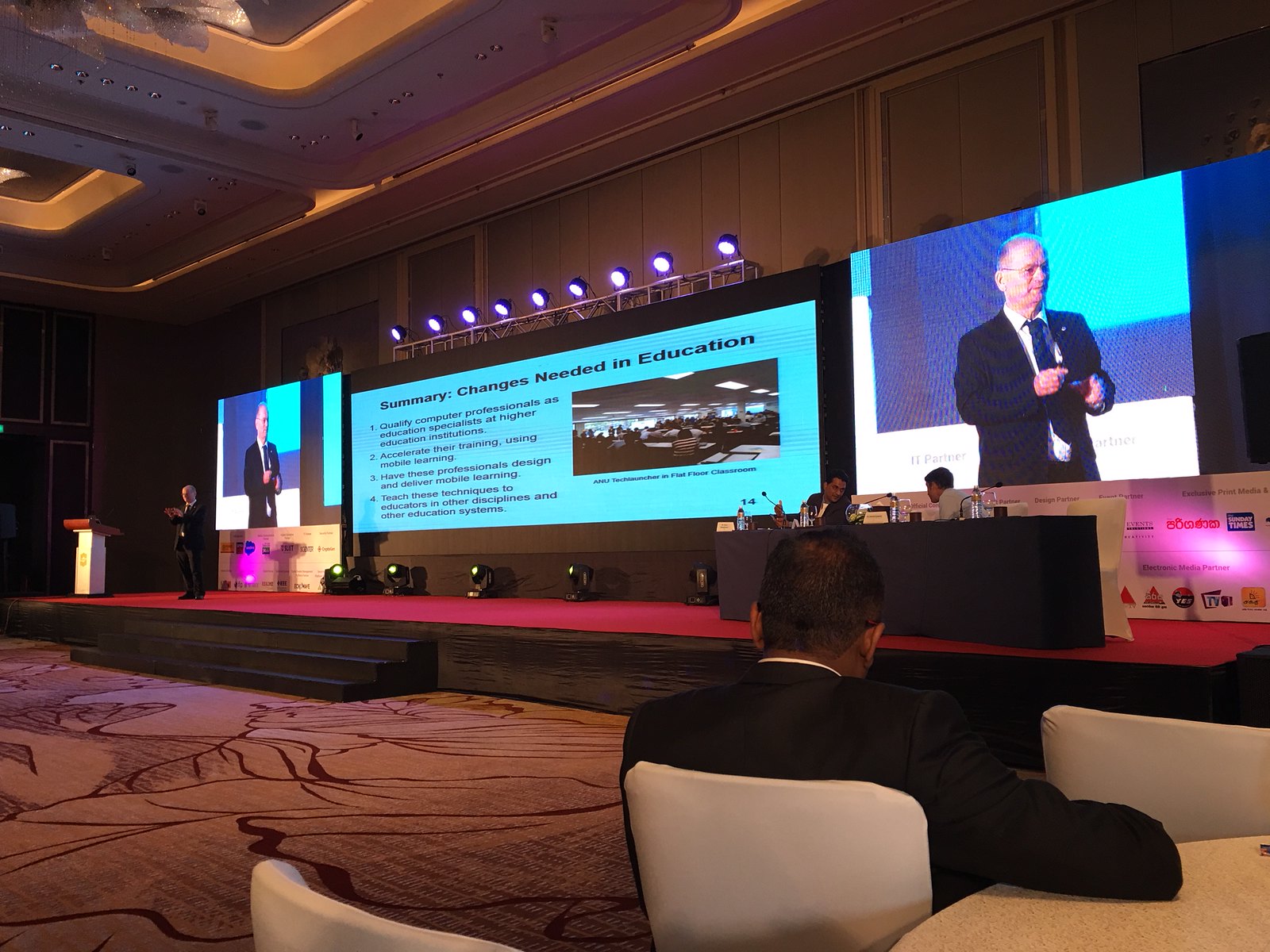
Tom Worthington Speaking at NICT 2018 in Colombo
Tom addressing the
Computer Society of Sri Lanka
A few weeks ago I outlined a proposal for a Colombo Plan 2.0, in the city of Colombo, at an international conference opened by the nation's president. This proposed delivering micro-credentials via mobile devices, to students of Indo-Pacific.  It would bootstrap mobile education by using m-learning to teach computer professionals how to design and deliver such courses. To provide maximum benefit from the courses, each would provide a micro-credential, as well as industry certification, and credit towards a degree. The courses could be designed and delivered jointly, by institutions across the Indo-Pacific, to mixed classes of students from the region. It would provide a response to China's Belt and Road Education Plan, but in a non-confrontational way.

A short paper to present on this has been accepted for TALE 2018, in Woolongong, 4-7 December 2018:
  • Worthington, Tom. Blended Learning for the Indo-Pacific. In Teaching, Assessment, and Learning for Engineering (TALE), 2018 IEEE 7th International Conference on. IEEE. url https://doi.org/10.1109/TALE.2018.8615183
     

Saturday, September 1, 2018

Energy, Education and Mobile Devices in the Indo-Pacific

From 2 to10 October I will be giving three talks on Energy, Education and Mobile Devices, in Sri Lanka and Singapore.

My first talk is "Computer Professionals Providing Mobile Learning for the Digital Economy" at the Computer Society of Sri Lanka's National IT Conference (NITC 2018),  9 am 3 October. Speakers were asked "... how do we drive a digital economy? What should be the key measurements? ..." and I am answering this with mobile education.

Second talk is "Decreasing Campus Energy Use With Flexible Classrooms and e-Learning" at EduBuild 2018 in Singapore, 9 October, 5:20pm. This is a new part of the annual EduTech conference, focusing on classroom design and use.

The next day at EduBuild (10 October, 11:55am), I will be taking part in a discussion of "Learning to use new  tech-infused teaching spaces".

I am happy to give talks at other venues.  On a previous visit to Sri Lanka I talked to the Sahana Foundation on disaster management.

Tuesday, July 24, 2018

Canberra Plan 2029: Blended Learning for the Indo-Pacific

This is to propose that over the next ten years Australia develop accessible, low cost post-secondary education for the Indo-Pacific region, using blended techniques. Students would study online using their mobile device at home and then come to Australia for more advanced classes. This would complement, rather than compete with, China's Belt and Road Education Plan (China Ministry of Education, 2016).

I am scheduled to speak at the National IT Conference in Sri Lanka (NITC 2018), in Colombo 2 to 4 October 2018, organized by the Computer Society of Sri Lanka (CSSL) and at EduTech Asia 2018 in Singapore 8 to 11 October 2018. So need something to talk about. So I thought I would develop ideas I explored in previous conferences.

Chinese universities are forming join ventures with institutions in the region and providing scholarships for citizens of the region to study in China (Australian Department of Education. (2017). However, these are based on the use of conventional campus based education. Australia could complement these initiatives using new forms of blended learning, which merge campus with online learning (Worthington & Wu, 2015). This would allow students of the region to work together online (Worthington, 2014).

References


Australian Department of Education. (2017, 27 November). China's Belt and Road Initiative - Education, Department of Education, Australian Government. URL https://internationaleducation.gov.au/International-network/china/PolicyUpdates-China/Pages/Chinas-Belt-and-Road-Initiative-.aspx

China Ministry of Education. (2016, July). Education Action Plan for the Belt and Road Initiative, Ministry of Education, People’s Republic of China. URL https://eng.yidaiyilu.gov.cn/zchj/qwfb/30277.htm

Worthington, T. (2014, August). Chinese and Australian students learning to work together online proposal to expand the New Colombo Plan to the online environment. In Computer Science & Education (ICCSE), 2014 9th International Conference on (pp. 164-168). IEEE. URL https://doi.org/10.1109/ICCSE.2014.6926448

Worthington, T., & Wu, H. (2015, July). Time-shifted learning: Merging synchronous and asynchronous techniques for e-learning. In Computer Science & Education (ICCSE), 2015 10th International Conference on (pp. 434-437). IEEE. URL https://doi.org/10.1109/ICCSE.2015.7250285

Monday, May 21, 2018

An Indo-Pacific Strategy for Australia

Greetings from the Australian National University in Canberra, where Director of the ANU Crawford School of Public Policy, Professor Rory Medcalf, is speaking on "Mapping our future: towards an Indo-Pacific strategy for Australia". He emphasized China's dependence on oil transported by ship through the Indian Ocean. However, China has embarked on the largest implementation of renewable energy, electrified railways and electric vehicles the world has seen. China does need oil from the middle east, for the present. But this may less important to China in the long term than it does in Australia and the USA.

Professor Medcalf suggested there is an unspoken consensus between the Australian government and opposition that Australia should participate in China's Belt and Road projects, on a case by case basis. He argues that China find the term "indo-pacific" politically loaded against it. Professor Medcalf also pointed out that France had called for an "Indo-Pacific Axis". That might be an even more unfortunate term, given the extent to which China suffered from the Rome–Berlin–Tokyo Axis in WWII.

Professor Medcalf mentioned soft power, including. The ANU now offeres courses in both defensive and offensive cyber-operations and teach a little on the ethics of cyber-warfare over the South-China Sea. He also mentioned aid and development. I was one of a team at ANU which prepared a proposal to provide high quality, accessible education across the Indo-Pacific: "Peace Through Superior Education".

Sunday, March 25, 2018

Senate Inquiry into UN Sustainable Development Goals

The Senate Foreign Affairs, Defence and Trade Committee has invited submissions to an Inquiry into the United Nations Sustainable Development Goals (closing 29 March 2018). Here are some thoughts on how the Australian education system can help our region.

Australia can use digital networks to engage, educate and influence sustainable development in the region. This can help with SDG Goal 17: "Enhance North-South, South-South and triangular regional and international cooperation on and access to science, technology and innovation and enhance knowledge sharing ...".

Apart from the original Colombo Plan, where Australia funded students from developing nations to study in Australia, there has been the Virtual Colombo Plan (2001) to provide $230M to support of distance education programs in developing countries. The most notable scheme funded under the virtual plan was the African Virtual University. More recently, in 2015, the Australian Academic Research Network (AARnet) proposed a fibre-optic link to the region's educational institutions to Australia in a Digital Colombo Plan. However such plans have been ah-hoc and lacking in a clear benefit to Australia.

Some areas for Australia:
Australian university academics currently lack the skills needed to produce quality on-line courses. This will require academics to obtain formal teaching qualifications.