 |
| Tom Worthington with the ACS Team at Edutech AU 2025 |
Showing posts with label Higher Education. Show all posts
Showing posts with label Higher Education. Show all posts
Wednesday, June 11, 2025
Educating Computer Professionals

Sunday, June 8, 2025
The University Evolving in Sydney This Week

I am delighted to be chairing "The Evolving University", at the Sydney Convention Center on Tuesday. This is the Higher Education stream of EDUtech Australia 2025. Here is the program (there are plenaries with the other streams before this):
Understanding authentic assessment and how it applies to digital learning
- Prof Kevin Ashford-Rowe, Pro Vice-Chancellor (Learning and Teaching), Queensland University of Technology
Heads we win, tails you lose: AI detectors in education
- Mark Bassett, Director, Academic Quality, Standards and Integrity, Charles Sturt University
Creating a more digitally enabled University,
- Cherie Diaz, Executive Director, Education Innovation, Western Sydney University
- Lynnae Venaruzzo, Head, Technology Enabled Learning, Western Sydney University
Capabilities of AI in the context of contemporary learning, teaching and assessment
- Danny Liu, Professor of Educational Technologies, The University of Sydney
Cheating ourselves: Higher ed’s missteps with Generative AI
- Lew Ludwig, Director, Teaching Center, Denison University
Grounding AI in learning theory
- Craig Sims, Academic lead: Digital Pedagogies, Curtin University
PANEL - International education and edtech ecosystems for higher education
- Moderator: Mark Greentree, Executive Director, Technology Enablement, NSW Department of Education
- Harneet Singh, The Lion Founder and Chief AI Officer, Rabbitt AI
- Zuraidah Ismail, Director, Pusat PERMATA Kurnia (Ministry of Education)
- Dr Geri Harris, Business Undergraduate Programme Director, Auckland University of Technology (AUT)
Wednesday, October 13, 2021
Integration with Universites Proposed by Private Training Providers
The Independent Tertiary Education Council Australia has proposed "Seven Priorities For A Skilled & Educated Workforce". ITECA is made up of private sector vocational training providers, and their proposals aim to integrate that sector with the mostly government funded university sector. The federal and state governments run separate funding and regulatory systems for the university (which are mostly public) and the vocational sectors (which has more private providers, both not and for-profit). Part of the difference is due to Australia's universities having dual roles of both research and education, and a resulting level of autonomy which neither the public or private sector vocational institutions enjoy.
Australia already has an integrated tertiary education system, at least conceptually. Universities and vocational education are part of the ten level Australian Qualifications Framework, with VET at the lower levels, university at the upper end and an overlap in the middle. Some Australian universities are dual sector, typically offering students a vocational qualification with the option of articulation to university. However, the level of standardization which exists in the VET sector, does not apply to university. As a result a student who has undertaken studies at VET, can't be assured of receiving full recognition at a university (or even from one university to another).
While a fully integrated system with student choice, and less red tape is appealing, it would not come without risks and costs. The Australian government previously expanded funding of student loans for VET without putting in place adequate controls. This resulting in billions of dollars being wasted, by unscrupulous providers, signing up students who had no hope of completing their courses. As well as a loss of public money, and damage to Australia's reputation as an education provider, this caused harm to thousands of students. Any new system will need to ensure there are checks and balances in place to prevent a repeat of this happening again. The use of real time online reporting, and industry self regulation would help.
The seven priorities proposed by the ITECA are:
- "An integrated tertiary education system: That the Australian Government develop a five-year strategy to deliver an integrated tertiary education system, in which the higher education and vocational education and training sectors operate as one, yet retain their separate and distinct strengths and identities.
- A more cohesive approach to regulation and reporting: That the Australian Government places tertiary education red tape reduction on the agenda at National Cabinet to develop a strategy that delivers a convergence of regulatory and reporting obligations, eliminating duplicative, redundant and burdensome regulation and reporting at a state/territory and national level.
- An investment that strengthens students choice in higher education: That the Australian Government expand the highly successful investment it has made, enabling students to study in a Commonwealth-subsidised place with a quality independent higher education provider and engage in the critical thinking and learning needs they choose.
- An approach to skills funding that empowers student choice: That the Australian Government’s investment in skills be provided only to those jurisdictions that award funding on the basis of empowering student choice, allowing students to study with a provider (whether independent or public) that has a demonstrated ability to help them achieve their life and career goals.
- An approach that funds courses where the skills shortages are: That the National Skills Commissioner, working with states and territories, identify where an increase to skills funding is required by identifying the qualifications to be subsidised with the support for students (and made available to an RTO) reflecting the cost of achieving excellence in training outcomes.
- A single student loan program that supports lifelong learning: That the Australian Government overhaul tertiary education student loans programs, creating a single lifelong learning account (incorporating FEE-HELP and VET Student Loans), enabling students to access income-contingent loans, without the existing Student Loan Tax, available from Certificate IV through to post-graduate level study in a seamless way, throughout their working lives.
- A bold new plan for international education: That the Australian Government immediately put in place a plan to rebuild Australia’s capacity and reputation to support international students, backed by a new International Education Commission tasked with implementing the new Australian international education strategy."
Sunday, June 13, 2021
Education for a Better World
Yesterday, President Biden announced that "The United States is rallying the world’s democracies to deliver for our people, meet the world’s biggest challenges, and demonstrate our shared values". I suggest part of this could be an online education program, to complement, rather than confront, China's Belt and Road Education Plan (Worthington, 2014 & 2018).
Expanding infrastructure in low and middle-income countries will required trained workers. The Build Back Better World (B3W) program aims to invest trillions of dollars in developing countries infrastructure. That will require millions of trained professionals, in the fields of energy, health, digital technology, and education.
I propose Australia be the lead partner for B3W Education, in the indo-pacific, but world wide. We can mobilize our decades of expertise in higher education. In doing so, we can create new opportunities around the world, as well as jobs at home.
References
Worthington, T. (2014, August). Chinese and Australian students learning to work together online proposal to expand the New Colombo Plan to the online environment. In 2014 9th International Conference on Computer Science & Education (pp. 164-168). IEEE. URL https://doi.org/10.1109/ICCSE.2014.6926448
Worthington, T. (2018, December). Blended Learning for the Indo-Pacific. In 2018 IEEE International Conference on Teaching, Assessment, and Learning for Engineering (TALE) (pp. 861-865). IEEE. URL https://doi.org/10.1109/TALE.2018.8615183
Thursday, May 13, 2021
Protecting Australian Education Exports
Van der Kley and Herscovitch, have produced a four page policy paper, for the ANU National Security College, on the risks to international student enrollments from China, due to tensions with Australia. Unfortunately, the provocative title of the paper may make the situation situation worse. I suggest policy proposals for protecting Australia's interests can be worded in a way which avoids giving offence.
As the paper points out, education is a $10B export industry which employs many Australians, and one of the few major ones not effected by Chinese restrictions. The industry is fragmented, with Australian public and private institutions both competing for international students. The authors propose an Office for Education Trade, but Austrade, I suggest, is particularly unsuited to this role and may well do more harm than good. It is perhaps the lack of government intervention, which has been behind the success of this export sector. Australia has excellent, independent institutions, which international students value highly and government branding may damage this.
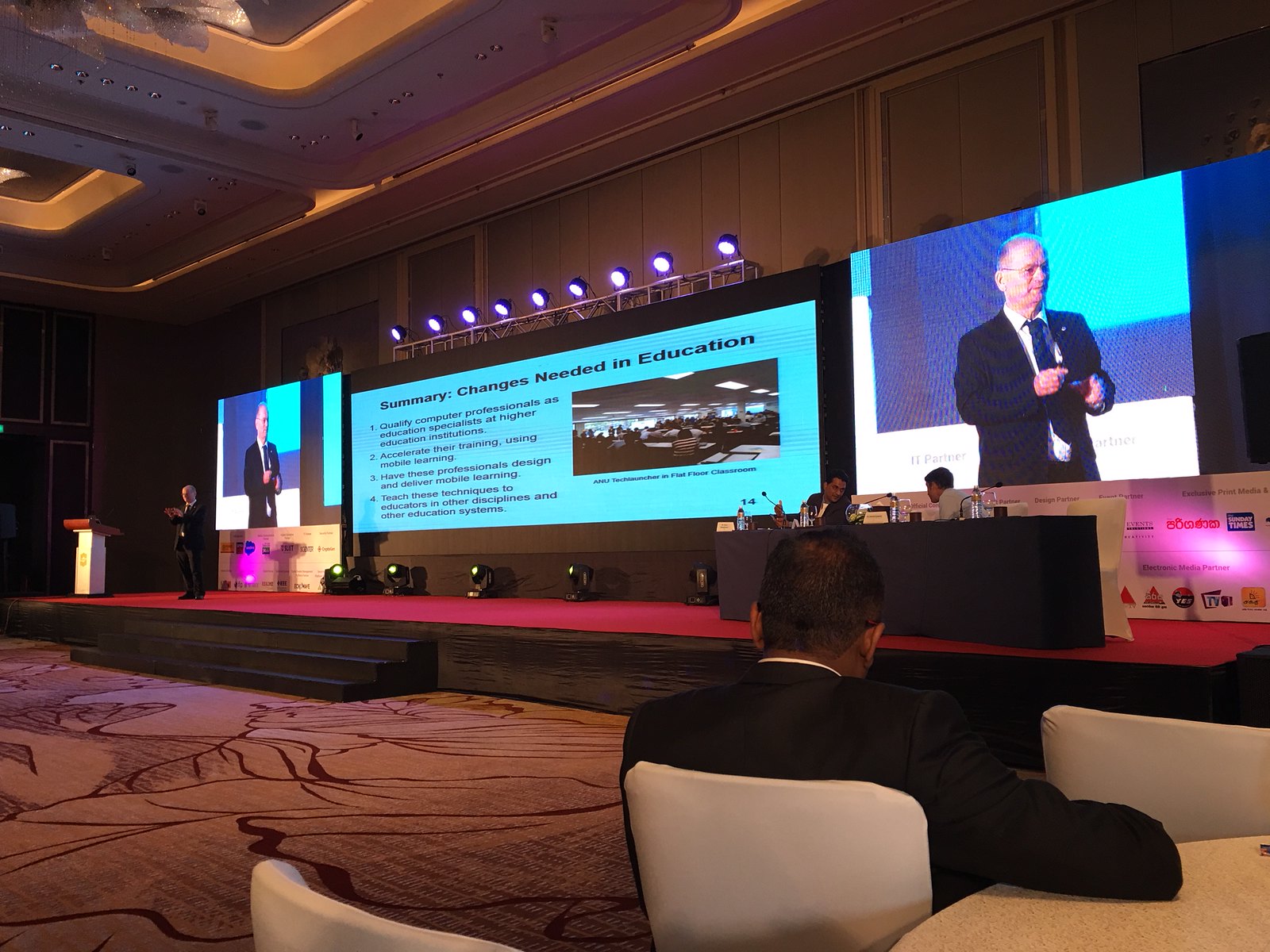 |
| Tom Worthington, proposing Indo-Pacific joint education initiative, in Colombo, 2018 |
Australia should, obviously diversify its education market to new countries. That can take years, but Australia academics connections with the region can help with this (obvious markets are India, Sri Lanka and Indonesia).
As the authors suggest, Australia should prepare for Chinese students being discouraged from studying in Australia. In 2017 I warned of this possibility and suggested online learning should be prepared as an option. In this I avoided explicitly mentioning China, to avoid giving offence. The crash programs to implement e-learning in 2020 for COVID-19 have now made this possible. However, while providing some flexibility, a reliance on e-learning also creates a risk, as technical means could be used to cut off Australian institutions access to their students in China.
The paper recommends increasing Australia’s education diplomacy. However, there is no mention of China's Belt and Road Education Plan, its implications for Australian education exports, or the geopolitical and geoeconomic situation of the region. Rather attempting to directly challenge China, I have suggested offering alternative forms of education to the region (Worthington, 2014 & 2018). While the loss of Chinese international students is of concern, in the longer term there are far graver implications for Australian education, and the nation's strategic situation.
References
Protecting Education Exports: Minimising the damage of China’s future economic coercion, Policy Options Paper No 18, Dirk van der Kley and Benjamin Herscovitch, National Security College, May 2021. Url https://nsc.crawford.anu.edu.au/sites/default/files/publication/nsc_crawford_anu_edu_au/2021-05/digital_nsc_policy_options_paper_no18.pdf
Worthington, T. (2014, August). Chinese and Australian students learning to work together online proposal to expand the New Colombo Plan to the online environment. In 2014 9th International Conference on Computer Science & Education (pp. 164-168). IEEE. URL https://doi.org/10.1109/ICCSE.2014.6926448
Worthington, T. (2018, December). Blended Learning for the Indo-Pacific. In 2018 IEEE International Conference on Teaching, Assessment, and Learning for Engineering (TALE) (pp. 861-865). IEEE. URL https://doi.org/10.1109/TALE.2018.8615183
Thursday, October 22, 2020
Managing Change in Australian Higher Education
Greetings from the Australia and the post-pandemic world symposium at the Australian National University. I am on a panel at on "education and online learning in a pandemic". By keeping international students away from Australian university campuses, COVID-19 has caused a sudden change in the way higher education is provided. The question now is: what of the future?
COVID-19 will hopefully be under control around the world in the next few years, but there may not be a return to business as usual at Australian universities. The geopolitical situation Australia finds itself in may again prevent international students from coming to Australian campuses and may also offer international alternatives to them.
The increasing number of domestic students attending Australian universities is also forcing a rethink of what it is for. When only a few attended university, they could expect a good job after, regardless of what they had studied. With many more at university, employers can be more selective, looking for those with relevant qualifications and practical experience.
Some academics long for the return to a golden age, when university was about the pure pursuit of pure knowledge. But Australian universities were founded to provide trained professionals and research to assist with economic development. What jobs should graduates now being trained for? Which research will help the Australian economy?
Australian universities are now considering what to do in the longer term after COVID-19. As it happens my MEd studies focused on how Australian universities could provide online education to international students, particularly in China and India.
Some have argued that we need to retain traditional campus based teaching to provide quality education. However, the research I have examined over seven years studying the topic indicates online learning is at least as good. Also at international conferences on the topic I have seen how my colleagues from China and India have embraced large scale online learning. What has been holding them (and I) back has been a widespread perception online learning is inferior, some of which is set in government regulations. COVID-19 has seen regulations preventing online learning waved and a grudging acceptance of it. As with fax machines, email, and the web, which were all considered suspect at first and not for official purposes, I suggest we are just past the tipping point, where online learning has become the default option. This is not before time, as in 2017 I predicted it would happen by 2020. ;-)
While plans for change by private institutions tend to be hidden away, public universities operate with a level of consultation. The Australian National University has taken the step of consulting widely with staff and making its change management plans public. This includes the Change Management Plan: College of Engineering and Computer Science (CECS), issued 15 October 2020. This is a detailed 39 page document covering the context of why change is needed, the current structure of the College and a proposed slimmed down structure with a new operating model using activity clusters.
The current CECS structure has four research schools, three institutes, a professional services group and the deputy dean. The proposed new structure would have three clusters, plus the professional services group and the deputy dean. The new clusters would be Engineering, Computing and Cybernetics. The first two of these do not appear a radical change, and the third is built around the groundbreaking work of the 3Ai Institute.
Having spent decades as a public servant, an office holder in the Australian Computer Society, honorary lecturer at ANU and a Visiting Scientist at CSIRO, I have been through many organisational restructures.
The question which I first look at in any restructure is "How does the effect me?". I don't get paid by ANU for being an honorary lecturer, so there are no financial consequences from a restructure (I donate money to ANU for prizes and scholarships). However, I have a professional and emotional investment in helping with research and teaching at the university. Currently I am delivering a learning module for the TechLauncher Program and supervising a project to provide better online learning. Can I continue with these, or what else can I help with in the new structure?
My area of interest is the human aspects of computing: professional ethics, human computer interfaces, communication and project skills for professional, how to teach these online and in the workplace. My background is in defence computing, so I also take an interest in cyber security. Currently I am associated with the RSCS Human-Centered computing (HCC) group. But where would I fit in the new organisation, if at all?
Looking at the proposed new structure there in no HCC group. The proposed new Computing cluster appears to be mostly "hard" science, with the human elements moved to Cybernetics. The closest match for my interests in Cybernetics appears to be "Systems" (that is systems engineering). This is of particular interest as it includes a proposal to provide professional development (PD) courses, which I have designed and delivered previously.
Considering the role of university more broadly, I encourage my students to think about who the customer is and what product they are being offered. The restructuring of the Australian university sector has to consider what products are to be produced, how, and who will be willing to pay for them. Universities produce two main products: educated professionals and research.
Clearly, the education of professionals has changed: this will take place more online and (hopefully) in the workplace, not on a campus. My rule of thumb is that the typical student will need to be on campus (or an educational setting in the workplace) for about 20% of their studies. Students have jobs, families and other commitments, which they must fit in their studies around. This requires greater flexibility.
Universities need to be able to provide education in smaller units (thus the move to micro-credentials). However, this is not simply a matter of replacing lectures with Zoom and moving exams online. This requires staff, and I suggest students, to be formally educated (not just trained) in how to teach and learn.
For several years I have been designing a set of micro-credentials, to teach computer students how to teach. Rather than think of teaching as something new employees at university are "trained" in, this could be part of the education of professionals. Advanced students would enroll in a course as part of their degree to learn to teach, while at the same time being tutors to less advanced students. The tutors would be paid to tutor, but would have to pay the university the usual course fee for their teaching course. This would enable enough time and resources to be made available to teach students to teach well.
Several times I have mentioned training for and in a workplace. This may sound like the sort of Vocational Education and Training (VET) done by TAFEs and not at university level. In practice TAFEs do a very good job of training (I have a a Certificate IV in Training and Assessment from the Canberra Institute of Technology). The upper end of VET training with the lower end of university education and there are useful possible synergies from this. Also there are forms of advanced workplace and vocational training at universities. Medical practitioners are educated on university campuses and then trained in teaching hospitals. The same can be done with other professions, including engineering and computing.
Under the Australian university system, institutions and individual academics, have to balance conflicting demands of research and education. A university's reputation is based primarily on research. The more theoretical and specialized the research, the more highly regarded it is. In terms of public benefit, applied research carried out by multi-disciplinary teams is more useful. However, universities and individual academics tend not to be rewarded for applied useful research.
Similarly with education, that provided by a leading researcher is considered more prestigious. However, researchers don't necessarily make good teachers. What makes good teachers is formal training in teaching, incorporating practice. However, students tend to select a university and program based on public rankings which are largely based on research reputation, not measured of education quality.
The dilemma for university and individual academics is to provide research and education of a high quality, while the measures used reward them for something else. One way is to change the system, such as through promotion of new metrics, such as the Webometrics Ranking of World Universities. This ranks 30,000 educational institutions, many more than other measures, and included non-university institutions, such as Australian TAFEs and private providers.
Another approach is to train academics, particularly new ones, in collaborative commercialization and educational techniques, which will benefit them, their institution, their students and the community.
ps: A very simple low cost ideas is "Student Ambassadors: One student in each on-campus activity monitors the chat from those remote by video and alerts the room of anything relevant.".
Wednesday, September 9, 2020
Higher Education in the Post-pandemic World
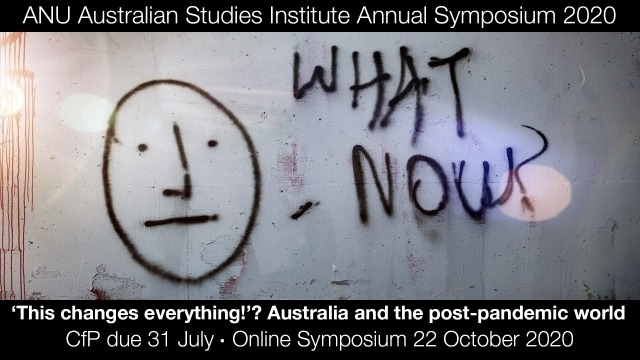
The organizers first asked for an abstract (below) and then a 5 to 8 minute video. The videos will be made available two weeks before the symposium. On the day, there are one hour sessions scheduled with five "papers" each, so about ten minutes per paper. Each presenter has been asked to include two or three questions, or statements, to promote discussion. This is an interesting attempt to translate the symposium format to the online world.
In a traditional academic symposium, the presenter reads their entire paper word by word. With a literate writer, who is also an engaging speaker, on an interesting topic, this can be spellbinding, but often it is very tedious. It will be interesting to see if the online format, with pre-recorded videos and the questions is successful in creating a useful discussion.
I am not sure what I can fit in a 5 to 8 minute video. So to start I produced a video with just the abstract, using Vidnami, synthetic speech and Creative Commons Licensed images. The abstract took just over one minute to read, so there was room for about seven more paragraphs.
This work started as a series of six talks in the Microlearning Series curated by Manisha Khetarpal at Maskwacis Cultural College in Canada. You can read the original talks, as well as the revised five minute version for the symposium: Video, Notes and Script
Higher Education in the Post-pandemic World
Mr Tom Worthington, Honorary Lecturer, Research School of Computer Science, The Australian National University
Abstract
Like many educators, my world changed suddenly in early 2020. I was called to an emergency meeting of the staff of the Australian National University, College of Engineering and Computer Science. We were told that due to COVID-19 many of our international students would be unable to get to campus: could we teach them online? There was a moment of shocked silence, then a roar of questions: “How many? How long for? Will they have Internet access? What about assessment?” It happened for my Masters of Education I looked at how to provide online education to international students at a research intensive university. Also I had worked in emergency planning at the Australian Department of Defence, so had some relevant experience. But it has been a challenging year. What are the lessons learned for educating professionals online? How will this change higher education for domestic and international students into the future?
Shift to Remote Work and Study in March 2020
"The advice from our ANU medical experts is clear: to control the spread of COVID-19 we must take tough action ... so effective tomorrow Thursday 26 March, all our campuses will shift to remote work and study." From the Vice Chancellor of the Australian National University, Professor Brian P. Schmidt AC FAA FRS, 25 March 2020.
On 6 February 2020 I attended an emergency staff meeting at the Australian National University where we were asked if we could quickly switch to teaching online. Some of our students and staff were overseas so unable to return to campus. The Vice Chancellor announced first a "pause", then a wholesale shift to online teaching and working from 26 March.
Online Teaching for COVID-19 Worked

- Course materials and assessment using the existing Moodle Learning Management System
- Project group work using the existing project tools, such as Slack
- Face to face student/staff interaction replaced with video conferencing (Zoom).
The Australian National University already had a well supported suite of online learning tools, based around the Moodle Learning Management System. This continued to be used to deliver documents, pre-recorded videos and assessment tasks to students. Moodle was also used to provide students with quizzes and text based asynchronous forums to aid their learning Computer science students continued to use project management and communication tools, such as GitHub and Slack, for working in teams on group projects (Worthington, 2020). COVID-19 forced the replacement of face to face team meetings, tutorials and workshops with video conference tools, such as Zoom.
Higher education after COVID-19: Online Plus Campus
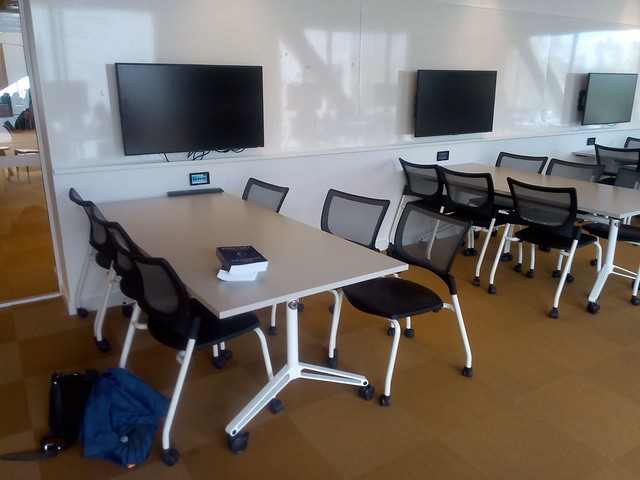 |
| Wall mounted LCD screens & desks on wheels at ANU Marie Reay Teaching Centre |
One possible future for higher education is Online Plus. There can still be campuses with classrooms, but with flexible flat floor rooms, like those in the the Australian National University's Marie Reay Teaching Center. The core of the curriculum will be online for delivery in asynchronous mode, so a typical student can spend about 80% of their time off campus, learning while working anywhere the world.
Pathways to Work, Training and Further Education
"Senior secondary certification requirements and the way learning is packaged should be restructured so that students are not presented with a binary choice between vocational or higher education pathways." (Shergold and others, 2020)

A recent report to the Council of Australian Governments lead by Shergold (2020) recommended not presenting students with a binary choice between vocational and university education. COVID-19 has forced much of secondary and higher education online and this provides the opportunity to consider how to integrate them better and provide them more flexibly. Australian secondary education can be blended into the vocational education system and that into university.
The Degree of the Future is Like a Car Platform
 |
| MQB Platform for VW, Audi, SEAT, Škoda, coupes, hatchbacks, saloons, station wagons, convertibles, MPVs, SUVs, and panel vans (Ra Boe / Wikipedia) |

Global Professional Standards
 |
| Excerpt from ACS Certified Professional Certificate |
An example of the platform approach is the International Professional Practice Partnership (IP3) under the Seoul Accord for certifying computer professionals. The Australian Computer Society (ACS) certifies computer professional under the scheme, along with other nations, such as the Canadian Information Processing Society (CIPS). Engineering qualifications are similarly accredited under the Washington Accord. This provides a level of international standardization of the skills and knowledge required in professions, and a guide to university curricular. Universities are not required to teach in the same way, as long as graduates have the required attributes. Like a car maker's platform, such global agreements take many years to produce, but once agreed, they increase the quality and reliability of global education.
Synchronous learning in an asynchronous matrix
 |
| Fighting Pandemics virtual hackathon, August 8, 2020, by the ANU Humanitarian Innovation Society (ANU HISoc), with the Clinton Global Initiative University and IBM |
Classroom activities which require student interaction and group work were easily able to transition from face to face to online mode in 2020. Examples of high interaction student group activities at the Australian National University are the TechLauncher computer science projects, Innovation ACT entrepreneurial competitions, and hackerthons. An example of the latter is the Fighting Pandemics virtual hackathon, run in August by the university's Humanitarian Innovation Society, with the Clinton Global Initiative University and IBM.
The transition from classroom to online was made possible by delivering synchronous learning embedded in an asynchronous matrix. This form of flipped learning uses a text message system, such as Slack, before, during and after video conference sessions, using a platform such as Zoom. Students are given a series of challenges, each with a deadline. The deadlines are used to synchronize the asynchronous communication (Worthington & Wu, 2015).
COVID-19 & Geopolitics Changing Higher Education
 |
Infographic: Learning |
China's Education Action Plan for the Belt and Road Program offers assistance to students in developing nations (Worthington, 2014). The Chinese government is now also promoting online education as a result of COVID-19. International tensions may limit future student travel, without warning, just as COVID-19 did.
For most students a campus experience will remain attractive, but only for a small part of their study. Australian universities should therefore offer an online option to domestic and international students, if they wish to remain a viable education option. Universities which require attendance for no good reason will find students voting with their smart-phones and taking their business online, elsewhere.
References
- Chandran, R. (2010, May). National University of Singapore's Campus-Wide ELearning Week. In Global Learn (pp. 2062-3302). Association for the Advancement of Computing in Education (AACE). URL https://cpb-us-w2.wpmucdn.com/blog.nus.edu.sg/dist/0/119/files/2011/03/national-university-of-singapores-campus-wide-elearning-week.pdf
- Shergold P., Calma, T., Russo, S., Walton, P., Westacott, J., Zoellner, J. and O’Reilly, P. (2020, 17 June). Looking to the future – Report of the review of senior secondary pathways, into work, further education and training, for the Education Council of the Council of Australian Governments (COAG). URL https://uploadstorage.blob.core.windows.net/public-assets/education-au/pathways/Final%20report%20-%2018%20June.pdf
- Worthington, T. (2020). The Higher Education Whisperer on COV-19 (Blog). URL https://blog.highereducationwhisperer.com/search/label/COVID19
- Worthington, T. (2020, April). Responding to the Coronavirus Emergency with e-Learning, Athabasca University. Video URL https://youtu.be/CUiVH_g4PL4 Text URL https://blog.highereducationwhisperer.com/2020/04/responding-to-coronavirus-emergency.html
- Worthington, T. (2020, June). Blend and Flip for Teaching Communication Skills to Final Year International Computer Science Students. Paper accepted for the IEEE International Conference on Teaching, Assessment and Learning for Engineering (TALE), 10-13 December 2019, Yogyakarta, Indonesia. URL https://openresearch-repository.anu.edu.au/handle/1885/204833
- Worthington, T. (2018, December). Blended Learning for the Indo-Pacific. In 2018 IEEE International Conference on Teaching,Assessment, and Learning for Engineering (TALE) (pp. 861-865). IEEE. URL https://openresearch-repository.anu.edu.au/handle/1885/148733
- Worthington, T. (2017). Digital Teaching In Higher Education: Designing E-learning for International Students of Technology,Innovation and the Environment (ebook). URL http://www.tomw.net.au/digital_teaching/
- Worthington, T., & Wu, H. (2015, July). Time-shifted learning: Merging synchronous and asynchronous techniques for e-learning. In 2015 10th International Conference on Computer Science & Education (ICCSE) (pp. 434-437). IEEE. URL http://hdl.handle.net/1885/13554
- Worthington, T. (2014, August). Chinese and Australian students learning to work together online proposal to expand the New Colombo Plan to the online environment. In 2014 9th International Conference on Computer Science & Education (pp. 164-168). IEEE. URL: https://openresearch-repository.anu.edu.au/handle/1885/11724
- Worthington, T. (2012, July). A Green computing professional education course online: Designing and delivering a course in ICT sustainability using Internet and eBooks. In 2012 7th International Conference on Computer Science & Education (ICCSE) (pp. 263-266). IEEE.
The video contains images that were used under a Creative Commons License. https://link.attribute.to/cc/1559254
Wednesday, April 8, 2020
Transforming the Australian University System After COVID-19

Professor Brian Schmidt, Vice-Chancellor of the Australian National University has predicted universities will be transformed by the COVID19 emergency. He has asked what domestic courses should look like and how do universities make themselves less dependent on international student income. I suggest planning for a gradual return to the classroom with blended learning. The distinction
between on-campus and online students should be removed, along with full
and part-time, domestic and international. The typical student will
likely study 20% on campus and 80% online. But students should be
allowed to choose the blend which suits them. Courses and programs can
be flipped, with a design for online delivery, plus some campus-based elements added were appropriate. In any case Australian
institutions should include online learning, as part of permanent
contingency planning.
As it happens, in 2014, at the ICCSE international technical education conference I proposed international and Australian students could learn to work together online. That is now happening, with computer project students I help teach working in online teams, using a learning module I designed for this purpose. Rather than treat this as a temporary measure, for exceptional circumstances, it could be made routine for all students who learn teamwork. This online way of working was already common for computer professionals, and many other disciplines, before COVID-19. It should be part of training of professionals. Australian universities an offer options where international students start their education in their own country studying online, before coming to Australia.
International and Australian Students Working Together Online
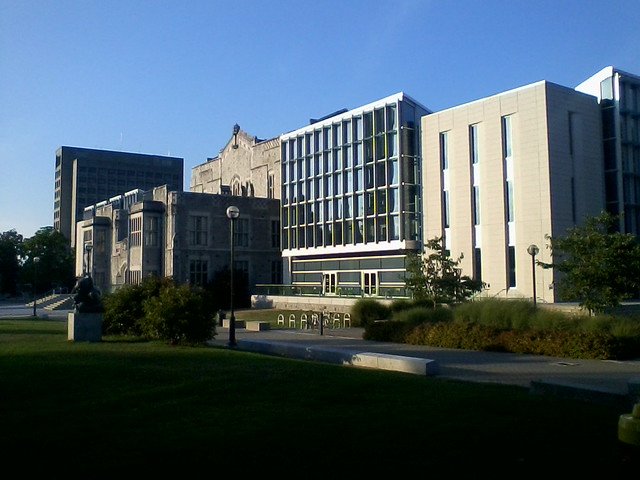 |
| UBC: Venue for ICCSE 2014 |
As it happens, in 2014, at the ICCSE international technical education conference I proposed international and Australian students could learn to work together online. That is now happening, with computer project students I help teach working in online teams, using a learning module I designed for this purpose. Rather than treat this as a temporary measure, for exceptional circumstances, it could be made routine for all students who learn teamwork. This online way of working was already common for computer professionals, and many other disciplines, before COVID-19. It should be part of training of professionals. Australian universities an offer options where international students start their education in their own country studying online, before coming to Australia.
Policy Change for Blended Study
Monday, January 21, 2019
Education for the Indo-Pacific Does Not Need 5G Mobile Communications
 |
| Exploring the mobile internet, Solomon Islands, Photo: Irene Scott/DFAT. |
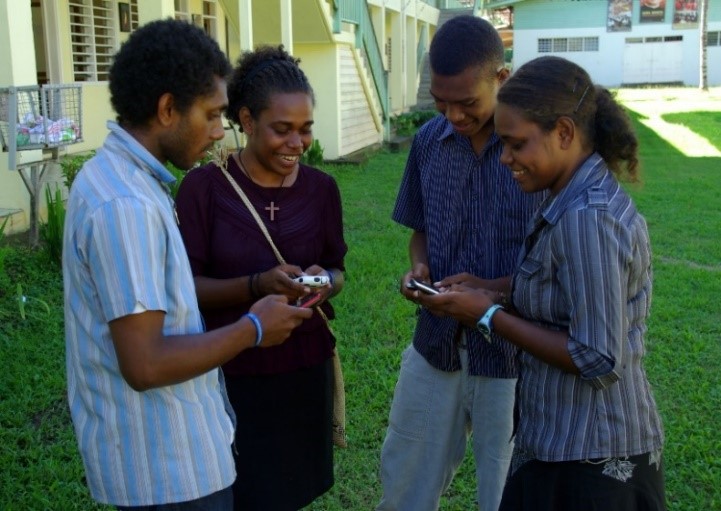
A 3G or 4G network connection is more than enough for a student. A 3G network provides tens of megabits per second and 4G hundreds. This is sufficient for a student to watch videos, and upload their own, as well as take part in live video conferences. In practice students may have much more limited access, due to cost and logistics, so I design online courses where the student can download large materials infrequently, and then use a much slower connection for interaction.
An example of where this may be an issue is the Solomon Islands. The Australian Government is funding a fibre optic cable to the Solomon Islands and the Department of Foreign Affairs and Trade has asked for ideas how this could help young people with skills and education. I have submitted a proposal "Micro-credentials by Mobile Phone for the Solomon Islands", which is based on my TALE paper.
The problem in the Solomon Islands will be getting the data from the point where the fibre optic cable lands, to where the population is. It is likely the the capital, Honiara on Guadalcanal, will be connected, but not all of the other populated islands.
To address this issue I design online courses which do not require a high speed connection. The student can download all the materials required at the start of the course from a cyber cafe (or be sent a data file in the post). They then only need a slow connection to read announcements and participate in text based forums. Live interactive video is nice to have, but not at the cost of excluding many students. If a 2G GPRS connection is available, providing about 100 kbps, the student can take part in Webinars with audio and slides.
Where video and audio are not available, the course designer and instructor have to make sure that the student gets a sense of human connection, through the text based forums. This is not ideal, but can be made to work.
Paper
T. Worthington, "Blended Learning for the Indo-Pacific," 2018 IEEE International Conference on Teaching, Assessment, and Learning for Engineering (TALE), Wollongong, Australia, 2018, pp. 861-865. doi: 10.1109/TALE.2018.8615183 URL https://doi.org/10.1109/TALE.2018.8615183Keywords: 5G mobile communication; Australia; Conferences; Education; training; employment; educational institutions; teaching; Australian educational system; assessment; cognitive learning theory; social learning theory; Indo-Pacific; blockchain; micro-credentials
Thursday, December 6, 2018
Blended Learning for the Indo-Pacific
 Greetings from the the IEEE 7th International Conference on Teaching, Assessment, and Learning for Engineering (TALE) in Wollongong where I was speaking on "Blended Learning for the Indo-Pacific". This proposal has been entered in the the Solomon Islands Technology for Development Challenge to provide Micro-credentials by Mobile Phone for the Solomon Islands.
 "Information technology disciplines make up a significant proportion of the degrees taken by international students at Australian universities. These programs are primarily delivered on-campus, but are increasingly using e-learning techniques and becoming, in effect, blended. This provides the opportunity to offer international students part of their program by distance education before, or instead of, traveling to Australia. This could complement the campus-based education provided and complement initiatives by China, Australia, Japan and the United States for regional development. However, Australian university academics have little background or training in e-learning and program designs have not made use of the flexibility this provides. In this paper, we discuss how computer professionals can be trained online to deliver online training to students of the Indo-Pacific. The application of learning theory to support distance learners is also discussed in this paper."This followed papers from others at the conference on the globalization of Chinese education, Smart Learning at the University of the South Pacific and 21st Century Skills.
ps: TALE 2019 will be December 3-6, in Yogyakarta, Indonesia. And, just announced, TALE 2020 will be in Takamatsu, Japan.
Arjun Singh on Gradescope
 Greetings from the the IEEE 7th International Conference on Teaching, Assessment, and Learning for Engineering (TALE) in Wollongong where Arjun Singh, Co-Founder & CEO of Gradescope is talking on grading of large numbers of STEM exam papers. This product, recently acquired by TurnItIn, allows student exam papers to be scanned in, and then marked online by an examiner, using a rubric.
One claim for the product is that the rubric can be customized by the examiner, as they do the marking. The product was demonstrated for engineering and computer science examinations, including for computer code.
There appear to be two distinct uses for the product: one is for marking traditional paper based examinations. The other is for digitally input long-form input, such as computer code.
This product is new to Turnitin, and integration with their copy detection function is to be added in early 2019. However, even in its current form the interface looks similar to Turnitin's GradeMark.
Globalization of Chinese Education
Greetings from the the IEEE 7th International Conference on Teaching, Assessment, and Learning for Engineering (TALE) in Wollongong where Liang Zhao from Shenyang Aerospace University was speaking on "How We Face Globalization of Chinese Education" (Zhao, Dong, Li, Lin & Li, 2018,). This, I suggest, is also a question for Australian universities in the next few years.
Just as China has been increasingly producing quality goods at a competitive price, it now aiming to export education services. One interesting point in the paper is that international students in China are instructed in English (although this is not the first language of the staff or students). Australian educational institutions, and companies, may be able to provide specialist services to their Chinese counterparts.
Just as China has been increasingly producing quality goods at a competitive price, it now aiming to export education services. One interesting point in the paper is that international students in China are instructed in English (although this is not the first language of the staff or students). Australian educational institutions, and companies, may be able to provide specialist services to their Chinese counterparts.
"In the next decade, China is expectedly becomingAustralian universities need to consider how they will respond to expanded Chinese offerings. As with consumer goods, they might try to compete on price, quality, or convenience. I will be speaking on alternative delivery methods for education in "Blended Learning for the Indo-Pacific" later in the conference. In this I suggest, rather than trying to directly compete, a more flexible form of education could be offered.
the most significant education destination for foreigners. Since information technology is a leading industry in China, its related major computer science would surely attract a considerable number of international students. Therefore, our university and teaching group are going to face this big challenge. Due to the scarcity of teaching resources in ordinary Chinese universities, we have to seek a way to fulfil the vast demand of educating these international students while especially most of them require lecturers provide courses in English. In this paper, we discuss the current problems of international education in China and whether the mixed English teaching can be one possible solution or not. Then we present our teaching reform strategies by showing an example of a module called Mobile Programming with Android. Through applying these strategies, we also list the numerical improvements of students results and skills."
Reference
Zhao, L., Dong, Y., Li, Z., Lin, N., & Li, J. (2018, December). How We Face Globalization of Chinese Education. In 2018 IEEE International Conference on Teaching, Assessment, and Learning for Engineering (TALE) (pp. 635-640). IEEE. URL https://doi.org/10.1109/TALE.2018.8615155 (or request preprint)
Smart Learning at the University of the South Pacific
Greetings from the the IEEE 7th International Conference on Teaching, Assessment, and Learning for Engineering (TALE) in Wollongong where staff of the University of the South Pacific (UPS) are discussing "Smart Learning in the Pacific: Design of New
Pedagogical Tools". USP is multi-nationals with students who have studied under different school systems. They have ab "early warning system" which extracts data from their Moodle Learning Management System to indicate which students are struggling. They also use Big Blue Button (BBB), for synchronous webinars. Students are tested online for English skills and those who don't score well are automatically signed up of a support course.
Challenges at USP include limited bandwidth to some Pacific countries (something being addressed by the Australian Government funded fibre optic cable to the Solomon Islands). A major focus of USP is teacher training. I will be speaking on "Blended Learning for the Indo-Pacific" later in the conference.
Pedagogical Tools". USP is multi-nationals with students who have studied under different school systems. They have ab "early warning system" which extracts data from their Moodle Learning Management System to indicate which students are struggling. They also use Big Blue Button (BBB), for synchronous webinars. Students are tested online for English skills and those who don't score well are automatically signed up of a support course.
Challenges at USP include limited bandwidth to some Pacific countries (something being addressed by the Australian Government funded fibre optic cable to the Solomon Islands). A major focus of USP is teacher training. I will be speaking on "Blended Learning for the Indo-Pacific" later in the conference.
"Smart learning ecosystems leverage on state-of-the-art tools and technologies to help students learn better with Information Communication Technologies (ICT). The ubiquity, innovations and advancements of ICT have transformed pedagogies and approaches to content facilitation and delivery in higher education worldwide, the Pacific region being no exception. The paper essays a number of learning and support tools designed in-house or adopted (or outsourced) recently by a higher education institution in the Pacific contributing to the smart learning ecosystem. The institution has integrated these ICT driven tools to its academic and support programmes, and more recently the in-country science programmes introduced in its member countries. The strengths and challenges from the implementation of these new adaptive tools are highlighted with recommendations to the wider academic populace."
Sunday, May 20, 2018
Using an ePortfolio to capture students' skill sets to align to workplace

"Tom teaches university computing students how to undertake real projects for real clients. This has included an artifact mapping tool for the Plain of Jars in Laos and test software for the radars on Australian warships. These real-world projects require real-world assessment techniques, including e-portfolios. In this presentation he discusses:
- Innovative education techniques to teach students how to better communicate with employers and people
- How to build students confidence and capture their skills set to become more job ready
- How to provide formal postgraduate education to students in their workplaces via mobile devices"
Wednesday, May 9, 2018
Australian Government Funding for Regional Study Hubs
One of the new measures in the Australian Government Budget for 2017/2018 is expanded funding for Regional Study Hubs. These are community-owned facilities where students studying by distance education can meet with tutors and other students. As a distance education student myself I felt a need to meet other students face to face. This was noticed decades ago shortly after the Open University UK started correspondence courses: students sought out each other and booked rooms at the nearest educational institution.
The budget has funded 500 sub‑bachelor and 500 bachelor students. It is good to see the inclusion of sub-degree programs, as these are very useful for distance education students, who tend to take longer and drop out more frequently. The regional study hubs have some similarities to the government programs supporting regional tele-centers of the 1990s.
 In 2000 I visited the University of WA Albany centre, where as well as the usual STEM subjects, there was a groups of students having a poetry reading via teleconference.
The budget has funded 500 sub‑bachelor and 500 bachelor students. It is good to see the inclusion of sub-degree programs, as these are very useful for distance education students, who tend to take longer and drop out more frequently. The regional study hubs have some similarities to the government programs supporting regional tele-centers of the 1990s.
 In 2000 I visited the University of WA Albany centre, where as well as the usual STEM subjects, there was a groups of students having a poetry reading via teleconference.
 Monday, April 23, 2018
Participation in VET Predicted to Drop to 1.4% by 2030
 |
| Projected participation by Noonan and Pilcher (2018). |
Participation in Vocational Education and Training (VET) in Australia is predicted to drop from the current 4.3% to 1.4% by 2030, while university participation is expected to remain at the current 4.9% of the population. This is in a recent study by Noonan and Pilcher (2018) from the Mitchell Institute at Victoria University.
The study has some limitations. One is that while noting postgraduate qualifications "are increasingly required for entry to many professions" they are not included in the study (Noonan & Pilcher, p. 4, 2018). A limitation not noted by the authors is that they have assumed other sub-degree qualifications (certificates, Diplomas and Advanced Diplomas) are only offered by the VET sector. I suggest there is likely to be increasing use of sub-degree university qualifications, as a way for government and students to stretch the education budget.
The study assumes that current government policies and practices are unchanged. This is unlikely as the current situation is unsustainable. The VET sector is in a state of near collapse, due to state and federal mismanagement. University budgets are being propped up by international student fees which could come to an end at any time.
The study has some limitations. One is that while noting postgraduate qualifications "are increasingly required for entry to many professions" they are not included in the study (Noonan & Pilcher, p. 4, 2018). A limitation not noted by the authors is that they have assumed other sub-degree qualifications (certificates, Diplomas and Advanced Diplomas) are only offered by the VET sector. I suggest there is likely to be increasing use of sub-degree university qualifications, as a way for government and students to stretch the education budget.
The study assumes that current government policies and practices are unchanged. This is unlikely as the current situation is unsustainable. The VET sector is in a state of near collapse, due to state and federal mismanagement. University budgets are being propped up by international student fees which could come to an end at any time.
Reference
P. Noonan and S. Pilcher, Participation in tertiary education in Australia: Modelling and scenario analysis,
Mitchell Institute, 2018. URL http://www.mitchellinstitute.org.au/wp-content/uploads/2018/04/Participation-in-tertiary-education-in-Australia.pdf
Mitchell Institute, 2018. URL http://www.mitchellinstitute.org.au/wp-content/uploads/2018/04/Participation-in-tertiary-education-in-Australia.pdf
Subscribe to:
Posts (Atom)