Wednesday, October 16, 2024
Podcast on E-portfolios for Education
A slight variation on this, is to have the student prepare the portfolio in the form of an application for a real job which they would like on graduation. This makes sense as a capstone exercise, at the end of a program of study, as many students are then looking for jobs. This transforms the portfolio from something which might be of use to the student one day, to something of vital importance right now. At the moment I am overseeing the assessment of 400 student portfolios by a dozen tutors.
Tuesday, August 13, 2024
Skills for Career
![]() |
| Joe Schmetzer, Head of Software Engineering, Applied AI at Penten |
This morning I was interviewed by Kristina Hoeppner for her Portfolio Podcast series "Create. Share. Engage". I explained that for Techlauncher we have disguised the capstone e-portfolio reflection exercise as a job application. Joe is now taking students through what he likes to see from applicants. He has students do a short coding exercise, which is not unusual for a technical job but a "cultural interview" is. After the code test the Penten Head of Operations asks the applicant why they are there and they have an idea of what the company they are applying to. This is something STEM graduates tend to have difficulty with. It helps if students have done some sort of practical project. Joe then talked about the Trident Career Model.
Tuesday, November 15, 2022
More Flexible Macro-Credentials Needed
The new Australian Government is going ahead with a modest micro-credential initiative of the previous government. But we also need some reforms to conventional degrees. Recently I have been helping assess applications from students for course credit. One thing about these is the wide range of institutions people have studied at. Another is the impressive depth of work experience some students have. However, students who change institution tend to be penalised, with not all prior studied recognised, due to the difficulty of finding equivalencies. This is not a problem in the vocational sector in Australia, where modules are nationally standardised, but each university in the world tends to do its own thing. There is some university standardisation through requirements for professional accreditation. One approach might be to give a standard amount of credit for a professional membership, or having completed a professionally accredited qualification.
Professional experience also tends to get limited recognition at university. Someone who has spent years working on projects at a major international computer company likely knows more than the university lecturers teaching them. A better approach then giving them some credit and making them do courses is to have them write up their work experience, align it to the qualification requirements, and assess that as an e-portfolio. However, that requires training which most university lecturers don't have (I learned it at CIT, and Athabasca University).
Wednesday, October 19, 2022
Using a Job Application as the Capstone Exercise for Work Integrated Learning
| On the Yogyakarta Train, after TALE 2019 |
Original paper:
Worthington, T. (2019, December). Blend and Flip for Teaching Communication Skills to Final Year International Computer Science Students. In 2019 IEEE International Conference on Engineering, Technology and Education (TALE) (pp. 1-5). IEEE. https://doi.org/10.1109/TALE48000.2019.9225921
Tuesday, July 26, 2022
ANU Techlauncher Learning to Reflect Introduction
Today I had the delight of being in a classroom with the Australian National University's Techlaucher students, as well as those joining online (video available). Normally I stick to the mechanics of how the "Learning to Reflect" module I supervise is run. The staff of ANU Careers provide the actual content, running students through exercises to help them think about a career. However, after reading Becoming by Michelle Obama, I was inspired to talk a little about my own career. The point wasn't big-noting myself (well not entirely), it was to show a career is rarely a straight linear path. I happened to join ABS, just as they had millions of dollars for IT training I joined the DoD computer division only to have it abolished ending up in the nation's military HQ. I nominated for VP of the ACS, but ended up President. I joined ANU to do research and ended up teaching. The latest coincidence is that I went to an ACS meeting last night, and it was the launch of the new version of a computer job analysis used in Techlauncher. The person launching it happened to have an interest in training computer people in Indonesia, as do I ...
Thursday, August 19, 2021
Learning to Reflect Module Version 5.0: Hybrid Edition
"Learning to Reflect" is a module for the ANU TechLauncher program, where students reflect on what they have learned, by writing an application for a real job, as their last assessed task before graduating. This was developed in late 2018 and first run in semester 1, February 2019. It was designed for blended delivery, with the option of easy conversion to full online delivery. That option was needed for Semesters 1 & 2 in 2020, and Semester 1 2021 due to COVID-19. This version 5 is designed for hybrid delivery, with students in a physical classroom linked to those online, using the MidFlex Minimal Hybrid Format. Unfortunately COVID-19 again required a return to pure online delivery, but without any changes required to the material.
Two additional workshops were added from Version 4, at student request, bringing the total to four. The first three have exercises for a 2% mark each (not for the last when a major assignment is due). The optional student logbook has been dropped due to lack of use. The middle two workshops are half the length of the others with the first hour used for the new ANU Computing Showcase, featuring prominent ANU alumni, speaking about their careers.
Please note that the course notes only supply the structure for the module and the assessment. The detailed content for the workshops is provided by Tempe Archer, Careers Consultant at ANU Careers, and the students undertake exercises using the ANU Careers Toolkit.
A paper on the design and blended delivery of the module is available:
- Worthington, T. (2019, December). Blend and Flip for Teaching Communication Skills to Final Year International Computer Science Students. In 2019 IEEE International Conference on Engineering, Technology and Education (TALE) (pp. 1-5). IEEE. https://doi.org/10.1109/TALE48000.2019.9225921
Wednesday, February 24, 2021
Learning to Reflect Module Version 4.0 the 2021 Blended Edition
"Learning to Reflect" is a module for the ANU TechLauncher program, where students reflect on what they have learned, by writing an application for a real job, as their last assessed task before graduating. This was developed in late 2018 and first run in semester 1, from February 2019. This was designed for blended delivery, with the option of easy conversion to full online delivery. That option was needed for Semesters 1 and 2 in 2020 due to COVID-19. The 2021 version is intended to be run online, with a blended delivery option ready for a return to the classroom and is available under a CC-BY licence.
Two small workshop exercises have been added for a 2% mark each, in place of the quizzes and forums used previously. The first assignment has been dropped, to make the assessment less complex. An optional student logbook has been added, to aid student reflection and deter plagiarism.
A paper on the design and blended delivery of the module is available:
- Worthington, T. (2019, December). Blend and Flip for Teaching Communication Skills to Final Year International Computer Science Students. In 2019 IEEE International Conference on Engineering, Technology and Education (TALE) (pp. 1-5). IEEE. https://doi.org/10.1109/TALE48000.2019.9225921
Thursday, February 4, 2021
Why a Student Logbook? A Personal reflection
Professionals working in academia, research, industry and government document their work. This is to protect their own intellectual property and that of their employers and clients. It is also a way to record what has been done, so they, or others can build on the work. It is a way to plan what might be done next, as well as what has been done. For students this is also a good way to learn, by reviewing what they have learned, and planning what they need to learn next.
Records Keep Professionals Accountable
![]() |
Title page, Lieutenant James Cook, |
Lieutenant James Cook wrote a detailed 354 page logbook as a "... trusted and coherently authored account with which to convince his backers in London" (Eóin Phillips, History and Philosophy of Science, University of Cambridge). While the technology has changed, professionals still use logbooks to protect their own interests, as well as their employers and clients.
Student Logbook For Work Notes
'I found Robert Ackland's "Web Social Science: Concepts, Data and Tools for Social Scientists in the Digital Age" (SAGE Publications, 2013), on the new books stand at the ANU Library. This is very relevant ... Ackland discusses how a "community" develops "common beliefs, norms and shared understandings. ...'
From Web Social Science: Concepts, Data and Tools for Social Scientists in the Digital Age, Posted by Tom Worthington on 19 January 2014, 9:31 PM
As an international online graduate student from 2013 to 2016, I kept a private electronic journal. This was stored on the university's electronic portfolio system. By the end of three years study, I had made 1,200 postings of about 100,000 words. This was useful to keep notes for later use in assessed work. Notes included a full reference to the source, so these could later be used in an assignment. Above is an early entry for my journal, which contains a note about a book, which I later used in an assignment.
Student Logbook for Reflection

"It is four days before I start as an on-line student ... So I am checking I have access to the course materials. So far everything looks very familiar... The one worry is a group "presentation". I am worried about how I am going to work in a group on-line internationally (there appear to be no other Australian students). Also there are some syncronous (real-time) activities, which I will be unlikley to attend due to the time differece. These are listed under assesment as not complusory, but in that case why are they listed?"
From Starting as a Student at University, Posted by Tom Worthington on 07 January 2014, 4:17 PM
Student Logbook as Evidence of Having Done the Work
"I have not had a reply from the tutor about my selected paper, but another student replied saying it looked okay. The instructions said to post to the forum in preference to emailing the tutor, so I guess this is okay (otherwise the tutor would have said). So far I have 450 words, but these seem to be more about me than the paper. ;-)
Attached files ... Assignment1...doc - [22.5KB]" From: Assignment 1: First Attempt, Posted by Tom Worthington on 29 January 2014, 12:05 AM
Another reason to keep a journal was is a defense against plagiarism. At any time anyone, however senior, can be accused of using someone else's work without acknowledgment. If an examiner asked "where did this come from?", a logbook provides a day by day, draft by draft, timestamped audit trail of of work on the topic, back to the start. This can not only includes the what, but the why. As an international student this was particularly important, as the norms where I was studying were different. In this journal excerpt I not only wrote about the assignment submission process, but attached a draft of my assignment, in case I needed evidence later of when I wrote it.
What Technology to Use for an Electronic Student Logbook?
"It appears to me that students can "game" assignment deadlines by creating incomplete Journal entries before the assignment deadline, then editing them after the deadline, since the Journal entry time stamps don't update after editing..."
From: Journal entry time stamps - not updated when edited...?, by Robert Lyon, Mahara Forums, 30 September 2014: https://mahara.org/interaction/forum/topic.php?id=6470&offset=0&limit=10
The best technology to use is whatever students are already using. Many universities which use the Mahara electronic portfolio system, teamed with the Moodle Learning Management System. Mahara was used for early offerings of the Techlauncer program. The system was updated to record both a "Posted on" and "Last updated" timestamp, so changes to student journal entries could be identified, making it suitable for a student logbook.
However, if students are not using Mahara, or another journalist system already, then asking them to do this is a burden. This is also a burden for the teacher who has to learn to use just another product.. Also Mahara is much more than the student needs for a simple logbook.
Writing prompts
![]() |
| Dr Alisa James, SUNY Brockport |
There has been much written in the educational literature about the use of reflective e-portfolios for assessment. However this is something the STEM students and teachers find difficult. James (2005) sets out how to guide physical educations students through preparing an assessed journal.
"Write a paragraph about a ... goal you would like to reach. Explain why you want to reach that goal.- Write a paragraph about what you did today that helped you to be successful in today's activities.
- Write a paragraph about your ... behavior for the day. What things might you do to demonstrate more sporting behavior in the future?
- What was the hardest thing for you to do today? Why was it hard?
- Write a paragraph that includes the cues of striking that we learned today. What will you do outside of school to practice these cues?
- Write a paragraph that includes the main aspects one should consider when developing a fitness program. Hint: Remember the FIT principle
- Write a paragraph that describes activities that you can do in your community that promote cardiovascular endurance .
- Write a paragraph that explains the difference between verbal and nonverbal communication. Why is it important to use both in cooperative activities? Be sure to give specific examples of both verbal and nonverbal communication."
From p.43, James, Alisa, "Journaling as an Assessment Option" (2005). Kinesiology, Sport Studies and Physical Education Faculty Publications. 78. (numbering added) https://digitalcommons.brockport.edu/pes_facpub/78
Writing prompts are more important for an e-journal used with an online course, than for the face to face classes James (2005) discusses. As the student will be mostly studying asynchronously, the teacher is not there to be saying "put a copy of that in your journal now". This has to be explicitly stated in course materials, ideally as part of a assessed task, so the student has an incentive. This can also mark a point in the course, an approach of synchronization of asynchronous learning (Worthington, 2013).
James' prompts are ordered from more to less reflective. The first four are about the individual student goals, success, behavior, difficulties. The next three are about future plans of the student to learn skills. The last is a more traditional study question about the course material. These questions are not that different to ones which might be asked as study aids in any course. One of my frustrations as a student was that my answers to such questions were never looked at by anyone, let alone count towards assessment. In theory they help with learning, but in practice, like any student, I would tend to focus on what got looked at and especially marked. The e-journal gets around this problem by having answers go somewhere, perhaps be looked at and help me at least pass the course.
Logbook Entries can be Visual
![]() |
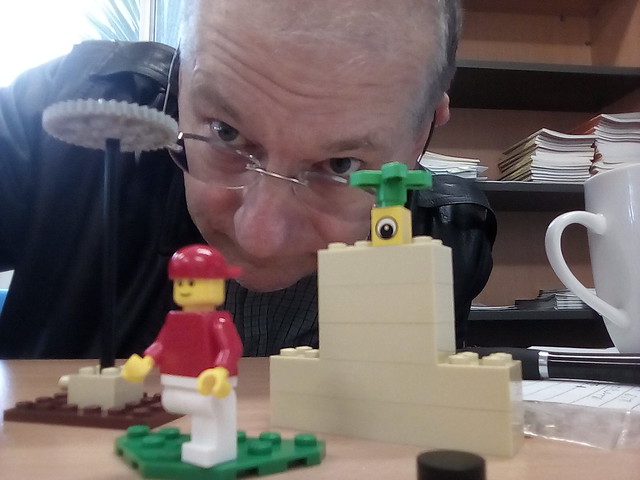
| My teaching philosophy, expressed in Lego, Photo by Tom Worthington, CC-BY, 2017 |
Logbook entries need not be just text, there can be diagrams, photographs, and with an electronic journal, video. Dr Stephen Dann, has adapted the Lego Serious Play technique for reflection workshops (2018). In 2017 Dr Dann ran a workshop for ANU staff working on their reflective e-portfolio for the Higher Education Academy Fellowship. In 2018 he ran a similar exercise for ANU Techlauncher students to consider their role in a group project. In each case the student is asked to make something with building blocks representing the topic and then talk about it. By talking about it, the students are encouraged to talk about themselves. They are also encouraged to take a photograph of their work.
The photo shows my Lego interpretation of an approach to teaching. I did not include this in my formal application for fellowship of the Higher Education Academy. However, describing the build was useful in clarifying my thoughts about teaching and the success of my application.
Moodle Wiki for a Student Logbook
An Moodle Wiki has been set up so each student gets their own, with a template pre-filled for a student logbook.There is just one page, with sections for the student to fill in each week. The student can create extra pages if they have a lot of content. But Ione page will do for a typical student. They just click on "edit" the heading for a week, and put in some content.
The fill in the blanks sentences are adapted from James (p.43, 2005). The topics for each week are from the Australian National University's Techlauncher program (Awasthy, Flint, and Sankaranarayana, 2017). Questions for the Work Portfolio (Weeks 4 and 8) were suggested by Tempe Archer, ANU Careers. The idea here is to provide a prompt for the student each week to start writing and avoid presenting then with a confronting blank page. The students are asked to write about the activity set for that week and a specific aspect of it.
Jacques, Ouahabi and Lequeu (2020) refer to the use of logbooks in Google Drive for French first year first year engineering students learning online, but unfortunately give no more details. Kumar, Silva and Prelath, R. (2020) mention not having a project logbook as a problem for studio based learning in a Malaysian course, but again provide no more details.
Blockchain to Stop Academic Plagiarism
The Creative Commons licenses, commonly used for open materials, all have a "by attribution" requirement: "... the original creator (and any other nominated parties) must be credited and the source linked to". However, this is only a legal and moral requirement, the technology doesn't enforce it. Professor McGreal proposes to go a step further and use a blockchain to securely record who first created the work, and all the changes made and by whom.
While technically feasible, using block chain would throw up some challenges. As an example, nothing can ever be deleted from the blockchain, so if there was something which was incorrect, or harmful, or illegal, it would be there in perpetuity.
References
Awasthy, R., Flint, S., & Sankaranarayana, R. (2017, April). Lifting the constraints—Closing the skills gap with authentic student projects. In 2017 IEEE Global Engineering Education Conference (EDUCON) (pp. 955-960). IEEE. URL https://doi.org/10.1109/EDUCON.2017.7942964
Dann, S. (2018). Facilitating co-creation experience in the classroom with Lego Serious Play. Australasian Marketing Journal, 26(2), 121-131. https://doi.org/10.1016/j.ausmj.2018.05.013
James, Alisa, "Journaling as an Assessment Option" (2005). Kinesiology, Sport Studies and Physical Education Faculty Publications. 78.
https://digitalcommons.brockport.edu/pes_facpub/78
Jacques, S., Ouahabi, A., & Lequeu, T. (2020). Remote Knowledge Acquisition and Assessment During the COVID-19 Pandemic. International Journal of Engineering Pedagogy (iJEP), 10. URL https://www.thierry-lequeu.fr/data/JACQUES-04.pdf
Kumar, J. A., Silva, P. A., & Prelath, R. (2020). Implementing studio-based learning for design education: a study on the perception and challenges of Malaysian undergraduates. International Journal of Technology and Design Education, 1-21. URL https://link.springer.com/content/pdf/10.1007/s10798-020-09566-1.pdf
McGreal, Rory. (January 20, 2021) How blockchain could help the world meet the UN’s global goals in higher The Conversation. URL https://theconversation.com/how-blockchain-could-help-the-world-meet-the-uns-global-goals-in-higher-education-152885
Sunday, January 24, 2021
Show-Your-Work to Discourage Students Cheating Online
These are the notes for the second of four webinars on"Engaging students in the online environment", Wednesday, 27 January at 11 am AEDT Sydney time (Tuesday, 26th, 5 pm MST in Edmonton). Please register now for the webinar and send your suggestions.
Show-Your-Work to Discourage Students Cheating Online
Records Keep Professionals Accountable
![]() |
| Title page, Lieutenant James Cook, Journal of the Proceedings of His Majesty's Bark Endeavour in a Voyage Round the World, 1768-1771. UK National Maritime Museum, CC BY-NC 3.0 |
Lieutenant James Cook wrote a detailed 354 page logbook as a "... trusted and coherently authored account with which to convince his backers in London" (Eóin Phillips, History and Philosophy of Science, University of Cambridge).
Traditional records are on paper. As a public servant, I was trained in how to make these harder to tamper with. Official files were kept in secure storage, administered by specialist staff who recorded who had which file out, when. Pages were required to be numbered and destroying a record without authorization was (and is) a crime. Professionals can use use this paper trail to protect the public interest, and themselves, by making it clear, who did what when. The advent of electronic documents has made it harder for the record keeper, as electron ic documents can be easily altered or deleted. However, it has also made it harder for the fraudster, as it can be hard to track down every copy and every log of changes.
Student Logbook For Work Notes
![]() |
| Web Social Science, Ackland, 2013 |
'I found Robert Ackland's "Web Social Science: Concepts, Data and Tools for Social Scientists in the Digital Age" (SAGE Publications, 2013), on the new books stand at the ANU Library. This is very relevant ... Ackland discusses how a "community" develops "common beliefs, norms and shared understandings. ...' From Web Social Science: Concepts, Data and Tools for Social Scientists in the Digital Age, Posted by Tom Worthington on 19 January 2014, 9:31 PM
As an international online graduate student from 2013 to 2016, I kept a private electronic journal. In addition, I created one for each course. These were stored on the university's electronic portfolio system. By the end of three years study, each journal had about one hundred postings (1,200 postings in total, made up of about 100,000 words). This was useful to keep notes for later use in assessed work. I would jot notes as topics came up and was careful to include a full reference to the source, so I could use these later.
Student Logbook for Reflection
Vancouver from 17th floor, UBC Walter Gage Student Residence, 2014.
"It is four days before I start as an on-line student ... So I am checking I have access to the course materials. So far everything looks very familiar... The one worry is a group "presentation". I am worried about how I am going to work in a group on-line internationally (there appear to be no other Australian students). Also there are some syncronous (real-time) activities, which I will be unlikley to attend due to the time differece. These are listed under assesment as not complusory, but in that case why are they listed?" FromStarting as a Student at University, Posted by Tom Worthington on 07 January 2014, 4:17 PM
Student Logbook as Evidence of Having Done the Work
"I have not had a reply from the tutor about my selected paper, but another student replied saying it looked okay. The instructions said to post to the forum in preference to emailing the tutor, so I guess this is okay (otherwise the tutor would have said). So far I have 450 words, but these seem to be more about me than the paper. ;-)Attached files ... Assignment1...doc - [22.5KB]" From: Assignment 1: First Attempt, Posted by Tom Worthington on 29 January 2014, 12:05 AM
Another reason to keep a journal was as a defense against plagiarism. At any time anyone, however senior, can be accused of using someone else's work without acknowledgment. If an examiner asked "where did this come from?", I had a day by day, draft by draft, timestamped audit trail of my work on the topic, back to when I started. This not only included the what, but the why. As an international student this was particularly important, as the norms could be different, and even down to the page size.
What Technology to Use for an Electronic Student Logbook?
"It appears to me that students can "game" assignment deadlines by creating incomplete Journal entries before the assignment deadline, then editing them after the deadline, since the Journal entry time stamps don't update after editing..." From: Journal entry time stamps - not updated when edited...?, by Robert Lyon, Mahara Forums, 30 September 2014: https://mahara.org/interaction/forum/topic.php?id=6470&offset=0&limit=10
The best tech to use is whatever you already have. I have been fortunate as a post-graduate student, in that the three institutions where I studied, all used the same electronic portfolio (Mahara), teamed with the same Learning Management System (Moodle). This made it very easy for me to create Journals in Mahara and keep them secure.
One problem, was that Mahara did not record when a student updated a journal entry, so they could game the system by creating a empty entry, then updating it later. This was later fixed, with each journal entry displayed showing both a "Posted on" and "Last updated" timestamp. I tried this out on Mahara and it seems to work. But is anyone using this?
However, if students are not using Mahara, or another journalist system already, then asking them to do this is a burden. This is also a burden for the teacher who has to learn to use just another product.. Also Mahara is much more than the student needs for a simple logbook.
Writing prompts
![]() |
| Dr Alisa James, SUNY Brockport |
There has been much written about the use of reflective e-portfolios for assessment. I have been trained to write, teach and assess reflectively. However this is something the average STEM student and teacher finds very difficult. James (2005) sets out how to guide physical educations students through preparing an assessed journal.
"Write a paragraph about a ... goal you would like to reach. Explain why you want to reach that goal.- Write a paragraph about what you did today that helped you to be successful in today's activities.
- Write a paragraph about your ... behavior for the day. What things might you do to demonstrate more sporting behavior in the future?
- What was the hardest thing for you to do today? Why was it hard?
- Write a paragraph that includes the cues of striking that we learned today. What will you do outside of school to practice these cues?
- Write a paragraph that includes the main aspects one should consider when developing a fitness program. Hint: Remember the FIT principle
- Write a paragraph that describes activities that you can do in your community that promote cardiovascular endurance .
- Write a paragraph that explains the difference between verbal and nonverbal communication. Why is it important to use both in cooperative activities? Be sure to give specific examples of both verbal and nonverbal communication." From p.43, James, Alisa, "Journaling as an Assessment Option" (2005). Kinesiology, Sport Studies and Physical Education Faculty Publications. 78. (numbering added) https://digitalcommons.brockport.edu/pes_facpub/78
Writing prompts are more important for an e-journal used with an online course, than for the face to face classes James (2005) discusses. As the student will be mostly studying asynchronously, the teacher is not there to be saying "put a copy of that in your journal now". This has to be explicitly stated in course materials, ideally as part of a assessed task, so the student has an incentive. This can also be a good point. I suggest to mark a point in the course, an approach of synchronization of asynchronous learning (Worthington, 2013).
James' prompts are ordered from more to less reflective. The first four are about the individual student goals, success, behavior, difficulties. The next three are about future plans of the student to learn skills. The last is a more traditional study question about the course material. These questions are not that different to ones which might be asked as study aids in any course. One of my frustrations as a student was that my answers to such questions were never looked at by anyone, let alone count towards assessment. In theory they help with learning, but in practice, like any student, I would tend to focus on what got looked at and especially marked. The e-journal gets around this problem by having answers go somewhere, perhaps be looked at and help me at least pass the course.
Logbook Entries can be Visual
![]() |
| My teaching philosophy, expressed in Lego, 2017 |
Logbook entries need not be just text, there can be diagrams, photographs, and with an electronic journal, video. Dr Stephen Dann, has adapted the Lego Serious Play technique for reflection workshops. In 2017 Dr Dann ran a workshop for ANU staff working on their reflective e-portfolio for the Higher Education Academy Fellowship. In 2018 he ran a similar exercise for ANU Techlauncher students to consider their role in a group project. In each case the student is asked to make something with building blocks representing the topic and then talk about it. By talking about it, the students are encouraged to talk about themselves. They are also encouraged to take a photograph of their work.
Moodle Wiki for a Student Logbook
The Mahara Journal looked promising, especially as it is usually installed alongside Moodle. However, this would still be an additional tool students and staff would have to become familiar with. An alternative which looks promising is the Moodle Wiki. This can be set up so each student gets their own. I have created a logbook template which can be provided in the Wiki.
My template has a paragraph of explanatory text, then sections for the student to fill in. The student could create extra pages if they have a lot of content. But I expect one page will do for a typical student. They just click on "edit" the heading for a week, and put in some content.
The fill in the blanks sentences are adapted from James (p.43, 2005). The topics for each week are from the Australian National University's Techlauncher program (Awasthy, Flint, and Sankaranarayana, 2017). Questions for the Work Portfolio (Weeks 4 and 8) were suggested by Tempe Archer, ANU Careers. The idea here is to provide a prompt for the student each week to start writing and avoid presenting then with a confronting blank page. The students are asked to write about the activity set for that week and a specific aspect of it.Jacques, Ouahabi and Lequeu (2020) refer to the use of logbooks in Google Drive for French first year first year engineering students learning online, but unfortunately give no more details. Kumar, Silva and Prelath, R. (2020) mention not having a project logbook as a problem for studio based learning in a Malaysian course, but again provide no more details.
Reference
Awasthy, R., Flint, S., & Sankaranarayana, R. (2017, April). Lifting the constraints—Closing the skills gap with authentic student projects. In 2017 IEEE Global Engineering Education Conference (EDUCON) (pp. 955-960). IEEE. URL https://doi.org/10.1109/EDUCON.2017.7942964
James, Alisa, "Journaling as an Assessment Option" (2005). Kinesiology, Sport Studies and Physical Education Faculty Publications. 78.
https://digitalcommons.brockport.edu/pes_facpub/78Jacques, S., Ouahabi, A., & Lequeu, T. (2020). Remote Knowledge Acquisition and Assessment During the COVID-19 Pandemic. International Journal of Engineering Pedagogy (iJEP), 10. URL https://www.thierry-lequeu.fr/data/JACQUES-04.pdf
Kumar, J. A., Silva, P. A., & Prelath, R. (2020). Implementing studio-based learning for design education: a study on the perception and challenges of Malaysian undergraduates. International Journal of Technology and Design Education, 1-21. URL https://link.springer.com/content/pdf/10.1007/s10798-020-09566-1.pdf
Blockchain to Stop Academic Plagiarism
The Creative Commons licenses, commonly used for open materials, all have a "by attribution" requirement: "... the original creator (and any other nominated parties) must be credited and the source linked to". However, this is only a legal and moral requirement, the technology doesn't enforce it. Professor McGreal proposes to go a step further and use a blockchain to securely record who first created the work, and all the changes made and by whom.
While technically feasible, using block chain would throw up some challenges. As an example, nothing can ever be deleted from the blockchain, so if there was something which was incorrect, or harmful, or illegal, it would be there in perpetuity.
The idea of using blockchain in academia might have other uses. Recently I have been considering how students could record their progress with assessed work, such as assignments. One problem is to find an easy way for students to record what they did, but not be able to falsify the record. I have been looking at using some form of electronic logbook stored on the educational institution's system, so the student can't tamper with it. An alternative would be a blockchain.
Reference
McGreal, Rory. (January 20, 2021) How blockchain could help the world meet the UN’s global goals in higher The Conversation. URL https://theconversation.com/how-blockchain-could-help-the-world-meet-the-uns-global-goals-in-higher-education-152885
The video presentation contains images that were used under a Creative Commons License. Click here to see the full list of images and attributions: