Showing posts with label Moodle. Show all posts

Friday, December 10, 2021

Martin Dougiamas on Moodle 4.x

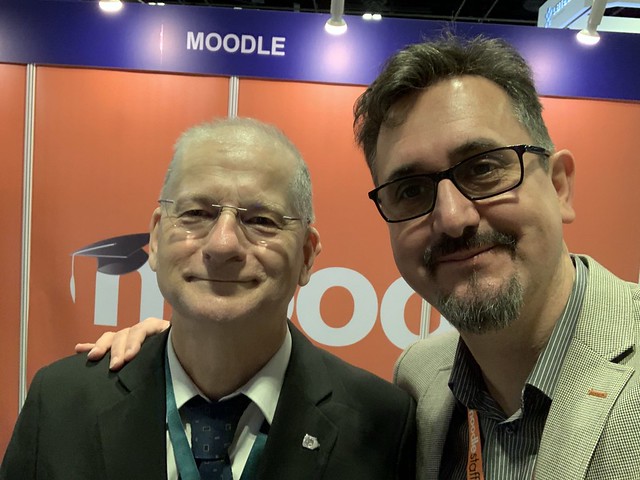
Tom Worthington and Martin Dougiamas at EduTech Asia 2018
 Martin Dougiamas, & Tom Worthington
at EduTech Asia 2018

Martin Dougiamas, creator of the Moodle, is talking at EdTechPosium on the future of the learning management system. Moodle 4 is getting a makeover with a new user interface. The problem, as Martin explains it, that Moodle looks old fashioned, compared to Apps. For me this is not a problem, as I like the basic interface. The problem is how to freshen the design without making it too complicated. The preview shown looked a good clean approach for thsients who want "Just show me what I need to do next".

Next Martin talked on the Moodle Academy, which has free courses for educators, administrators and developers. This is based on a European standard, but implemented specifically for Moodle. Each course has an introductory quiz, to help potential students decide if the course is for them. 

MoodleNet provides a curated collection of educational content which can be used in courses. This is a challenging area. When a student of open education I had to find content to use. It was very difficult to find quality, complete, educational content. What I instead found were outlines of courses, but not the full, usable content. I will see if it is possible to donate my ICT Sustainability course and reflective learning module

Lastly Martin speculated about the use of wearable devices for education. One example was being able to provide healthy eating information when in the supermarket. I worry that instead the consumer will be bombarded with 3D advertisements. Martin touched on this by arguing that this should not be left to companies such as Meta.

ps: I bumped into Martin at EduTech Asia 2018

Friday, August 6, 2021

Melbourne EdTech Summit, 17 to 20 August

 The Melbourne EdTech Summit is 17 to 20 August. COVID-19 has forced the event online, which not all bad news: it is free and you don;t have to be in Melbourne (Australia) to attend. Here is what caught my attention in the program (if you do nothing else, you must, at least, hear the keynote from Martin Dougiamas, founder of Moodle, 11:45am Wednesday):

Tuesday K-12

9.45am

Keynote | Future of Student Assessment

Speaker | Geoff Masters, CEO for Australian Council for Educational Research
Moderator | David Linke, Managing Director of EduGrowth

What if the primary outcome of assessment was not a grade, but an estimate of the point an individual has reached in their learning? Assessment is a diagnostic tool, but too often it is treated as the end-point. This session will discuss how we need to rethink and redesign assessment to measure progression and inform teaching.


3.40pm

Using data to support whole-school wellbeing

Speakers | Richard Clark, Head of Secondary School of the Springfield Anglican College; and Nicole Archard, Principal of Loreto College
Moderator | Joe Thurbon, Co-Founder & CTO of Educator Impact

Supporting the wellbeing of a whole-child takes a whole school approach. The wellbeing of staff and students is interconnected. Hear from two innovative school leaders about how data helps them drive whole-school wellbeing improvements for their staff and students, both strategically and every day in the classroom.

4.20pm

New Tools – New Possibilities: Classrooms enhanced with technology

Speakers | Zoe Milne, Co-Founder and Director of LoopLearn; and Lauren Sayer, Executive Director Research and Innovation at Melbourne Girls Grammar
Moderators | Joe Thurbon, Co-Founder & CTO of Educator Impact

High tech, leading edge, bleeding edge! Can these things coexist in a K12 classroom whilst navigating student privacy, data sovereignty and data protection? Let’s explore cutting edge technology to support the modern classroom achieve all that’s possible.


Wednesday Entrepreneurship:

9:15 Listening to the Student Voice

Speakers | Michelle Demirel, Deputy Principal-Instructional Leader & Accredited Lead Teacher at Leichhardt Public School; and Kerry Weston, Principal of Guildford West Public School
Moderator | Nikki Bonus, Founder & CEO of Life Skills Go

Learner agency is important to ensuring engagement. The first step to empowering students is to listen. How do we ensure the voice of the student is central to learning and what role does technology and design have in supporting this pedagogy.


11:45 am Keynote | Hear from the founder of Moodle, an Australian EdTech success story

Speaker | Martin Dougiamas, CEO of Moodle
Moderator | Jack Goodman, Founder & Executive Chair of Studiosity

Moodle is the most popular open source LMS in the world and has got more than 110+ million users globally. Hear from Martin Dougiamas the founder who built Moodle into the renowned EdTech solution it is today. We’ll find out about the future of Moodle in this new phase of EdTech opportunity.


Thursday Higher Education:


4.20pm

Innovation in the institution
Speaker | Chris Campbell, Senior Lecturer Learning Innovation at Griffith University & President of ASCILITE
Moderator | TBC

As leading research institutions many of the greatest innovations in Australia come out of our higher education sector. But our TAFEs and Universities are also an incubator for technology to support teaching and learning informed by their deep understanding of the needs of students. This session will examine new ways that innovation can be leveraged beyond the walls of the institution.

Friday Skills and Workforce:

9:45am Keynote | The War for Talent: EdTech enabling industry growth
Speaker | Belinda Tynan, Provost of Australian Catholic University
Moderator | Claire Field, Principal at Claire Field & Associates

Job ready graduates is the goal. But what jobs are we preparing these graduates for? The jobs that exist today, the jobs we think might be there tomorrow, the jobs that we hope will be there. What is the intersection between education and industry in a rapidly evolving labour market.

Friday, July 23, 2021

Australia Should Aim for the Stratosphere with Online Learning

In "Nation-building moonshots and why they matter" Georgie Skipper argues Australia should "aim big", as the USA did with the Apollo program. However, history only remembers the winners of a race, and I suggest we should also learn from the losers. Like the USA, the USSR had a space program shooting for the moon. But their big rocket failed and the vast expense was wasted, placing the country further behind. Australia can't afford all-or-nothing moonshots and should adopt the more cautious approach exemplified by the Chinese space program, focusing on smaller goals and learning from others. I suggest an area which Australia can safely reach the stratosphere, if not the moon, is online education.

China has had success with rockets and automated probes. But because of the risk, time and cost in developing technology for crewed space travel, China instead purchased proven technology from Russia. China's  Shenzhou spacecraft is an improved version of the Russian Soyuz, and China's Feitian space suit is derived from Russia's Orlan-M. Each new Chinese version incorporates more local technology, but starting from a proven base.

Australia should adopt the same approach, not reinventing what is already available for the sake of being different, but instead adding local unique features. We should choose projects with ambitious, but achievable goals which have real tangible outcomes. We can't afford to build moon rockets in the hope it might lead to a better powdered orange juice. A little symbolism is okay, but better are projects aimed to help people here on earth.

The USA new approach to space may also be useful in Australia. While Elon Musk's Space X private space venture has been rightly hailed, it is backed with funding from NASA and the US Government. The US is funding private space ventures, offering competitive tenders for delivery of people and cargo to orbit, and the construction of a lunar lander. Like the Chinese approach, this takes older proven technology developed by government and updates it.

The COVID-19 vaccines delivered by Pfizer, Astra Zeneca, and Johnson & Johnson are another example of government funding combined with private enterprise. Governments around the world funded fundamental research into vaccines over decades. When COVID-19 hit, governments provided billions of dollars to companies for development. However, this was not a moonshot, this was a measured response to a very real threat to the world. 

History shows that a big bet sometimes pays off, but a slow steady, modest investments can also give good returns. While vaccines have received most attention, there are other technologies, such as online education, which have been key to dealing with the pandemic. Few realise that the Moodle learning management system, used by schools and universities around the world for teaching students online, was developed in Perth, Australia. Australian governments failed to back the development of Moodle, and Australia lost the opportunity to lead the world in online education. Moodle is still based in Perth, but in 2018 announced a new Barcelona headquarters. While Moodle will not say so publicly, this was due to the lack of support from the Australian and WA governments. 

After mining, international education is Australia's major export industry. However, Australian governments have failed to back this industry, in the way they back mining, even though it employs far more people. It is not too late to aim for orbit with online learning, if not the moon. Australia's current international export industry is under threat from new competitors, as well as new technology. We need to invest now to save this industry and see it flourish.
Sunday, January 24, 2021

Show-Your-Work to Discourage Students Cheating Online


These are the notes for the second of four webinars on
"Engaging students in the online environment", Wednesday, 27 January at 11 am AEDT Sydney time (Tuesday, 26th, 5 pm MST in Edmonton). Please register now for the webinar and send your suggestions.

Show-Your-Work to Discourage Students Cheating Online


These are the notes to accompany the Powerpoint/PDF presentation:

How do we keep students engaged with their major assessment tasks all the way through a course? I propose to have students record their notes and work for assignments, both to keep them engaged and make cheating harder. Be ready to contribute your ideas and experience of having students show their work.

Professionals working in academia, research, industry and government document their work. This is to protect their own intellectual property and that of their employers and clients. It is also a way to record what has been done, so they, or others can build on the work. It is a way to plan what might be done next, as well as what has been done. For students this is also a good way to learn, by reviewing what they have learned, and planning what they need to learn next. 

As with working professionals, students can use their logbook to provide evidence that their work is there own. It is much easier to defend a charge of plagiarism if you have a timestamped record of everything you did for a project, from the time it was conceived.

Records Keep Professionals Accountable

Title page, Lieutenant James Cook,
 
Journal of the Proceedings of
His Majesty's Bark Endeavour
in a Voyage Round the World
1768-1771. 
UK National Maritime Museum, CC BY-NC 3.0

Lieutenant James Cook wrote a detailed 354 page logbook as a "... trusted and coherently authored account with which to convince his backers in London" (Eóin Phillips, History and Philosophy of Science, University of Cambridge).


Traditional records are on paper. As a public servant, I was trained in how to make these harder to tamper with. Official files were kept in secure storage, administered by specialist staff who recorded who had which file out, when. Pages were required to be numbered and destroying a record without authorization was (and is) a crime. Professionals can use use this paper trail to protect the public interest, and themselves, by making it clear, who did what when. The advent of electronic documents has made it harder for the record keeper, as electron ic documents can be easily altered or deleted. However, it has also made it harder for the fraudster, as it can be hard to track down every copy and every log of changes.


Student Logbook For Work Notes

Web Social Science, Ackland, 2013
'I found Robert Ackland's "Web Social Science: Concepts, Data and Tools for Social Scientists in the Digital Age" (SAGE Publications, 2013), on the new books stand at the ANU Library. This is very relevant  ... Ackland discusses how a "community" develops  "common beliefs, norms and shared understandings. ...' From Web Social Science: Concepts, Data and Tools for Social Scientists in the Digital Age, Posted by Tom Worthington on 19 January 2014, 9:31 PM
As an international online graduate student from 2013 to 2016, I kept a private electronic journal. In addition, I created one for each course. These were stored on the university's electronic portfolio system. By the end of three years study, each journal had about one hundred postings (1,200 postings in total, made up of about 100,000 words). This was useful to keep notes for later use in assessed work. I would jot notes as topics came up and was careful to include a full reference to the source, so I could use these later. 

Student Logbook for Reflection

Vancouver from 17th floor, UBC Walter Gage Student Residence, 2014.

"
It is four days before I start as an on-line student ... So I am checking I have access to the course materials. So far everything looks very familiar...  The one worry is a group "presentation". I am worried about how I am going to work in a group on-line internationally (there appear to be no other Australian students). Also there are some syncronous (real-time) activities, which I will be unlikley to attend due to the time differece. These are listed under assesment as not complusory, but in that case why are they listed?" From 
Starting as a Student at University, Posted by Tom Worthington on 07 January 2014, 4:17 PM
Another use for the journals was to make notes about my reaction to the course. Being a student, and particularly an online student can be a lonely, frustrating experience. Through the journals I in effect had a conversation with myself about what I was doing and why I was doing it. 

Student Logbook as Evidence of Having Done the Work

"I  have not had a reply from the tutor about my selected paper, but another student replied saying it looked okay. The instructions said to post to the forum in preference to emailing the tutor, so I guess this is okay (otherwise the tutor would have said). So far I have 450 words, but these seem to be more about me than the paper. ;-)
Attached files ... Assignment1...doc - [22.5KB]" From: Assignment 1: First Attempt, Posted by Tom Worthington on 29 January 2014, 12:05 AM

Another reason to keep a journal was as a defense against plagiarism. At any time anyone, however senior, can be accused of using someone else's work without acknowledgment. If an examiner asked "where did this come from?", I had a day by day, draft by draft, timestamped audit trail of my work on the topic, back to when I started. This not only included the what, but the why. As an international student this was particularly important, as the norms could be different, and even down to the page size.

What Technology to Use for an Electronic Student Logbook?


"It appears to me that students can "game" assignment deadlines by creating incomplete Journal entries before the assignment deadline, then editing them after the deadline, since the Journal entry time stamps don't update after editing..." From: Journal entry time stamps - not updated when edited...?, by Robert Lyon, Mahara Forums, 30 September 2014: https://mahara.org/interaction/forum/topic.php?id=6470&offset=0&limit=10


The best tech to use is whatever you already have. I have been fortunate as a post-graduate student, in that the three institutions where I studied, all used the same electronic portfolio (Mahara), teamed with the same Learning Management System (Moodle). This made it very easy for me to create Journals in Mahara and keep them secure.

One problem, was that Mahara did not record when a student updated a journal entry, so they could game the system by creating a empty entry, then updating it later. This was later fixed, with each journal entry displayed showing both a "Posted on" and "Last updated" timestamp. I tried this out on Mahara and it seems to work. But is anyone using this?

However, if students are not using Mahara, or another journalist system already, then asking them to do this is a burden. This is also a burden for the teacher who has to learn to use just another product.. Also Mahara is much more than the student needs for a simple logbook. 

Writing prompts


Dr Alisa James,
SUNY Brockport


  1. "Write a paragraph about a ... goal you would like to reach. Explain why you want to reach that goal.
  2. Write a paragraph about what you did today that helped you to be successful in today's activities.
  3. Write a paragraph about your ... behavior for the day. What things might you do to demonstrate more sporting behavior in the future?
  4. What was the hardest thing for you to do today? Why was it hard?
  5. Write a paragraph that includes the cues of striking that we learned today. What will you do outside of school to practice these cues?
  6. Write a paragraph that includes the main aspects one should consider when developing a fitness program. Hint: Remember the FIT principle
  7. Write a paragraph that describes activities that you can do in your community that promote cardiovascular endurance .
  8. Write a paragraph that explains the difference between verbal and nonverbal communication. Why is it important to use both in cooperative activities? Be sure to give specific examples of both verbal and nonverbal communication." From p.43, James, Alisa, "Journaling as an Assessment Option" (2005). Kinesiology, Sport Studies and Physical Education Faculty Publications. 78. (numbering added) https://digitalcommons.brockport.edu/pes_facpub/78
There has been much written about the use of reflective e-portfolios for assessment. I have been trained to write, teach and assess reflectively. However this is something the average STEM student and teacher finds very difficult. James (2005) sets out how to guide physical educations students through preparing an assessed journal. 

Writing prompts are more important for an e-journal used with an online course, than for the face to face classes James (2005) discusses. As the student will be mostly studying asynchronously, the teacher is not there to be saying "put a copy of that in your journal now". This has to be explicitly stated in course materials, ideally as part of a assessed task, so the student has an incentive. This can also be a good point. I suggest to mark a point in the course, an approach of synchronization of asynchronous learning (Worthington, 2013)

James' prompts are ordered from more to less reflective. The first four are about the individual student goals, success, behavior, difficulties. The next three are about future plans of the student to learn skills. The last is a more traditional study question about the course material. These questions are not that different to ones which might be asked as study aids in any course. One of my frustrations as a student was that my answers to such questions were never looked at by anyone, let alone count towards assessment. In theory they help with learning, but in practice, like any student, I would tend to focus on what got looked at and especially marked. The e-journal gets around this problem by having answers go somewhere, perhaps be looked at and help me at least pass the course.

Logbook Entries can be Visual

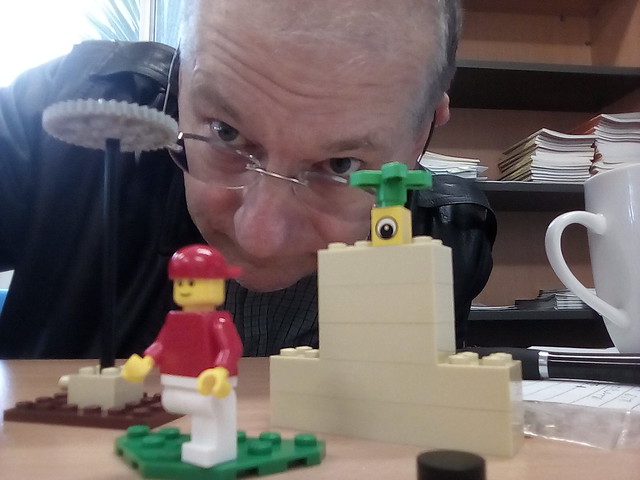
Tom Worthington taking part in Lego Serious Play session at the Australian National University, 20 October 2017 http://blog.highereducationwhisperer.com/2017/10/lego-play-for-higher-education-academy.html
My teaching philosophy, expressed in Lego, 2017

Logbook entries need not be just text, there can be diagrams, photographs, and with an electronic journal, video.  Dr Stephen Dann, has adapted the Lego Serious Play technique for reflection workshops. In 2017 Dr Dann ran a workshop for ANU staff working on their reflective e-portfolio for the Higher Education Academy Fellowship. In 2018 he ran a similar exercise for ANU Techlauncher students to consider their role in a group project. In each case the student is asked to make something with building blocks representing the topic and then talk about it. By talking about it, the students are encouraged to talk about themselves. They are also encouraged to take a photograph of their work. 

Moodle Wiki for a Student Logbook


The Mahara Journal looked promising, especially as it is usually installed alongside Moodle. However, this would still be an additional tool students and staff would have to become familiar with. An alternative which looks promising is the Moodle Wiki. This can be set up so each student gets their own. I have created a logbook template which can be provided in the Wiki.

My template has a paragraph of explanatory text, then sections for the student to fill in. The student could create extra pages if they have a lot of content. But I expect one page will do for a typical student. They just click on "edit" the heading for a week, and put in some content. 

The fill in the blanks sentences are adapted from 
James (p.43, 2005). The topics for each week are from the Australian National University's Techlauncher program (Awasthy, Flint, and Sankaranarayana, 2017). Questions for the Work Portfolio (Weeks 4 and 8) were suggested by Tempe ArcherANU Careers. The idea here is to provide a prompt for the student each week to start writing and avoid presenting then with a confronting blank page. The students are asked to write about the activity set for that week and a specific aspect of it.

Jacques, Ouahabi and Lequeu (2020) refer to the use of logbooks in Google Drive for French first year first year engineering students learning online,  but unfortunately give no more details. Kumar, Silva and Prelath, R. (2020) mention not having a project logbook as a problem for studio based learning in a Malaysian course, but again provide no more details. 

Reference

Awasthy, R., Flint, S., & Sankaranarayana, R. (2017, April). Lifting the constraints—Closing the skills gap with authentic student projects. In 2017 IEEE Global Engineering Education Conference (EDUCON) (pp. 955-960). IEEE. URL https://doi.org/10.1109/EDUCON.2017.7942964

James, Alisa, "Journaling as an Assessment Option" (2005). Kinesiology, Sport Studies and Physical Education Faculty Publications. 78.
https://digitalcommons.brockport.edu/pes_facpub/78

Jacques, S., Ouahabi, A., & Lequeu, T. (2020). Remote Knowledge Acquisition and Assessment During the COVID-19 Pandemic. International Journal of Engineering Pedagogy (iJEP)10. URL https://www.thierry-lequeu.fr/data/JACQUES-04.pdf

Kumar, J. A., Silva, P. A., & Prelath, R. (2020). Implementing studio-based learning for design education: a study on the perception and challenges of Malaysian undergraduates. International Journal of Technology and Design Education, 1-21. URL https://link.springer.com/content/pdf/10.1007/s10798-020-09566-1.pdf


Blockchain to Stop Academic Plagiarism


Professor Rory McGreal,
Athabasca University

Professor Rory McGreal, who taught me open educational resources (OER) at Athabasca University, has proposed the use of blockchain for their dissemination. While most OER are free and authors are happy to see their work widely, they still want to be acknowledged for their work. 

The Creative Commons licenses, commonly used for open materials, all have a "by attribution" requirement: "... the original creator (and any other nominated parties) must be credited and the source linked to". However, this is only a legal and moral requirement, the technology doesn't enforce it. Professor McGreal proposes to go a step further and use a blockchain to securely record who first created the work, and all the changes made and by whom. 

While technically feasible, using block chain would throw up some challenges. As an example, nothing can ever be deleted from the blockchain, so if there was something which was incorrect, or harmful, or illegal, it would be there in perpetuity.

The idea of using blockchain in academia might have other uses. Recently I have been considering how students could record their progress with assessed work, such as assignments. One problem is to find an easy way for students to record what they did, but not be able to falsify the record. I have been looking at using some form of electronic logbook stored on the educational institution's system, so the student can't tamper with it. An alternative would be a blockchain.

Reference

McGreal, Rory. (January 20, 2021) How blockchain could help the world meet the UN’s global goals in higher The Conversation. URL https://theconversation.com/how-blockchain-could-help-the-world-meet-the-uns-global-goals-in-higher-education-152885


The video presentation contains images that were used under a Creative Commons License. Click here to see the full list of images and attributions:

https://link.attribute.to/cc/1841924

Friday, April 19, 2019

E-Trainers free online training for vocational educators

E-Trainers is an EU supported project providing free online training for educators in the vocational education and training (VET) sector. There are three courses:  creating digital content, life and career skills, and  digitally competent and confident teacher. The courses are implemented in Moodle, with an appealing clean, no fuss design. However, the details of the course and quiz design is confusing.

Entry Test


I registered and took the entry test. My score was 12/14. But in a couple of cases I had to guess. The courses are provided in nine languages, so there are bound to be some translation difficulties. At one point the system lapsed into Italian.

Some questions were confusing, for example: "Which of these are video sites?", had two right answers, but I was only allowed to pick one. Another was a free text entry asking for an answer from some competency framework, which was not cited, so I had no idea what the answer might be. Another question said that a "flipped course" was an "online course", which I suggest is incorrect (it combines online and face-to-face).  But these are all minor quibbles.

I started with the first course:

Creating Digital Content


The course content itself is divided into very small web pages, with an image and a sentence or two, with about a dozen of these pages making up one lesson. These appear to be designed to fit on a smartphone screen without scrolling. However, this makes for very disjointed reading, especially on a larger tablet, laptop, or desktop screen. Even on a smartphone I would prefer larger chunks.

The first course, on  creating digital content, references the Co Building a Good Guidance project. This aims to improve students "active involvement" in school. It is an interesting approach to do this via online techniques.

The course suddenly takes a change of pace, going from offering single sentences to complex instructions for suggests entering a co-building international contest. I suggest not encouraging students, as their first exercise, to creating online content which will be made public and judged. 

Also, I suggest students should be introduced to content creation with text, and still images, first, and video later. Text and images are an easier introduction to preparing online content, these are the foundation for video, and are far more useful than video. However, the course frames the use of of text, and images as just a way to plan and prepare videos, not an important commutations media in themselves.

The course suggests using the Tricider free brainstorming tool. It gets a little confusing at this point, as brainstorming seems to be a broach in the course. Also, I could not work how to proceed without actually registering for a Tricider account. There is a similar branch for Padlet. This is not to say these are not good products, but I did not want to register at this time, and a student may want to use another product, or not be permitted to use these by their employer, or government. 

It is curious this EU endorsed project is promoting the use of Facebook and Google, given concerns the body has had concerning these companies. In particular the course recommends for teachers with students having special needs: "Teachers should help students to create Facebook and/or Google accounts."

I had completed 7% of the course when I gave up. I was not sure what exactly I still had to do.


Life and Career Skills


The second course is for VET  teaching. A survey of european employers is quoted as finding they want employees who have:
  1. Positive attitude
  2. Problem solving
  3. Communication
  4. Working under pressure / Resilience
  5. Learning to learn
  6. Flexibility
  7. Personal discipline
  8. Time management
  9. Teamwork
  10. Responsibility
Unfortunately there is no citation to where these results came from.  Also I have doubts about teaching behaviors, such as a "positive attitude". As an extreme example, I don't want the computer professionals I am training to say software is going to work, when their judgement is otherwise, especially for safety critical systems.

At the second step of this course I started to get a little frustrated. The second section "planning" started with a quiz question about competencies which had not yet been discussed, so how was I supposed to know the answer. Based on my knowledge of education (I have several qualification, and a couple of decades of experience) I guessed, and got it wrong.  I don't mind getting a question wrong, but I was not offered any remedial material to help me learn, but was offered another nine attempts at the same true/false question. I got the question right at the second attempt, but was none the wiser as to what this was about.

Then the details of a "PERSONAL COMPETENCE CARD" were detailed. However, the concept of what this was for, who developed or used it was not provided. I can guess that from the context, but a course should explain this explicitly.

8% into the course I gave up.

Wednesday, October 17, 2018

3D for Education

Greetings from the Research School of Computer Science at the Australian National University, where Peter Baranyi, of Szechenyi Istvan University, is speaking on Cognitive infocommunications (CogInfoCom). He started by comparing a DOS character based computer interface with a Microsoft Windows interface. At the time the desktop metaphor was popularized by Microsoft many said that this interface was either trivial like a computer game, or much too complex to be usable. However, it turned out to be wildly popular.

Professor Baranyi argues the GUI works well because the visual centers of the brain came can process it. He compared this to the whiteboard wall in the computer science building, which can be written on, from wall to wall, uninterrupted. He then showed several command center designs with multiple screens for each operator and wall-to-wall display screens.

Professor Baranyithen pointed out that we don't all have the luxury of the space for displays there are in a purpose designed command center. Instead this can be emulated in virtual reality. The VR space can be populated with with windows showing separate projects. This can be enhanced using a 3D effect.

However, I have some doubts about the value of emulating a real space in VR. If emulating a real world situation, this may make sense, but for more abstract representation may be better. As an example, Professor Baranyi showed an animation of a chemical plant. However, the operators of such a plant use a simplified schematic diagram. Another example is the London Underground map, which doesn't accurately reflect the location of stations, but is easier to use.

Professor Baranyi showed the results of an experiment (Lampert and others, 2018), where subjects were given a series of documents to ope. The documents were first provided as attachments to an email, then as hypertext links, then using the Moodle  Learning management System and lastly using a 3D interface. The result was that the 3D interface was much faster. He argued that this was because the 3D interface supplied the documents in the order required and were grouped.

I did not find this experiment very convincing. In designing e-learning using Moodle I provide a documents as hypertext links in the text, then three or four grouped as a reading list in the order I want them to read them. In addition I provide a bibliography in alphabetical order.

Like many new university lecturers I started by providing dozens of documents for students to read. In part through experience of teaching, but more so as a student of education, I learned that providing dozens of readings just confuses students. Now I provide three or four, in the order I want them read. Also I "chunk" what I want students to do, so they are not exposed to too many steps at once.

Currently I have a student working on a way to insert quizzes and discussions into a video. The idea is that the video will stop, the student do a quiz and the video restarts. This doesn't need a 3D interface and such an interface would be difficult to use if, for example, the student is sitting on a bus.

The us of 3D interfaces may well suit very complex tasks. But such interfaces do not suit users under stress, be they airline pilots or students. Pilots are given simple checklists and are trained to do each step in the same order every time. The checklists my be chunked, so that they do not have to go back to the start when they miss a step. Similarly a student under stress, wanting to know what to do for an assignment needs a series of simple steps. 

There was a fashion for the use of Second Life for education some years ago. However, there are now many abandoned college campuses in Second Life (Patrick Hogan', 13 August 2015). The problem was, I suggest, these were too accurate reproductions of the real campus. This is not to say a 3D interface cannot be useful, but it needs to be a bit more creative than just a rendering of the real world.

Reference


Lampert, B., Pongracz, A., Sipos, J., Vehrer, A., & Horvath, I. (2018). MaxWhere VR-Learning Improves Effectiveness over Clasiccal Tools of e-learning. Acta Polytechnica Hungarica, 15(3). url: https://www.uni-obuda.hu/journal/Lampert_Pongracz_Sipos_Vehrer_Horvath_82.pdf