Showing posts with label pedagogy. Show all posts

Thursday, May 2, 2024

The Secret Lecturer: A book of what goes on in the head of one windging British academic

"The Secret Lecturer : What Really Goes on at University" (Anon, 2024), is a very annoying book. I would like to say, despite that, it makes some good points, but it doesn't. The book is innovative in that a UK academic, who wisely chooses to remain anonymous, has taken the sort of thing we might think, and in a lapse of judgement write in a Tweet, and set it all down in a book for people to buy. 

When a graduate student. I made the mistake of accepting the instructor's invitation to the class to provide comment and suggestions on the program. They were so upset by my comments, I had to study at another university, for a year, until they calmed down. After that, I used a private journal to express my frustrations, with the though some researcher might be able to use it for background one day*. However, Anon has taken their stream of consciousness, about everything wrong with UK universities (real and imagined) and put it out for all to read.

This work is not a particularly engaging read, it doesn't make suggestions for improving the university system, nor does it suggest alternatives. Hopefully it was cathartic for the author, assuming it wasn't written by generative AI. This book becomes tiresome long before the end of its 224 pages.

This book should not be confused with "The Secret Lecturer: An Insider's Guide to Working in a Modern University" (Anon, 2016). Despite the same main title, this appears to be by a different annoyed academic: Australian, rather than British.

* In three years study wrote 1,200 postings in my journal, made up of about 100,000 words: enough for me to write my own tell all book, if I did not have more sense. ;-)

Sunday, November 28, 2021

Media Rich Asynchronous Online Education with OB3

Gloria Gomez
Greetings from ASCILITE 2021 at UNE. This morning there are workshops, and I am in "STUDENTS AND TEACHERS CO-DESIGNING MEDIA-RICH DOCUMENT RESOURCES IN AN ASYNCHRONOUS VIRTUAL PERSONAL LEARNING ENVIRONMENT". This is with the product OB3 from NZ, presented by Gloria Gomez. I was worried this would just be a sales pitch, but it is well founded in pedagogy, addressing a real problem, and could be applied with other tools.

The issue of engaging asynchronous materials is one I have been investigating since I stared teaching at a university 20 years ago. I have had supervised individual students and teams working building a "Async-Sync Learning System", with limited success.

The examples used for the workshop were from University of Sydney medical courses, which have a lot in common with the STEM computer courses I teach. The model where students jointly create course content in the form of a Wiki, and review it, could be applied in computing and other STEM subjects. With this approach students are assessed both on content contribution and collaboration.

Having been a student of collaborative work, and set it for a class with hundreds of students, the question for me was how not to get overwhelmed by the quantity of detail to assess. 

OB3 provides a system for students to jointly assemble complex documents, with tutors able to keep track which student contributed what. What could be added to this, I suggest, is a way for students to peer assess, and then the tutor assess the peer assessment. That would help with situations like mine, in ANU Techlauncher, where I have hundreds of students to keep track of.

Reference

Gomez, G., Daellenbach, R., Kensington, M., Davies, L., & Petsoglou, C. (2017). Benefits of enabling lecturers and students to author, share and discuss media-rich documents for online study. In Digital poster presented at ASCILITE 2017 at 34th International Conference on Innovation, Practice and Research in the Use of Educational Technologies in Tertiary Educationhttp://2017conference.ascilite.org/program/benefits-of-enabling-lecturers-and-students-to-author-share-and-discuss-media-rich-documents-for-online-study-2/


Monday, June 28, 2021

COVID-19 is the end of the in-person lecture: long live the in-person lecture

In "COVID-19 is no excuse to end the live and in-person lecture" Lyndon Megarrity (James Cook University) argues killing the lecture is a bad idea. In the same edition of  Campus Morning Mail (28 July 2021) Dr Rhiannon Lee White of Western Sydney University says that "Teaching: what works on and off campus is different". I suggest they are both wrong: what works on and off campus is the same, but lectures, live or recorded, are not a very useful part of either. I gave up lectures ten years ago and now design for online learning, with optional face to face components.

Lecturers Are Over-invested in Lectures: Students Are not

COVID-19 has forced learning online, but most students were not attended most lectures even before. Research shows that a face to face lecture is no more useful for learning outcomes, than a video conference, or a video, or reading a book. Universities are retaining tutorials, online or face to face, as these provide interaction and active participation from students missing from old fashioned talk and chalk lectures and their modern vid-and-slide equivalents.

There is no conspiracy from vice-chancellors to kill the lecture to save money. Given the sunk cost in the stock of lecture theaters, there are few short term savings from leaving the idle, as compared with mostly empty, as they were before COVID-019.

Lectures can be isolating for students, who sit in a big room with people who all appear to know more about the topic than they do, thus reinforcing the impostor syndrome rampant at universities. Students don't get to know each other during lectures, as they are required to sit still and be quiet while the lecturer talks. If they ask a question they risk ridicule from the lecturer in front of their peers, so most do not. 

The realization which dawns on students at university is that you are, mostly, on your own. Unfortunately university, through marketing materials foster a myth that it is a happy mutually supportive environment, with professors helping each student individually. This worsens the anxiety for the students who therefore feel they must be dong something wrong. With a class of hundreds of students, no professor can give all the students individual attention. There is no substitute for well designed course materials, supported by tools and tutors, to help each student with their study. This ca be aided by group work (which students hate, but is good the them).

It is certainly easier for lecturers if all students are forced to attend lectures on campus. However, even without a deadly global pandemic, there are reasons why most potential students cannot attend a campus, and never could. Forcing students to class is effectively saying: "If you are rich, privileged, live in a city, do not have a job, do not have children or others to care for, or other community responsibility, then sure you can come to university". 

One of the dirty little secrets is that most Australian university lecturers are not qualified to teach and would not be permitted in front of a class at a school or TAFE. Standing up and talking to a class is only a very small part of teaching and one of the lest important and least effective. Lecturers who take the time and trouble to learn to teach will discover there are many more effective ways to do it. 

No Need to Change Learning and Design

As Dr Lee White points out that, as terrible as COVID-19 has been, it provided an opportunity to rethink learning design. This rethink moves the emphasis away from the classroom, physical or virtual, out to the wider world. However, this is a less which those who teach professional skills, such as computing and engineering already knew. While theory can be covered in a classroom, or better still online. Students need to interact with outer students, with experienced professionals and with clients. 

As Dr Lee White notes, the key approach for a more hand on form of learning is asynchronous. The instructor explains to the student what they need to do, provides tools and then lets them try to do it. The student then checks in regularly, to see how they are doing. But this is not really about on campus or online, it is about an approach to teaching.

In 2008 I had the good fortune to be asked to design a professional development course on green computing for the Australian Computer Society. I documented the design process in 21 blog posts and a conference paper. The course was first delivered in 2009 and was later offered through the Australian National University,  and Universities Australia. It is currently offered by Athabasca University, Canada. This is in asynchronous mode, with no video conference and no face to face lectures. I still design courses much the same way, but with face to face or videoconferencing, where possible, as an optional extra. 

As an experienced university lecturer, the idea that my lectures were about the least useful part of a student's education was hard to accept. It was only through years of formal training, where I became a student (of education), experiencing alternative techniques, that I really understood what to do. We need to give university lecturers that learning experience. 

Sunday, October 21, 2018

Efficiency Needed for Higher Education

In A Higher Ideal for Higher Education, Dr Patrick Blessinger, of  St. John's University, argues for humanism, in an expanded system. However, I suggest this will not be enough to produce the globalized and democratized world Dr Blessinger envisages. As an example we have seen the world's most eminent scientists warn of an approaching climate disaster, backed up with overwhelming evidence, but ignored by the world's governments. Idealism is not enough, we need teachers trained in cost effective course design, in expanding higher education.

Dr Blessinger argues for the "... integration of teaching, learning and research ...". However, integration requires more than professors who leave their lab occasionally to do some part time teaching. Achieving this integration requires academics who teach to be formally trained, tested and qualified in education. This also requires specialists in packaging education to make it cost effective.

Expanding higher education requires changes to address the vocational needs of the population. Education needs to be more accessible, and cost effective. This can be done through proven vocational and distance education techniques. Unfortunately, many academics have been reluctant to embrace these approaches, despite the evidence this is effective.

Recently I returned from two weeks in Sri Lanka and Singapore, speaking on education at conferences and visiting universities. I saw many impressive campuses and dedicated staff. However, these campuses cannot meet the demand for higher education in the region. Even if enough campuses could be built, teachers could not be found to staff them. Even if the staff could be found, the students, their families, the community and governments could not afford to fund this expansion of education.

We require different approaches to the traditional campus education. These approaches exist and are proven from decades of experience, backed up by research, but academics are still reluctant to embrace new ways of teaching and learning.

Students learn best when they work on a practical problem, in a team, and ideally, in the workplace. Academics acknowledge this approach when it comes to higher degree research students: get them in the lab, or out in the field, working on their project. However, academics are reluctant to embrace this approach for undergraduate and postgraduate non-research-track students. The temptation is to have students in a lecture theater and doing examinations: these are just about the worst ways to teach and test, but are easy, cheap, and familar.

Part of the problem is the sheer complexity and cost of having thousands of students at a university in teams working on projects. But we have the pedagogy and technology to do this now. Academics need to learn how to do this, and I suggest the best way to learn is to do it. We need to have academics as students using the teaching techniques we want them to use.

My discipline of computing has the fortunate problem of too many students and not enough instructors. I suggest we make a virtue of necessity and train professionals from the discipline to teach. We can use mobile learning to provide computer professionals with micro-credentials in teaching.

Friday, October 19, 2018

ANU Course on Key Concepts for University Teaching

The Australian National University is offering a free online short course "Seven Key Concepts for University Teaching and Learning",  14 to 20 November 2018. This is part of the ANU Coffee Course series, where the student spends only about as much time it takes to have a coffee break studying each day. You read a brief summary, watch a video, answer some questions and discuss in an online forum. ANU staff can obtain formal professional development recognition, but teaching staff at any institution are welcome to take part. This will be the sixteenth coffee course I have been a student in.
"Have you ever wondered about concepts like 'constructivist learning' and what this approach means in practice?  How relevant are these ideas to everyday teaching at university? This fully online, self-paced coffee course will provide an opportunity to unpack this and related concepts in five quick snapshots over your daily coffee breaks!
Course outline:
  • Day 1 – Why learning theory?  How will this help my daily work as a university teacher?
  • Day 2 – Surface versus Deep Learning.  How deep do your students dive?
  • Day 3 – Taxonomies of learning and knowledge – are they useful?
  • Day 4 – Adult learning theory.  Do adults learn differently?
  • Day 5 – Constructivism and some other ‘isms.’  What do they  mean? "

Wednesday, October 17, 2018

3D for Education

Greetings from the Research School of Computer Science at the Australian National University, where Peter Baranyi, of Szechenyi Istvan University, is speaking on Cognitive infocommunications (CogInfoCom). He started by comparing a DOS character based computer interface with a Microsoft Windows interface. At the time the desktop metaphor was popularized by Microsoft many said that this interface was either trivial like a computer game, or much too complex to be usable. However, it turned out to be wildly popular.

Professor Baranyi argues the GUI works well because the visual centers of the brain came can process it. He compared this to the whiteboard wall in the computer science building, which can be written on, from wall to wall, uninterrupted. He then showed several command center designs with multiple screens for each operator and wall-to-wall display screens.

Professor Baranyithen pointed out that we don't all have the luxury of the space for displays there are in a purpose designed command center. Instead this can be emulated in virtual reality. The VR space can be populated with with windows showing separate projects. This can be enhanced using a 3D effect.

However, I have some doubts about the value of emulating a real space in VR. If emulating a real world situation, this may make sense, but for more abstract representation may be better. As an example, Professor Baranyi showed an animation of a chemical plant. However, the operators of such a plant use a simplified schematic diagram. Another example is the London Underground map, which doesn't accurately reflect the location of stations, but is easier to use.

Professor Baranyi showed the results of an experiment (Lampert and others, 2018), where subjects were given a series of documents to ope. The documents were first provided as attachments to an email, then as hypertext links, then using the Moodle  Learning management System and lastly using a 3D interface. The result was that the 3D interface was much faster. He argued that this was because the 3D interface supplied the documents in the order required and were grouped.

I did not find this experiment very convincing. In designing e-learning using Moodle I provide a documents as hypertext links in the text, then three or four grouped as a reading list in the order I want them to read them. In addition I provide a bibliography in alphabetical order.

Like many new university lecturers I started by providing dozens of documents for students to read. In part through experience of teaching, but more so as a student of education, I learned that providing dozens of readings just confuses students. Now I provide three or four, in the order I want them read. Also I "chunk" what I want students to do, so they are not exposed to too many steps at once.

Currently I have a student working on a way to insert quizzes and discussions into a video. The idea is that the video will stop, the student do a quiz and the video restarts. This doesn't need a 3D interface and such an interface would be difficult to use if, for example, the student is sitting on a bus.

The us of 3D interfaces may well suit very complex tasks. But such interfaces do not suit users under stress, be they airline pilots or students. Pilots are given simple checklists and are trained to do each step in the same order every time. The checklists my be chunked, so that they do not have to go back to the start when they miss a step. Similarly a student under stress, wanting to know what to do for an assignment needs a series of simple steps. 

There was a fashion for the use of Second Life for education some years ago. However, there are now many abandoned college campuses in Second Life (Patrick Hogan', 13 August 2015). The problem was, I suggest, these were too accurate reproductions of the real campus. This is not to say a 3D interface cannot be useful, but it needs to be a bit more creative than just a rendering of the real world.

Reference


Lampert, B., Pongracz, A., Sipos, J., Vehrer, A., & Horvath, I. (2018). MaxWhere VR-Learning Improves Effectiveness over Clasiccal Tools of e-learning. Acta Polytechnica Hungarica, 15(3). url: https://www.uni-obuda.hu/journal/Lampert_Pongracz_Sipos_Vehrer_Horvath_82.pdf

Thursday, September 27, 2018

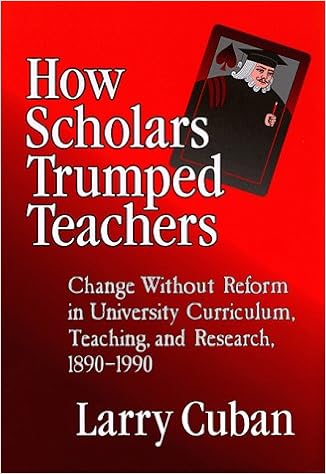
How Scholars Trumped Teachers at the Modern University

Browsing the shelves of the UNSW Canberra Library, I came across "How scholars trumped teachers: change without reform in university curriculum, teaching, and research, 1890-1990" by Larry Cuban (1999). This book is a case study comparing the history and medical facilities of Standford University.  The author argues that the modern US university evolved from a combination of German research university and English teaching colleges. The result of this merging is tension between between the role of teaching and research, which has been unresolved for more than a hundred years. The author argues that the many attempts to change have failed.

Unfortunately the Cuban does not offer an explanation as to why the combined teaching/research model of the US university (and university in Australia) has been so successful. I suggest it is simply that a research reputation is a good way to market courses. A student may well get a better education from a college which has staff trained to teach, but the resulting qualification will not be as prestigious as one from a research institution.

As Cuban points out, university academics tend to be promoted based on research results, not teaching expertise, despite attempts to reform this. Unfortunately, what is detailed as having been attempted and failed at Standford decades ago sound very much like some of the reforms proposed to promote education at Australian universities today. Those reforms appear to be doomed to failure, just as those at Standford were.

The problem, as Cuban details, is inconsistency between universities saying they value quality teaching, and rewarding staff with promotions for it. One way to resolve this would be to by using specialist staff for each function. This would be, I suggest, similar to a car company which has a motor racing team to bring prestige to the brand. The racing drivers, mechanics and engineers are not expected to be involved in the design or manufacture of mass produced passenger cars, but just help promote them trough success on the racetrack.

Even if they wanted to build passenger cars, a racing car team  would not be qualified to do so, as the demands of racing and ordinary day driving are very different. Similarly, even if researchers wanted to teach, their research skills do not equip them to teach. The researchers can bring prestige to the university, and thus promote enrollments in courses, but not teach the courses.

Friday, September 21, 2018

Ten Years Teaching Graduate Students Online: Some Hard Lessons


I will be speaking on "Ten Years Teaching Graduate Students Online: Some Hard Lessons", at ANU TELFest, in Canberra, 5 November 2018. Here is the extended outline:

Ten Years Teaching Graduate Students Online: Some Hard Lessons

Tom Worthington, MEd FHEA FACS CP
Honorary Lecturer
ANU Research School of Computer Science, Australian National University

Summary

The online graduate course "ICT Sustainability" was first run in 2009 and has been offered each year since by ANU, two other institutions in Australia and in North America. Course designer Tom Worthington discusses how the needs of global industry and academia were incorporated and the changes made in the ten years this award winning course has been running. Tom discusses how to keep students working online and keep study relevant to the workplace. Adapting the course for industry, open universities and as a free open online module are covered.

The Course

The Australian Computer Society identified a need for training of computer professionals in environmental issues in 2008. Tom Worthington was commissioned to design a 12 week online course on what was then called “Green Computing”  (Worthington, 2012). This was intended to be delivered as part of an industry graduate certificate for computer professionals. The course was designed for the Moodle learning management system and released under a Creative Commons license. The first cohort of students started the course in early 2009. At this time the Australian National University had transitioned to the Moodle system and the porting of the course from ACS to ANU was found to be relatively simple. The first cohort of ANU students commenced in second semester 2009.

Two cohorts of students (ACS and ANU) progressed through the course a few weeks apart with the same tutor, who was also the course designer. While the course content was identical for the two cohorts, there were subtle differences in assessment for the vocational and university cohorts. Later one of the graduates of the ANU course adapted the material for Athabasca University Canada, creating a third version (Stewart, ?). Athabasca staff later created self paced MOOC-like version of the course, resulting in four known versions (the course materials are open access, so more may exist). All known versions are listed in the introduction to the published course notes for the ANU course, along with details of revisions (Worthington, 2017b).

Addressing Global Requirements

The course was designed for the needs of the global computer industry and international qualifications standards. Course content and assessment is aligned with the Skills Framework for the Information Age (SFIA Foundation, 2009). The course is also designed for the requirements of the international accreditation of computer professional qualifications under the Soul Accord (2011).

Evolving Teaching and Assessment Techniques

The course was designed for online delivery, not having been adapted from a face-to-face course.  A set of text based notes are provided to students electronically (also published as a book), along with readings and optional videos. Unlike many online courses there are no recorded lectures, instead students are guided through the text with weekly discussion questions. Students were initially given a weekly grade by the tutor based on their answering and discussion in a text based forum. This was later changed to peer assessment using Moodle's forum module. Athabasca's self paced version of the course introduced weekly automated quizzes and these were adopted for ANU using Moodle's quiz module. The latest version of the course assessment has 20% for weekly forum contributions (2% per week, best 10 of 12 weeks, by peer assessment), 10% automated quizzes (10 x 1% each) and two assignments of 35% each (each in two parts: 5% plan, 30% do).

Some of the hard lessons

1. Online Teaching is a Skill to Learn: The initial course design was adapted from an existing ACS online course by a university lecturer with no formal training in course design and no experience as an online student. Subsequent formal training in course design and particularly experience of being an online student, made the process much easier (Worthington, 2017a).

2. Videos Are Not Necessary for Online Courses: The course was developed using traditional distance education techniques, with text based notes,  text based asynchronous communication between students and with staff. This has proved robust and successful. Students undertaking the online course achieve similar results to those for their conventional lecture based on-campus courses.

3. Peer Assessment Works: Peer assessment of students produced similar results to tutor assessment. Students accepted this form of assessment, provided it was made clear a tutor was checking the process.

4. Marks Are Needed to Keep Online Students Working: The course assessment scheme has marks awarded every week for discussion and a quiz. This was found necessary to keep students studying. Without the routine of a face-to-face class to attend it is too easy for students to neglect their online studies. The assessment scheme has been adjusted several time to attempt to find the correct balance between small rewards for weekly work, and large assessment items for evaluating deeper knowledge. The current scheme limits the grade a student can achieve from the weekly work to a “Credit”.

5. A little feedback goes a long way: Students are provided with weekly feedback. This consists of their mark for the week and one or two sentences. This has been found to be effective, as students look out for the mark. The weekly marks have also been found to be a good indicator of student progress. Students at risk can be identified from their low marks in the first few weeks of the course.

6. Provide Accessible Notes to Student's Phones: Learning Management Systems, such as Moodle, are now capable of providing  most of their functions to a student via a mobile phone. However, the course content has to be suitably formatted. Much time and trouble can be saved by formatting the course materials as accessible HTML documents, which will scale to fit on the student's phone or laptop. There is then no need for a special mobile version of the software or course materials. As the course materials are in a standard web format they can also be  easily ported to other software, and produced as an eBook or printed book

Demonstration

  1. Globals skills definitions translated to Learning Outcomes and Assessment Tasks.
  2. Text based course eBook also published book.
  3. Content reflows for Mobile devices.
  4. Automated quizzes.
  5. Peer assessed forums.

Course eBook and Published Book


Responsive & reflowing for mLearning


Automated quizzes


Peer assessed forums

 References 

  1. Seoul Accord Secretariat, (2011). Seoul Accord. URL: http://www.seoulaccord.org/
  2. SFIA Foundation. (2009). Skills Framework for the Information Age. URL: http://www.sfia.org.uk/
  3. Stewart, B (?). Green ICT Strategies, COMP 635, Athabasca University, Canada. URL: http://www.athabascau.ca/syllabi/comp/comp635.php
  4. Worthington, T. (2012, July). A Green computing professional education course online: Designing and delivering a course in ICT sustainability using Internet and eBooks. In Computer Science & Education (ICCSE), 2012 7th International Conference on (pp. 263-266). IEEE. URL: https://doi.org/10.1109/ICCSE.2012.6295070
  5. Worthington, T. (2017a). Digital Teaching In Higher Education: Designing E-learning for International Students of Technology, Innovation and the Environment. URL: http://www.tomw.net.au/digital_teaching/introduction.shtml#user_goals
  6. Worthington, T. (2017b). ICT Sustainability: Assessment and Strategies for a Low Carbon Future. URL: http://www.tomw.net.au/ict_sustainability/introduction.shtml