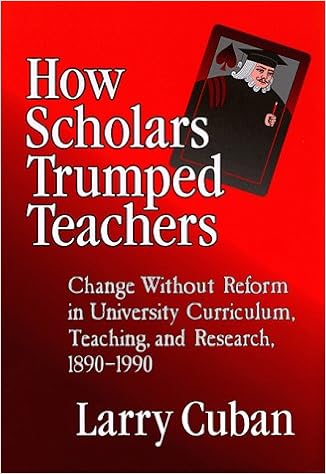
Browsing the shelves of the UNSW Canberra Library, I came across "How scholars trumped teachers: change without reform in university curriculum, teaching, and research, 1890-1990" by Larry Cuban (1999). This book is a case study comparing the history and medical facilities of Standford University. The author argues that the modern US university evolved from a combination of German research university and English teaching colleges. The result of this merging is tension between between the role of teaching and research, which has been unresolved for more than a hundred years. The author argues that the many attempts to change have failed.
Unfortunately the Cuban does not offer an explanation as to why the combined teaching/research model of the US university (and university in Australia) has been so successful. I suggest it is simply that a research reputation is a good way to market courses. A student may well get a better education from a college which has staff trained to teach, but the resulting qualification will not be as prestigious as one from a research institution.
As Cuban points out, university academics tend to be promoted based on research results, not teaching expertise, despite attempts to reform this. Unfortunately, what is detailed as having been attempted and failed at Standford decades ago sound very much like some of the reforms proposed to promote education at Australian universities today. Those reforms appear to be doomed to failure, just as those at Standford were.
The problem, as Cuban details, is inconsistency between universities saying they value quality teaching, and rewarding staff with promotions for it. One way to resolve this would be to by using specialist staff for each function. This would be, I suggest,
similar to a car company which has a motor racing team to bring prestige
to the brand. The racing drivers, mechanics and engineers are not
expected to be involved in the design or manufacture of mass produced
passenger cars, but just help promote them trough success on the racetrack.
Even if they wanted to build passenger cars, a racing car team would
not be qualified to do so, as the demands of racing and ordinary day driving are very different. Similarly, even if researchers wanted to teach, their research skills do not equip them to teach. The researchers can bring prestige to the university, and thus promote enrollments in courses, but not teach the courses.
Showing posts with label Stanford University. Show all posts
Thursday, September 27, 2018
Tuesday, December 5, 2017
Cyber Information Warfare in Canberra
Dr Herb Lin, Senior Research Scholar,
Stanford University, is speaking on "Cyber-enabled information warfare and the end of the Enlightenment" at the Australian National University in Canberra. He argues that Information Warfare and Influence Operations (IWIO) is a hostile act, but not "warfare" under the UN Charter and laws of war. I agree that using the Internet to influence an enemy is just an extension of previous analog information techniques, but I am not sure those being targeted would not see it as warfare.
Dr Lin's characterizes IWIO operations as being effective, with the use of violence. However, the doctrine of the USA (and Australia) is to respond to cyber attacks based on the effect the attack has, not the nature of the weapons used:
"When warranted, the United States will respond to hostile acts in cyberspace as we would to any other threat to our country. ... We reserve the right to use all necessary means—diplomatic, informational, military, and economic—as appropriate and consistent with applicable international law, in order to defend our Nation, our allies, our partners, and our interests.”I suggest that if IWIO has a damaging effect on a nation, that nation will respond accordingly. If the attacked nation has a IWIO capability, then they may use that to respond, but reciprocity doesn't require that.
From: International Strategy for Cyberspace, The Whitehouse, May 2011
Conventional military forces could be used to respond to IWIO, despite the problem that this may play into the information agenda of the attacker. For this reason a nation may use a covert kinetic military response to IWIO.
Dr Lin discussed ways to disarm a information warfare attack, by carefully identifying the attacker and their motives, as well as debunking false claims made. However, this task may be made more difficult, I suggest, by the nation's own politicians and organizations using the same IW techniques for political campaigning and marketing.
Dr Lin asserted cyber warfare is not a threat to civilization. I don't agree. Conventional and nuclear weapons can only kill people, but cyber war can kill an idea.
Dr Lin used the example of the Russian Government allegedly funding both "black lives matter" and "while lives matter" campaigns in social media in the USA, to spread discontent. These he characterized as chaos-producing operations. While such attacks existed before the Internet, they can now be carried out much easier on-line.
As an example, the technique of fuzzing with AI (Rajpal, Blum & Singh, 2017) might be applied to IW. With fuzzing is used to test the security of computer systems by generating a large number of sets of test data. AI can be used to see which sets are most effective for breaking into a system. The same could be (and may already be) applied to IW: the attacker would generate a large number of variations on a message, such as "black lives matter" and AI would be used to refine the versions of the message which are most effective at creating discontent. On-line marketers already use similar techniques to measure the effectiveness of advertising, by sending slightly different advertisements to individual consumers. However the use of AI could speed up the process. It may that social media is itself is a form of inadvertent IW attack, with a reports linking social media use and depression in teenagers.
One one the more amusing parts of Dr Lin's entertaining presentation was a clip from Star Trek Deep Space Nine:
As an example, the technique of fuzzing with AI (Rajpal, Blum & Singh, 2017) might be applied to IW. With fuzzing is used to test the security of computer systems by generating a large number of sets of test data. AI can be used to see which sets are most effective for breaking into a system. The same could be (and may already be) applied to IW: the attacker would generate a large number of variations on a message, such as "black lives matter" and AI would be used to refine the versions of the message which are most effective at creating discontent. On-line marketers already use similar techniques to measure the effectiveness of advertising, by sending slightly different advertisements to individual consumers. However the use of AI could speed up the process. It may that social media is itself is a form of inadvertent IW attack, with a reports linking social media use and depression in teenagers.
One one the more amusing parts of Dr Lin's entertaining presentation was a clip from Star Trek Deep Space Nine:
"The truth is usually just an excuse for lack of imagination ...".
From "The Wire", script by Robert Hewitt Wolfe, Episode 2x22, Production number: 40512-442, First aired: 8 May 1994).
Start Trek presented an idealized image of a united world where a western (mostly US) world view had prevailed. This form of soft-power perhaps should not be underestimated.
Dr Lin's "On Cyber-Enabled Information/Influence Warfare and Manipulation" with Jackie Kerr is to be published in the Oxford Handbook of Cybersecurity (2018).
"The West has no peer competitors in conventional military power. But its adversaries are increasingly turning to asymmetric methods for engaging in conflict. In this public seminar, Dr Herb Lin will address cyber-enabled information warfare (CEIW) as a form of conflict or confrontation to which the Western democracies are particularly vulnerable.CEIW applies the features of modern information and communications technology to age-old techniques of propaganda, deception, and chaos production to confuse, mislead, and perhaps to influence the choices and decisions that the adversary makes. A recent example of CEIW can be seen in the Russian hacks on the US presidential election in 2016. CEIW is a hostile activity, or at least an activity that is conducted between two parties whose interests are not well-aligned, but it does not constitute warfare in the sense that international law or domestic institutions construe it. Some approaches to counter CEIW show some promise of having some modest but valuable defensive effect. If better solutions for countering CEIW waged against free and democratic societies are not forthcoming, societal discourse will no longer be grounded in reason and objective reality – an outcome that can fairly be called the end of the Enlightenment."
References
Rajpal, M., Blum, W., & Singh, R. (2017). Not all bytes are equal: Neural byte sieve for fuzzing. arXiv preprint arXiv:1711.04596. URL https://arxiv.org/abs/1711.04596
Thursday, March 10, 2016
A scientific approach to teaching science and engineering
Greetings from the Australian National University in Canberra, where Nobel Laureate, Professor Carl Wieman of Stanford University is speaking on "A scientific approach to teaching science and engineering". He argues that science courses should teach how to think like a scientist. This involves subject knowledge, organization frameworks, monitor own thinking and learning, with hours of practice (thousands of hours to become an expert). The student has to reflect on their learning and receive feedback. He suggests teachers need to design practice tasks and timely feedback, but also motivate the student.
Professor Wieman gave an example of an introductory physics class with a pre-class assignment and quiz. The students in class then solve practical problems and answer questions using "clickers".
It was an honor to hear of this first had from a distinguished professor. However, none of this is new and is now part of the training of teachers. I have been trained in thee techniques by the Canberra Institute of Technology for vocational education and several universities for university teaching.
Professor Wieman stressed the value of these techniques for research universities. However, I suggest for this to be effective, those doing the teaching need formal training in how to teach and be given time to design courses. Universities need to treat teaching as an important activity for which formal qualifications are required and to which resources will be committed. It will not work if teaching is something researchers, without teaching qualifications, do in their spare time.
A recent paper on this is Holmes, Wieman, and Bonn (2015).
Professor Wieman gave an example of an introductory physics class with a pre-class assignment and quiz. The students in class then solve practical problems and answer questions using "clickers".
It was an honor to hear of this first had from a distinguished professor. However, none of this is new and is now part of the training of teachers. I have been trained in thee techniques by the Canberra Institute of Technology for vocational education and several universities for university teaching.
Professor Wieman stressed the value of these techniques for research universities. However, I suggest for this to be effective, those doing the teaching need formal training in how to teach and be given time to design courses. Universities need to treat teaching as an important activity for which formal qualifications are required and to which resources will be committed. It will not work if teaching is something researchers, without teaching qualifications, do in their spare time.
A recent paper on this is Holmes, Wieman, and Bonn (2015).
Reference
Holmes, N. G., Wieman, C. E., & Bonn, D. A. (2015). Teaching critical thinking. Proceedings of the National Academy of Sciences, 112(36), 11199-11204. Retrieved from http://www.pnas.org/content/112/36/11199.full
Subscribe to:
Posts (Atom)


