Showing posts with label lecture recording. Show all posts

Monday, June 28, 2021

COVID-19 is the end of the in-person lecture: long live the in-person lecture

In "COVID-19 is no excuse to end the live and in-person lecture" Lyndon Megarrity (James Cook University) argues killing the lecture is a bad idea. In the same edition of  Campus Morning Mail (28 July 2021) Dr Rhiannon Lee White of Western Sydney University says that "Teaching: what works on and off campus is different". I suggest they are both wrong: what works on and off campus is the same, but lectures, live or recorded, are not a very useful part of either. I gave up lectures ten years ago and now design for online learning, with optional face to face components.

Lecturers Are Over-invested in Lectures: Students Are not

COVID-19 has forced learning online, but most students were not attended most lectures even before. Research shows that a face to face lecture is no more useful for learning outcomes, than a video conference, or a video, or reading a book. Universities are retaining tutorials, online or face to face, as these provide interaction and active participation from students missing from old fashioned talk and chalk lectures and their modern vid-and-slide equivalents.

There is no conspiracy from vice-chancellors to kill the lecture to save money. Given the sunk cost in the stock of lecture theaters, there are few short term savings from leaving the idle, as compared with mostly empty, as they were before COVID-019.

Lectures can be isolating for students, who sit in a big room with people who all appear to know more about the topic than they do, thus reinforcing the impostor syndrome rampant at universities. Students don't get to know each other during lectures, as they are required to sit still and be quiet while the lecturer talks. If they ask a question they risk ridicule from the lecturer in front of their peers, so most do not. 

The realization which dawns on students at university is that you are, mostly, on your own. Unfortunately university, through marketing materials foster a myth that it is a happy mutually supportive environment, with professors helping each student individually. This worsens the anxiety for the students who therefore feel they must be dong something wrong. With a class of hundreds of students, no professor can give all the students individual attention. There is no substitute for well designed course materials, supported by tools and tutors, to help each student with their study. This ca be aided by group work (which students hate, but is good the them).

It is certainly easier for lecturers if all students are forced to attend lectures on campus. However, even without a deadly global pandemic, there are reasons why most potential students cannot attend a campus, and never could. Forcing students to class is effectively saying: "If you are rich, privileged, live in a city, do not have a job, do not have children or others to care for, or other community responsibility, then sure you can come to university". 

One of the dirty little secrets is that most Australian university lecturers are not qualified to teach and would not be permitted in front of a class at a school or TAFE. Standing up and talking to a class is only a very small part of teaching and one of the lest important and least effective. Lecturers who take the time and trouble to learn to teach will discover there are many more effective ways to do it. 

No Need to Change Learning and Design

As Dr Lee White points out that, as terrible as COVID-19 has been, it provided an opportunity to rethink learning design. This rethink moves the emphasis away from the classroom, physical or virtual, out to the wider world. However, this is a less which those who teach professional skills, such as computing and engineering already knew. While theory can be covered in a classroom, or better still online. Students need to interact with outer students, with experienced professionals and with clients. 

As Dr Lee White notes, the key approach for a more hand on form of learning is asynchronous. The instructor explains to the student what they need to do, provides tools and then lets them try to do it. The student then checks in regularly, to see how they are doing. But this is not really about on campus or online, it is about an approach to teaching.

In 2008 I had the good fortune to be asked to design a professional development course on green computing for the Australian Computer Society. I documented the design process in 21 blog posts and a conference paper. The course was first delivered in 2009 and was later offered through the Australian National University,  and Universities Australia. It is currently offered by Athabasca University, Canada. This is in asynchronous mode, with no video conference and no face to face lectures. I still design courses much the same way, but with face to face or videoconferencing, where possible, as an optional extra. 

As an experienced university lecturer, the idea that my lectures were about the least useful part of a student's education was hard to accept. It was only through years of formal training, where I became a student (of education), experiencing alternative techniques, that I really understood what to do. We need to give university lecturers that learning experience. 

Thursday, May 21, 2020

Cambridge University Cancels Lectures Until 2021


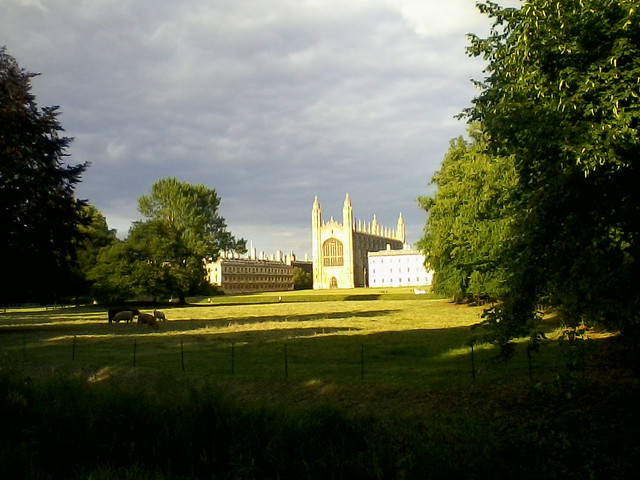
Chapel of King's College CambridgeThe University of Cambridge (UK) has suspended mass face to face lectures until the northern summer in 2021. Small group teaching will continue in person. I suggest this is a prudent move, as mass lectures are likely to be the highest risk educational activity for COVID-19, as well as the least useful form of education. Lectures are easy to replace with video, and research shows the videos are just as useful in terms of student learning.

In 2015 I was asked by the Office of Scholarly Communication at University of Cambridge to talk to staff about how to teach students online. Dr Danny Kingsley, then Head of the Office of Scholarly Communication took some notes. At the time, the University of Cambridge was using the same Australian developed Moodle learning management system, as I used at the ANU. So Cambridge had the technology to provide online learning, if not the training or motivation to use it. 

There were some technical deficiencies: I has assumed that Cambridge lecture theaters would be equipped for video recording, as is common in Australia. But one bemused local pointed out that some of the buildings did not have indoor plumbing, let alone video. However, that is a problem easily solved. I assume that with the COVID-19 lock-down, staff now have been equipped with laptops and web cameras, adequate for recording lectures in a theater, as well as at home. 

A bigger problem than technology is teacher training, and the motivation for teaching staff to undertake it. As I was explaining at how to support students online at Cambridge , I noticed part of the audience nodding. These were teachers from a nearby polytechnic. To them e-learning was routine, as it was essential to an institution which had to provide education as cost-effectively as possible. In contrast, a research university such as Cambridge, has a business model built on research output. Teaching is important, but just part of what they do. 

For the last few years I have been considering how to the problem of improving the quality of teaching at research universities. I suggest it requires making teaching part of the syllabus for students who wish to tutor, and go on to a career in academia. This needs to be done before the student graduates, and becomes too important to be told to do teacher training. ;-)

Cambridge University does not appear to be alone with students asking for a refund, when they found themselves studying online, rather than in the hallowed halls. However, it is the small group teaching, which will continue, where the magic of Oxbridge is supposed to happen. Australian universities are also likely to first return to small group teaching first, with large lectures much later, if ever.

Even with large classes, there are ways, face to face or online, for students to get to know each other. One commonly used icebreaker is to have students form small groups to find out about each other. They then introduce each other to the whole class. This is one of the techniques which university teachers are routinely trained to use.

For those with good social skills, this can seem a very trivial and artificial. However, I was once enrolled in a course, face to face, where I never met anyone. I went to the lectures, listened to the lecturer, and went home. There was no get-to-know-you: the lecturer lectured and we were supposed to just listen, no questions, no discussion.

Icebreakers can be done online, where video conference system puts participants into small groups for a set period. Online text forums can also be used. This was done last weekend for the ANZDF logistics hackerthon, where teams were formed using Slack.

It will be interesting to see to what extent such icebreaker exercises can be held face to face, while maintaining social distancing. The Canberra Innovation Network (CBRIN) had very successful First Wednesday Connect events with hundreds of people crammed in. These events have moved online. But when they can again be held in person will it work, if everyone has to keep their distance in a mostly empty room?

On my last visit to Cambridge I also dropped in to the business faculty (where the MBAs are) and talked to the equivalent of CBRIN. One insight was that most students do not participate in these activities if they are not required to. They tend to turn up shortly before they graduate, when they realize they might need to network to get a job.
 

Friday, May 15, 2020

Universities Should Not Plan a Return to Lectures-as-Usual

Recently US colleagues asked about plans for the return to the university campus for students, after COVID-19 lock-downs. The consensus emerging seems to be to provide for students remote online, as well as in the class at the same time. Classrooms would be equipped with microphones, cameras, screens and computers (many already are), so remote students could see and hear the instructor, as well as those in the room.

However, I will still be taking the laptop and web camera I have been  using for teaching at home, along as a backup. That might be a useful  approach for institutions which don't have all classrooms equipped for live video.

In Australia we are fortunate to receive reasonably consistent advice from local, state and federal authorities on COVID-19 measures. Some of this has the force of law, through health and safety legislation, as well as specific COVID-19 emergency regulations. However, there are currently no specific guidelines for universities (the ones for schools are clearly not applicable), so the closest is for workplaces.

A prudent approach, I suggest, would be to have staff return to work first, then small group teaching, and lastly large groups. However, there are some difficult legal and ethical dilemmas, particularly with large group teaching.

Conventional lectures, with large numbers of students, in a cramped lecture theater, probably pose the highest infection risk. Also this is the least effective form of teaching. A conventional face to face lecture is no better for student learning than watching a video. So there is no good reason to resume lectures, ever (I stopped giving lectures ten years ago). There will still be scope for a presentation by a celebrity guest speaker, and for interactive learning with a group of people,. However, I suggest universities do not plan a return to conventional lectures, with someone speaking for an hour to hundreds (most students gave up attending these years ago, anyway). Instead universities should start decommissioning, re-purposing, or demolishing, lecture theaters, to make way for flexible learning spaces.

ANU Marie Reay Teaching Centre
The ANU Kambri complex, opened in February 2019, provides an example of an alternate approach to large university teaching spaces. The Marie Reay Teaching Centre has six floors of entirely flat floor classrooms, with movable chairs and tables. This allows occupants to be more easily spread out, than in a fixed seating lecture theater. If conditions allow, the tables can be pushed aside and chairs arranged close togehter lecture style. During construction, I asked the engineers if the prefabricated manufactured wood panels allowed the building to be modified more easily modified than in a concrete building. The reply was that this would need just a structural engineer, and a chainsaw: in other words the building could be easily modified.

The adjacent Culture and Events Building has multipurpose rooms with retractable theater seating. At the push of a button the tiered seating retracts into the wall, leaving a flat floor space for chairs and tables to be placed. The foresight of those who planned these buildings is to be commended.

Tuesday, November 14, 2017

Dogfooding the Interactive Lecture at ANU

Greetings from the Australian National University (ANU) in Canberra, where I have been taking part in an interactive lecture on "Deep Learning and Interactive Lectures" by Glen O'Grady, Director of the ANU Centre for Higher Education, Learning & Teaching. This used the Echo 360 Active Learning Platform (ALP) and is an example of dogfooding: leading by example, using the tools you are advocating others use.

Echo's ALP seems to have moved some way towards the combining of lecture recording and webinar software which I outlined in a paper (Worthington, 2013) and discussed later that year with staff at Echo360's Perth office. This would allow students to interact live in the classroom, remotely in real time, or later with a recording. One feature still missing is for the student to be able to pause the live event and time shift. Students would then be able to interact as if the lecture was in real time, answering quiz questions, entering and reading text chat, but minutes or days, later.

However, the focus of Glen's talk was the pedagogy of increasing interaction in "lectures", rather than the gadgets. This seems to be a development of "Lecture 2.0" from a decade ago, to make the classroom experience more engaging. The problem with this was, and still is, the constraints of the room layouts available, the curriculum, and perhaps most of all, the lecturer's limited course design and teaching skills.

Conventional lecture theaters are designed for the student to be able to see and hear the lecturer, not for group interaction. Even where interaction is physically possible, lecturers have difficulty using a format other then them talking and students listening, as this is the only teaching technique they know.

The focus needs to be, I suggest, on students and their learning needs, not lecturer's dreams of full lecture theaters. Rather than try to modify lectures to make them more interactive, I suggest replacing them with better teaching techniques. This requires the teaching staff to be trained in how to teach (not lecture) and to use different forms of assessment. Lectures can then be a very minor supplement to more effective teaching techniques.

The ANU is building a new flexible learning centre with rooms for "flipped" classes (as discussed in "Brave New World in Future Teaching Spaces" by Bella Dimattina, Woroni, ANU, 3 October 2017). What is needed to use the new building effectively is to also flip the thinking of the teaching staff. Rather than worry about how to get students to come to "lectures", the priority should be first the learning outcomes, then the assessment for those outcomes and lastly what form of scaffolded learning activities are needed.

An example of this approach is the ANU Techlauncher program, where students undertake a project on a real-world problem in teams, or as individual interns, working for a real organization. The student's work is project based, with them attending weekly tutorials for mutual support and advice from a tutor. There are also workshops and conventional lectures. However, the lectures are the least important part of the course.

Reference


Worthington, T. (2013). Synchronizing Asynchronous Learning: Combining Synchronous and Asynchronous Techniques. In Proceedings of 2013 8th International Conference on Computer Science & Education (ICCSE), 26 Apr - 28 Apr 2013 , Sri Lanka. URL: http://dx.doi.org/10.1109/ICCSE.2013.6553983
Preprint available at: http://hdl.handle.net/1885/9556

Tuesday, September 10, 2013

Alternatives to University Tutorials and Lectures

Greetings from the Australian National University in Canberra, where I am talking part in "Education Development StudioTeaching & Learning Day: Evolving practice and expectations". John Minns, talked o  Combining forms of teaching delivery. He advocated an approach where lectures are replaced by three hour interactive sessions with the entire class of 300 students. Small group tutorials are still offered in addition, for those students who want them. It seemed to me that the idea of offering different forms of instruction and then allowing students to choose is not a new one, being the traditional OxBridge approach of Oxford and Cambridge universities.

Thursday, July 18, 2013

Audio Recording Options for an On-line Course

Recently I was asked about recording options for on-line courses. The simplest recording option when creating an on-line course is not to use any audio or video. I created a whole 12 week course for which I recorded no audio and no video. I do refer the students to relevant video and audio produced by others, but I only supply text myself. This course, "ICT Sustainability", is popular with students and got me an award from my peers.

When I am producing audio I use a USB Headset. This puts the microphone close to the mouth and the audio is digitized in the headset, which improves the quality. MP3 is fine for the audio format.

If you are recording with a live audience, see if your institution has a built in recording option. The Australian National University has lecture theaters equipped with a recording system which takes the audio from the room PA system and the video from the main screen. This saves having to worry about a separate microphone. I just have to remember to press "Record" at the start and "Stop" at the end and a podcast is produced. The ANU system is called the Digital Lecture Delivery Service and many universities have similar facilities.