Showing posts with label First Wednesday Connect. Show all posts

Wednesday, September 4, 2024

ANU Computer Interns Available


Greetings from Canberra Innovation Network's First Wednesday pitch night. I am here to let people know the Australian National University has computer interns needing placements to hone their skills. 

Wednesday, June 5, 2024

CIT New Campus at First Wednesday

Rikkii Norris, CIT CEO
Greetings from Canberra Institute of Technology (CIT) catering school where Rikkii Norris  is pitching the new CIT Woden Campus. This will be a far cry from the old rooms I studied video production here on the Reid Campus. CIT are hosting June First Wednesday, so there are several CIT pitches, including fir the new EV Center of Excellence. It is assumed that Canberra is just about government work, but there are significant tech related industries in Canberra, underpinned by educational institutions. 

Wednesday, March 6, 2024

March First Wednesday Connect

Greetings from March CBRIN First Wednesday Connect at Canberra Airport. At the moment we are hearing about how the Airport uses robot mowers. I am not sure where the robot dog fits in.

Wednesday, November 1, 2023

Innovation at the ANU

Greetings from the award winning Birch Building at the Australian National University, where 60 second pitches are on. Think Shark Tank, but with a friendly audience of 300. This is the First Wednesday Connect event of the Canberra Innovation Network (first Wednesday of each month). 

I might be about to do something innovative. On the way to the event I stopped in at the ANU Library on the way and found myself looking up "Cambridge Phenomenon". This is a report I read 27 years ago, and changed my life. Perhaps it is time to work out what to do next.

Wednesday, August 2, 2023

Billion Dollar UNSW Canberra Campus


Greetings from First Wednesday Connect in Building K at Canberra Institute of Technology. Normally this is at Canberra Innovation Network's office and I went there finding only two confused students. We found the event at the other side of the city, after a quick number 3 bus ride. We are here to celebrate approval of UNSW's new campus and new CIT courses.

The catering for this event was excellent, as Building K is the CIT Hospitality and Culinary School. ;-)

Wednesday, July 7, 2021

Start-up Pitches by Smartphone

Automed Battery
Powered Medication Delivery

Greetings from First Wednesday Connect at the the Canberra Innovation Network (CBRIN). This was planned to be in the foyer of the ACT Government's new HQ, but has been moved online due to COVID-19. CBRIN kept the format the same: informal discussion, followed by 60 second pitches, but moved it online using the Remo platform. In the past I have had difficulties getting Remo to work on my old slow computer, but have found it works much better on my newer smartphone. One of the startups is Automed, with a livestock medication system. One of the participants commented that perhaps this could be used for COVID-19 vaccinations. It is not such a silly idea, to use a computerized powered injector which links to a database. That would not only allow injections to be given faster, it would reduce the time spent manually recording details. But a patient QR code might be used for identification, rather than an ear tag. ;-)

Tuesday, May 25, 2021

Shaping Ideas That Shape the Future

Expert Panel
Greetings from the ANU TechLauncher Student Showcase, at the Canberra Innovation Network. ANU Techlauncher students get to show off the computer systems they have built in teams for real clients through the semester. A panel of experts, from academia, and industry and discussing education and innovation. Most students are participating online via Remo. Tony Hosking mentioned that such projects get students out of their comfort zone. Petr Adamek, plugged First Wednesday Connect. In response to a student question online from China, the panel discussed learning from what happened unexpectedly in a project. As it happens I run the last assessment task for the course, where students learn to reflect on their experience.

Thursday, May 21, 2020

Cambridge University Cancels Lectures Until 2021


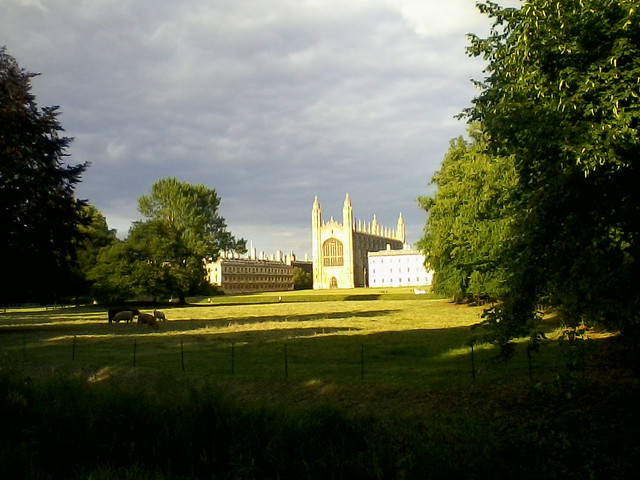
Chapel of King's College CambridgeThe University of Cambridge (UK) has suspended mass face to face lectures until the northern summer in 2021. Small group teaching will continue in person. I suggest this is a prudent move, as mass lectures are likely to be the highest risk educational activity for COVID-19, as well as the least useful form of education. Lectures are easy to replace with video, and research shows the videos are just as useful in terms of student learning.

In 2015 I was asked by the Office of Scholarly Communication at University of Cambridge to talk to staff about how to teach students online. Dr Danny Kingsley, then Head of the Office of Scholarly Communication took some notes. At the time, the University of Cambridge was using the same Australian developed Moodle learning management system, as I used at the ANU. So Cambridge had the technology to provide online learning, if not the training or motivation to use it. 

There were some technical deficiencies: I has assumed that Cambridge lecture theaters would be equipped for video recording, as is common in Australia. But one bemused local pointed out that some of the buildings did not have indoor plumbing, let alone video. However, that is a problem easily solved. I assume that with the COVID-19 lock-down, staff now have been equipped with laptops and web cameras, adequate for recording lectures in a theater, as well as at home. 

A bigger problem than technology is teacher training, and the motivation for teaching staff to undertake it. As I was explaining at how to support students online at Cambridge , I noticed part of the audience nodding. These were teachers from a nearby polytechnic. To them e-learning was routine, as it was essential to an institution which had to provide education as cost-effectively as possible. In contrast, a research university such as Cambridge, has a business model built on research output. Teaching is important, but just part of what they do. 

For the last few years I have been considering how to the problem of improving the quality of teaching at research universities. I suggest it requires making teaching part of the syllabus for students who wish to tutor, and go on to a career in academia. This needs to be done before the student graduates, and becomes too important to be told to do teacher training. ;-)

Cambridge University does not appear to be alone with students asking for a refund, when they found themselves studying online, rather than in the hallowed halls. However, it is the small group teaching, which will continue, where the magic of Oxbridge is supposed to happen. Australian universities are also likely to first return to small group teaching first, with large lectures much later, if ever.

Even with large classes, there are ways, face to face or online, for students to get to know each other. One commonly used icebreaker is to have students form small groups to find out about each other. They then introduce each other to the whole class. This is one of the techniques which university teachers are routinely trained to use.

For those with good social skills, this can seem a very trivial and artificial. However, I was once enrolled in a course, face to face, where I never met anyone. I went to the lectures, listened to the lecturer, and went home. There was no get-to-know-you: the lecturer lectured and we were supposed to just listen, no questions, no discussion.

Icebreakers can be done online, where video conference system puts participants into small groups for a set period. Online text forums can also be used. This was done last weekend for the ANZDF logistics hackerthon, where teams were formed using Slack.

It will be interesting to see to what extent such icebreaker exercises can be held face to face, while maintaining social distancing. The Canberra Innovation Network (CBRIN) had very successful First Wednesday Connect events with hundreds of people crammed in. These events have moved online. But when they can again be held in person will it work, if everyone has to keep their distance in a mostly empty room?

On my last visit to Cambridge I also dropped in to the business faculty (where the MBAs are) and talked to the equivalent of CBRIN. One insight was that most students do not participate in these activities if they are not required to. They tend to turn up shortly before they graduate, when they realize they might need to network to get a job.
 

Tuesday, May 14, 2019

Standards for Innovation management

While I have been looking at how to do, and teach innovation for several years, it was only this month I discovered there were formal standards. After giving a pitch at CBRIN's First Wednesday Connect, I was chatting to Rizwan Khan, who pointed out that ISO TC 279 is developing innovation management standards. The idea of a standard for innovation sounds a contradiction in terms, but DE CASANOVE, and MOREL (2018), provide a useful overview of the work of the committee.

Reference

DE CASANOVE, A. L. I. C. E., & MOREL, L. INNOVATION MANAGEMENT PRINCIPLES FROM ISO 50500 SERIES. URL https://www2.aston.ac.uk/aston-business-school/documents/IAMOT2018_paper_97.pdf

Tuesday, March 5, 2019

Renewable Energy Hackathon in Canberra

Shane Rattenbury, 
ACT Minister for Climate
Change and Sustainability
Greetings from the ZeroCO2 Renewable Energy & Sustainability Hackathon at the Canberra Institute of Technology (CIT). I will be mentoring teams working for two days on renewable energy, waste disposal, sustainability in food and manufacturing, transport & travel, smart cities, building and education. There is a a $10,000 prize pool, plus access to Canberra Innovation Network desk space and coaching.

It is easy to get cynical: what can you do to save the planet in two days? Certainly new tech can't be completed in that time, but new ideas of what is needed, and how what is available can be better used. The hackerthon is a compressed version of the group project teaching techniques we use in ANU Techlauncher.

Before the hacking, we have Shane Rattenbury,  ACT Minister for Climate Change and Sustainability speaking.The ACT Government is currently working on the sustainability plan for 2025. He pointed out that this gets more difficulty when households have to change their behavior. Canberra's transport emissions are increasing.

There is also a Renewable Energy and Sustainability Industry Forum taking place in conjunction with the hackerthon. Both events will end with competition results at  First Wednesday Connect, 5pm tomorrow.

All events are taking place in Building K at CIT Bruce  Campus. This was a purpose built for renewable engendering. There is a big workshop on the ground floor, full of neat color coded pipes and machinery. Above the workshop are floors of classrooms, and then space for texting solar panels on the top.

ps: CIT is where I studied for my Certificate IV in Training and Assessment.