Showing posts with label Canberra. Show all posts

Thursday, June 27, 2024

Canberra's Digital Creatives Like Lunch

Creative Connect Panel at CBRIN:
Lucy Sugerman, Elvis Gleeson,
Emma Laverty, & Owen Walter
Greetings from Canberra Innovation Network, where I am taking part in "Creative Connect", sponsored by the ACT Government. We were surveyed beforehand and it turns out the largest group are digital creatives (which I guess I am) and we like meeting over lunch (CBRIN have put on a good spread). We have a panel with Lucy Sugerman (Music ACT), Elvis Gleeson (Blank Creative),  Emma Laverty (Project Dust), and Owen Walter (Oculo Digital). So we have a musician, writer, dancer, and video maker. This was a revelation, as most people think of Canberra as a place for public servants, and government contractors. I knew we also have a large education sector, but hadn't realized there was also a "creative" industry. Some of that supports education and government. One of the panel talked about getting paid to make "Beats to sound-cloud rappers". From this limited sample creatives don't fit the pattern of university fine arts degree and then work. 

The question for me is what can Canberra do to help this industry? One surprising answer is "Be a nice place to live". I had assumed creatives would want a grungy inner city squat, but apparently the novelty of that wears off quickly. Another answer was that it is a place you go when your partner gets a job in Canberra.

Tuesday, October 25, 2022

Back to the Conference in Canberra

At the TiG food truck.
Greetings from Tech in Government (TiG) at the National Convention Center in Canberra. While I have enjoyed online conferences over the last three years, it is good to be back in a room, with people. I am speaking tomorrow on Learning to Innovate for Sustainable Computing.

TiG's big innovation this year are food trucks parked outside the exhibition hall. This prompts casual conversations with people you don't know. I was offered work with one of the world's big four consulting companies, and a pair of sox, while waiting for my Chicken Tikka. ;-)

Google slogan at TiG 2022:
"Let's getting solving for Government".

Google got perhaps more attention than they wanted for the slogan on their booth: "Let's getting solving for Government". ;-)

Friday, April 8, 2022

ANU Alumni Meeting in 75 Cities, Including Houston, Islamabad, Melbourne, Lucknow and Denver

ANU 75th

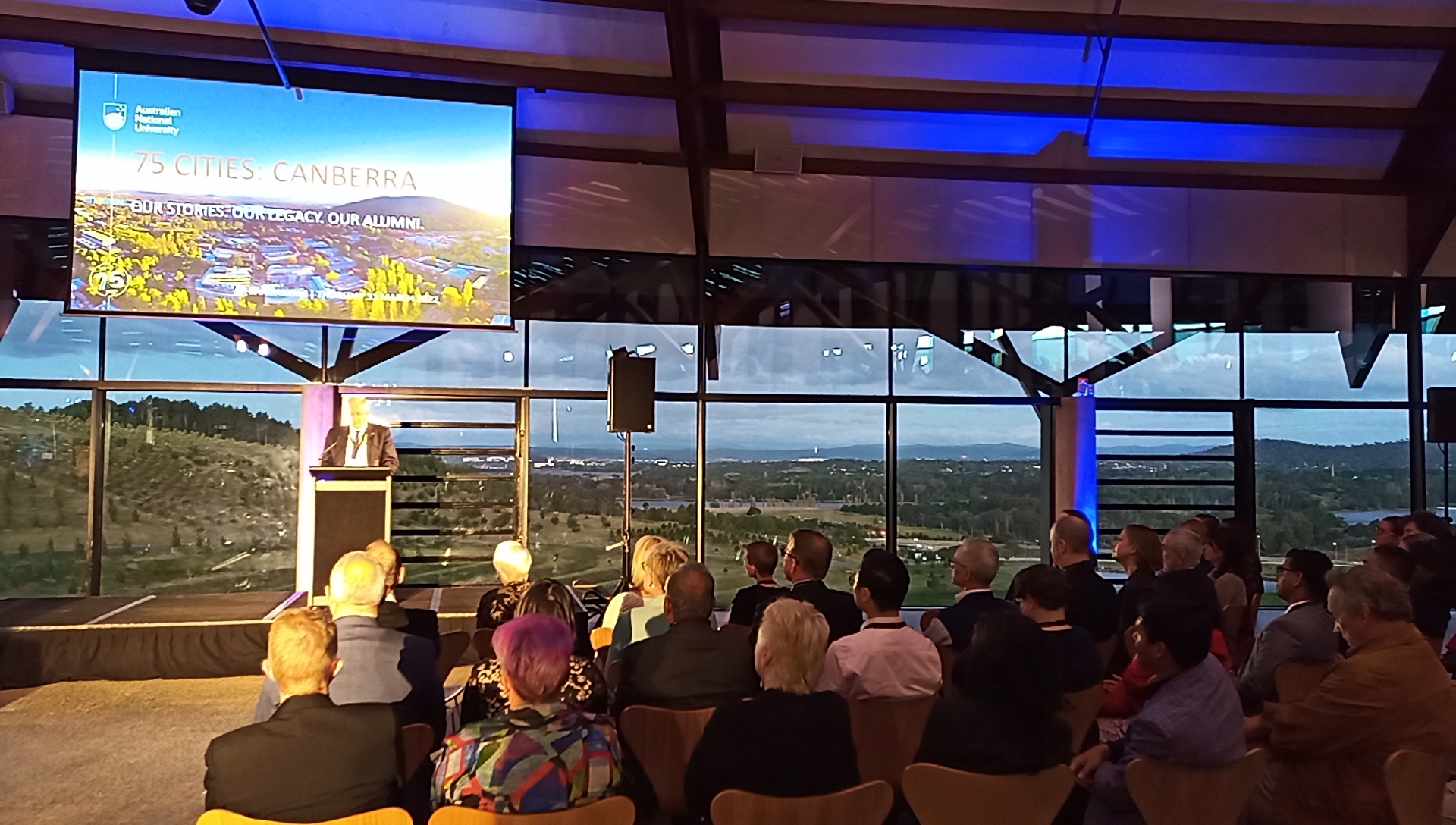
As an ANU alumni, I attended the inaugural 75 Cities event in Canberra last week. It was good to be at a face to face event and see old faces, and some new ones. But I did not understand what the "75 Cities" was about. Now I see the idea is to have alumni events at cities around the world to celibate 75 years since the ANU's founding at cities around the world.


Monday, October 19, 2020

ACT Higher Education Post-COVID-19 Strategy

Canberra's universities need to change how they work to remain viable during, and after ,the COVID-19 emergency. The major post-secondary educational institutions in the ACT are the Australian National University, University of Canberra and the Canberra Institute of Technology. I have studied at all three and am on the staff at ANU, however, these suggestions do not necessarily reflect the current policy of any, or of the ACT Government. I will be discussing some of this at an ANU symposium on Thursday.


The approach to COVID-19 has been short term, assuming that it will be over in months. However, it may take years to recover and it is certain there will be further pandemics in the future. Also the geo-political situation Australia finds itself in may result in international students again being unable, or unwilling, to study on Canberra's campuses, without warning. In addition other countries are offering increasingly attractive quality online and blended learning. Both Australian and international students may decide to take up those offers, if Canberra's institutions do not have quality, cost effective, flexible educational offerings. 

1. Adapt Infection Control Measures for Institutions

Reduced distancing for students

COVID-19 restrictions in the ACT have been eased, but even the current STAGE 3 makes it difficult for educational institutions.  As an example, the ACT requires persons to remain 1.5 m apart. I propose that for educational institutions, this be reduced to the WHO recommended distance of 1 m

Where seated, people should be able to be 250 mm apart, side to side. This would allow existing fixed seating lecture theaters to be used at 50% capacity, with every second chair empty. Active lecture theaters, flexible learning spaces and laboratories could be used at full capacity. Institutions should be encouraged to build these guidelines into the design of new teaching spaces to reduce infection rates for annual respiratory infections and allow for future outbreak measures.

Tracking on campus

The ACT Government and institutions should commission a tracking application compatible with the Apple/Google Privacy-Preserving Contact Tracing Standard. Unlike the current Australian Govenrment's COVIDSafe App, this would be reliable, effective and voluntarily taken up.

2. Training for Hybrid Teaching 

Canberra's university have been able to quickly introduce online learning for students unable to get to campus. Unfortunately, most people teaching at university have not been trained to teach online. and have no formal qualifications for doing so. Vocational teachers at CIT, and private providers, are required to have a qualification in training and assessment. It is proposed that the ACT Government assist Canberra's universities to introduce a qualification for university teachers at least to the standard for vocational education. This could be provided a set of micro-credentials building to an AQF qualification.

3. Offering Hybrid Qualifications

In the past domestic and international students have been required to move to Canberra to undertake the majority of their university studies. I suggest this be changed so that a typical student can undertake 80% of their study online. The ACT Government can lobby the federal government to make the necessary changes to visa rules for international students. The Canadian government has already eased its visa rules, making Australia a less desirable destination. 

The ACT Government can assist Canberra's universities to develop advanced qualifications in the design and delivery of education to provide a quality online experience. This can then be used in marking campaigns national and internationally which emphasize students can have both the flexibility of an online education and the option of quality lifestyle experience in Canberra, leading to a world-class qualification.

4. Work Integrated Learning

Many vocational qualifications require students to undertake work experience as part of their degree. This is increasingly seen as a desirable part of any university qualification. However, international students experience problems obtaining access to a workplace in Canberra, due to federal government restrictions on non-citizens working for the public service and for government contractors. I suggest the ACT Government assist the Canberra Innovation Network to expand its current start-up program,. Also the ANU's Innovation ACT and TechLauncher programs could be expanded to provide cross institutional participation.

5. Vocational Supplementation to University Qualifications

The Canberra Institute of Technology has the capacity to provide training to supplement the university education of students. I suggest the ACT Government work with the universities to develop and market standard packages of degrees with vocational qualifications.

Monday, January 6, 2020

Available to Help with Distance Educaiton from Sydney During Bushfire Emergency

Preparing web pages
for Defence Exercise K95
I was in Sydney when the smoke hit Canberra, and will be working from here until conditions improve. As I have some experience in distance and e-learning, I would be happy to help out any Canberra educational institutions needing to provide remote access for their students (although most are well equipped for this already). If staff or students in Sydney needed face-to-face support, I expect one of the local institutions would loan us a room. As a member of the Australian Computer Society I can also make use of the ACS Hub at Barangaroo.

If any emergency or relief organizations need extra help with just-in-time online training of staff and volunteers, I would be happy to help.

My skills in design of military and emergency websites are a little rusty, but if anyone needs help with that I would be happy to do so.

ps: The photo is from when I was at Mallacoota in 1995, preparing web pages for a military exercise.

Saturday, August 3, 2019

Square One Coworking Space at ANU

The Australian National University has announced "ANU Square One",  a coworking space for "student entrepreneurs working on projects, startups or freelancing". There will be a launch at 5pm, 21 August 2019. Students can apply now to be "onsite" members. As an ANU alumnus, I have applied to be an "off-site" member, to work on the "Async-Sync Learning System".

Monday, October 29, 2018

K-10 Digital Technologies Curriculum Impact on Higher Education

Greetings from EdTechPosium at the Australian Catholic University's new teaching building in Canberra. Michael de Raadt and Russell Waldron are discussing "Australian Curriculum for Digital Technologies, NAPLAN and the impact on higher education in future years". One point Michael de Raadt made that this is not just about teaching computer programming and there are physical tasks used, especially for younger children. As an example, some of the audience took part in a bubble sort: exchanging places until they were sorted by name.
Russell Waldron pointed out that students have been through the Digital Technologies Curriculum from K-10 will already have some of the university graduate attributes before they start. However, students from other education systems may not.

Russell Waldron, Senior Learning Designer, ANURussell Waldron  also pointed out the Digital Technologies Curriculum students will have a different approach to assignments, including group work. These students will be familiar with using online document creation tools, including assigning attribution for group work. The students skills for working this way will likely exceed that of their university teachers.

Michael de Raadt discussed problems and benefits with Online NAPLAN. This requires less manual handling of forms, but more dependence on IT staff, with the potential for technical failures. One benefit is that the feedback happens faster. Russell Waldron pointed out that the online tests require keyboard skills and are adaptive. These students will expect the same at university. A subtle aspect of this is that the assessment changes from how the student did on a standard test, to how the student has progressed.

Evolving Online Graduate Education: From Synchronous to Asynchronous

avatar for Julian Cox
Greetings from EdTechPosium at the Australian Catholic University's new teaching building in Canberra. The keynote speaker is Julian Cox, Associate Professor, Food Microbiology, University of New South Wales on  "Pedagogy, Peers, Professionalism, Platforms and Practice… and the Workshop Activity". He is describing evolving from online learning as an analogue of face to face lectures, with synchronous sessions, to something students can do in their own time (asynchronous).

I agree with most of what Professor Cox was saying, but suggest online students need some synchronization, just not in the form EdTech people normally think of it. Ideally a self disciplined students can be left to complete tasks, including assessment tasks, to when it suits them. However, as a student myself, I found that if there was no deadline, and no marks, I would put off a task forever.

One of my students has been working on a tool to break down the Synchronous/Asynchronous dichotomy. and hope to demonstrate this today at the conference.

Professor Cox  went on to detail the use of the Moodle Workshop Module to have students peer assess. This module is unused, perhaps because the name makes it sounds like something you would only use for a live face-to-face activities.

Professor Cox  then discussed how to guide students through preparing an e-portfolio (with Mahara). I fond it frustrating when I was told to "reflect" in an e-portfolio, as if this was an inherent skill. After six months hard work and guidance, I had a reasonable idea of what it was about. Then I had to tutor students who had been told to do this with no scaffolding.

Thursday, September 20, 2018

Collaboration across Boundaries 2018 Conference Canberra

Resister now and apply to present at Collaboration across Boundaries, a free one day conference for early career academics, 4 December, at the Australian National University in Canberra. There are two $3,000 research grants for the best collaborative idea. Also there is a free skills development workshop on Tuesday 20 November.

Thursday, September 13, 2018

Bomb Proof Timber Buildings

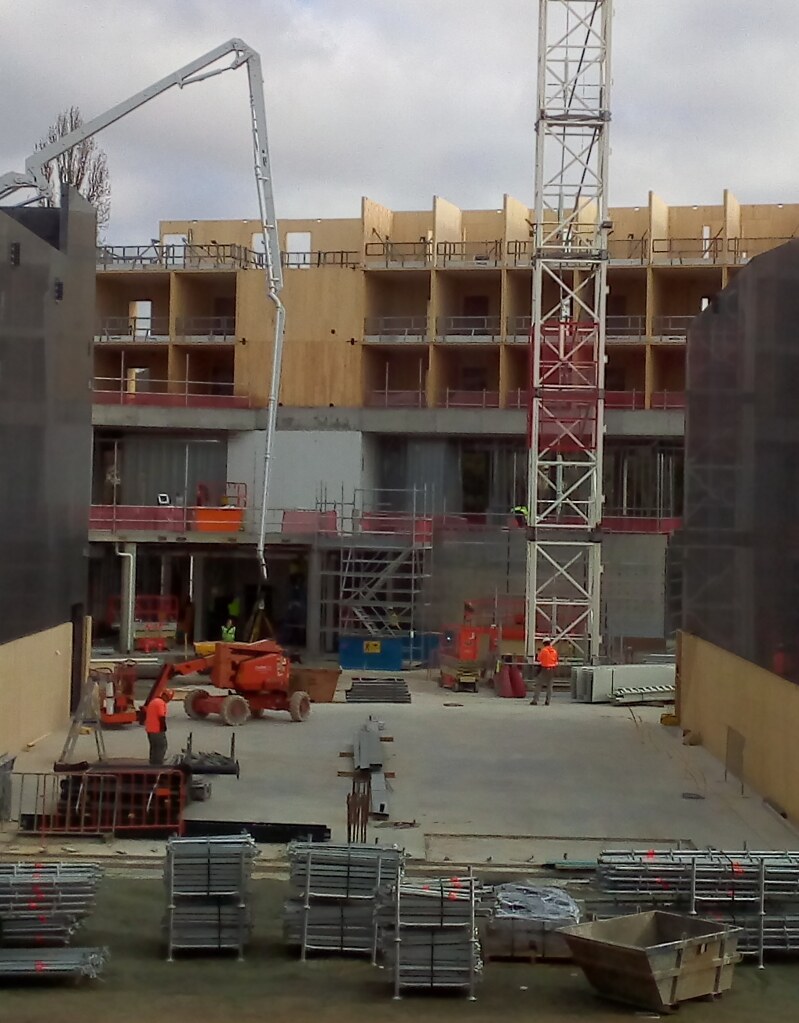
Greetings from the Mass Timber Building Seminar at the Australian National University. The new ANU teaching building is being constructed from timber, which is still unusual for large modern buildings. One aspect of this building technique which was pointed out by Andrew Smith from Lendlease DesignMake, is that it has been tested as bomb proof for the US Army.

What might have wider applicability is that Andrew suggested the use of a technique similar to that used by automobile manufacturers to produce a wide range of different cars from the same set of engineered components. With this a set of steel connectors and wooden panels would be used to quickly produce custom buildings. But perhaps from car making as an analogy, flat-pack furniture would be more applicable.

I asked Andrew if timber provided flexibility for a teaching building. He said that they settled on a 8 x 8 m module for the new ANU Flexible Teaching building would provide a good balance between flexibility and cost. The wood floor of the building is stiffened with wood ribs.

I was one of those who argued for eliminating conventional lecture theaters, but exactly what size or shape space might be best is still not yet clear. It is also likely this will change over time. Six years ago I looked at remodeling the ANU's Computer Science and Information Technology Building (CSIT) for flexible learning. However, this was difficult to do due to the placement of the columns in the building. These had been placed to suit the computer workstations in common use when it was built. The computers were long gone, being obsolete, but the concrete columns could not be moved.

Andrew Smith also emphasized "volumetrics". Buildings are mostly empty space and so it is not necessarily economic to build them in modules.  It is more efficient to assemble them from pre-cut panels and beams. The panels can then be "nested" for delivery: carefully laid out like a jigsaw puzzle to reduce wasted space. He pointed out that the panels must be smaller than the shipping containers they are transported in. However the panels are very strong and it occurred to me they might be stacked on a logistics platform.

Later speakers at the seminar will discuss how the Cross Laminated Timber (CLT) building panels are made (Sean Bull, XLAM) and how to prevent Mould & Fire (Andreas Luzzi, Laros Industries).

While the construction of large buildings from timber appears challenging,  Rohan George from Equatorial Launch Australia mentioned they were looking at it for their Arnhem Space Centre in the Northern Territory.


ps: I will be speaking on "Learning to use new  tech-infused teaching spaces" at EduBuild 2018 in Singapore, 9 October, 5:20pm.

Sunday, August 19, 2018

Quickly Constructing University Buildings from Timber

ANU Timber Student
Building Construction
A free half day seminar on how the Australian National University's newest student accommodation and teaching buildings are built in Canberra from timber, will be held 12:30 pm, 13 September 2018. This includes a guided walk to the building site.
"The Union Court Redevelopment project includes a 450 bed student accommodation and 7,000 m2 teaching building to be built using cross laminated timber (CLT) and glulam (GLT).
Mass Timber in the form of Cross Laminated Timber and Glulam has finally come to Canberra, with the recent redevelopment occurring within the campus of the Australian National University.
Lendlease DesignMake, the designer and fabricator of the engineered timber structures for this project will discuss the design and construction of this redevelopment. Other speakers will discuss mass timber use, CLT and fire rating of timber. The seminar will also include a guided walk to view the actual construction on the ANU site.
This half-day seminar is a must for all building and design professionals including architects, engineers, building designers, certifiers, developers, builders, regulators and educators. ...

Program

12.30pm Welcome
  • Welcome and WoodSolutions Update and Mass Timber - Andrew Dunn, TDA
  • Building’s use in Australia to date
12.45pm Union Court, ANU
  • Design and Construction of Union Court
  • Student Accommodation and Teachers Facility - Andrew Smith, DesignMake
  • Guide walk to building site - Andrew Smith, DesignMake
03.00pm Afternoon tea and coffee break
03.30pm Mass Timber Solutions
  • CLT Design and Fabrication insight - Sean Bull, XLAM
  • Mould & Fire = Destructive Forces & Solutions for Mass Timber - Andreas Luzzi, Laros Indust.
  • Calculating Timber Charring Rates and AS1720.4 Update - Andrew Dunn, TDA
05.00pm Finish"

From: "Mass Timber (CLT) Building Free WoodSolutions Seminar"

 ps: I will be speaking on "Learning to use new  tech-infused teaching spaces" at EduBuild 2018 in Singapore, 9 October, 5:20pm.

Tuesday, March 28, 2017

Australian University City

Richard Evans suggests "Adelaide has everything to become Australia’s first university city", emulating Cambridge, UK (The Advertiser, "speed dating" event for students to meet employers, yesterday, Australian National University Vice-Chancellor, Professor Brian Schmidt noted that Canberra had a higher proportion of students than any other Australian city. 

The Defence Department is to establish a naval engineering college in Adelaide. Perhaps Silicon Valley, would make a better model for Adelaide. While now best known for civilian technology, it started out providing high tech products to the US military.

Saturday, November 26, 2016

Canberra Renewables is the University of the Future

This week I attended the opening of the Less Than Two  Degrees Renewables Innovation Hub in Canberra. This is a new office building professionally fitted out, specifically as an innovation hub. This contrasts with the typical innovation center in a converted warehouse, such as  Fishburners in Sydney. As well as being an excellent design for an innovation center, Renewables Canberra provides a template for the university of the future.

Half the ground floor of Renewables Canberra is open space for events. This area has no permanent furniture: it just is just a large room. The other half of the building has offices and meeting rooms around the periphery, each with a frosted glass inner wall. The interior has rows of desks on wheels, with clip on power boards, connected to cables from the ceiling. There are rows of lockers forming room dividers. There are two kitchens, with some bench seating.

The space allows for individuals or small groups to start at the open plan desks (keeping their belongings in the lockers) and then graduate to an offices, or suite of offices.

The desks are on wheels and and be pushed aside for events, or to make a classroom. I suggest this will be the design of the university campus of the future. The space can be rearranged as required, for individual, small group work or large classes.

One addition I would make to the design is cafe booths on wheels. With this two rows of bench seats (each on wheels) is arranged facing a table between (also on wheels, but remember to lock all the wheels for a semi-permanent arrangement). These units provide high density, semi-private meeting spaces for groups of six, with the fabric of the high backs on the bench seats absorbing sound.

Another addition would be USB power sockets. USB sockets are much smaller and less intrusive than mains sockets.

The Australian National University is having a Union Court Revitalisation Project Update, 7December 2016, 1 pm. This would be a good place to incorporate multi-use spaces similar to Renewables Canberra.

Monday, November 14, 2016

Renewables Innovation Hub Opening in Canberra

The Canberra Renewables Innovation Hub is having a grand opening 4pm 22 November 2016. The official name for the facility is the "<2degrees Renewables Innovation Hub"*, and is dedicated to helping renewable energy and cleantech start-ups. The hub on the northern end of the innovation zone I previously identified between Canberra's CBD and the ANU campus.

ps: * Innovation hubs seem to delight in obscure and hard to pronounce names. This one is a spin-off of "Entry 29".

Thursday, December 3, 2015

World's Greatest Programming Language

Entry 29, the co-working space at the Canberra Innovation Network Incubator, held a debate this evening on what is the "World's Greatest Programming Language". It was a little like Big Bang Theory meets pub trivia night. Dr. Lachlan Blackhall, CTO of Reposit Power was the moderator and kept the witty banter flowing.
  • David Peterson, CTO of ImageBrief representing functional programming and delighted the audience with an almost erotic description of the joys of FP.
  • Mike Leonard, Fivium, put the case for Google G.O., which could have just been "Its from Google", but was so much more.
  • Dr Ali Salehi, SensorFront Co-Founder, wrapped Python around us.
  • Marcus Dawe, HealthHorizon Co-Founder , kept use sharp with C and C#.
There were some acronyms and a lot of laughs from the metaphors and something about how many monkeys you could wash). This reminded me a little of Dr Richard P. Gabriel and Dr Guy Steele presenting "50 in 50: 50 Programming Languages in 50 Years", with mention of Gödel, Escher, Bach: An Eternal Golden Braid.

The next debate is swinging the dial all the way to  11 on business. I have suggested the topic be "What Color Should your Business Plan Be?".

Sunday, November 1, 2015

Team 101 Tutotra Innovation Award Winner

Eamon Weiner and Awais Bhattee of Team 101 Tutotra having accepted an award at the Innovation ACT awards night
Congratulations to Awais Bhattee and Eamon Weiner of "Team 101 Tutotra" who were one of the six teams to be awarded in the Innovation ACT at the finals last night. I mentored the team during the start-up competition, developing a product to help international students. For next year's competition I am working on  m-leaning innovation materials: students will be able to use mobile devices for studying aspects of innovation and then use these to participate in the live events.
Eamon WeinerAwais BhatteeOur value proposition is reducing learning and language barriers for international students. In particular it provides understanding to course content which may not other be achieved. This is achieved through bilingual study guides and support tools, allowing students to absorb knowledge in their native language."

Wednesday, October 21, 2015

Innovation ACT Pitch Night

The Innovation ACT Pitch Night (Innovation Noir) was held this evening at the Shine dome in Canberra. It was "Back to the Future" day but this setting was more "The day The Earth Stood Still" being in a building like a 1960s flying saucer.

Innovation ACT is a start-up business planning competition for university students in Canberra, created by ANU, but now backed by the ACT government with participants from other universities.

This evening a shortlist of teams presented their products. Each team has only a five minutes to impress a panel of judges, in front of hundreds of people, with a video camera recording. This is a high stress situation with the time limit for presentations tightly controlled.

The presentations were:

 1. Eternabooks: indestructible books for children.
 2. Recomeal "Shop Smarter. Eat Better" smart grocery list.
 3. Workhorse Finance: A website to help young people invest in the share market.
 4. HF Games Studio, with a game called "For King and Coinage".
 5. Project Cleopatra: Forex market.

 -  90 Day House*: Polystyrene core plywood wall low cost DIY house* Open house 2pm this Sunday.
 -  Sustainable Packaging Design*: "N-G"
 -  Team Mude Creative Agency*: Photography, Music, Video, Graphic Design.

 6. BringTeam+: Bringing like-minded students together for group work.
 7. Tutora#: Educational assistance for international students.
 8. Gradlife: Find rental accommodation for graduate students.
 9. Popular Choice: Help for consumers choosing products.
10. Certified Renewable: Certify businesses as using renewable energy.

The presenters have to get their message across is a clear and engaging way, without looking like a clone of Steve Jobs. Also the teams have to overcome the skepticism of the judges who have seen any number of web based business proposals before. The problem is that really good new business ideas either sound simple and obvious, or weird and impossible. The teams this evening did well. It is interesting that several of the teams are proposing products and services for postgraduate international students.

The winners will be announced at the Innovation ACT Awards Night, 31 October.

Events like this are taking place around the world every day, to help university students make the transition from study and research to business. Canberra has a unique advantage in that it has a government supported competition integrated with a co-working space and incubator (the "Canberra Innovation Network"). I am mentoring one team in the competition, am the customer for another and one team this year I mentored last year. In past years my teams have won the pitch. Also I have been a presenter, a competitor and am currently designing on-line learning materials to help.

This same approach can be used inside large companies and government organizations, to encourage innovation.

Notes:

* Three presentations were not part of the competition.
+ I mentored some of the BringTeam last year on an earlier version of this idea and it is interesting to see it refined.
# I mentored Tutora this year. I am be biased, but I thought they had the best presentation, if not the best product.

Sunday, August 23, 2015

Low Cost Vocational Training for Canberra Residents

The ACT Government is subsidizing the cost of Vocational Education and Training (VET) programs for people in Canberra. The Skilled Capital Vocational Education Training Program covers courses offered both by commercial Registered Training Organizations and the Canberra Institute of Technology (where I got my Cert IV in T&A).

There is a wide range of qualifications covered by the courses, but there is a cap on the number of places in each. The list appears to reflect the demand for skilled workers in the Canberra. The subsidy varies from qualification to qualification and is up to half the course fee. It is not clear why the variation in subsidy, but perhaps this reflects the jobs priorities of the ACT Government.


There are limits on eligibility, for example being an Australian citizen or permanent resident,  living or working in the ACT.

Wednesday, August 12, 2015

Business Planning Competition for Canberra University Students

Professor Michael Cardew-Hall
Greetings from the Australian National University in Canberra, where Innovation ACT 2015, a business planning competition for Canberra's university students is being launched. Professors Michael Cardew-Hall and (Pro Vice-Chancellor, Innovation, ANU) and
Frances Shannon (Deputy Vice-Chancellor, Research, University of Canberra).

Students are taken through a ten week program with one topic a week to produce business model. There are five weekend workshops (starting this weekend) and a series of weekly seminars. The first task for the students is to learn to work together and perhaps is the most valuable part of the program. The students also have to produce a pitch about their idea, which can be fun to watch.

As well as universities, IP Australia are supporting Innovation ACT. One interesting aspect of Innovation ACT is that anyone can participate. Only staff, students and graduates can enter the competition and win $50,000 in funding. Teams have to be at least 50% students.

There is a handbook for participants and another for mentors.